Thursday, March 25, 2010

Water Wars Part... uhm... I lost count

Not that I am actually counting - but i do consistently tag posts by 'water' when relevant. Future "Water Wars" is warned of every now and then, occasionally toned down. Two more recent stories:

New Statesman / The real water wars
"Unlike oil, water's unique importance for human and economic development means that dependence on this shared resource generally does more to bring people together than force them apart."


United Nations: Water shortage can cause global conflict
"Increasing demand for water and shortage of the resource across the world can become a potential source of conflict, the United Nations has warned."

Sunday, March 14, 2010

The Dalai Lama and the UN

The COP15 barely ended before the UN started planning the 2010 meeting on the MDGs and the year of biodiversity. Having just failed to curb climate change world leaders now must try to evade their promises of ending poverty, illiteracy, the destruction of nature and more.

Recently the UN put Keeping the Promise - A forward-looking review to promote an agreed action agenda to achieve the MDGs by 2015 ADVANCE UNEDITED VERSION on their website. Ironically, in a chapter titled "Progress so far", conflict is first mentioned:
Countries in or emerging from conflict are more likely to be poor and face greater constraints as basic infrastructure, institutions and adequate human resources are often absent while lack of security hampers economic development.

[...]

Income-based disparities intersect with wider inequalities: children from rural areas, slums and areas affected by or emerging from conflict, children with disabilities and other disadvantaged children face major obstacles in accessing good quality education.

Then again in a chapter on Emerging issues and challenges, sub-chapter on humanitarian crises:
Armed conflicts (inter-state and civil) are also a major threat to human security as well as to the hard-won MDG gains. Thus, there is urgent need for focusing on the root causes of these conflicts and advancing people-centred solutions. This requires strengthening institutions that mitigate conflicts as well as identifying and resolving existing tensions before they turn into armed conflicts and lead to humanitarian crises. Reforms to strengthen institutions should include promoting transparency and giving voice and representation to previously underrepresented communities to make them stakeholders in the peace process.
Post-conflict resolution steps are also vital. These should include promoting the rule of law, early economic recovery support, rebuilding capacities, building democratic institutions and reengaging countries in the global architecture without undermining national ownership of these strategies. This period must be used more effectively to eliminate inequalities and discrimination in law and in practice, and to guarantee equal access to resources and opportunities.

I leave speculation on the following observation up to someone else (for now):
The distribution of development assistance remains highly skewed. Although the share of ODA [official development assistance] flows allocated to the poorer countries increased somewhat between 2000 and 2007, with Sub-Saharan Africa continuing to be the largest recipient of ODA, having more than doubled receipts in current dollar terms, most of the increase in ODA since 2000 has been limited to a few post-conflict countries, including Iraq and Afghanistan. Together, these two countries received about a sixth of country allocations from DAC countries, even though they account for less than two per cent of the total population of the developing countries. African aid lags far behind commitments and far behind needs. Detailed analyses by the IMF and the UNDP have shown that highly worthy MDG-based programmes are unfunded because of non-delivery of promised donor funding.

Then in The Way Forward:
Working in partnership with all stakeholders, the international community must support national development strategies, expand national policy space, accelerate investments in developing countries, minimize the likelihood of crisis and conflict and substantially improve the international response to humanitarian, rehabilitation and recovery needs, and encourage and sustain reforms for a more conducive international environment for development.

Once again war and strife is strongly linked to humanitarian and environmental issues. And not just by the UN. The Tibetan Dalai Lama put a post on his Facebook page (it's really 2010, huh):
lack of respect [for Earth] extends even to earth's human descendants, the future generations who will inherit a vastly degraded planet if world peace does not become a reality, and destruction of the natural environment continues at the present rate. [...] Global communication is possible, yet confrontations take place more often than meaningful dialogues for peace.

2,466 "likes" as of quoting.

Saturday, February 27, 2010

Occupation 101

Just watched Occupation 101 two years late. It's a gripping documentary about the history and status quo of the Israeli occupation of Palestinian lands. While not being about battle for resources it does mention the grabbing of fertile lands by Jewish settlers.


[In 1947] The UN - under pressure - proposed to divide the land into two states. An Arab state and a Jewish state. Arabs were to be given 43% of the land despite the fact that they made up more than two thirds of the population and owned over 92% of the land. Jews were to be given 56% although they comprised only one third of the population and owned less than 8% of the total area. [...] They were given not only most of the land, they were given the most fertile land. [21:10]


[Today Israeli] settlements are strategically built colonies of Israel [on UN designated "Arab" land] that are connected by a network of roads which separates each Palestinian community from the next and confine their ability to expand. They are often constructed around the best farmland and resources. [11:10]


You can watch the whole thing using the above embedded Google Video og you can order the DVD from the official website.

Wednesday, February 24, 2010

Food security: climate change and sustainable development (TH!NK2½ part I)

I and the other TH!NKers are moving from part 2 to part 3, from climate change and COP15 to sustainable development and the Millennium Development Goals. Both topics are multifaceted, overlapping and quite complex.
In fact, apart from climate change essentially being a sustainability issue, sustainable development was addressed directly several times during TH!NK2. Including by the good old “skeptic” who appeared shocked COP15 had dealt with “international economic development policy”. I strongly suspect climate change will be mentioned more than once during TH!NK3 too.
Luckily, the highly esteemed scientific journal Science published a review article this month: Food Security: The Challenge of Feeding 9 Billion People. Food security is one of those topics that is extremely important and linked to both climate change and sustainable development. As well as to security policy which is something I have been blogging about at my own Ecowar. It's a good article, summing up on the most important aspects while providing reliable figures.
To sum it up: A growing population with an increasing consumption will have to get by on an exceedingly exploited Earth. This will lead to crises, challenges and tough choices. A global political effort is needed to solve the most pressing problems and take advantage of the windows of opportunity: closing the yield gap, reducing waste, changing diets and more.

The yield gap

The first subject is enormous and actually mixed into most parts of the article. To “close the yield gap” means moving from the harvest we do achieve to what we theoretically could achieve if our current knowledge and technology was utilized. They mention a political aspect as well:
Food production in developing countries can be severely affected by market interventions in the developed world, such as subsidies or price supports.”
Just look at the subsidization of sugar beet farming in the EU, US and Australia which makes the otherwise sound sugar cane farming in the 3rd world less profitable. The chapter on the yield gap also addresses something that is central to the whole sustainability discussion:
Food production has important negative “externalities,” namely effects on the environment or economy that are not reflected in the cost of food.”
Take the difference between a liter of “normal” aka “industrial” milk on the one hand and a liter of organic milk on the other. The latter is a bit more expensive. Having been buying organic food for many years I have more than once been ridiculed by someone who just saw a TV show claiming organic food isn't more healthy that other types of food. Well, my answer usually is that “normal” food is cheap because you really don't pay for it. You don't pay for the pesticides you indirectly put in our common ground water, the global warming you cause by the energy intensive production of fertilizers, the woes of future generations who will not be able to sustain this “normal” production et cetera, et cetera.
And contrary to what is sometimes claimed, sustainability isn't synonymous with a drop in production:
One study of 286 agricultural sustainability projects in developing countries, involving 12.6 million chiefly small-holder farmers on 37 million hectares, found an average yield increase of 79% across a very wide variety of systems and crop types”

Increased food production

Part of closing the yield gap – or rather, raising the bar – is the whole genetic modification issue. So far what we have seen from that opportunity is decreased sustainability. Because the first large scale GM crops have been optimized for profits through aggressive patenting, monopolies, design for intensively industrialized farming and reliance on pesticides. What needs to be developed is crops with beneficial traits (such as drought resistance and less greenhouse gas side-effects in both cultivation and livestock digestion). Available to 3rd world farmers without a debt trap attached.
Advances in genetic technology can help us take great strides in crop cultivation in general. One of the things we need to preserve to most efficiently take advantage of such technology is our natural biodiversity. Our ecosystem is a treasure trove of biochemistry that shouldn't be squandered away. Year 2010 is the United Nations International Year of Biodiversity because MDG number 7 included “achieving, by 2010, a significant reduction in the rate of loss” of biodiversity. As I have already complained, this goal has failed. Doubly painful since it is so integrally linked to the climate change issue.

Reducing food waste

Now there is an obvious solution, right. 30 to 40% of all food is wasted. Solve that problem and we're almost halfway!
Except in the developing world much waste is due to infrastructure limitations including lack of refrigeration. But installing refrigerators for 3 billion more people will consume enormous amounts of energy leading to increased greenhouse gas emissions and other problems.
In the 1st world we are rich enough to throw away food for cosmetic reasons. We rely on dates printed on packaging, not an actual assessment of the freshness of our foods. And due to diseases caused by industrialization (mad cows et cetera) we feel forced to destroy food waste rather than compost it or feed it to livestock.
Lastly, we waste massive amounts of food by converting grain into meat. Since the conversion efficiency is about 10% why don't we try and go without eating for nine days after one day of meat? That would be a lesson. However, vegetarian zealots: back off. There is plenty of room for livestock by feeding with human food waste and grass, meat is a good source of protein, vitamins and minerals, livestock doubles as workforce in ploughing and transport plus produces manure.
The conclusion begins: “There is no simple solution to sustainably feeding 9 billion people.” No, obviously not. And we'll experience endless discussion, crises and conflict over the arable land we have left as well as over the way we manage it and divide it's harvests.
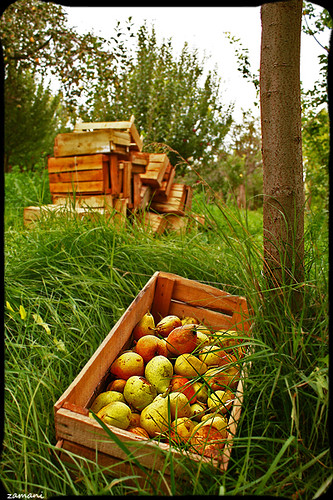


"Harvest" by seyed mostafa zamani


This article is also posted to my column at TH!NK ABOUT IT #2: Climate Change.

The article Food Security: The Challenge of Feeding 9 Billion People was brought to my attention by The Oil Drum. Thanks.

ResearchBlogging.orgGodfray, H., Beddington, J., Crute, I., Haddad, L., Lawrence, D., Muir, J., Pretty, J., Robinson, S., Thomas, S., & Toulmin, C. (2010). Food Security: The Challenge of Feeding 9 Billion People Science, 327 (5967), 812-818 DOI: 10.1126/science.1185383

Sunday, February 07, 2010

Minor oil conflicts saber rattling

Oil conflicts are not just about Iraq, Afghanistan and obscure former Soviet republics in between.

The Falkland Islands

As drilling equipment approaches Falkland Oil & Gas stocks are up. So is the Argentine-UK diplomatic heat.

"The Foreign Ministry reiterates its sovereign rights over the Malvinas Islands, South Georgia and the South Sandwich Islands and the sea surrounding them, which form a part of its national territory. [...] Argentina again warns the UK about the illegality and consequences of this new unilateral action, extensive to all private actors involved, that they will be liable of future legal demands in the maximum tribunals, for the potential exploration and exploitation of Argentine resources."
- Argentine Foreign Ministry sources


"The British Government will continue to support the development of [The Falkland Islands'] hydrocarbons sector, the British Government will continue to work with you on this agenda. [There are] no doubts about United Kingdom's sovereignty over the Falkland Islands."
- British Prime Minister Gordon Brown


Sources: U.K. Says ‘No Doubt’ on Falklands After Argentina Row, Argentina warns UK about Falkland Islands oil.

Nigeria

In Nigeria the president leaving the country to undergo heart surgery plus some Christian vs Muslim tension is increasing existing tensions.

"All companies related to the oil industry in the Niger Delta should prepare for an all-out onslaught [...] Nothing will be spared."
- Jomo Gbomo of the Movement for the Emancipation of the Niger Delta (MEND)


We want to own our land, we want control of the land and the resources, so we can determine who comes to our land, but instead we have communities that have been forcibly relocated from their land so that oil companies can start operations."
- Henry Okah, leader of MEND


Sources: Nigerian rebels threaten 'all-out oil war', Nigeria militants call off truce in oil-rich Niger Delta.


Search This Blog