Showing posts with label agriculture. Show all posts

Thursday, January 12, 2012

Watch DIRT! The Movie

I just watched DIRT! The Movie for free at dotSUB. A really good movie about soil and the importance of a healthy biosphere of rich biodiversity. Takes a couple of detours (ie one about various spiritual connections to soil) that may seem weird depending on who you are and is quite a bit pro-organic agriculture but all in all a good, educational movie about not just soil, but about deforestation, climate change, agriculture - and a bit about conflict too!

Trailer:

Full movie:


"You create deserts where you are and eventually these micro deserts form much bigger areas. And we can't live very happily in a desert. And so we start fighting between farming communities and nomadic communities over land that is not a desert, that still has dirt. Desertification or land degradation is one good way of undermining security in any country."
- Wangari Maathai [0:29]
"There is a very strong correlation between human degradation and environmental degradation."
 - Sebastiao Salgado, photographer [0:42]

Although I just watched it, I could certainly use having the full quality DVD on my shelf along with HOME, FUEL, FOOD Inc, CRUDE and the other (upper case letter) enviro-flicks.

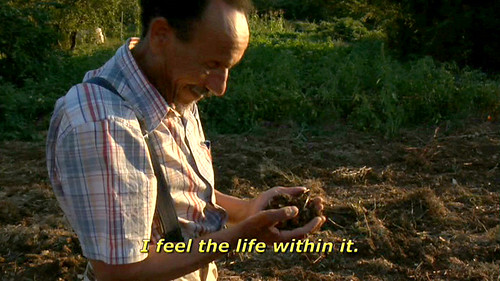
Pierre Rhabi holds dirt

Find DIRT! The Movie: at their own website, at YouTube, at Facebook, at Twitter and at IMDb.


Sunday, November 27, 2011

War for territory - World tour November 2011

We live in peaceful times. Conflicts being linked to something as mundane as natural resources is a conspiracy theory. Just kidding...

Cambodia: Villages razed to clear land for sugar plantation
Amnesty International and other organisations have exposed the Cambodian authorities' systematic failure to protect people from forced evictions. Forced evictions in the name of economic development now occur regularly across Cambodia, as local elites and foreign investors seek to capitalize on a newly privatized land market and take control of the country's natural resources.


Colombia: Tribes flee civil war and gold miners

About 10% of the hunter-gatherer Awa tribe have fled their ancestral mountain homes in the past decade. Some now survive as subsistence farmers on small lots provided by the government.

The tribe has been fighting palm oil plantations encroaching on their land for about 16 years, the civil war between leftist FARC and the government has produced an extremely dangerous territory including indigenous grounds littered with landmines and lately gold mines have taken away even more land and polluting its surroundings.


Read: BBC / Colombia's indigenous peoples face uncertain future, SOS Childrens' Villages / Dealing with the threat of landmines in Colombia.

Peru: Indigenous tribes protest planned gold mines

Several protesters were injured on November 25th when police dispersed anti-gold mine demonstration with tear gas. The US-based Newmont Mining Corporation plan to reconstruct local water flows used in farmers' irrigation. Locals protest mining projects throughout Peru and injuries are not uncommon.
"Companies come here, take the gold and then go away - just like in colonial times. People feel cheated." - Jorge Rimarachin


Read: AFP / Peruvian gold mine, locals clash over resources , MercoPress / Peruvian peasants clash with police to protest against gold mine in the Andes.


Sudan - South Sudan border: Ethnic cleansing?

After a brief spell in international media as a success story, newly founded South Sudan is now fighting a "war by proxy" paramilitaries with Sudan. The latter appear to currently be evicting certain ethnic groups.


SAF Aircrafts at El Obeid Airbase
DigitalGlobe imagery shows the presence of Antonov An-26's and other aircraft at El Obeid Airbase on 14 November 2011.

The Sea: The race for off-shore resources intensifying world wide

One third of oil production is now off-shore and the rate is climbing. Resources are found in the Arctic, in the South Chinese Sea, in the Mediterranean and elsewhere. Chinese and Turkish warships circle Vietnamese and Israeli drilling ships and platforms in each their own gunboat diplomatic efforts. These countries as well as the US, Russia and others are investing in new aircraft carriers, cruisers and destroyers.


Read: The New York Times / A New Era of Gunboat Diplomacy.


All just one big hoax. All of the above from the month of November 2011.


Thursday, October 20, 2011

Biofuel demand and CO2 quotas drive violent land grabs in Honduras

To the country whose history coined the term "banana republic" land grabs is not a new phenomenon. The European Union funding it by buying carbon credits and biofuel from the perpetrators is, however.


In the case of Honduras, the global rush for production of biofuel and access to carbon credits is making it profitable for national and international business to maintain the unequal distribution of land between Honduras' poor and the elite. It also makes it possible for international institutions, corporations and donors to support domestic land grabbing or the
status quo of unequal land ownership where serious human rights abuses occur. To this date, there is no global human rights mechanism incorporated in the global carbon market that can prevent countries from buying carbon credits from CDM-projects in developing countries, which include land grabbing tactics or land issues where human rights are violated.
- "Stolen Land, Stolen Future", p. 4

The Bajo Aguan valley on the north coast is a hot spot for not just land disputes but drug trafficking and crime in general. The elite owns most of the land which is increasingly used for production of internationally subsidized biofuels and other export crops. During year 2011 about 40 people were killed in conflicts between security forces and landless peasants. October 2011 about 45 people were killed in a clash between poor squatting peasants and authorities.


"There are worrying signs that the Honduran government is moving 1200 police officers and military personnel into the area [...] That has previously been a source of conflict."
- Toni Sandell, human rights worker with Aprodev, a coalition of Christian NGO's

The Green group in the European Parliament demand of Climate Commissioner Connie Hedegaard that the EU stop buying carbon credits via the CDM project from the Honduran palm plantations.


Sources: Stolen Land, Stolen Future (1.26 MB PDF), Inside Costa Rica / Honduras: Nearly 44 People Killed in Aguan, EurActive / Carbon credits tarnished by human rights 'disgrace'.


Wednesday, March 30, 2011

Middle East riots for food, interventions for oil?

It's a historical truth that when food prices rise, conflict increases. So it's no wonder that the spike in the cost of agricultural commodities in recent months has been a contributing factor to revolution in the Middle East. As the map below shows, people in relatively poor countries--including Egypt, Tunisia and others in the developing world--spend a much higher percentage of their incomes on food.
© 2011 Time Inc. Source: U.S. Department of Agriculture. The percentage of household consumption expenditures going to food is one indicator of riot prone countries.
"We're in Libya because of oil. And I think both Japan and the nuclear technology and Libya and this dependence that we have upon imported oil have both once again highlighted the need for the United States to have a renewable energy agenda going forward. [The US is right to intervene] but it all goes back to the 5 million barrels of oil that we import from (the Organization of the Petroleum Exporting Countries) on a daily basis."
- Ed Markey, Democrat.


Saturday, January 08, 2011

US ecowar soundtrack by Woody Guthrie

The 1913 Italian Hall Massacre


a tragedy that occurred on December 24, 1913 in Calumet, Michigan. Seventy-three men, women, and children, mostly striking mine workers and their families, were crushed to death in a stampede when someone falsely yelled "fire" at a crowded Christmas party. [Wikipedia]

The Ludlow Massacre


the violent deaths of 19 people during an attack by the Colorado National Guard on a tent colony of 1,200 striking coal miners and their families at Ludlow, Colorado on April 20, 1914. The deaths occurred after a day-long fight between strikers and the Guard. Two women and eleven children were asphyxiated and burned to death. Three union leaders and two strikers were killed by gunfire, along with one child, one passer-by, and one National Guardsman. In response, the miners armed themselves and attacked dozens of mines, destroying property and engaging in several skirmishes with the Colorado National Guard. [Wikipedia]

The Dust Bowl


[aka] or the Dirty Thirties was a period of severe dust storms causing major ecological and agricultural damage to American and Canadian prairie lands from 1930 to 1936 (in some areas until 1940). The phenomenon was caused by severe drought coupled with decades of extensive farming without crop rotation, fallow fields, cover crops or other techniques to prevent erosion. Deep plowing of the virgin topsoil of the Great Plains had displaced the natural grasses that normally kept the soil in place and trapped moisture even during periods of drought and high winds. [...] Millions of acres of farmland became useless, and hundreds of thousands of people were forced to leave their homes; many of these families (often known as "Okies", since so many of them [though not all of them] came from Oklahoma) traveled to California and other states, where they found economic conditions little better than those they had left. Owning no land, many traveled from farm to farm picking fruit and other crops at starvation wages. [Wikipedia]

this_machine_kills_fascists_1

Woodrow Wilson "Woody" Guthrie (1912–1967) is best known as an American singer-songwriter and folk musician, whose musical legacy includes hundreds of political, traditional and children's songs, ballads and improvised works. He frequently performed with the slogan "This Machine Kills Fascists" displayed on his guitar. [...] Such songwriters as Bob Dylan, Phil Ochs, Tom Paxton, and Mike Ness have acknowledged their debt to Guthrie as an influence. Guthrie traveled with migrant workers from Oklahoma to California and learned traditional folk and blues songs. Many of his songs are about his experiences in the Dust Bowl era during the Great Depression, earning him the nickname the "Dust Bowl Troubadour". [Wikipedia]


Monday, October 25, 2010

How many people can live on Planet Earth? Watch this BBC documentary!

Whether you're discussing water resources, food security, climate change, migration, developing countries or pretty much any geopolitical or human ecological topic there is one other topic often avoided: Overpopulation. Watch this 58 minute BBC documentary on YouTube.


Regarding "Ecowar relevance" the following parts are especially interesting.

14 min: Value of ecosystem services
Doug Hamilton, International Space Station.
"When you see how hard it is to reproduce what Mother Nature does every day for all of us you begin to really appreciate the world that you have."
17 min: Water
Mexican government emergency water truck driver.
"At some time in the future wars are going to be fought over water, not oil. But people don't seem to understand."
27 min: Land grabs
Chinese, Saudi Arabian and British "land grabs". Most are in Africa which already has trouble feeding itself.
In the 29th minute a segment about Rwanda begins... Then there is peak oil, carrying capacity, relative ecological footprints, Indian family planning... almost the entire package.

Thank you David Attenborough and BBC. And thank you EJC for alerting me of this program.


Wednesday, May 26, 2010

Google Maps shows North Korea logging endangered tigers' protected forest

This scandal has been reported on several websites:
The sharp images from Google Earth clearly shows the North Korean communist dictatorship is logging forest areas in a UN national park. Not only does the megalomaniac Kim Jong-il seek to build a nuclear armament, impoverish his subdued people and occasionally sink South Korean ships – he's also cutting down trees in the fragile, ancient forest where the last Siberian tigers live.
International researchers have long been monitoring the NASA satellite images of the area since they are not allowed to inspect it on ground. They were wondering why the green color of the forest was fading to brownish. But the precise satellite images from Google Earth now shows why: The North Koreans have been secretly logging in strips no wider than 10 meters – too slim to stand out on the old NASA images.
“I have applied for a permit to visit the area but have been denied access”, says scientist Lina Tang.

Or maybe not. The above text is typical but it's not really a quote. It has been further dramatized in order to illustrate the symptomatic: There are two “good stories” in the recent academic research published in Biological Conservation. One is in the tale of the reckless North Koreans. The other in the coolness of Google.

Wait a second – what are we talking about?

Forest areas surrounding a mountain on the border between North Korea and China. The Koreans call the mountain Baekdu-san, the Chinese call it Changbaishan and Wikipedia calls it Baekdu Mountain. At it's peak is a picturesque lake – sacred to some, probably tourist attraction to more – called Heaven Lake. Down its slope the climate changes from freezing tundra to temperate forest. It is home to many plants and animals; including the endangered Siberian tiger and wild ginseng.

So, what did the article by Lina Tang and the eight co-authors really say? Below is a summary.

Forest degradation deepens around and within protected areas in East Asia

It is true that the NASA Landsat images didn't show the finer details. But they do show a story going back to 1985. The methods chapter is interesting for people into geeky stuff about image analysis. It is indeed also true that the forests have suffered degradation on both sides of the border.
The Changbaishan and Baekdu-san were established as UNESCO Biosphere Reserves in 1979 and 1989 respectively to protect the ecosystem there which is home to the highest plant biodiversity in the cool temperate zone and – as mentioned – many endangered species. But there are many differences in the way the forests have been managed and much more is known about the Chinese parts.
The Chinese government has successfully enforced a ban on logging but areas has been severely damaged by storms and are still recovering. From 1985 to 2007 about 6% of the forest was lost. On the other hand, poaching has occurred and wild ginseng has been collected into obscurity. Right outside the reserve the Chinese have extensively logged the pine forest, doing some reforestation with birch and aspen.
On the Korean side about half the reserve area had suffered strip logging by 2007. This was clear only recently as the strips are about 10 meters wide, whereas in the older satellite images each pixel cover about 30 meters. The Koreans have cleared about 39% of the forest outside the reserve for agriculture.
Another thing the older satellite images didn't reveal was seed collecting and tourism. From the year 2000 to 2007 it was allowed to gather pine seeds in the Chinese reserve, a cherished food ingredient and valuable source of income for locals. In those years very few seeds were left to enter the natural cycle (animal food source and natural reforestation) and today nearly every tree bears wounds from climbing spurs. Also, in 2006 administration was moved from the Forestry Bureau to the Tourism Bureau. The number of visitors has rocketed from about 30,000 per year in the 1980ies to as much as 10,000 a day now. Much less is known about how the Koreans administrate the reserve but they do allow tourism.
The researchers estimate the “truly well-protected” reserve forest areas to be 44.9% in China and 34.6% in Korea. But these areas are ecologically isolated due to the extensive deforestation of the areas surrounding the reserves.

Second thoughts

Before raising an environmentalist call to relieve Kim Jong-il of his duties let us consider the following: The North Koreans are probably at least as effective as the Chinese in banning illegal logging, the Chinese side has suffered similar levels of deforestation and unfortunately this situation isn't exactly unique.
We're having problems with ecological isolation, illegal logging, poaching, severe weather events, climate change in many places around the world. The difference is in how to influence the leader(s) of this country – a problem similar to what we see in places like Zimbabwe.
Writing about development we are encouraged to not portray the third world as the victims of the story. Norht Korea, however, despite its few glimmers of progress and success is a unique tragedy. One with the bomb.

This story elsewhere: Treehugger / North Korea Logging in Protected Forest Discovered With Google, NASA Data, Mongabay / NASA, Google Earth catch North Korea logging protected area, UPI / Study: North Korea logs in protected area.
The Primary source is, of course:
ResearchBlogging.org
Tang, L., Shao, G., Piao, Z., Dai, L., Jenkins, M., Wang, S., Wu, G., Wu, J., & Zhao, J. (2010). Forest degradation deepens around and within protected areas in East Asia Biological Conservation, 143 (5), 1295-1298 DOI: 10.1016/j.biocon.2010.01.024


This article is also posted at TH!NK ABOUT IT #3: Developing World.


Saturday, February 27, 2010

Occupation 101

Just watched Occupation 101 two years late. It's a gripping documentary about the history and status quo of the Israeli occupation of Palestinian lands. While not being about battle for resources it does mention the grabbing of fertile lands by Jewish settlers.


[In 1947] The UN - under pressure - proposed to divide the land into two states. An Arab state and a Jewish state. Arabs were to be given 43% of the land despite the fact that they made up more than two thirds of the population and owned over 92% of the land. Jews were to be given 56% although they comprised only one third of the population and owned less than 8% of the total area. [...] They were given not only most of the land, they were given the most fertile land. [21:10]


[Today Israeli] settlements are strategically built colonies of Israel [on UN designated "Arab" land] that are connected by a network of roads which separates each Palestinian community from the next and confine their ability to expand. They are often constructed around the best farmland and resources. [11:10]


You can watch the whole thing using the above embedded Google Video og you can order the DVD from the official website.

Sunday, September 13, 2009

Trouble brewing in dried-out India

Years of excessive use of water for irrigating fields, a drying trend from global warming, a record drought and astronomical scale pollution all adds up to trouble in India.

Harvests go down, farmer income the same direction, malnourishment and desperation up. So much according to The Star / India: Dying of thirst a family was murdered in a riot over water. (We need a -cide word somewhere between homi- and geno- for this!)

"We are running out of it, and crops are going to slow. We will see more hunger, more disputes and clashes. More theft."
- Naranjan Singh, a 63-year-old farmer


"In a decade, India could look like Darfur. You have people running out of water, and it's a recipe for killing. It really does make people desperate. You go without it for just three days and you've had it."
- Vandana Shiva, nuclear physicist and water activist


"Climate change is threatening our ecosystems, water scarcity is becoming a way of life and pollution is a growing threat to our health and habitat."
- Prime Minister Manmohan Singh


Over-use of water is a problem that has created as the so-called "Green Revolution" of decades past sought to address other issues. Human caused depletion was confirmed by NASA satellites last month. (Source: NASA data shows groundwater trouble)

Sunday, August 16, 2009

Wednesday, March 18, 2009

Chilean town withers in free market for water

Quillagua is among many small towns that are being swallowed up in the country’s intensifying water wars. Nowhere is the system for buying and selling water more permissive than here in Chile

[...]

Some economists have hailed Chile’s water rights trading system, which was established in 1981 during the military dictatorship, as a model of free-market efficiency that allocates water to its highest economic use.

But other academics and environmentalists argue that Chile’s system is unsustainable because it promotes speculation, endangers the environment and allows smaller interests to be muscled out by powerful forces, like Chile’s mining industry.


Economists and military dictatorship vs academics and environmentalists - gee.

unbridled water trading and a two-year drought mean that “there are many more water rights for the river than water that arrives from the river,”

Sunday, March 08, 2009

Video: Israeli Military Shooting Gaza Farmers

18th February 2009 Israeli forces shot a twenty year-old Palestinian farmer as he worked his land in the village of Al-Faraheen, east of Khan Younis in the Gaza Strip.


Friday, February 27, 2009

We're on the brink of disaster

Every outbreak of violence has its own distinctive origins and characteristics. All, however, are driven by a similar combination of anxiety about the future and lack of confidence in the ability of established institutions to deal with the problems at hand.

[...]

The riots that erupted in the spring of 2008 in response to rising food prices suggested the speed with which economically related violence can spread.

[...]

The cost of food is now closely tied to the price of oil and natural gas because petrochemicals are so widely and heavily used in the cultivation of grains.

[...]

zero economic growth in the developing world and rising food prices -- and you have a perfect recipe for unrelenting civil unrest and violence.

[...]

Statistical modeling shows that economic crises increase the risk of regime-threatening instability if they persist over a one to two year period

Monday, December 22, 2008

Somalia's agricultural region faces dire future


Somalia's humanitarian situation has been deteriorating in recent months, amid an increase in attacks on the country's transitional government by opposition fighters.

People living in the country are losing hope as politicians in the government, which was once seen as the best possible chance for Somalia, argue among themselves.

In Somalia's agricultural region the situation could not be more dire, as Al Jazeera's Mohammed Adow reports.

Sunday, December 21, 2008

"Conflict over resources could reemerge"

GLOBAL TRENDS 2025: THE NATIONAL INTELLIGENCE COUNCIL'S 2025 PROJECT


"Aging populations in the developed world; growing energy, food, and water constraints; and worries about climate change will limit and diminish what will still be an historically unprecedented age of prosperity.

[...]

In terms of size, speed, and directional flow, the transfer of global wealth and economic power now under way — roughly from West to East — is without precedent in modern history. [...] First, increases in oil and commodity prices have generated windfall profits for the Gulf states and Russia. [...] If current trends persist, by 2025 China will have the world’s second largest economy and will be a leading military power. It also could be the largest importer of natural resources and the biggest polluter.

[...]

Resource issues will gain prominence on the international agenda. Unprecedented global economic growth—positive in so many other regards—will continue to put pressure on a number of highly strategic resources, including energy, food, and water, and demand is projected to outstrip easily available supplies over the next decade or so. [...] Lack of access to stable supplies of water is reaching critical proportions, particularly for agricultural purposes, and the problem will worsen because of rapid urbanization worldwide and the roughly 1.2 billion persons to be added over the next 20 years. [...] Climate change is expected to exacerbate resource scarcities. Although the impact of climate change will vary by region, a number of regions will begin to suffer harmful effects, particularly water scarcity and loss of agricultural production. [...] Agricultural losses are expected to mount with substantial impacts forecast by most economists by late this century.

[...]

Types of conflict we have not seen for awhile — such as over resources — could reemerge. Perceptions of energy scarcity will drive countries to take actions to assure their future access to energy supplies. In the worst case, this could result in interstate conflicts if government leaders deem assured access to energy resources, for example, to be essential for maintaining domestic stability and the survival of their regimes. However, even actions short of war will have important geopolitical consequences. Maritime security concerns are providing a rationale for naval buildups and modernization efforts, such as China’s and India’s development of blue-water naval capabilities. The buildup of regional naval capabilities could lead to increased tensions, rivalries, and counterbalancing moves but it also will create opportunities for multinational cooperation in protecting critical sea lanes. With water becoming more scarce in Asia and the Middle East, cooperation to manage changing water resources is likely to become more difficult within and between states.


And that's just from the summary. Chapters 4: Scarcity in the Midst of Plenty? and 5: Growing Potential for Conflict no doubt has plenty more for Ecowar. The report appears rather US centric and conservative though.

Also see...
BBC / US Global Trends report: Key points
Global Trends 2025, a new report written by the US National Intelligence Council (NIC) ahead of President-elect Barack Obama's inauguration, envisages a future world marked by diminished US power, dwindling resources, and more people.

The NIC, an independent government body, emphasises that its report is not about "crystal-ball gazing" but offers a range of potential futures, including the following key trends.


Blog "Tragedy of the Commons" / Global Trends 2025
Reports like these really cause me concern. This is not some crazy doomer on a wacko peak oil message board. This is a consensus of top American Intelligence Community officials.

Sunday, November 02, 2008

Drought

Drought land 'will be abandoned'
"In many ways [water] is the most dramatic expression of mismanagement of natural or nature-based assets [...] The day a person or a community is bereft of water is the day that your chance of even the most basic life or livelihood is gone and economic activity seeps away. Unchecked climate change will mean that some parts of the world will simply not have enough water to sustain settlements both small and large, because agriculture becomes untenable and industries relying on water can no longer compete or function effectively. This will trigger structural changes in economies right through to the displacement of people as environmental refugees. [...] In rich countries, there's always the potential of channelling water from one river basin to another. But even there people are hitting the limits of what we can do with money and infrastructure because there simply isn't enough water any more."
- Achim Steiner, executive director of the UN Environment Programme (my emphasises)


Some of the most dramatic examples of water shortages this year include conflict-stricken Sudan, the dramatic drying of Lake Faguibine in Mali on which 200,000 mostly nomadic people depend, fatal clashes over drying boreholes in northern Kenya, and economic and social crisis on the sparsely populated border between Bolivia and Argentina, according to Unep. Oxfam has estimated that 25 million people have been affected by the most recent drought in Ethiopia.


Is water the new oil?
as the population keeps growing and getting richer, and global warming changes the climate, experts are warning that unless something is done, billions more will suffer lack of water - precipitating hunger, disease, migration and ultimately conflict. [...] Ultimately, lack of water is seen as a threat to peace. From genocide in Darfur to rows between states in India and the US [...] Intuitively it is obvious people will fight over their most precious resource, but so far few conflicts have broken out. [...] water is often an underlying cause of tension, but has only identified one water 'war', between Egypt and Sudan


USA


California water shortages could lead to rationing, officials say
Water agencies could get as little as 15% of their allocations next year unless rain and snowfall return to normal levels in the coming months. [...] The overall water storage is roughly 70% of the average for this time of year. [...] a voluntary conservation program [by one water supplier] has reduced water use by 8% to 10%.


Tiny village threatened with loss of its water
Brunswick, pop. 6,000, city leaders were close to issuing an ultimatum: If Rosemont, or the county or somebody somewhere didn't take over the dilapidated pipes that carry water to 80 homes in Rosemont, the city would turn off the village's water May 25. Just like that: Off. [...] This is hardly the first time water has divided two communities. In Western Maryland, past disputes have turned on a scarcity of supply during times of drought. In this case the supply is not the issue; distribution is.


Kenya


Clashes over water kill 4 in drought-hit Kenya
Fighting over boreholes in arid northern Kenya has killed at least four people as competition for resources mounts in the drought-hit region, the Kenyan Red Cross said on Friday.


Drought threatens child health and survival in northern Kenya
Turkana district in northern Kenya is on the brink of disaster. There's been no rain for months, the forecast is grim and thousands of children are at risk.

Sunday, October 12, 2008

Mining conflict: Farmers claim company seized their lands

on August 9, 2008, around 200 residents from barangays Cagusuan and Pagbabangnan raided the barracks of Cambayas Mining Corp. in Homonhon, eastern Samar.

[...]

The attack was staged mostly by farmers who claimed that the mining company seized the lands awarded to them by the Department of Environment and Natural Resources (DENR) through a certificate of stewardship agreement in 1992.

Tuesday, August 26, 2008

Three cases of migration and conflict: Hurricane Katrina, Bangladesh and The Dust Bowl

"Environmental change can trigger large out-migration, which can cause violent conflict in areas receiving migrants."

A peer reviewed article on environmental migration would fit right into my little project here, right? As I realized Reuveny's Ecomigration and Violent Conflict: Case Studies and Public Policy Implications was a look at only three incidents and that two of these were from the USA my expectations dropped somewhat. Most of this is supposed to be going on in Africa, right?

Well, when the cases from the world's most affluent nation only confirms what speculation you have on the third world... this is a rather interesting article. The three cases are the 1930'ies US Dust Bowl [Wikipedia], Bangladesh since the 1950'ies especially the Farakka Barrage situation [Wikipedia] and August 2005's Hurricane Katrina [Wikipedia]. It's main conclusion you have already read above. But I'll look into a few details...

The theory

Standard migration theory operates with economic, political and other forces - not environmental. Doing so could have serious implications as governments have signed treaties to accept political refugees, not "environmental". However, already in 1985 a paper on droughts and land degradation in sub-Saharan countries concluded these problems caused "population movements".

I think it's pretty much stating the obvious: If you live from the land and suddenly you can't, you're a lot more likely to simply leave the area. It's a different type of border you seek to cross though: While "traditional migrants" would seek to cross a cultural or political border, environmental migrants just wish to leave the stricken area.

The mechanics of "ecomigration" issues is described in four non-exclusive parts:

  • "the in-migration can burden the destination's economy and resources, promoting native-migrant competition for jobs and other resources"

  • "the arrival of in-migrants may upset the existing ethnic balance"

  • "in-migration can enable ploys to exploit the situation and induce suspicions about such ploys"

  • "the conflict may follow existing fault lines"


In-migration is more likely to cause trouble in poor receiving counties than in rich. And migrating women, children and elderly having family ties in the receiving area are least likely to cause conflict. Trouble risk is also correlated to migration mass and period: the more and the faster the more problematic.

Reuveny finishes his theoretical stuff with a pinch of optimism:
"Migration can benefit the receiving area through several channels, including increasing the labor force and tax-base."


The cases

In the 1930s the US Great Plains were stricken by droughts and storms while the area's agricultural practices were far from geared towards the situation. Massive soil erosion and obvious declines in life quality resulted. The area was now called The Dust Bowl. Close to 2.5 million people out-migrated.

Most went to neighboring states but about 300,000 traveled to California. They were received as "ignorant filthy people", called "Okies", some argued Bible in hand that they were "inferior" and it was even suggested to pay them to be sterilized. They were beaten, their shacks burned and they were accused of "communism". In 1936 Los Angeles police stopped migrants at the state border. Welcome to California.

The Bangladesh case is a bit more typical. A small less developed country with a huge and growing population strains it's natural resources to a breaking point. It's geography happens to make it particularly vulnerable to both accumulated environmental stresses (soil erosion etc.) and periodic natural disasters (namely floods).

Then in 1975 the neighboring country builds a barrage, diverting water away from Bangladesh. Salt water intrudes the sinking fresh water resources and land productivity plummet. 35 million people were directly affected.

Some 12 to 17 million Bangladeshis have migrated illegally to India and about half a million to other areas in Bangladesh. Migrants have since clashed with residents over social, ethnic, religious, national and other proximate issues. Countless people have been killed in clashes.

Reading about Hurricane Katrina is particularly weird as this is fresh from TV memory. But as it turns out the case fits right in.

A combination of human and natural factors combined to aggravate a disaster situation: the Mississippi River had been turned into a maritime highway destroying natural sedimentation, land clearing and draining of swamps eliminated natural coastline protection, compromises led to levee building only protecting from hurricanes level 3. The false sense of security from the levee only led to more risky development.

80% of the population fled the area when weather forecasts told of the impending hurricane. Including 100,000 elderly and poor who were evacuated by the government. Shortly after Hurricane Rita hit too and US government estimates a total of nearly 2 million people were displaced.

As we all remember, New Orleans was smashed. One year after Katrina hit 2,180 people had died as a direct consequence of the storm, more than 200,000 people lost their jobs, about 335,000 homes were destroyed and only about 40% of New Orleans' population had returned.

Across the river from New Orleans the city of Gretna [Google Maps] had police block the entry of displaced people firing warning shots in the process. Rhode Island, South Carolina and West Virginia insisted more than half the evacuees they'd accepted were violent criminals. The city of Houston reported a rise in homicides of 70% in November and December 2005 and 28% in February 2006 compared to normals. March 2006 75% of Houston residents answered a poll they felt "strained" by the 150,000 migrants living there.

Reuveny sees three main similarities: The three societies all depended on their environments for livelihood, human actions or lack thereof exacerbated the disasters and political, economic, sociological and psychological factors overlapped with environmental ones. A number of obvious differences are mentioned too.


Climate change is expected to cause a wide array of disasters and stresses on our ecosystem. Sea level rise is just one of them. Flickr Creative Commons image is "Climate Change Refugees" by ItzaFineDay.


Can climate change cause migration and conflict in the future?

Reuveny says "yes". The evidence of impact scale is worrying already; history is there to suggest it will repeat itself.

If sea levels rise by just 1 meter more than 260 million people will be exposed to flooding. (Yes, that was two hundred and sixty million individual humans) Most of these Asians but at least some 14 million Europeans too. These people will have to move somewhere. Imagine something like 130 Katrinas but with permanent land loss and in countries less able to cope with the situation. Bitterly ironic since climate change is largely caused by rich, developed countries.

A set of initiatives for alleviation or solution is also proposed, but I dare not post it uncensored in the mere blogosphere. But Reuveny feels it's safe to assume...
"[...] the expected cost of climate change-induced ecomigration and conflict will likely rise quickly [...]"


ResearchBlogging.org

Reuveny, R. (2008). Ecomigration and Violent Conflict: Case Studies and Public Policy Implications. Human Ecology, 36(1), 1-13. DOI: 10.1007/s10745-007-9142-5

Wednesday, March 26, 2008

The Fertile Crescent ®

On the fifth anniversary of the occupation in Iraq, an old piece of news must be brought to the surface; the war is rapidly destroying traditional farming practices in the area, instating a legal model that calls for a dependency on the seeds of large corporations like Monsanto.

Seeds of False Hope: The Occupation of Iraq’s Farming Economy

That piece reminded me. Amazing how the atrocities of our modern world compete for our attention. Back at the beginning of the war on Iraq I was very concerned about one of it's driving forces really being the eradication of the country's agricultural sector, replacing it with a fully subsidized, franchised, patented and industrialized US model. Specifically, weeding out what was left of The Fertile Crescent's ancient farming and replace it with US Aid funded Monsanto GMO crops for export.

My worst fears of a few years back are now in progress pretty much as planned. Sacks of seeds - US or not - doesn't get bombed, they get eaten or sowed. It's weird how I and a couple of other bloggers put everything we could find about it up at Newsvine tagging it all cpa-81. Yet at this five years "anniversary" I'm practically surprised to see it mentioned somewhere. Depressing really.

Dive in to the links above, you will not be disappointed. That war was not just about securing oil supplies. And the genetics of the agricultural sector is just one battlefield among many. Remember how even Microsoft and, I believe, McDonalds attended the pre-attack loot-planning meeting as shown in Michael Moore's Fahrenheit 9/11? Even people who don't like Michael Moore and his movies has to recognize the sponsors of right wing politics were already planning on how to profit. Oil, wheat, whatever. I haven't read Naomi Klein's latest book, The Shock Doctrine, (yet) but from what I understand the "theory of disaster capitalism" explains the CPA-81... crime... perfectly.

Note: CPA-81 doesn't specifically ban the saving of seeds for next season. But it paves the way for the multinational agricultural businesses to come in and seize the whole cycle of crop growing in the wake of disaster. In fact, Iraq's old seed bank was... unfortunately... ruined during invasion. One competitor less. Also note how I was years ahead of Naomi ;-)

Friday, February 08, 2008

Israeli attempt to divert water from Lebanon thwarted

Lebanese residents have thwarted an attempt by Israeli workers backed by Israeli troops to reopen a channel that would allow them to divert rain water form Lebanese territory, the state-run National News Agency reported.

It said on Saturday the channel was shut by the Lebanese army for over a year after it had caused damage to crops in the border Lebanese villages of Adassiyeh and Kfar Kila.

NNA said work stopped at the channel when a Lebanese army patrol, backed by Spanish peacekeepers, was dispatched to the area after tension ran high.

Search This Blog