Showing posts with label Turkey. Show all posts

Wednesday, December 24, 2014

2014 bookmarks - the year in war over natural resources

From the depths of my bookmarks (that were all automatically tweeted) on conflict and natural resources, here is a quick review of the way in which Earth was plundered for natural resources in the past year. Year 2014, the 100th anniversary of the first war to run on oil.

In short, 2014 was just more of the same. Like...
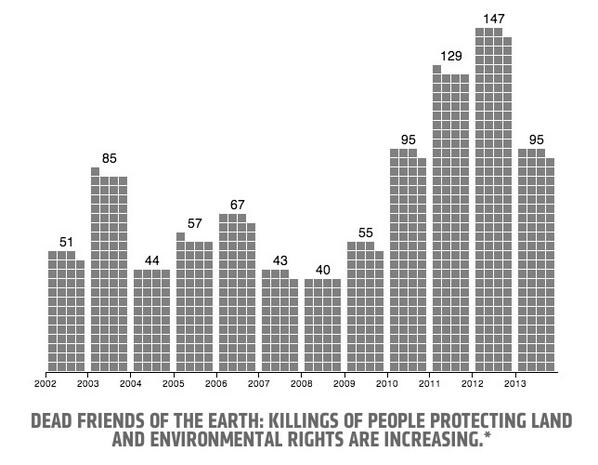
But a lot more of the same also means obscure news stories grow into reports from acknowledged organizations—like when
Some of the worst news this year was how Islamic State grew out of the chaos in Iraq and Syria, and became known not as the richest terrorist group in the world, but as the poorest terrorist country. Because they successfully occupy and exploit vast oil fields, loot everything lootable while controlling many smuggler's routes and ruthless dealers. I get how they control the population by mass executions rivaling the worst in history, denying crucial water supplies to villages and other callous misdeeds. But how do they manage to sell oil worth millions of dollars every single day even as all eyes are on the region? Money talks, of course, anywhere and anytime, but still?

Part of the answer came in this fascinating report by Suzan Fraser and Yilmaz Akinci from the border between Turkey and Syria, where... hillbillies, basically... tell how they have always been smuggling. Everyone did it. For generations. So, suddenly a few more bearded men came with a bit more oil than usual. It worked for a time, but Turkish police cracked down on it. Their large scale “pipeline” was smacked into smaller, obscure “pipelines” - like the ones the Islamic terrorists have for every other country, apparently.

Probably more efficient that the Turkish police, however, is the Saudi Arabian financial muscle. To them and most of their allies, the sum of benefits of a low oil price seems to currently triumph the more obvious benefits of a high oil price. Mainly by cutting the cash flow to Iran, Syria, Islamic State, Russia, even North American non-conventional (fossil) energy producers and others. In fact, I've seen some speculate Saudi Arabia has almost won the war on Ukraine's behalf as Russia's weakening rubles soon cannot pay for any more war. Speaking of Ukraine: This country used to be self-sufficient in coal, but the territory occupied by rebels and Russians just happen to host 66 coal mines, leaving Ukraine's power plants under-supplied; and the shores off now Russian Crimea just happen to be full of gas. What a coincidence.

That was all just slightly scratching the surface of year 2014 in war for natural resources. On slightly more positive notes, Interpol published a most-wanted list of environmental criminals at large – go get 'em – and Egypt and Ethiopia seems to be agreeing on how to share the Nile.
https://twitter.com/Global_Witness/status/456347470071463936

Happy New Year!


Sunday, November 27, 2011

War for territory - World tour November 2011

We live in peaceful times. Conflicts being linked to something as mundane as natural resources is a conspiracy theory. Just kidding...

Cambodia: Villages razed to clear land for sugar plantation
Amnesty International and other organisations have exposed the Cambodian authorities' systematic failure to protect people from forced evictions. Forced evictions in the name of economic development now occur regularly across Cambodia, as local elites and foreign investors seek to capitalize on a newly privatized land market and take control of the country's natural resources.


Colombia: Tribes flee civil war and gold miners

About 10% of the hunter-gatherer Awa tribe have fled their ancestral mountain homes in the past decade. Some now survive as subsistence farmers on small lots provided by the government.

The tribe has been fighting palm oil plantations encroaching on their land for about 16 years, the civil war between leftist FARC and the government has produced an extremely dangerous territory including indigenous grounds littered with landmines and lately gold mines have taken away even more land and polluting its surroundings.


Read: BBC / Colombia's indigenous peoples face uncertain future, SOS Childrens' Villages / Dealing with the threat of landmines in Colombia.

Peru: Indigenous tribes protest planned gold mines

Several protesters were injured on November 25th when police dispersed anti-gold mine demonstration with tear gas. The US-based Newmont Mining Corporation plan to reconstruct local water flows used in farmers' irrigation. Locals protest mining projects throughout Peru and injuries are not uncommon.
"Companies come here, take the gold and then go away - just like in colonial times. People feel cheated." - Jorge Rimarachin


Read: AFP / Peruvian gold mine, locals clash over resources , MercoPress / Peruvian peasants clash with police to protest against gold mine in the Andes.


Sudan - South Sudan border: Ethnic cleansing?

After a brief spell in international media as a success story, newly founded South Sudan is now fighting a "war by proxy" paramilitaries with Sudan. The latter appear to currently be evicting certain ethnic groups.


SAF Aircrafts at El Obeid Airbase
DigitalGlobe imagery shows the presence of Antonov An-26's and other aircraft at El Obeid Airbase on 14 November 2011.

The Sea: The race for off-shore resources intensifying world wide

One third of oil production is now off-shore and the rate is climbing. Resources are found in the Arctic, in the South Chinese Sea, in the Mediterranean and elsewhere. Chinese and Turkish warships circle Vietnamese and Israeli drilling ships and platforms in each their own gunboat diplomatic efforts. These countries as well as the US, Russia and others are investing in new aircraft carriers, cruisers and destroyers.


Read: The New York Times / A New Era of Gunboat Diplomacy.


All just one big hoax. All of the above from the month of November 2011.


Wednesday, November 03, 2010

Water wars!... or climate peace?

Two climate change stories: one driving African tribes into new conflict and another leading old foes on a shared diplomatic course.


The conflict


For thousands of years, nomadic herdsmen have roamed the harsh, semi-arid lowlands that stretch across 80 percent of Kenya and 60 percent of Ethiopia. [...] As temperatures in the region have risen and water supplies have dwindled, the pastoralists have had to range more widely in search of suitable water and land. That search has brought tribal groups in Ethiopia and Kenya in increasing conflict, as pastoral communities kill each other over water and grass.
Watch the video at yale.edu / When The Water Ends: Africa’s Climate Conflicts.


The diplomacy


Israel and the Palestinian Authority are among 15 Mediterranean nations who have just signed a historic agreement to work together to combat the effects of climate change, one month ahead of the next United Nations conference on climate change, meeting at Cancun in November. [...] Both Israel and Palestine are acutely aware of their vulnerability to climate change, which is expected to make water resources even more scarce for what is already the most water-stressed highly populated area in the world. The region faces a potential 4 degree rise in average temperatures and a 70% drop in precipitation. Sea level rise is expected to further contaminate nearby aquifers such as the coastal aquifer of Gaza that provides water to 1.5 million Palestinians. The annual decrease in rainfall is already raising farm prices for fruits and vegetables, and creating a two-tiered class system for water: those who can afford to pay, and those who can’t.

Check out the Mediterranean Climate Change Initiative website (via Green Prophet).

Saturday, April 12, 2008

New Scientist: Is this the beginning of water wars?

Barcelona and the surrounding region are suffering the worst drought in decades. There are several possible solutions, including diverting a river, and desalinating water. But the city looks like it will ship water from the French port of Marseilles.


The Tigris and Euphrates rivers start in Turkey and supply Syria and Iraq. The Turkish government is building dams on those rivers, reducing the flow downstream and stoking long-standing tensions with its neighbours.


Somewhat sensationalist headline perhaps. But none the less... here we go. This situation is expected to worsen and spread. Trade solutions are still possible but as soon as neighboring countries start both thirsting more radical approaches will be attempted.

Search This Blog