Showing posts with label Kenya. Show all posts

Friday, October 28, 2011

Climate change and the new geography of violence

One of the unpleasant effects of climate change is its tendency to incite further conflict where such already exist and in some cases war is already looming. Sociologist and writer Christian Parenti is blaming "pathologies of neoliberalism" and Cold War leftovers that converge with climate change effects for inciting further conflict where it already lingers. Already by now large parts of the political landscape are out of the target group of Parenti's message but he supports his assertion by way of his good storytelling based on personal experiences and interviews - and he finishes with an almost pro-capitalism conclusion.


Chapter 2 is pretty much a summary of some of the military reports I have linked to in Ecowar posts tagged 'military' plus a few other. Chapter 3 is a brief history of the US military which at first seems a bit thorough for a climate change book but actually shows how it has been on a long journey from conventional "European" warfare to guerrilla warfare inspired by North American Indian tribes and Ernesto "Che" Guevara. And ends up with a grim forecast (p. 36) of "the essence of militarized adaption to climate chaos: dirty war forever." In part, global counter-insurgency is an adaption to climate change that most of us wouldn't agree to if given the choice.

Part 2 is about Africa and describe how the Cold War proxy-wars have left unresolved conflicts now to converge with climate change effects, mostly via Parenti's own experiences visiting the areas. Most notably the stories from northern Kenyan herders who increasingly arm themselves to defend and raid cattle as droughts kill off livestock. Chapter 7 details the Cold War prequel to the current desert anarchy in Somalia. Chapter 8, the last of part 2, is a brilliant description of what a failed state is exactly.
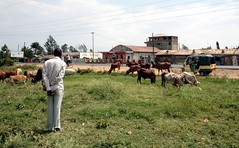
Urban herd
I traveled in Kenya January/February 2011. This photo is from the suburbs of Kisumu. I enjoyed the view over the Rift Valley and Lake Victoria. It is a bit chilling to read Parenti's stories from Kenya - in fact the book begins and ends with the corpse of a cattle herder left to rot under a tree and the questions of and answers to who killed him. All of the brutal incidents and trends in drought and plunder play out some kilometers away down the great valley.

Part 3 is about Asia and observes how in Afghanistan "the poppy economy and its armed defense are local adaption mechanisms" (wheat use six times more water than poppy which is worth 50 times the price). Chapter 10 is a rare insight to the conflicts in Kyrgyzstan - a lot more interesting than it may sound! Parenti then moves on to the India-Pakistan conflict of declining river flows, provoking dams, mass-murderous droughts, devastating floods, cross border state terrorism, suicide by pesticide Monsanto farmers and Maoist guerrillas. Very complex and under-reported in Western media yet clearly fueled by climate change.

Part 4 is about Latin America and the US. On page 181 Parenti's main message is summed up:
"catastrophic convergence: policies that create poverty and violence are now colliding with the new realities of climate change, and together these three forces are creating socially destructive forms of adaption."
Brazil and Mexico receive treatment in each their own chapters. Not just the always shockingly brutal gang violence is described, so too are more positive examples of coping: an example of organic agriculture and Keynesian economics. The efforts by Bolivia are hailed before the US is described in less than praising terms.

However, although being very critical of neoliberalism and in favor of state run initiatives to halt pollution and force clean technologies forward, Parenti is distancing himself from radical approaches involving revolutionary changes to the economy and society as we know it. First of all for a simple reason: There is no time. We need to start solving the climate problem now, thus we need to start doing it with tools known to work within the capitalist system. And it can be done, Parenti argues, because we have both the technology and the money. Fossil energies probably only have a lead right now because it has been so heavily subsidized for decades. And if there is money now for blowing up bubbles (housing, food etc) to create poverty as prices go up, unemployment and riots as the bubbles burst then, surely, that money could be redirected towards sustainable development.

Christian Parenti's Tropic of Chaos is a great book. Concise, well written and fair in reasoning. It isn't exhaustive as many conflicts from around the world are left untold of. It isn't academic as it assumes basic understanding of the climate, the economy and world affairs and simply move on with its stories from there while it doesn't dig into recent scientific results either. At times, perhaps, it's a bit too much a book of stories as Parenti shares many details of the converging issues. It is brave as it is critical of both the far-right media environment as well as of Bill "350" McKibben. Tropic of Chaos is the third book about how (not if) climate change is causing increased conflict I have read. If you want to read only one book about climate change and war this book should probably be it. (Alternatives are the more imaginative and dystopic Climate Wars by Gwynne Dyer reviewed here December 2010 and the scientifically precise and short Climate Conflict by Jeffrey Mazo reviewed here April 2011.)


Further reading/viewing for you right now: Large parts of the book can be read at Google Books. Also, Christian Parenti has given interviews on the book and its topics...

From Foreign Policy in Focus / Interview with Christian Parenti:
"The military runs scenarios of what the future will bring. What they see is not so much an increase in conventional warfare between states as an increase in humanitarian crisis, civil war, banditry, religious wars, state breakdown. And they realize that the armed forces will be called on to respond with various forms of low-intensity conflict: counter-insurgency, direct intervention, humanitarian intervention, shoring-up allied states, as well as increased training and advisory roles in these conflicts. [... In international negotiations] The United States has played a non-productive role, a destructive role. It has not taken the UN Framework Convention on Climate Change negotiations seriously, and as a result they have broken down. We are the largest economy in the world, and until recently we were the largest greenhouse gas emitter in the world before China overtook us. The world looks to the United States for leadership but U.S. actions, especially at Copenhagen, were really depressing. [...] What will change the U.S. position? Protest, clearly. There has to be a movement that forces the Obama administration to do this. The Obama administration is proving itself to be very right-wing on many issues, including this one."


Wednesday, August 17, 2011

News from Kenya: food price spike worsen hunger, smartphone sales skyrocket

While the emergency in the Horn of Africa was triggered by prolonged droughts, especially in areas struggling with conflict and internal displacement such as Somalia, food prices that are near the record high levels seen in 2008 also contributed to the situation.
- The World Bank, Food Price Watch report according to The Guardian, August 2011 / Africa famine: soaring food prices intensifying crisis, report warns.

In a related news report by France 24 a 14 years old is armed with an AK-47 when herding his skinny goats in drought stricken northern Kenya.


Earlier this year, the Chinese firm Huawei unveiled IDEOS through Kenya’s telecom titan, Safaricom. So far, this $80 smartphone has found its way into the hands of 350,000+ Kenyans, an impressive sales number in a country where 40% of the population lives on less than two dollars a day. The IDEOS’s success in this market firmly establishes the open source Android as the smartphone of the people and demonstrates how unrelenting upswings in price-performance can jumpstart the spread of liberating technologies.
- Singularity Hub, August 2011 / $80 Android Phone Sells Like Hotcakes in Kenya, the World Next? (via Slashdot).

The tecnical specs are just slightly below those of "our" iPhones, Samsungs and HTCs but the price is about one tenth (yes, 1/10). In other words, Huawei and Google just saved Kenyans (800 USD minus 80 USD) times 350.000 equalling 252 million USD. At least. (Shows how incredibly conservative my 3 billion USD estimate on how much Linux has saved people and business recently was; see Apple, PCs, Linux and the economy.)

An entrepreneurial conference in Nairobi called Pivot25 showcased some of the most innovative Android apps in East Africa. Among these include M-Farm, an app that allows farmers to broadcast product prices and locations to the world via SMS. Another agri-app developed by Makerere University helps diagnose and track the spread of crop diseases via crowdsourcing. In a nation where agriculture accounts for nearly a quarter of GDP, apps like these could prove invaluable in maximizing harvests and facilitating the spread of precision farming.


[This blog post has been cross-posted to Linux vs Mac and TH!NK3.]


Wednesday, July 20, 2011

While everyone's on holiday: Ghosts of the past, crises of the present and warnings for the future

From the distant and near past

The Washington Post reports Oil leaks from 233 World War II shipwrecks could threaten US coast as vessels corrode.
oil and fuel leaks could devastate coastal communities and environments. NOAA is taking an inventory of more than 30,000 coastal shipwrecks. It has narrowed the worst-threat list to 233 vessels. That could lead to efforts to remove oil before it washes ashore.

"The number of birds [migrating
through Afghanistan] has dropped by 85 percent."
Others are in shock staring at the Staggering Price Tag for Iraq, Afghanistan Wars.

a just-released, far-reaching study estimating the cost of these wars to the United States at $4 trillion. [...] since September 11, 2001, the wars have claimed the lives of 6,000 U.S. troops and 2,300 contractors, and the number of displaced Afghans and Iraqis is eight million.
Currently hunger devastates East Africa

Aid organizations complain donations suffer from people being on vacation while the disaster has many under-reported consequences. One such is that the Refugee crisis threatens wildlife in northern Kenya.

“The influx of refugees is not only degrading the environment due to demand for firewood for cooking and building shelters but those that have not enlisted in the camps are relying on game meat for food.”
 -  Thomas Mailu, The Kenya Wildlife Service (KWS)
Meanwhile in Nairobi Kenyan Police Fire Tear Gas at Food Protest, which happen as a consequence of the drought too, and fuel prices, which, of course, is linked to world market whims.

From this corner of the world aid agencies advise the Drought in east Africa the result of climate change and conflict. We told you so. And Kenya's own Wangari Maathai, Nobel Peace Laureate (whose speech at Copenhagen University I blogged recently), similarly calls for action on climate change:
"Here in Africa, we are paying a high price for a rapidly changing climate - more droughts, food crises and it is set only to get worse.  We can see how climate change is already aggravating the competition for resources and the economic stability all over this continent. [...] Many of our countries have experienced decades of environmental mismanagement or outright neglect. Indeed, some governments-including my own-have facilitated the plunder of the forests, the degradation of the land and unsustainable agricultural practices. Many communities in Africa are already threatened by the negative impacts of climate change. Children in Africa are dying from malnutrition as women struggle to farm on land that is less and less productive.  People on coastlines are losing their homes as the seas consume the coastlines."
Just signs of the decline?

Like we have to pay on environmental and financial debts of past wars even as current wars and environmental decline unfold and worsen, so too can we expect history to repeat itself. Soon both demand and supply of the basic building blocks of society will fundamentally change

Read, for example, Michael Klare's recent article Energy: the new thirty years' war or the interview with him, The new 30 Years War: Why energy will be the next battlefield.
"The struggle for energy resources is guaranteed to grow ever more intense for a simple reason: there is no way the existing energy system can satisfy the world’s future requirements."
He's talking about a thirty years 'war' between energy sources and the powers that wield them, not a world war. But clearly a war that will weaken some states, empower others. Regarding water, the Wall Street Journal is even more worried: Water Wars May Lie Ahead.
The World Bank in a report said that 1.4 million people could be facing water scarcity by 2025. But the Organization for Economic Co-operation and Development (OECD) forecast is even more gloomy. It estimates that 47% of the world’s population could face water stress in the same period–equivalent to more than three billion people. [...] Egypt and Ethiopia have been battling the issue for the share of the Nile’s water reserves, and Israel–already fighting Palestine for territory that includes precious water reserves–has started to charge the agricultural sector high rates for using the resource.


Friday, July 08, 2011

Wangari Maathai: "If the rivers stop flowing, people will fight."

Wednesday the 6th of July 2011 Wangari Maathai received a honorary doctorate at Copenhagen University and spoke about her work with the Green Belt movement, the Taking Roots movie and more. Watch her speech, I recorded it for you:


[15:39] Protecting forests is extremely important [...] also very important for conflict [...] many of the local conflicts that we were having, especially in East Africa, [...] were being fed by competition over resources. Especially over land, [?], farming land, water, watering points [?]. And many of these conflicts are unavoidable unless we learn to manage the resources in a responsible way, in an accountable way and also we learn to share these resources in a more equitable way. Now, these are words, but when you translate them into practicalities on the ground it is actually [?] possible to stop people fighting. If there is no water and there is only one watering point people will fight over that watering point. If the rivers stop flowing [...] people will fight. And usually when people fight, that's when [the developed, rich world hear about the developing, 3rd world and begin to wonder] 'why are they fighting?'. Well they are fighting over resources because either those resources are degraded, they are diminished or they are exhausted or they are not being shared equitably.


Thursday, February 10, 2011

Home, Sweet Home

Having just arrived home from Kenya - summed up at TH!NK3 in Touching. Brutal. Unfair. - I instantly find two stories from Kenya in my search alerts and one Ecowar-like post on the new TH!NK blog.

First, Photo District News / An Under-Reported War Over Water is an interview and background article about photographer Evan Abramson’s recent project called When the Water Ends: Africa’s Climate Conflicts. I have already mentioned Abramson's photos and short film and in fact borrowed a few seconds for my little Ecowar trailer.
Because of drought, the north end of Lake Turkana has retreated from southern Ethiopia into northern Kenya in the last 35 years. Abramson says there are unconfirmed reports that the Ethiopian government is arming indigenous tribes near its border with Kenya and encouraging them to assert their rights to the lake as it retreats. The Kenyan government, meanwhile, is disarming tribes within its borders, making them vulnerable to raids from Ethiopian tribes.
Adventurous photographers and journalists really should read this article about the production of Abramson's When the Water Ends. 7000 USD and one Canon EOS camera and the project began!

Secondly, Kenyan Daily Nation / Land conflict simmers in Rift Valley reports of futile government attempts to solve internal refugee issues.
The violence that rocked Likia in Njoro District on February 2 brought to the surface the simmering conflict over land in the Rift Valley [...] 70-year-old Kuria Wakaba was hacked to death and seven others critically injured brought to the fore the stark reality of unresolved land-based animosities. [...] The government had planned to resettle 850 families living in a camp in Nakuru town on a 2,400-acre piece of land in Mau Narok by December 31 last year.  But the plan was put on hold when members of the Maasai community opposed it. [...] Clashes over land use and ownership have been fuelled by politicians for their own benefit since the restoration of multiparty democracy in 1991 [Irin, a UN-affiliated humanitarian news and analysis agency says...] vast tracts of arable land in the Rift Valley were designated as White Highlands and reserved for European settlers during British rule. The pastoralist communities, mainly the Kalenjin and Maasai, were edged out. [... later, during Kenyan government administration] many well-connected politicians were illegally allocated public land.
Thirdly, a new blogger has appeared at the TH!NK platform with the bold postulate that water scarcity may contribute to future conflicts in the Middle East: TH!NK5 / Water politics and Middle East: a growing conflict. A new friend...


Wednesday, January 19, 2011

Nile water match

Last fall I was just about to write a bit about Egypt threatening the Nile upstream countries not to increase their use of the river's water when... I don't know why I didn't. A 1929 treaty by the then British colonial rule reserved 80% of the Nile’s entire flow for Egypt and Sudan but May 2010 Ethiopia, Uganda, Tanzania, Kenya, the Democratic Republic of Congo, Burundi and Rwanda agreed to disagree with the old treaty.
"Not only is Egypt the gift of the Nile, this is a country that is almost completely dependent on Nile water resources. We have a growing population and growing needs. There is no way we can accept this kind of threat."
 - spokesman for the Egyptian Foreign Ministry, Hossam Zaki

[New York Times / Egypt and Thirsty Neighbors Are at Odds Over Nile | NPR / Ethiopia Claims High Ground In Right-To-Nile Debate]


Today James M. Dorsey published an article about an Egyptian football tournament at European Journalism Center's TH!NK5 Water blog: Egypt Employs Soccer to Assert Its Nile Basin Water Rights. Can't believe I nearly missed that one - better follow TH!NK5! So, what does a football tournament have to do with water conflict?
"The tournament aims to create awareness among all countries sharing the Nile Basin, to safeguard the water resource for the benefit of future generations. [...] Let’s face it, football is politics. That’s why countries pour money into hosting tournaments”
 - senior Egyptian official.
Egypt won the tournament beating Uganda in the final. [CAF / The Pharaohs win the first Nile Basin tournament]


Wednesday, November 03, 2010

Water wars!... or climate peace?

Two climate change stories: one driving African tribes into new conflict and another leading old foes on a shared diplomatic course.


The conflict


For thousands of years, nomadic herdsmen have roamed the harsh, semi-arid lowlands that stretch across 80 percent of Kenya and 60 percent of Ethiopia. [...] As temperatures in the region have risen and water supplies have dwindled, the pastoralists have had to range more widely in search of suitable water and land. That search has brought tribal groups in Ethiopia and Kenya in increasing conflict, as pastoral communities kill each other over water and grass.
Watch the video at yale.edu / When The Water Ends: Africa’s Climate Conflicts.


The diplomacy


Israel and the Palestinian Authority are among 15 Mediterranean nations who have just signed a historic agreement to work together to combat the effects of climate change, one month ahead of the next United Nations conference on climate change, meeting at Cancun in November. [...] Both Israel and Palestine are acutely aware of their vulnerability to climate change, which is expected to make water resources even more scarce for what is already the most water-stressed highly populated area in the world. The region faces a potential 4 degree rise in average temperatures and a 70% drop in precipitation. Sea level rise is expected to further contaminate nearby aquifers such as the coastal aquifer of Gaza that provides water to 1.5 million Palestinians. The annual decrease in rainfall is already raising farm prices for fruits and vegetables, and creating a two-tiered class system for water: those who can afford to pay, and those who can’t.

Check out the Mediterranean Climate Change Initiative website (via Green Prophet).

Sunday, July 12, 2009

Stealing sun and water

News in crime: theft of solar panels and fresh water is up.

March 2008 we saw people stealing bees, essentially a work force in horticulture up in demand and down in availability due to diseases. Lately I have seen stories about people stealing water and solar panels.

In fact, Treehuger / Solar Panel Theft is Rampant in California Wineries links to older stories about the trend and has tips on securing your panels! In New Mexico police busted a couple of criminals who seemed to have specialized in solar panel theft and dealing (see Solar panel theft ring busted in Farmington). Energy prices are up, solar panels are expensive, in demand and out there often not being watched and relatively easy to run off with.

Then there is water. Most obviously in need in poor, drought stricken areas, right. Like Kenya where a crime syndicate is diverting half the capitals water for farm irrigation. In the city water is now rationed and feared a possible source of disease. (See BBC / Nairobi water 'stolen for farms'.) But the truth is we need not go to the "third world" to see crime erupt over resources. As prices go up so does the incentive to "bend rules" a bit it seems. I'm sure this example of corruption - city workers tampering with water bills - is far from the first, the only or the last we'll see.

Sunday, November 23, 2008

Pirates and oil

November 17 Somali pirates captured Saudi oil tanker Sirius Star carrying over 2 million barrels of oil destined for the USA. This is probably a record bounty as well as the farthest from their home shores the Somali pirates have boarded a ship.

At first I didn't even think of posting it here. Although it is so obviously ecowar relevant. Fortunately, I just discovered a very interesting blog - Oil and Glory by Steve LeVine - that I will surely be visiting in the future and his latest post - Pirates and Oil.

But this story is a lot deeper than just criminals extorting oil and shipping companies. The shores of Somali used to be rich with fish that provided the livelihood for many fishermen and food for the country's citizen. Torn apart by civil war the Somali government is unable to protect it's waters which is being looted by foreign trawlers. From Europe too.

Consequently, fishermen have turned pirates. Read more at Protecting Somalia's Fishing Grounds and Somali Fishermen Support Somali Pirates.

Muslim militias have vowed to fight these pirates to have the 'Muslim oil' released (Militants, pirates may fight over Saudi oil tanker). More likely, they are in it for the US$25 million ransom - these militiamen have been less worried in the past.

Sunday, November 02, 2008

Drought

Drought land 'will be abandoned'
"In many ways [water] is the most dramatic expression of mismanagement of natural or nature-based assets [...] The day a person or a community is bereft of water is the day that your chance of even the most basic life or livelihood is gone and economic activity seeps away. Unchecked climate change will mean that some parts of the world will simply not have enough water to sustain settlements both small and large, because agriculture becomes untenable and industries relying on water can no longer compete or function effectively. This will trigger structural changes in economies right through to the displacement of people as environmental refugees. [...] In rich countries, there's always the potential of channelling water from one river basin to another. But even there people are hitting the limits of what we can do with money and infrastructure because there simply isn't enough water any more."
- Achim Steiner, executive director of the UN Environment Programme (my emphasises)


Some of the most dramatic examples of water shortages this year include conflict-stricken Sudan, the dramatic drying of Lake Faguibine in Mali on which 200,000 mostly nomadic people depend, fatal clashes over drying boreholes in northern Kenya, and economic and social crisis on the sparsely populated border between Bolivia and Argentina, according to Unep. Oxfam has estimated that 25 million people have been affected by the most recent drought in Ethiopia.


Is water the new oil?
as the population keeps growing and getting richer, and global warming changes the climate, experts are warning that unless something is done, billions more will suffer lack of water - precipitating hunger, disease, migration and ultimately conflict. [...] Ultimately, lack of water is seen as a threat to peace. From genocide in Darfur to rows between states in India and the US [...] Intuitively it is obvious people will fight over their most precious resource, but so far few conflicts have broken out. [...] water is often an underlying cause of tension, but has only identified one water 'war', between Egypt and Sudan


USA


California water shortages could lead to rationing, officials say
Water agencies could get as little as 15% of their allocations next year unless rain and snowfall return to normal levels in the coming months. [...] The overall water storage is roughly 70% of the average for this time of year. [...] a voluntary conservation program [by one water supplier] has reduced water use by 8% to 10%.


Tiny village threatened with loss of its water
Brunswick, pop. 6,000, city leaders were close to issuing an ultimatum: If Rosemont, or the county or somebody somewhere didn't take over the dilapidated pipes that carry water to 80 homes in Rosemont, the city would turn off the village's water May 25. Just like that: Off. [...] This is hardly the first time water has divided two communities. In Western Maryland, past disputes have turned on a scarcity of supply during times of drought. In this case the supply is not the issue; distribution is.


Kenya


Clashes over water kill 4 in drought-hit Kenya
Fighting over boreholes in arid northern Kenya has killed at least four people as competition for resources mounts in the drought-hit region, the Kenyan Red Cross said on Friday.


Drought threatens child health and survival in northern Kenya
Turkana district in northern Kenya is on the brink of disaster. There's been no rain for months, the forecast is grim and thousands of children are at risk.

Search This Blog