Præsident Donald Trump planlægger at suspendere en lov, der pålægger amerikanske virksomheder åbenhed om oprindelsen af de råstoffer, de bruger. Dermed vil blandt andet såkaldte blod-diamanter atter frit kunne importeres fra for eksempel Congo.
Jobs eller børnearbejde?
Afsnit 1502 i "Dodd-Frank Wall Street Reform and Consumer Protection"-loven, der blev indført under Barack Obama i 2010, kræver mærkning af guld, diamanter, tin og andre mineraler udvundet i krigszoner og fejlslagne stater. Bestemmelsen hyldes af menneskrettighedsorganisationer for at hindre finansiering af krigshandlinger, børnearbejde og andre overgreb.
Men Dodd-Frank har kostet jobs og er gået ud over virksomheder i både USA og oprindelseslandene, skriver Trump-administrationen i et udkast, der den 8. februar 2017 blev lækket af The Guardian og The Intercept. Trump-administrationen lover en alternativ plan imod finansiering af ulovligheder i krigszoner inden 180 dage.
Kriminelle og korrupte forretninger
Suspension af de nuværende restriktioner er "en gave til de menneskerettighedskrænkende, væbnede grupper, der søger at udnytte Congos mineraler, samt en gave til virksomheder, der ønsker at lave kriminelle og korrupte forretninger," skriver organisationen Global Witness.
Væbnede grupper tjener i ly af borgerkrigen i Congo, der måske er den blodigste konflikt siden anden verdenskrig, penge på ureguleret minedrift. Råstofferne bruges af i-lande i vielsesringe, smart phones og missiler.
Dodd-Frank-loven blev vedtaget i kølvandet på finanskrisen efter 2008. Dens primære formål er ved regulering af den finansielle sektor at modvirke økonomiske kriser.
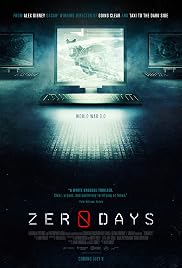
Omkring år 2010 løb Irans atomprogram ind i mystiske problemer: Dels blev flere af deres atomfysikere snigmyrdet, dels brød centrifugerne på deres anlæg til forarbejdning af uran sammen. Problemerne viste sig at skyldes ondsindet software, der af Symantec fik navnet Stuxnet.
Stod Israel bag? Stod USA bag? Hvordan kunne det lade sig gøre at inficere det topsikre anlæg? Og ikke mindst: Hvad betyder alt dette for vores fremtidige opfattelse af it-sikkerhed og krigsførelse i cyberspace?
I understand the difference in destruction is dramatic, but this has the whiff of August 1945. Somebody just used a new weapon, and this weapon will not be put back into the box.
Ikke blot udpensler dokumentaren Zero Days mange flere detaljer, end jeg havde turdet håbe på, - som ganske vist til syvende og sidst hænger på anonyme kilder - den ender også med at underbygge en opfordring om at få en Genevekonvention for cyberkrig. Og det er da flot klaret, når man tænker på, det er en hel film om én computer-orm.
When you shut down a country's power grid, it doesn't just pop back up, you know. It's more like humpty-dumpty... And if all the king's men can't turn the lights back on or filter the water for weeks, then lots of people die. And something we can do to others, they can do to us too. Is that something that we should keep quiet? Or should we talk about it?
Jeg giver ikke filmen topkarakterer. Dertil er der for mange klip med kilder, der ikke vil udtale sig, og for uspændende formidling om selve softwaren. Men filmen er sindsygt væsentlig og absolut et must see, hvis man vil hævde at vide noget som helst om Irans atomprogram eller cyberwarfare.
De amerikanske myndigheders reaktion på demonstrationer og aktivisme kan være vidt forskellige. To nylige eksempler ridser forskellene op i skarp kontrast.
I januar 2016 besatte en gruppe svært bevæbnede, hvide mænd iklædt skudsikre veste, camouflagetøj og cowboyhatte Malheur National Wildlife Refuge i Oregon, USA. De ville protestere imod blandt andet fredningen og gebyrer for at avle kvæg i området. Imens besættelsen stod på kunne de ansatte i naturreservatet ikke passe deres jobs, men Bundy-brødrene kunne modtage post, mad og forsyninger. Samt bolldoze den lokale indianerstammes helligdom. Besættelsen varede i 40 dage, og kostede en militsmand livet. Under retssagen ødelagde medlemmer af gruppen endnu en indiansk helligdom. Oktober 2016 blev de to ledere af besættelsesaktionen frikendt.
Ingen vil have Bakken-olierørledningen igennem sit eget nabolag, så den bliver lagt gennem et reservat. Igennem gravpladser og økologisk sårbare områder. Aktivister fra Sioux-stammen arrangerer ubevæbnede protester ved at slå lejr i rørledningens planlagte forløb og tweete #NoDAPL. De er blevet skubbet af vejen ved hjælp af pansrede mandskabsvogne, tåregas og knippelsuppe. De bliver i skrivende stund anholdt for optøjer og holdt fanget i tremmebure.
Pensioneret dommer Steve Russell har skrevet en klumme om netop denne forskel i håndteringen af Bundy-brødrene og Sioux-aktivisterne. Han og Kieran Suckling fra Center for Biological Diversity har udtalt sig til Democracy Now!
Chilcot-rapporten, der evaluerer Storbritanniens deltagelse i invasionen og besættelsen af Irak, afslører, at olie spillede en vigtig rolle for briterne. Og at briterne og amerikanerne udkæmpede en diplomatisk kamp om olien.
"Det ville være upassende for den britiske regering at indgå i diskussioner om fremtidig fordeling af Iraks olieindustri," sagde Sir David Manning, Tony Blairs udenrigspolitiske rådgiver, til Condoleezza Rice, George W. Bushs nationale sikkerhedsrådgiver, december 2002, "ikke desto mindre er det essentielt at britiske virksomheder får adgang til denne og andre sektorer på lige vilkår med amerikanske."
Allerede to måneder før invasionen mødtes den britiske regering med olieselskaberne BP og Shell, for at forberede deres kommende forretninger. Og til et møde mellem USA og Storbritanniens forsvarsministre, Donald Rumsfeld og Geoff Hoon, i 2003 havde sidstnævnte ligelig adgang til Iraks olie i på dagsordenen. I et notat fra september 2004 skriver embedsmænd om britiske virksomheders potentiale for "substantielle olieforretninger i de næste fem til ti år".
BP og Shell vandt nogle irakiske oliekontrakter ved auktioner mod blandt andet russiske og kinesiske firmaer, men briterne følte sig alligevel forfordelt. Således mødtes Edward Chaplin, Storbritanniens ambassadør i det besatte Irak, i december 2004 med Iraks premierminister Ayad Allawi for at tale BP og Shells sag. Irakiske embedsmænd gav udtryk for, de britiske virksomheder ikke udviste samme dedikation som andre landes olievirksomheder. BP og Shell har tilsyneladende afventet vedtagelse af en ny irakisk grundlov.
"Vi fik ikke noget som helst i oliesektoren," beskrev tidligere FN-ambassadør Sir Jeremy Q. Greenstock de britiske frustrationer til Chilcot-kommissionen, "besættelsesadministrationen holdt det på amerikanske hænder, for de ville selv styre oliesektoren."
From the damage wrought by Hurricane Sandy to the upheaval caused by drought in the Middle East, this groundbreaking documentary event series provides first-hand reports on those affected by, and seeking solutions to, climate change. This episode full of footage from Syria, Texas and Indonesia. Watch it.
During a broad scope text on the suicidal tendencies of our global society Noam Chomsky touches a couple of resource conflict topics.
all over the world – Australia, India, South America – there are battles going on, sometimes wars. In India, it's a major war over direct environmental destruction, with tribal societies trying to resist resource extraction operations that are extremely harmful locally, but also in their general consequences
So, at one extreme you have indigenous, tribal societies trying to stem the race to disaster. At the other extreme, the richest, most powerful societies in world history, like the United States and Canada, are racing full-speed ahead to destroy the environment as quickly as possible.
[during the Korean War] everything else in North Korea had been destroyed, the [US] air force was sent to destroy North Korea's dams, huge dams that controlled the water supply – a war crime, by the way, for which people were hanged in Nuremberg. [...] the water pouring down, digging out the valleys, and the Asians scurrying around trying to survive. [...] It meant the destruction of their rice crop, which in turn meant starvation and death. How magnificent!
However, flooding an area did not automatically get generals hanged after the WWII. This tactic was used by China, the Dutch, the Soviet Union, Germany and Great Britain. At least. To be honest, I haven't checked if any German soldiers were hanged for drowning people in this way. But my wild guess is no.
"If the Earth wars were a sporting contest, here's how the half-time score might stand at the beginning of 2012..."
Georff Hiscock concludes his near 300 pages factual account of who owns the world with a surprisingly relaxed "scoreboard":
1st: USA 10 points
2nd: China 8p
3rd - 4th: Europe, Japan 6p
5th - 6th: Russia, India 5p
7th: Brazil 4p
8th - 10th: Mexico, Canada, Australia 3p
11th - 14th: Saudi Arabia, Qatar, Kuwait, UAE 2p
15th - 22nd: South Korea, Indonesia, South Africa, Nigeria, Turkey, Iran, Central Asian republics, Mongolia 1p
Vietnam, Venezuela, Colombia, Chile and some African countries also in 1st division but still no points
EARTH WARS is a concise business report on the current deals in global energy and metals production as seen from down under. It also mentions the main water disputes but does not go into details on food production controversies. It is a treasure trove of information and numbers on especially Asian contracts but often the most important situations from other important continents such as South America or Africa are mentioned as after little more than afterthoughts at the end of chapters.
It's business report like writing is it's strength and it's weakness. The "bullshit factor" is one of the lowest I have ever seen. In many ways this book is just pure reporting. However, at times it is a tough read. And occasionally I wonder if I better run double checks on some numbers: Having been flipping through numerous skeptical blogs, articles and books earlier, I am of the impression that repository estimations and future extraction plans are not always that crystal clear. Did Hiscock leave out some valid doubts somewhere?
To get an impression of what the book offers you can look at the contents on page "v". Or you can take a glance at the 27 lists in it, because the chapters are very much structured as walk-throughs of those lists. So, "Exhibit 3.3" is a top ten of Russian oil and gas companies (no. 1 is Gazprom) - well that part of chapter three is an ordered sequence of paragraphs briefing on the owners, sizes and belongings of those companies. Pretty much.
One gem of the book is it's quite detailed second chapter on "geographical flashpoints". This chapter contained the bulk of the info I needed for my "contested resource territories" map published yesterday (take a look!).
The book hardly takes into account climate change. That may seem weird, but actually Hiscock barely bother predicting the future. Which is actually quite a relief. As such, it is fair enough not to mention projected environmental impacts decades into the future. The demand for renewable energy, however, is mentioned. Compared to the focus on the business as usual going on with fossil energy the demand for renewable energy looks depressingly weak.
If I had used it for my own book, it would certainly be on my list of recommended reading. It's not for everyone, though. Those other books are typically more into storytelling (like witnessing pollution in Nigeria or dictatorships in South America) or typical popular science (past societal collapses, influence of climate change on geopolitics). Normal books. Geoff Hiscock's book is a business book that doesn't dream and doesn't imagine anything.
Either way, there is absolutely no reason to doubt a fierce global business war is raging over our natural resources. That much is very clear after Hiscock's documentation. As documentation of this situation the book is a very valuable contribution. But it's not exactly edutainment.
Geoff Hiscock (2012): EARTH WARS - The Battle for Global Resources at Google Books, book website.
Even if wars are not all about oil, soldiers have certainly been killed for oil: Up to one in three US casualties has happened at gasoline convoys. Check out how solar panels are saving lives and improving the flexibility of US Marines deep in foreign deserts: Grist / U.S. military kicks more ass by using less fossil-fuel energy.
"Other people are busy saving the planet; this is about saving Marine lives [...] I’d kiss a polar bear if it meant getting one Marine off an IED-filled highway."
- Col. Bob Charette, director of the Marine Corps Expeditionary Energy Office
Irrespective of one's sentiments towards US soldiers in Afghanistan, the story is a parable for all of society. As the article finishes: "In a time of rising fossil-fuel prices and increasingly apparent climate dangers, the tether of fuel binds all of us — homes, businesses, communities, and whole economies — to a future of vulnerability and instability. Using less energy and generating more of our own is about more than dollars spent or saved. It’s about self-determination. That makes for a more effective military and a more secure, productive society".
You should think the politicians most eager for war would support such initiatives. But no. Because those politicians are at the same time the ones whose careers are sponsored by the existing energy sector hegemony. Read Slate / Why We Need a Greener Military and Wired / Republicans Order Navy to Quit Buying Biofuels for the full story about right wing politicians working hard to pass a law banning military spending on fuels more expensive than conventional oil. But since it is designed to obstruct initiatives to experiment with (currently relatively expensive) biofuels it explicitly omits alternative energy sources based on coal and gas (probably to allow shale gas, fracking et cetera).
In a way it's hard to believe the hypocrisy, the idiocy, the callousness. On the other hand it all makes depressing sense. Strong powers in business and politics accumulate vast fortunes on the people wasting obsolete energy and endangering their lives at home, at work and abroad.
We live in peaceful times. Conflicts being linked to something as mundane as natural resources is a conspiracy theory. Just kidding...
Cambodia: Villages razed to clear land for sugar plantation
Amnesty International and other organisations have exposed the Cambodian authorities' systematic failure to protect people from forced evictions. Forced evictions in the name of economic development now occur regularly across Cambodia, as local elites and foreign investors seek to capitalize on a newly privatized land market and take control of the country's natural resources.
Colombia: Tribes flee civil war and gold miners
About 10% of the hunter-gatherer Awa tribe have fled their ancestral mountain homes in the past decade. Some now survive as subsistence farmers on small lots provided by the government.
The tribe has been fighting palm oil plantations encroaching on their land for about 16 years, the civil war between leftist FARC and the government has produced an extremely dangerous territory including indigenous grounds littered with landmines and lately gold mines have taken away even more land and polluting its surroundings.
Several protesters were injured on November 25th when police dispersed anti-gold mine demonstration with tear gas. The US-based Newmont Mining Corporation plan to reconstruct local water flows used in farmers' irrigation. Locals protest mining projects throughout Peru and injuries are not uncommon.
"Companies come here, take the gold and then go away - just like in colonial times. People feel cheated."
- Jorge Rimarachin
After a brief spell in international media as a success story, newly founded South Sudan is now fighting a "war by proxy" paramilitaries with Sudan. The latter appear to currently be evicting certain ethnic groups.
DigitalGlobe imagery shows the presence of Antonov An-26's and other aircraft at El Obeid Airbase on 14 November 2011.
The Sea: The race for off-shore resources intensifying world wide
One third of oil production is now off-shore and the rate is climbing. Resources are found in the Arctic, in the South Chinese Sea, in the Mediterranean and elsewhere. Chinese and Turkish warships circle Vietnamese and Israeli drilling ships and platforms in each their own gunboat diplomatic efforts. These countries as well as the US, Russia and others are investing in new aircraft carriers, cruisers and destroyers.
Materials and resources once common, inexpensive or just non-existing pop up in a new league of the craved for or expensive. Copper and solar panels have been new objects of theft in recent years. Now grease is getting locked up to protect it from thieves. Yes, grease.
Biofuel producers are now buying used cooking oil from restaurants. What was once foul waste is today a resource for the non-fossil energy sector. In this crisis struck economy the temptation of containers filled to the brim with valuable grease left unguarded behind restaurants is too much for some.
"It's become the new copper. [...] It's difficult to get law enforcement people to spend a lot of time on somebody who's stealing grease."
- Tom Cook, president of the National Renderers Association
The grease sells at 3 USD per gallon (0.6 € per liter) - five times its price a decade ago.
"It's a big deal. There's a huge underground out there for this stuff."
- Bobby Tessler, owner of St. Louis Wing Co., who had about 2,000 USD worth of grease stolen since April.
One of the rare cases of grease thieves getting fined is from a town called Springfield. Grease theft was "predicted" in a 1998 episode of The Simpsons.
The European Union is about to take two small steps on the long journey of combating climate change: A small "tax" on air travel and another small tax on fossil fuels based on exactly how polluting the specific type of fossil fuel is. Both could ultimately end up in WTO courts; the former brought there by the US, the latter by tar sands would-be super-power Canada.
The European Union Emissions Trading Scheme Prohibition Act of 2011
The Republican majority US House of Representatives voted to bar US airlines from paying the tax on carbon emissions ("European Union Emissions Trading Scheme Prohibition Act of 2011"). The airline tax is part of the EU Emissions Trading System (ETS) from 2008; it hands out 85% of the industry's emissions to them for free, lets them buy the remaining 15% on a free (dirt cheap) market. The industry estimate the tax would cost US airlines about $3.1 billion between 2012 and 2020.
"This bill could ignite a trade war that would put tens of thousands of U.S. jobs in jeopardy. [...] By barring U.S.- based airlines from complying with applicable law for flights traveling to EU airports, this bill would compel those airlines either to drop their EU routes or become scofflaws."
- Annie Petsonk, Environmental Defense Fund
Pause for a second to consider the opposite situation: The EU or other countries prohibiting their corporations to comply with a US environmental law. Not to mention the facts that the Republican's arguments - that the EU law is a "competitive disadvantage" and in "violation of international law" are both simply wrong. Dear Obama, please archive this law in your paper recycling bin.
A tax based on the relative environmental harm done by different kinds of fuel doesn't sound that bad an idea does it? Well, Canada, currently projecting the billions it plans to make from transforming huge swaths of forest into polluted gravel deserts, consider it a European political attack on them. Elsewhere this would file under "conspiracy theory".
"We have the knowledge and the fact that the oil sands are more CO2-polluting than other kinds of fuel [...] And therefore we say it should have a specific value. It's nothing targeted against this particular fuel. We are doing that with all our different biofuels. It's the same methodology that we are applying for different things in the same directive [...] And now we are discussing this also with our member states, with the Commission, which has proposed this."
- Climate Commissioner Connie Hedegaard
"Canada's plans for tar sands will put the world on track for 6 degrees of warming, way past the globally accepted limit of 2 degrees [...] Six degrees would be game over."
- Franziska Achterberg, Greenpeace
The Fuel Quality Directive ranks...
coal-to-liquid: 172 grams of carbon per megajoule
oil shale: 131.3 grams
oil sands crude: 107 grams
conventional oil: 87.5 grams
Greenpeace is blaming Britain (Canada ally) and Estonia (having oil-shale resources) of delaying the legislation.
Oil have been found in the underground below Lake Albert on the border between Uganda and the Democratic Republic of the Congo. Western companies are working with the Ugandan government to get development under way but a myriad of issues seem to delay the project: Criminal and rebel activity is up and rising, Ugandan democracy is struggling for control with the shady closed door negotiations and now US troops enter the picture. Al Jazeera summed up the situation in less than two minutes, October 14th:
Recipe for an oil war
Heritage Oil and Tullow Oil are guessing the 2.5 billion barrel or larger field is the largest onshore field found in sub-saharan Africa in more than two decades. Production of 150,000 barrels of oil per day by 2015 place Uganda among top 50 oil producing nations is planned. The latter company, Irish Tullow Oil, is now accused of having bribed three Ugandan ministers with 100 million USD in July 2010 in return for concessions. The ministers resigned October 2011. Tullow denies allegations, maintain an anti-bribe image and have funded a lake rescue station which they claim have already saved the lives of more than 70 local fishermen. Also in the deal are French Total and Chinese Cnooc. Those corporations are expected to claim 2/3 of the 3-4 billion USD hoped to be made annually.
A leaked US embassy cable (Wikileaks, #08KAMPALA393) reveals Uganda have been asking for help stepping up security in and around the oil rich area. John Morley of Tullow Oil is quoted for saying that as oil activity on Lake Albert increase a security presence would be vital. The cable mention "several clashes on Lake Albert between oil companies and entities from the Democratic Republic of Congo (DRC) demonstrate that oil production has increased local tensions and exacerbated cross-border hostilities". In 2007 a British drilling platform worker was killed by Congolese soldiers who claimed the barge had strayed into Congolese waters. Although the Ugandan and Congolese governments are talking and are in agreement concerning the precise geography of the border the armed forces on the Congolese side of the border are not always government-related.
An intervention overdue?
Several militias fight in the area and in just recent months thousands have had to fled their homes, hundreds have been kidnapped. Adding to the Congolese militias the Democratic Liberation Forces of Rwanda (FDLR) rebels as well as the infamous Lord’s Resistance Army (LRA) led by Joseph Kony add to the insecurity. FDLR is a Hutu group whose two top leaders are held in France and Germany on charges of crimes against humanity yet whose troops raped at least 154 civilians from July 30 to August 3, 2010, in the town of Luvungi. LRA is the Ugandan theocratic militia of self-proclaimed prophet Joseph Kony, who claims to be acting on orders from spirits sent by God, and whose ranks have been inflated by an estimated 66,000 children abducted for soldiering. October 2005 the International Criminal Court (ICC) issued arrest warrants on Kony and four other leading members of LRA; the 33 charges include murder, enslavement, sexual enslavement and pillaging.
Recently, the Ugandan presiden spent US$780 million on six Russian jet fighters. A decision that raises eyebrows in a country with a GDP of less than 500USD per capita.
"We don’t live in an enemy-free neighbourhood. So, don’t look at the purchase in terms of cost. The Great Lakes region is one of the most unsafe regions."
- Ugandan presiden Yoweri Museveni
Since 2008 the US have donated more than 40 million USD on supporting the Local counter-militia efforts. And now 100 Green Berets have been sent as military advisers for the governments of the region. They are receiving a warm welcome.
"For 20 years, the government of Uganda has been pleading with our American and European friends to help in the LRA problem, because these are international terrorists. We wanted our friends to help in providing technical support — such as intelligence — because they have the best."
- Uganda's acting foreign minister Henry Okello Oryem
"Any support to tackle the LRA is a good move [...] South Sudan is already working with Uganda's army in operations against the LRA, and we will be pleased to work with anyone who can help us combat the threat [...] We have large communities whose lives are ruined by these rebels, so the sooner we can end this once and for all will be something we will look forward to."
- South Sudan army spokesman Philip Aguer
"The Central African Republic today more than needs external assistance like that of United States [...] Many hundreds of our people have been killed, others kidnapped or displaced, their homes ransacked, destroyed, their possessions looted. It is unbearable."
- CAR Deputy defence minister Jean-Francis Bozize
A recent report, "Oil Extraction and the Potential for Domestic Instability in Uganda", warns about other dangers than cross-border guerrilla warfare: the possible side-effects of a sudden large scale resource industry entering a developing economy. President Museveni, who first seems to have orchestrated the addition of a third presidential term to the constitution then won a low turnout election disputed by international observers, is already speaking of "his" oil.
"If Museveni gains access to substantial oil revenue, the combination of considerable oil funds and strong presidential powers could increase the ability of his government to remain in power indefinitely. [...] Increases in corrupt behavior would essentially require secrecy in government dealings. A reduction in government transparency in oil and tax revenue management would then incentivize Museveni’s government to become increasingly autocratic in its relationship with the public and political opponents, as has so often been the pattern in other oil producing states."
Also, susceptibility to the Dutch Disease should be considered:
"If the government does not reinvest revenues into public works to soften the blow of economic change, domestic instability may ensue [...] The poor and disaffected youths are the most likely to turn to violence in order to redress socio-political grievances. A young, growing, and increasingly urban population indicates the potential for civil strife in Uganda. The added stress of urban migration associated with oil production may only exacerbate the dynamics behind civil strife. [...] If Museveni’s government makes its decisions public and is held accountable, it is more likely to choose anti-corruption policies that are favorable to the public interest."
The report estimate the risk of civil war in Uganda as 1.96% if the new found resource wealth is handled wisely, 14.05% if not. Dutch Disease effects could be both mitigated and worsened by the fact that multiple industries are likely to boom: in 2010 firms from Russia, China, India, Australia and South Africa started operating in Uganda after finds of copper, iron ore, cobalt, tin, gold and platinum.
"We must be Africa’s Norway. We must manage our oil resources in the stellar manner in which Botswana has managed its wealth from diamonds."
- Bank of Uganda Governor, Emmanuel Mutebile
We haven't heard much from the hopeful Iraqi politicians who once voiced similar intentions with their oil. However, it does seem Obama is at least trying to do better than his predecessor(s). And if a US president can't even go to war against someone as evil as Joseph Kony he truly can do nothing at all - yet, who knows if the Tea Party will side with Kony and his lunatic army?
On the initiative of small island states, Germany, Britain, the US and other members of the UN Security Council (UNSC) climate change was this week linked to conflict. Steiner and Ki-moon testified to the rationale:
"There can be little doubt today that climate change has potentially far-reaching implications for global stability and security in economic, social and environmental terms which will increasingly transcend the capacity of individual nation states to manage. [...] Competition over scarce water and land, exacerbated by regional changes in climate, are already a key factor in local-level conflicts in Darfur, the Central African Republic, northern Kenya, and Chad, for example-when livelihoods are threatened by declining natural resources, people either innovate, flee or can be brought into conflict. [...] In total, 145 countries share one or more international river basins. Changes in water flows, amplified by climate change, could be a major source of tension between states, especially those that lack the capacity for co-management and cooperation."
- Achim Steiner, UNEP addressing the UNSC
"Extreme weather events continue to grow more frequent and intense in rich and poor countries alike, not only devastating lives, but also infrastructure, institutions, and budgets - an unholy brew which can create dangerous security vacuums."
- Ban Ki-moon, UN
The key sections of the agreed upon statement:
The Security Council expresses its concern that possible adverse effects of climate change may, in the long run, aggravate certain existing threats to international peace and security.
The Security Council expresses its concern that possible security implications of loss of territory of some States caused by sea-level-rise may arise, in particular in small low-lying island states.
- United Nations Security Council statement July 20th, 2011.
Al Jazeera has produced a 25 minute program on the subject including a quite long discussion between three experts: Sabrina Chesterman, a climate change consultant based in South Africa; Tobias Seakin, a senior research fellow and the director of National Security and Resilience; and Cleo Paskal, an associate fellow with the Energy, Environment and Development Programme.
The statement faced opposition and required amendments to pass the vote. What should be obvious to anyone following these issues, Russia, India and China raised skeptic voices against. Notice the strong rhetoric:
"It [climate change] is a threat as great as nuclear proliferation or terrorism... neither have ever led to the disappearance of an entire nation, though that is what we are confronted with today... I often wonder where we would be if the roles were reversed. What if the pollution coming from our island nations was threatening the very existence of the major emitters?"
- Marcus Stephen, President of Nauru
"We have dozens of countries in this body and in this very room whose very existence is threatened. They've asked this council to demonstrate our understanding that their security is profoundly threatened. Instead, because of the refusal of a few to accept our responsibility, this council is saying, by its silence, in effect, 'Tough luck.' This is more than disappointing. It's pathetic. It's shortsighted, and frankly it's a dereliction of duty."
- Susan Rice, US Ambassador to the United Nations
The world uses 2.6 trillion cubic metres a year, we have 187.9 trillion cubic metres left. 187.9 divided by 2.6 gives 72.3 but the graphic says there's only 63 years left assuming constant consumption. Assuming a constant growth in consumption by 2% there's supposed to be 42 years left.
The top three biggest reserves are in Russia, Quatar and Iran (~53% total). The most production and consumption is in USA and Russia (~38% total production, ~35% total consumption).
In comparison, assuming constant growths in consumption of oil (1%) and coal (4%) we have 38 and 44 years left of these resources respectively.
What is really interesting, though, is that General Electrics and BP are mentioned at the bottom of the page. Have the big corporations finally given up pretending infinite supplies of natural resources?
It's a historical truth that when food prices rise, conflict increases. So it's no wonder that the spike in the cost of agricultural commodities in recent months has been a contributing factor to revolution in the Middle East. As the map below shows, people in relatively poor countries--including Egypt, Tunisia and others in the developing world--spend a much higher percentage of their incomes on food.
"We're in Libya because of oil. And I think both Japan and the nuclear technology and Libya and this dependence that we have upon imported oil have both once again highlighted the need for the United States to have a renewable energy agenda going forward. [The US is right to intervene] but it all goes back to the 5 million barrels of oil that we import from (the Organization of the Petroleum Exporting Countries) on a daily basis."
Oceanographer for the U.S. Navy, RADM David Titley discusses the hot topic of climate change, and its impending ramifications on national security. Listen as he details some of the top facts and figures you should know about climate change and your future, explained in terms that even the most unfamiliar with science would be able to understand.
Disposition / key points of his speech:
How he changed from skeptic to concerned.
"We are operating in nature's casino. I intend to count the cards."
A number of the most obvious explanations: not the sun, better models etc.
Funny comparison between carbon dioxide in the atmosphere to alcohol in the blood.
[From 15:47] Why the army cares about climate change.
"Changes in the opening of the Arctic. [...The Bering Strait could get] the importance of the Strait of Malacca and the Strait of Hormuz [combined] because we have fossil fuels coming out and we [USA] and Russia together control that strait - that's a big change."
"What's gonna happen to the sea level rise?" The IPCC under-estimates sea level rise. "We're the navy. We tend to build our bases at sea level. [...] But it's more than that; it's the US infrastructure. Look at where our oil refineries are. [They are in Houston, New Orleans, Oakland] it's all at sea level."
Ocean acidification could become a food security issue for one billion people.
Found via Peter Sinclair (thanks). (He also cut up the video in the two parts so go there if you prefer that.)
a tragedy that occurred on December 24, 1913 in Calumet, Michigan. Seventy-three men, women, and children, mostly striking mine workers and their families, were crushed to death in a stampede when someone falsely yelled "fire" at a crowded Christmas party. [Wikipedia]
The Ludlow Massacre
the violent deaths of 19 people during an attack by the Colorado National Guard on a tent colony of 1,200 striking coal miners and their families at Ludlow, Colorado on April 20, 1914. The deaths occurred after a day-long fight between strikers and the Guard. Two women and eleven children were asphyxiated and burned to death. Three union leaders and two strikers were killed by gunfire, along with one child, one passer-by, and one National Guardsman. In response, the miners armed themselves and attacked dozens of mines, destroying property and engaging in several skirmishes with the Colorado National Guard. [Wikipedia]
The Dust Bowl
[aka] or the Dirty Thirties was a period of severe dust storms causing major ecological and agricultural damage to American and Canadian prairie lands from 1930 to 1936 (in some areas until 1940). The phenomenon was caused by severe drought coupled with decades of extensive farming without crop rotation, fallow fields, cover crops or other techniques to prevent erosion. Deep plowing of the virgin topsoil of the Great Plains had displaced the natural grasses that normally kept the soil in place and trapped moisture even during periods of drought and high winds. [...] Millions of acres of farmland became useless, and hundreds of thousands of people were forced to leave their homes; many of these families (often known as "Okies", since so many of them [though not all of them] came from Oklahoma) traveled to California and other states, where they found economic conditions little better than those they had left. Owning no land, many traveled from farm to farm picking fruit and other crops at starvation wages. [Wikipedia]
Woodrow Wilson "Woody" Guthrie (1912–1967) is best known as an American singer-songwriter and folk musician, whose musical legacy includes hundreds of political, traditional and children's songs, ballads and improvised works. He frequently performed with the slogan "This Machine Kills Fascists" displayed on his guitar. [...] Such songwriters as Bob Dylan, Phil Ochs, Tom Paxton, and Mike Ness have acknowledged their debt to Guthrie as an influence. Guthrie traveled with migrant workers from Oklahoma to California and learned traditional folk and blues songs. Many of his songs are about his experiences in the Dust Bowl era during the Great Depression, earning him the nickname the "Dust Bowl Troubadour". [Wikipedia]
News about the oil business, campaigns against it's foul play, news about pollution incidents, academic studies dealing with the many implications of the importance of oil and similar reports are not infrequent. Quite a few entries at this present blog deals with oil. But how about a first hand account of visits to the oil business hotspots of the world? From an acknowledged journalist with a critical approach and an open mind. About 220 pages telling the stories of the people living from or in the shadow of oil extraction... that's Crude World.
Chances are you'll gobble it up like a SUV does gasoline but there's plenty in its ten creatively titled chapters to digest more thoroughly. Scarcity, introducing with the stories of a poster-boy whistleblower from inside the number one consuming nation, USA; Plunder, about the disturbingly overlooked textbook case of Equatorial Guinea; Rot, taking us down the polluted rivers of the Niger Delta; Contamination, continues with stories from the misery of the Ecuadorean jungle; Fear, dives into the psychology of the oil business and the ignorance and innocence of its workers; Greed, is composed of a handful of stories about the callousness of the oil business even when operating inside the West; Desire, is a bit of the impossible to ignore story of the Gulf Wars; Alienation, has the perhaps most scary story of the ghost country called Saudi Arabia; Empire, is a peek below the surface of the apparently feel-good story of Russia; and Mirage ends off the book with a similarly critical look at the naive story of the Boliviarians in Venezuela.
Around the world indeed. Plenty of facts but served in dishes of true stories. Warmly recommended.
Can't help quoting a few good quotes about the US relation to the Middle East:
“Let our position be absolutely clear. An attempt by any outside force to gain control of the Persian Gulf region will be regarded as an assault on the vital interests of the United States of America, and such an assault will be repelled by any means necessary, including military force.”
- US President Jimmy Carter, 1980
“Access to Persian Gulf oil and the security of key friendly states in the area are vital to US national security. The United States remains committed to defending its vital interests in the region, if necessary through the use of military force, against any power with interests inimical to our own.”
- US President George Bush in “National Security Directive 54”
“Armed with an arsenal of these weapons of terror, and seated atop ten percent of the world's oil reserves, Saddam Hussein could then be expected to seek domination of the entire Middle East, take control of a great portion of the world's energy supplies, directly threaten America's friends throughout the region, and subject the United States or any other nation to nuclear blackmail.”
- Dick Cheney, August 2002
Democracy Now! interviewed Peter Maass during the BP oil "spill" in the Mexican Gulf:
Also, he's talking for hours on YouTube! About the book in general...
This week the "Arctic nations" - Canada, Russia, Norway, the United States and Denmark - met in Moscow to agree on territorial claims. (Strangely, I didn't notice any coverage at all in Danish media - while even Al-Jazeera warmed up for it.)
"Serious political and economic interests are indeed crossing over in the Arctic. But I have no doubt that problems, including the continental shelf problem, can be solved in the spirit of partnership. It is well known that it is difficult to survive in the Arctic on your own. Nature itself makes people, nations and states help each other there. Unfortunately we are faced with alarmist predictions of a looming battle for the Arctic. We are monitoring the situation and making responsible forecasts."
- Russian Prime Minister Vladimir Putin
"No one problem of contemporary Arctic can be resolved by one country alone. So that's why I think that we are doomed to co-operate in the Arctic. And military confrontation especially is completely counterproductive."
- Russian Arctic expert Lev Voronkov
Russia plans to invest 312.8 billion US dollars on exploration and promise extra tax breaks for oil corporations wanting to do business in the Arctic. They have sent a submarine to plant the Russian flag on the sea bed but complain about NATO's presence.
The Arctic is thought to contain 25% of the planet's undiscovered oil and gas, about 200 billion barrels of oil.
"The industry has been around the world discovering easy oil and gas there are only the more difficult and riskier regions left - and the Arctic is one of them"
- Manouchehr Takin, Centre For Global Energy Studies
"It is a reckless prospecting endeavour, trying to find new oil reserves in this fragile and pristine environment"
- Greenpeace protestor
"If governments were serious about climate change [...] they would be putting proposals here at Copenhagen this week to determine which parts of carbon reserves would be left in the ground. [...] they would also be proposing a total global moratorium on all prospecting for new reserves of coal, oil and gas."
We have already found more than enough fossil fuel reserves to cause extreme climate change. We don't need the Arctic reserves to do that. A fact so blindingly obvious since they are only becoming accessible because of the melting ice caps.
Have been reading An Edible History of Humanity by Tom Standage. Good reading I can recommend!
You will find it interesting too if you, like me, is into Jared Diamond's books, agriculture or the more practical aspects of history. It is written in an accessible form and not quite as academic in nature as Diamond's books. If you, also like me, have already read all of Diamond's books as well as a selection of related literature and journal articles it will be repetitive at places. But at the same time full of great quotes and little stories.
The book tells the history of human civilization through the development of our food production and culture. A highly relevant book to the present blogging project although food is a special type of natural resource or products hereof and history is a wider subject than conflict.
The fate of nations hangs upon their choice of food.
- Jean-Anthelme Brillant-Savarin
Part I: The Edible Foundations of Civilization
First, the domestication of maize, wheat and rise is retold - essential beginning of the tale. Then the spread of farming discussed. Hunter-gatherer societies have always been and still are much more peaceful than farming societies. Why and how is explored and explained in chapter 2 from reasoning with the needs and circumstances of them as well as the historical conditions.
Chapter 3: Food, Wealth, and Power
Picking up where chapters 1 and 2 left off, now the gradual transition towards hierarchical social order is described. Especially the significance of irrigation is compelling; here are a few of the explanations for the onset of organized conflict:
One theory contends that a big man or leader can become more powerful by coordinating agricultural activity, particularly irrigation. [...] control of the irrigation system would confer power on the leader [...] the irrigation system might also need to be defended, using full-time soldiers funded by the food surplus and placed under the leader's control. [p. 41]
Another theory suggests that the communal storage of agricultural surpluses might provide the leader with an opportunity to establish greater control over his followers. [...] Increasingly elaborate public-works projects then legitimize the leader's position and require a growing number of administrators, who emerge as the ruling elite. [p. 42]
A third suggestion is that competition for agricultural land led to warfare between communities in areas where such land was environmentally circumscribed. [...] When one village defeated another it then appropriated the defeated village's land or forced its people to hand over a proportion of their harvest every year. [...] This all sounds plausible, but there is no evidence that people reached the limit of agricultural productivity in any of the places where stratified societies first emerged. In the event of a drought or a bad harvest, however, it is possible to imagine villages with food reserves coming under attack from neighboring villages where the food had run out. [p. 43]
Part III: Global Highways of Food
Standage delivers a great tale of a near-global multi-millennial trade war over spices (which I must admit I've been mostly ignorant of hitherto). A mostly non-violent conflict that occasionally flared into brutality. And, amazingly, indirectly contributed to the collapse of the Roman empire that spent two digit tonnes of gold on importing spices annually, later helped spread the plague to Italy. The latter includes one of the book's interesting detours: plague infected corpses were used by Mongols as catapult ammunition against slave trading Europeans [p. 80-81].
After the year 1500 there was no pepper to be had at Calicut that was not dyed red with blood.
- Voltaire, 1756
It is also explained how trade spread Islam by it providing suitable customs and laws. Then how the Portuguese (Pedro Álvares Cabral and Vasco da Gama) finally navigated around Africa to find unarmed trade vessels and immediately exploited it with extreme violence - bombardments of random cities, torture of innocent traders, mass executions, extortion et cetera.
Later in the 16th century the English and Dutch stepped up to compete in spice trade and global violence:
Clove production was concentrated on the central islands of Ambon and Ceram so that it could be more tightly controlled; the ancient groves of clove trees on other islands were uprooted, the clove pickers massacred, and their villages burned down. Where clove production was permitted, the growing of other crops was outlawed, to ensure that the local people would be dependent on the Dutch for their food. [p. 99]
Similar regimes were established to control nutmeg and mace production. Locals were enslaved for workforce, power was ruthlessly enforced by mercenary samurai warriors hired in Japan and problematic villages razed.
Obviously, the slaves-sugar-rum triangle is discussed. And later in the book one of the first consumer boycotts when in the 1790 British wanted slavery free tea.
Part V: Food as a Weapon
Needless to say: this is a central part of the book for Ecowar scrutiny. But it contains only two chapters. Chapter 9 on how food crucially influences warfare and chapter 10 on how some conflicts have been entirely centered around food.
Chapter 9: The Fuel of War
This chapter explains how Alexander the Great and Napoleon Bonaparte won numerous battles thanks to superior logistics. And how the English lost the American Revolutionary War due to inadequate supplies.
The fate of Europe and all further calculations depend upon the question of food. If only I will have bread, it will be child's play to beat the Russians.
- Napoleon Bonaparte
Starvation destroys an army more often than does battle, and hunger is more savage than the sword. [...] whoever does not provide for food and other necessities, is conquered without fighting.
- Vegetius, 4th century
If you occupy your enemies' storehouses and granaries and seize his accumulated resources in order to provision your army continuously, you will be victorious.
- Medieval Chinese military handbook
Besides stories of how food has influenced war we also get the story of how war inspired culinary research: Around year 1800 the French invented canned food for soldiers rations but failed to keep the technology to themselves. And it concludes with the stories of how sabotage of supplies helped settle the American Civil War and how the German General Rommel fought and lost his North African battles over and because of Middle Eastern oil supplies.
Chapter 10: Food Fight
Food is a weapon.
- Maxim Litvinov, Soviet Minister of Foreign Affairs, 1930-39
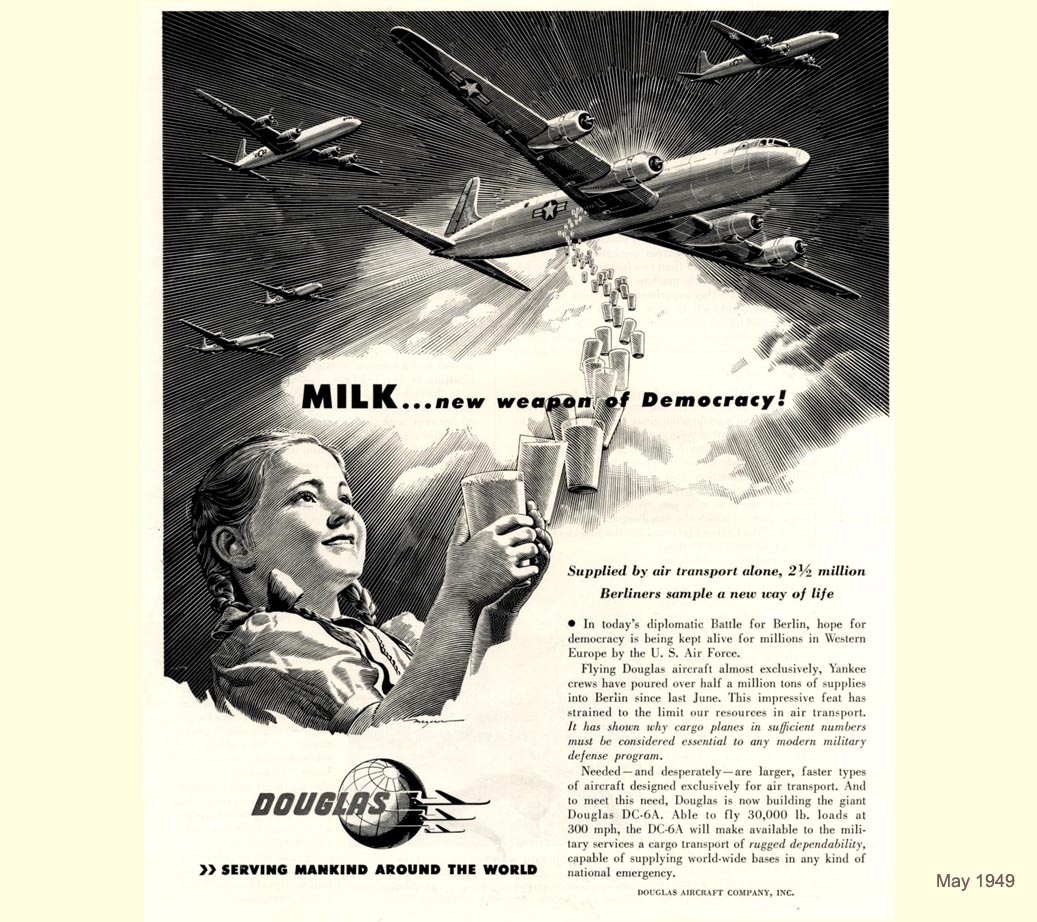
Beginning with the story of the Soviet blockade of West Berlin in the post-WWII era this chapter moves on to talk of the famines caused by Stalin and Mao. Thus, not a war story but some of the silent brutality of the Cold War.
"Milk... new weapon of Democracy". A 1949 ad for Douglas Aircraft Company.
Chapter 11: Feeding the World
Once fertilizer was invented it became the new limit defining factor in agricultural production. Hence subject of competition and conflict.
[...] huge deposits of sodium nitrate [...] had been discovered in Chile. Exports boomed, and in 1879 the War of the Pacific broke out between Chile, Peru and Bolivia over the ownership of a contested nitrate-rich region in the Atacama Desert. (Chile prevailed in 1883, depriving Bolivia of its coastal province so that it has been a land-locked country ever since.) [p. 204-205]
When Fritz Haber invented nitrogen fixation fertilizer could be produced chemically and natural deposits would not have to be fought over any more. Since then it has only contributed to the demand for fossil fuel as the process is energy intensive. Curiously, Haber also eagerly developed chemical weapons for the German war to use in the 1st World War - which drove his wife to commit suicide and earned him protests when later he was awarded the Nobel Prize.