Showing posts with label Peru. Show all posts

Wednesday, December 24, 2014

2014 bookmarks - the year in war over natural resources

From the depths of my bookmarks (that were all automatically tweeted) on conflict and natural resources, here is a quick review of the way in which Earth was plundered for natural resources in the past year. Year 2014, the 100th anniversary of the first war to run on oil.

In short, 2014 was just more of the same. Like...
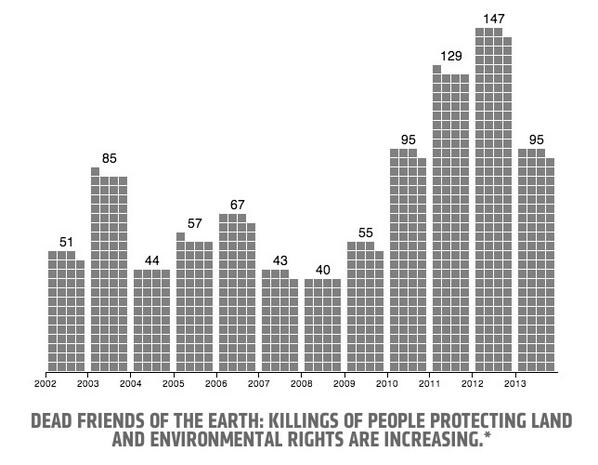
But a lot more of the same also means obscure news stories grow into reports from acknowledged organizations—like when
Some of the worst news this year was how Islamic State grew out of the chaos in Iraq and Syria, and became known not as the richest terrorist group in the world, but as the poorest terrorist country. Because they successfully occupy and exploit vast oil fields, loot everything lootable while controlling many smuggler's routes and ruthless dealers. I get how they control the population by mass executions rivaling the worst in history, denying crucial water supplies to villages and other callous misdeeds. But how do they manage to sell oil worth millions of dollars every single day even as all eyes are on the region? Money talks, of course, anywhere and anytime, but still?

Part of the answer came in this fascinating report by Suzan Fraser and Yilmaz Akinci from the border between Turkey and Syria, where... hillbillies, basically... tell how they have always been smuggling. Everyone did it. For generations. So, suddenly a few more bearded men came with a bit more oil than usual. It worked for a time, but Turkish police cracked down on it. Their large scale “pipeline” was smacked into smaller, obscure “pipelines” - like the ones the Islamic terrorists have for every other country, apparently.

Probably more efficient that the Turkish police, however, is the Saudi Arabian financial muscle. To them and most of their allies, the sum of benefits of a low oil price seems to currently triumph the more obvious benefits of a high oil price. Mainly by cutting the cash flow to Iran, Syria, Islamic State, Russia, even North American non-conventional (fossil) energy producers and others. In fact, I've seen some speculate Saudi Arabia has almost won the war on Ukraine's behalf as Russia's weakening rubles soon cannot pay for any more war. Speaking of Ukraine: This country used to be self-sufficient in coal, but the territory occupied by rebels and Russians just happen to host 66 coal mines, leaving Ukraine's power plants under-supplied; and the shores off now Russian Crimea just happen to be full of gas. What a coincidence.

That was all just slightly scratching the surface of year 2014 in war for natural resources. On slightly more positive notes, Interpol published a most-wanted list of environmental criminals at large – go get 'em – and Egypt and Ethiopia seems to be agreeing on how to share the Nile.

https://twitter.com/Global_Witness/status/456347470071463936

Happy New Year!


Sunday, November 27, 2011

War for territory - World tour November 2011

We live in peaceful times. Conflicts being linked to something as mundane as natural resources is a conspiracy theory. Just kidding...

Cambodia: Villages razed to clear land for sugar plantation
Amnesty International and other organisations have exposed the Cambodian authorities' systematic failure to protect people from forced evictions. Forced evictions in the name of economic development now occur regularly across Cambodia, as local elites and foreign investors seek to capitalize on a newly privatized land market and take control of the country's natural resources.


Colombia: Tribes flee civil war and gold miners

About 10% of the hunter-gatherer Awa tribe have fled their ancestral mountain homes in the past decade. Some now survive as subsistence farmers on small lots provided by the government.

The tribe has been fighting palm oil plantations encroaching on their land for about 16 years, the civil war between leftist FARC and the government has produced an extremely dangerous territory including indigenous grounds littered with landmines and lately gold mines have taken away even more land and polluting its surroundings.


Read: BBC / Colombia's indigenous peoples face uncertain future, SOS Childrens' Villages / Dealing with the threat of landmines in Colombia.

Peru: Indigenous tribes protest planned gold mines

Several protesters were injured on November 25th when police dispersed anti-gold mine demonstration with tear gas. The US-based Newmont Mining Corporation plan to reconstruct local water flows used in farmers' irrigation. Locals protest mining projects throughout Peru and injuries are not uncommon.
"Companies come here, take the gold and then go away - just like in colonial times. People feel cheated." - Jorge Rimarachin


Read: AFP / Peruvian gold mine, locals clash over resources , MercoPress / Peruvian peasants clash with police to protest against gold mine in the Andes.


Sudan - South Sudan border: Ethnic cleansing?

After a brief spell in international media as a success story, newly founded South Sudan is now fighting a "war by proxy" paramilitaries with Sudan. The latter appear to currently be evicting certain ethnic groups.


SAF Aircrafts at El Obeid Airbase
DigitalGlobe imagery shows the presence of Antonov An-26's and other aircraft at El Obeid Airbase on 14 November 2011.

The Sea: The race for off-shore resources intensifying world wide

One third of oil production is now off-shore and the rate is climbing. Resources are found in the Arctic, in the South Chinese Sea, in the Mediterranean and elsewhere. Chinese and Turkish warships circle Vietnamese and Israeli drilling ships and platforms in each their own gunboat diplomatic efforts. These countries as well as the US, Russia and others are investing in new aircraft carriers, cruisers and destroyers.


Read: The New York Times / A New Era of Gunboat Diplomacy.


All just one big hoax. All of the above from the month of November 2011.


Friday, August 27, 2010

Food & War: Highlights from 'An Edible History of Humanity'

Have been reading An Edible History of Humanity by Tom Standage. Good reading I can recommend!

You will find it interesting too if you, like me, is into Jared Diamond's books, agriculture or the more practical aspects of history. It is written in an accessible form and not quite as academic in nature as Diamond's books. If you, also like me, have already read all of Diamond's books as well as a selection of related literature and journal articles it will be repetitive at places. But at the same time full of great quotes and little stories.

The book tells the history of human civilization through the development of our food production and culture. A highly relevant book to the present blogging project although food is a special type of natural resource or products hereof and history is a wider subject than conflict.
The fate of nations hangs upon their choice of food.
 - Jean-Anthelme Brillant-Savarin
Part I: The Edible Foundations of Civilization

First, the domestication of maize, wheat and rise is retold - essential beginning of the tale. Then the spread of farming discussed. Hunter-gatherer societies have always been and still are much more peaceful than farming societies. Why and how is explored and explained in chapter 2 from reasoning with the needs and circumstances of them as well as the historical conditions.

Chapter 3: Food, Wealth, and Power

Picking up where chapters 1 and 2 left off, now the gradual transition towards hierarchical social order is described. Especially the significance of irrigation is compelling; here are a few of the explanations for the onset of organized conflict:
One theory contends that a big man or leader can become more powerful by coordinating agricultural activity, particularly irrigation. [...] control of the irrigation system would confer power on the leader [...] the irrigation system might also need to be defended, using full-time soldiers funded by the food surplus and placed under the leader's control. [p. 41]
Another theory suggests that the communal storage of agricultural surpluses might provide the leader with an opportunity to establish greater control over his followers. [...] Increasingly elaborate public-works projects then legitimize the leader's position and require a growing number of administrators, who emerge as the ruling elite. [p. 42]
A third suggestion is that competition for agricultural land led to warfare between communities in areas where such land was environmentally circumscribed. [...] When one village defeated another it then appropriated the defeated village's land or forced its people to hand over a proportion of their harvest every year. [...] This all sounds plausible, but there is no evidence that people reached the limit of agricultural productivity in any of the places where stratified societies first emerged. In the event of a drought or a bad harvest, however, it is possible to imagine villages with food reserves coming under attack from neighboring villages where the food had run out. [p. 43]
Part III: Global Highways of Food

Standage delivers a great tale of a near-global multi-millennial trade war over spices (which I must admit I've been mostly ignorant of hitherto). A mostly non-violent conflict that occasionally flared into brutality. And, amazingly, indirectly contributed to the collapse of the Roman empire that spent two digit tonnes of gold on importing spices annually, later helped spread the plague to Italy. The latter includes one of the book's interesting detours: plague infected corpses were used by Mongols as catapult ammunition against slave trading Europeans [p. 80-81].
After the year 1500 there was no pepper to be had at Calicut that was not dyed red with blood.
 - Voltaire, 1756
It is also explained how trade spread Islam by it providing suitable customs and laws. Then how the Portuguese (Pedro Álvares Cabral and Vasco da Gama) finally navigated around Africa to find unarmed trade vessels and immediately exploited it with extreme violence - bombardments of random cities, torture of innocent traders, mass executions, extortion et cetera.

Later in the 16th century the English and Dutch stepped up to compete in spice trade and global violence:
Clove production was concentrated on the central islands of Ambon and Ceram so that it could be more tightly controlled; the ancient groves of clove trees on other islands were uprooted, the clove pickers massacred, and their villages burned down. Where clove production was permitted, the growing of other crops was outlawed, to ensure that the local people would be dependent on the Dutch for their food. [p. 99]
Similar regimes were established to control nutmeg and mace production. Locals were enslaved for workforce, power was ruthlessly enforced by mercenary samurai warriors hired in Japan and problematic villages razed.

Obviously, the slaves-sugar-rum triangle is discussed. And later in the book one of the first consumer boycotts when in the 1790 British wanted slavery free tea.

Part V: Food as a Weapon

Needless to say: this is a central part of the book for Ecowar scrutiny. But it contains only two chapters. Chapter 9 on how food crucially influences warfare and chapter 10 on how some conflicts have been entirely centered around food.

Chapter 9: The Fuel of War

This  chapter explains how Alexander the Great and Napoleon Bonaparte won numerous battles thanks to superior logistics. And how the English lost the American Revolutionary War due to inadequate supplies.

The fate of Europe and all further calculations depend upon the question of food. If only I will have bread, it will be child's play to beat the Russians.
 - Napoleon Bonaparte
Starvation destroys an army more often than does battle, and hunger is more savage than the sword. [...] whoever does not provide for food and other necessities, is conquered without fighting.
 - Vegetius, 4th century
If you occupy your enemies' storehouses and granaries and seize his accumulated resources in order to provision your army continuously, you will be victorious.
 - Medieval Chinese military handbook
Besides stories of how food has influenced war we also get the story of how war inspired culinary research: Around year 1800 the French invented canned food for soldiers rations but failed to keep the technology to themselves. And it concludes with the stories of how sabotage of supplies helped settle the American Civil War and how the German General Rommel fought and lost his North African battles over and because of Middle Eastern oil supplies.

Chapter 10: Food Fight
Food is a weapon.
 - Maxim Litvinov, Soviet Minister of Foreign Affairs, 1930-39
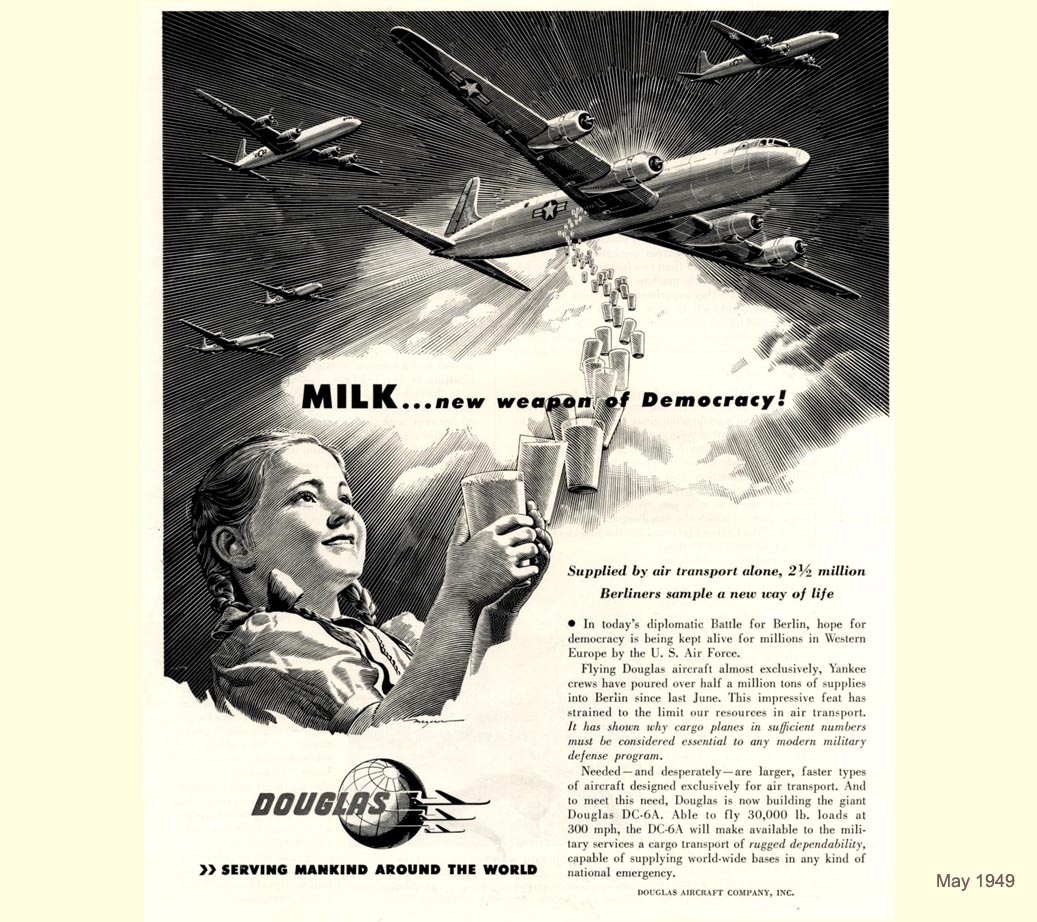
Beginning with the story of the Soviet blockade of West Berlin in the post-WWII era this chapter moves on to talk of the famines caused by Stalin and Mao. Thus, not a war story but some of the silent brutality of the Cold War.

"Milk... new weapon of Democracy". A 1949 ad for Douglas Aircraft Company.

Chapter 11: Feeding the World

Once fertilizer was invented it became the new limit defining factor in agricultural production. Hence subject of competition and conflict.
[...] huge deposits of sodium nitrate [...] had been discovered in Chile. Exports boomed, and in 1879 the War of the Pacific broke out between Chile, Peru and Bolivia over the ownership of a contested nitrate-rich region in the Atacama Desert. (Chile prevailed in 1883, depriving Bolivia of its coastal province so that it has been a land-locked country ever since.) [p. 204-205]
When Fritz Haber invented nitrogen fixation fertilizer could be produced chemically and natural deposits would not have to be fought over any more. Since then it has only contributed to the demand for fossil fuel as the process is energy intensive. Curiously, Haber also eagerly developed chemical weapons for the German war to use in the 1st World War - which drove his wife to commit suicide and earned him protests when later he was awarded the Nobel Prize.


For a quick view at the book's relevance to development issues please see TH!NK3 / Food & Development: Highlights from 'An Edible History of Humanity'.
Sunday, June 07, 2009

Indigenous Peruvians and police in deadly clashes at oil and mining protests

Sometimes researchers are blamed of being alarmists stirring up fears of a fictional dystopia by the business-as-usual crowd. But it seems a forewarning of conflict over oil in Peru is proceeding according to exactly such a warning. The news first...

40+ dead at protest

In extension of free trade agreements the Peruvian government has plans for 'developing' the Amazon homelands of many indigenous communities - opening it for oil, mineral, logging, and agricultural exploitation. Locals have been protesting some of these initiatives claiming they are unconstitutional and in violation of the UN Declaration on the Rights of Indigenous Peoples. When police intervened fighting erupted. Body counts wary; one is as high as 81.

President Alan Garcia Perez is claimed to have been behind a massacre on suspects of being Maoist guerrillas in 1986. A former army colonel turned politician is siding with the protesters. An arrest warrant has been issued on protest leader Alberto Pizango who has gone into hiding.

Sources: Upside Down World / 50 Days of Protest and One Massacre in the Peruvian Amazon | Peruanista blog | The New York Times / 9 Hostage Officers Killed at Peruvian Oil Facility | AP / 9 more police killed in Amazon protests in Peru | AP / At least 31 killed in Peru Amazon clashes | Mongobay / Oil or Death in the Amazon

Peer reviewed prophesies


A 2008 paper on PLoS ONE discussed this ongoing and accelerating exploitation in "the most species-rich part of the Amazon". From the paper:

Without improved policies, the increasing scope and magnitude of planned extraction means that environmental and social impacts are likely to intensify. [... We] consider the conflicts where the blocks overlap indigenous peoples' territories.


Oil and gas development in the western Amazon has already caused major environmental and social impacts. Direct impacts include deforestation for access roads, drilling platforms, and pipelines, and contamination from oil spills and wastewater discharges.


In Peru, hydrocarbon blocks now overlap 20 protected areas. Thirteen of these protected areas preceded creation of the oil blocks and lack compatibility studies required by the Protected Areas Law.


the history of oil and gas extraction in the western Amazon is one of massive ecological and social disruption, the future need not repeat the past.


No, it need not. But it just did. Heed the warnings of those who reason with statistics and logic.

ResearchBlogging.org
Finer, M., Jenkins, C., Pimm, S., Keane, B., & Ross, C. (2008). Oil and Gas Projects in the Western Amazon: Threats to Wilderness, Biodiversity, and Indigenous Peoples PLoS ONE, 3 (8) DOI: 10.1371/journal.pone.0002932


Vis stort kort
The lands of the Incas are endowed with copper, silver, gold, petroleum, timber, fish, iron ore, coal, phosphate, potash, hydropower and natural gas while troubled by deforestation, illegal logging, overgrazing, soil erosion, desertification, air and water pollution (including pollution from mining wastes). (Source: CIA Factbook)

Search This Blog