Showing posts with label books and movies. Show all posts

Thursday, January 12, 2012

Watch DIRT! The Movie

I just watched DIRT! The Movie for free at dotSUB. A really good movie about soil and the importance of a healthy biosphere of rich biodiversity. Takes a couple of detours (ie one about various spiritual connections to soil) that may seem weird depending on who you are and is quite a bit pro-organic agriculture but all in all a good, educational movie about not just soil, but about deforestation, climate change, agriculture - and a bit about conflict too!

Trailer:

Full movie:


"You create deserts where you are and eventually these micro deserts form much bigger areas. And we can't live very happily in a desert. And so we start fighting between farming communities and nomadic communities over land that is not a desert, that still has dirt. Desertification or land degradation is one good way of undermining security in any country."
- Wangari Maathai [0:29]
"There is a very strong correlation between human degradation and environmental degradation."
 - Sebastiao Salgado, photographer [0:42]

Although I just watched it, I could certainly use having the full quality DVD on my shelf along with HOME, FUEL, FOOD Inc, CRUDE and the other (upper case letter) enviro-flicks.

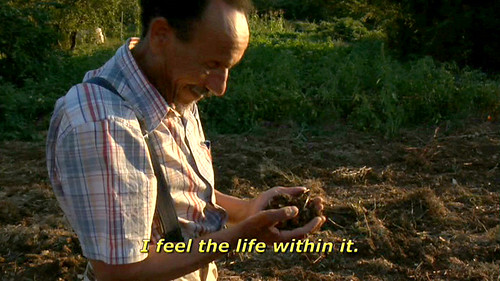
Pierre Rhabi holds dirt

Find DIRT! The Movie: at their own website, at YouTube, at Facebook, at Twitter and at IMDb.


Tuesday, September 27, 2011

Free book: "Natural Resources and Conflict in Africa the Tragedy of Endowment" by Abiodun Alao


Abiodun Alao Natural Resources and Conflict in Africa the Tragedy of Endowment Rochester Studies in African...
From the conclusion:

"the tendency to see natural resources either as a “curse” or a “blessing,” or the conflicts emanating from them as being rooted in “scarcity” or “abundance,” is inherently flawed" [...] neitherscarcity nor abundance has been a consistent factor as a cause of conflict [...] oil has, to a large extent at least, beena blessing to Libya while many Nigerians consider the same resource as acurse [...] The prevalence of violent conflicts over natural resources in Africa is due largely to the management of these resources.

[...]

despite the euphoria surround-ing the ongoing calls for transparency and good governance in Africa, theseefforts, though commendable in themselves, will not put an end to conflictsover natural resources in the continent. Although some of the conflicts arerooted in corruption and lack of democracy, a far greater percentage of theseconflicts have emerged because these resources are not distributed and man-aged in ways that benefit the population, especially the resource-producingcommunities, even in so-called democratic countries.

[...]

virtually all conflicts over natural resources in Africacan be linked to the governance of the natural resources sector [...] African countries do not have structuresto manage natural resources in ways that can prevent conflicts.

Haven't read it yet but it looks like a thorough overview of natural resource conflicts in Africa up to year 2007 although a bit simplistic in playing down the role of natural resources because other factors appear more important. Also, the Libya argument is kinda outdated...


Thursday, April 28, 2011

Just read "Climate Conflict" by Jeffrey Mazo

The book Climate conflict - How global warming threatens security and what to do about it by Jeffrey Mazo of The International Institute For Strategic Studies is a concise discussion of historical, current and future geopolitics as influenced by climate change. It is kind of an academic version of the more popularizing Climate Wars by Gwynne Dyer (reviewed here at Ecowar December 2010). And highly recommended to anyone interested in geopolitics, security issues or climate change.


The bad part is it has an introductory chapter on climate change and one about Darfur - both topics that I for one is getting tired of paying for. The good par is that even these chapters are really good. Short, to the point and comprehensive enough to contain details I hadn't heard of before.


In Mazo's own words, the book is "intended to illustrate the social and security consequences of climate change that will manifest over the next two to three decades regardless of the policies adopted in the next few years to mitigate more severe impacts over the long term. [...] it assumes a best-case scenario in terms of international policy responses to climate change [...]". Assuming a best-case scenario for politics? Did you ever read anything that naive? But as he says: It doesn't matter for the near future anyway.

The historical chapter is almost like a summary of Jared Diamond's Collapse. The final two chapters are a bit unclear in disposition but solid in content. The short-short-short version of the conclusion is:
"It is clear that unmitigated climate change will be nothing less than disastrous for the global community."
But scholarly as it is it qualifies its findings:
"Just as no specific weather event can be definitively attributed to climate change because of normal variation within a complex system, specific social or political developments cannot be definitively attributed to climate or other environmental factors."

It doesn't really deal a lot with bad policy scenarios, local conflicts, resource conflicts related to energy choices and many other issues. But the core issues it sets out to explore it dutifully maps with a bullshit factor of zero. Buy it and read it.

Wednesday, December 22, 2010

Read "Crude World" by Peter Maass

News about the oil business, campaigns against it's foul play, news about pollution incidents, academic studies dealing with the many implications of the importance of oil and similar reports are not infrequent. Quite a few entries at this present blog deals with oil. But how about a first hand account of visits to the oil business hotspots of the world? From an acknowledged journalist with a critical approach and an open mind. About 220 pages telling the stories of the people living from or in the shadow of oil extraction... that's Crude World.


Chances are you'll gobble it up like a SUV does gasoline but there's plenty in its ten creatively titled chapters to digest more thoroughly. Scarcity, introducing with the stories of a poster-boy whistleblower from inside the number one consuming nation, USA; Plunder, about the disturbingly overlooked textbook case of Equatorial Guinea; Rot, taking us down the polluted rivers of the Niger Delta; Contamination, continues with stories from the misery of the Ecuadorean jungle; Fear, dives into the psychology of the oil business and the ignorance and innocence of its workers; Greed, is composed of a handful of stories about the callousness of the oil business even when operating inside the West; Desire, is a bit of the impossible to ignore story of the Gulf Wars; Alienation, has the perhaps most scary story of the ghost country called Saudi Arabia; Empire, is a peek below the surface of the apparently feel-good story of Russia; and Mirage ends off the book with a similarly critical look at the naive story of the Boliviarians in Venezuela.

Around the world indeed. Plenty of facts but served in dishes of true stories. Warmly recommended.

Can't help quoting a few good quotes about the US relation to the Middle East:

“Let our position be absolutely clear. An attempt by any outside force to gain control of the Persian Gulf region will be regarded as an assault on the vital interests of the United States of America, and such an assault will be repelled by any means necessary, including military force.”
- US President Jimmy Carter, 1980

“Access to Persian Gulf oil and the security of key friendly states in the area are vital to US national security. The United States remains committed to defending its vital interests in the region, if necessary through the use of military force, against any power with interests inimical to our own.”
- US President George Bush in “National Security Directive 54”

“Armed with an arsenal of these weapons of terror, and seated atop ten percent of the world's oil reserves, Saddam Hussein could then be expected to seek domination of the entire Middle East, take control of a great portion of the world's energy supplies, directly threaten America's friends throughout the region, and subject the United States or any other nation to nuclear blackmail.”
- Dick Cheney, August 2002

Democracy Now! interviewed Peter Maass during the BP oil "spill" in the Mexican Gulf:


Also, he's talking for hours on YouTube! About the book in general...


...about Russia...


...about Nigeria...


...about Iraq...


...and about related subjects in many more recordings.

Regarding the Iraq War... was it about oil then? To Maass it turns out it's not whether the war was about oil - it's how it was about oil.


Thursday, December 09, 2010

"Climate Wars" by Gwynne Dyer (a review / rip-off)

With a title like Climate Wars this book looks "alarmist" even to someone sick and tired of being called just that. But actually, it is far less dramatic than the action paced science fiction that may come to mind. Written by a veteran soldier with academic degrees in military history and years of experience in journalism. Based mainly on the projections made by army analysts of the world from the prognoses in the IPCC 2007 report.

For those of us with academic backgrounds in ecological science and/or a couple of years of climate debate behind us several of its chapters are climate change science and policy repetition. But for me - working on mapping the links between natural resources and conflict - chapter 1 is a great summary with extra insights to the geopolitics of predicted climate change impacts.

And the factual chapters are interspersed with scenarios which are great and briefly outlined below. Being eager to dissect the book for information I find the structure of the factual / non-scenario chapters a bit too mixed up to help make the book as a whole more of a page turning thriller. COP15, for example, is summarized in chapter 6, Real World Politics. Perhaps I could have done with the part about the Copenhagen Accord [p. 209]:
Only a last minute intervention by the British, Americans and Australians, who called for an adjournment and used it to bundle the hapless Rasmussen out of the chair [My emphasis. I have a thing about the obvious incompetence of the Danish prime minister], prevented the 'Copenhagen Accord' from being formally rejected at the plenary session. During the recess, they managed to negotiate a last minute compromise in which the accord was neither accepted or rejected. It was simply 'noted'. And with that, everybody went unhappily off to bed and thence to the airport.
But not only is that entire chapter about COP15 - the topic is mentioned several other places in the book. Similar little issues with, for example, the necessary scientific explanations which come and go in different chapters. Exactly where they are needed, perhaps, if you don't know them already and isn't a "book dissector" like me. And underlining the fact that diplomacy and war are each others extensions.

The Dyer scenarios

The future scenarios are not predictions. They are more like not unlikely cases told with some necessary filling from Dyer's imagination. The longer into the future one tries to imagine the more uncertainty is in play - but the first scenarios are quite imaginable. Although summed up in chronology below they are not necessarily interlinked while also not mutually exclusive.

Incident scenarios:
  • Scenario 2, Russia 2019: The Colder War. The oil and gas revealed beneath the melting North Pole and the new trade routes opening between fewer and fewer icebergs does not lead to war between Russia and the USA. Of course. But it does lead to a lot of discussions on interpreting traditions for drawing sea borders as well as incidents of alleged violations of said disputed borders. Not just regarding drilling but also with incidents of detained fishermen. After years of non-violent conflict - during which the negotiations under UNFCCC has suffered greatly - Russia comes out much stronger: Its northern shores have benefited most from new sea routes due to their head start with a strong fleet of sea ice capable ships and well settled infrastructure, they have strong claims for some of the new resources and it's all coupled with some positive climatic impacts on the nations agriculture.
  • Scenario 3, United States 2029: The US-Mexican border is finally sealed off forcefully and completely after surges of refugee influx caused by runaway desertification in a country whose farmers are already struggling financially. The United States of Mexico collapses and several northern regions are effectively ruled by warlords. Inside the USA a strong ethnic group of Mexican heritage is increasingly in opposition to the rest of the country.
  • Scenario 4, Northern India 2036: India and Pakistan have shared glacier fed rivers for their water supply for decades although otherwise having a periodically hostile relationship. Droughts worsened by climate change, growing populations and increasing consumption have tempted governments to blame the hardships of their peoples on externalities - the neighbours - and forced Pakistan to ration food. After years of fragile peace a military coup and an attack on a dam escalates into an exchange of nuclear warheads. The result is hundreds of millions of casualties and two devastated countries still ruled by the same governments.
  • Scenario 7, China 2042: During the '30ies two kinds of terrorist groups are added to the ones previously known to be desperate enough: some from disgruntled oil exporting countries experiencing unforeseen financial losses and some from within the West made up of "leftists" furious at their governments for doing much too little of what they have been asking for (renewable energy etc.) while stepping up efforts on what they have been arguing against (geo-engineering, nuclear power etc.). The former cannot attack inside the West and instead aim at those of their neighboring countries who have begun exporting, for example, sunlight generated power. The latter accomplishes some minor attacks on airlines and even a more serious one on a nuclear power plant. While the world heats and the people of the West become increasingly divided over geo-engineering suddenly China and Indonesia acts without anyone's agreement. The Earth is dimmed by "artificial volcanic sulfur" being released into the atmosphere. Unfortunately, shortly after the project has begun working a real mega-size volcanic eruption triples the effect. The following years harvests fail world wide: hundreds of million of people die from starvation and almost as many from the armed conflicts, local genocides and mass-migration it incites.
  • Scenario 1, The Year 2045:The EU has collapsed and the Northern Union of Scandinavia, Poland, Germany, Benelux and France is fending off hordes of immigrants while the north of Italy has separated itself from the south of Italy. Russia is enjoying relative prosperity due to positive effects on its agriculture but is also facing some trouble over disputed Siberian territories eyed by a re-united China. Britain and Japan is guarding their shores fiercely while stacking nuclear arms. Temperatures are up and still rising.
  • Scenario 6, United States and United Kingdom 2055: The American people never learned to understand the problem of climate change. Peak oil hits hard and the globalized food trade largely collapses: "in this new and unforgiving world, self-sufficiency was the sole basis for security" [p. 182]. Gulf Coast states are devastated by hurricanes and floods, California's agriculture collapses from perpetual drought. A third party - called "The Goddies" - gains major political influence and the borders are shut tight. Similarly in Europe, the northern countries are getting overrun by people leaving the southern EU states. European Union collaboration starts to strain as food aid is sent south and northern borders tighten despite treaties. Increasingly, the border patrols sealing off Africa and the Middle East is made up of soldiers from northern Europe but eventually these countries decide to pull back and guard only their own territories.
Multi-year scenarios:
  • Scenario 5: A Happy Tale: Sincere and determined action is taken to combat climate change - but only after conversely harsh shocks from peak oil causing price leaps, a series of brutal natural disasters around the world and a Bangladesh threat a radical geoengineering initiative on their own if the rest of the world does not cooperate in combination shake up humanity. Global diplomacy works - but too late and too little. A green society keen on geoengineering is created but only some are fortunate enough to survive with it.
  • Scenario 8, Wipeout: 150-200 years into the future the average temperature has climbed by about 9 degrees from failure to curb climate change. Two groups of civilized settlements survive along the Arctic shores and small, more primitive societies here and there where conditions allow. Inland territories on continents suffer complete desertification. Increasingly, the oceans start to smell like rotten eggs. A process is being initiated in which hydrogen sulfide is being released to deteriorate the quality of air for all breathing forms of life while also breaking down the ozone layer. Which in turn will help scorch the remaining life in ultraviolet radiation. Only the harshest and luckiest life forms will make it to the other side of the "greenhouse extinction" event. A phenomenon that was known to paleontologists, not climatologists. The progress of which no human will live to experience, only few will recognize as it starts.
So, Dyers book is really good. But my own will be even better ;-)

Related info
Video interview with transcript: Democracy Now!, July 2010 / Gwynne Dyer on "Climate Wars: The Fight for Survival as the World Overheats", Gwynne Dyer at Wikipedia, Gwynne Dyer's website. Plus the following video interviews / speeches:


Monday, October 25, 2010

How many people can live on Planet Earth? Watch this BBC documentary!

Whether you're discussing water resources, food security, climate change, migration, developing countries or pretty much any geopolitical or human ecological topic there is one other topic often avoided: Overpopulation. Watch this 58 minute BBC documentary on YouTube.


Regarding "Ecowar relevance" the following parts are especially interesting.

14 min: Value of ecosystem services
Doug Hamilton, International Space Station.
"When you see how hard it is to reproduce what Mother Nature does every day for all of us you begin to really appreciate the world that you have."
17 min: Water
Mexican government emergency water truck driver.
"At some time in the future wars are going to be fought over water, not oil. But people don't seem to understand."
27 min: Land grabs
Chinese, Saudi Arabian and British "land grabs". Most are in Africa which already has trouble feeding itself.
In the 29th minute a segment about Rwanda begins... Then there is peak oil, carrying capacity, relative ecological footprints, Indian family planning... almost the entire package.

Thank you David Attenborough and BBC. And thank you EJC for alerting me of this program.


Tuesday, October 19, 2010

A Crude Awakening (four years late)

Predating the first post at this present blog by about 13 months in 2006 the documentary A Crude Awakening warned of the implications of oil soon running out.

From Wikipedia's section "Findings", my emphasis:
overall conclusions were that a global peak was imminent (if not already occurring), more wars would be fought to control access to oil resources, and economies most dependent on oil (or relying on trade with oil-dependent nations) would suffer dire consequences
At IMDb the user cross-45 rates it 10/10 and from his review:
This film puts into perspective and also gives me many answers for the bloodshed carried out in many of the wars of the last century, and continuing into this century
Already in the trailer, a woman says:
Oil is a magnet for war. Oil starts wars. 

Welcome to my Ecowar Movies list (and my 'Must See' list), A Crude Awakening.


See IMDbthe Wikipedia entry and the official site. (Thanks to Lara Smallman for alerting me about this one.)

Friday, August 27, 2010

Food & War: Highlights from 'An Edible History of Humanity'

Have been reading An Edible History of Humanity by Tom Standage. Good reading I can recommend!

You will find it interesting too if you, like me, is into Jared Diamond's books, agriculture or the more practical aspects of history. It is written in an accessible form and not quite as academic in nature as Diamond's books. If you, also like me, have already read all of Diamond's books as well as a selection of related literature and journal articles it will be repetitive at places. But at the same time full of great quotes and little stories.

The book tells the history of human civilization through the development of our food production and culture. A highly relevant book to the present blogging project although food is a special type of natural resource or products hereof and history is a wider subject than conflict.
The fate of nations hangs upon their choice of food.
 - Jean-Anthelme Brillant-Savarin
Part I: The Edible Foundations of Civilization

First, the domestication of maize, wheat and rise is retold - essential beginning of the tale. Then the spread of farming discussed. Hunter-gatherer societies have always been and still are much more peaceful than farming societies. Why and how is explored and explained in chapter 2 from reasoning with the needs and circumstances of them as well as the historical conditions.

Chapter 3: Food, Wealth, and Power

Picking up where chapters 1 and 2 left off, now the gradual transition towards hierarchical social order is described. Especially the significance of irrigation is compelling; here are a few of the explanations for the onset of organized conflict:
One theory contends that a big man or leader can become more powerful by coordinating agricultural activity, particularly irrigation. [...] control of the irrigation system would confer power on the leader [...] the irrigation system might also need to be defended, using full-time soldiers funded by the food surplus and placed under the leader's control. [p. 41]
Another theory suggests that the communal storage of agricultural surpluses might provide the leader with an opportunity to establish greater control over his followers. [...] Increasingly elaborate public-works projects then legitimize the leader's position and require a growing number of administrators, who emerge as the ruling elite. [p. 42]
A third suggestion is that competition for agricultural land led to warfare between communities in areas where such land was environmentally circumscribed. [...] When one village defeated another it then appropriated the defeated village's land or forced its people to hand over a proportion of their harvest every year. [...] This all sounds plausible, but there is no evidence that people reached the limit of agricultural productivity in any of the places where stratified societies first emerged. In the event of a drought or a bad harvest, however, it is possible to imagine villages with food reserves coming under attack from neighboring villages where the food had run out. [p. 43]
Part III: Global Highways of Food

Standage delivers a great tale of a near-global multi-millennial trade war over spices (which I must admit I've been mostly ignorant of hitherto). A mostly non-violent conflict that occasionally flared into brutality. And, amazingly, indirectly contributed to the collapse of the Roman empire that spent two digit tonnes of gold on importing spices annually, later helped spread the plague to Italy. The latter includes one of the book's interesting detours: plague infected corpses were used by Mongols as catapult ammunition against slave trading Europeans [p. 80-81].
After the year 1500 there was no pepper to be had at Calicut that was not dyed red with blood.
 - Voltaire, 1756
It is also explained how trade spread Islam by it providing suitable customs and laws. Then how the Portuguese (Pedro Álvares Cabral and Vasco da Gama) finally navigated around Africa to find unarmed trade vessels and immediately exploited it with extreme violence - bombardments of random cities, torture of innocent traders, mass executions, extortion et cetera.

Later in the 16th century the English and Dutch stepped up to compete in spice trade and global violence:
Clove production was concentrated on the central islands of Ambon and Ceram so that it could be more tightly controlled; the ancient groves of clove trees on other islands were uprooted, the clove pickers massacred, and their villages burned down. Where clove production was permitted, the growing of other crops was outlawed, to ensure that the local people would be dependent on the Dutch for their food. [p. 99]
Similar regimes were established to control nutmeg and mace production. Locals were enslaved for workforce, power was ruthlessly enforced by mercenary samurai warriors hired in Japan and problematic villages razed.

Obviously, the slaves-sugar-rum triangle is discussed. And later in the book one of the first consumer boycotts when in the 1790 British wanted slavery free tea.

Part V: Food as a Weapon

Needless to say: this is a central part of the book for Ecowar scrutiny. But it contains only two chapters. Chapter 9 on how food crucially influences warfare and chapter 10 on how some conflicts have been entirely centered around food.

Chapter 9: The Fuel of War

This  chapter explains how Alexander the Great and Napoleon Bonaparte won numerous battles thanks to superior logistics. And how the English lost the American Revolutionary War due to inadequate supplies.

The fate of Europe and all further calculations depend upon the question of food. If only I will have bread, it will be child's play to beat the Russians.
 - Napoleon Bonaparte
Starvation destroys an army more often than does battle, and hunger is more savage than the sword. [...] whoever does not provide for food and other necessities, is conquered without fighting.
 - Vegetius, 4th century
If you occupy your enemies' storehouses and granaries and seize his accumulated resources in order to provision your army continuously, you will be victorious.
 - Medieval Chinese military handbook
Besides stories of how food has influenced war we also get the story of how war inspired culinary research: Around year 1800 the French invented canned food for soldiers rations but failed to keep the technology to themselves. And it concludes with the stories of how sabotage of supplies helped settle the American Civil War and how the German General Rommel fought and lost his North African battles over and because of Middle Eastern oil supplies.

Chapter 10: Food Fight
Food is a weapon.
 - Maxim Litvinov, Soviet Minister of Foreign Affairs, 1930-39
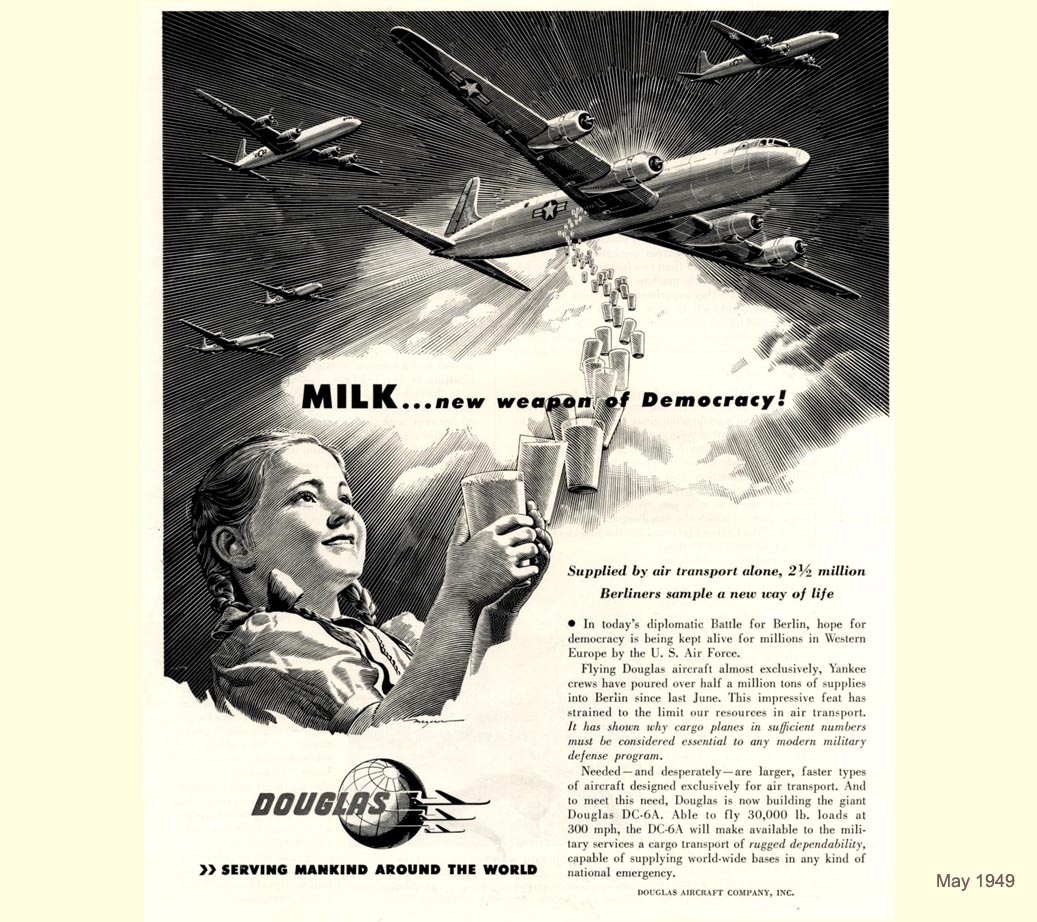
Beginning with the story of the Soviet blockade of West Berlin in the post-WWII era this chapter moves on to talk of the famines caused by Stalin and Mao. Thus, not a war story but some of the silent brutality of the Cold War.

"Milk... new weapon of Democracy". A 1949 ad for Douglas Aircraft Company.

Chapter 11: Feeding the World

Once fertilizer was invented it became the new limit defining factor in agricultural production. Hence subject of competition and conflict.
[...] huge deposits of sodium nitrate [...] had been discovered in Chile. Exports boomed, and in 1879 the War of the Pacific broke out between Chile, Peru and Bolivia over the ownership of a contested nitrate-rich region in the Atacama Desert. (Chile prevailed in 1883, depriving Bolivia of its coastal province so that it has been a land-locked country ever since.) [p. 204-205]
When Fritz Haber invented nitrogen fixation fertilizer could be produced chemically and natural deposits would not have to be fought over any more. Since then it has only contributed to the demand for fossil fuel as the process is energy intensive. Curiously, Haber also eagerly developed chemical weapons for the German war to use in the 1st World War - which drove his wife to commit suicide and earned him protests when later he was awarded the Nobel Prize.


For a quick view at the book's relevance to development issues please see TH!NK3 / Food & Development: Highlights from 'An Edible History of Humanity'.

Tuesday, July 13, 2010

The wisdom of zombie movies

Just read a nice observation at The Christian Science Monitor:
If war, as one wit famously observed, is “God’s way of teaching Americans geography,” then environmental disasters such as the BP oil spill seem to be the primary way that Americans learn about ecology.
In the absence of environmental disasters we watch zombie movies. Consider their key ingredients: extreme violence and number of casualties, crazed fight over or race for the few remaining resources, collapsing civilization and often an outbreak of man made disease.

I already mentioned The Happening along with a couple of non-zombie movies. This one isn't really a zombie movie though and the threat is at most indirectly caused by humanity.


28 Days Later... is a real classic. Human made disease released by misguided animal rights activism. Its sequel isn't as good though.

Also, I have to mention Dawn of the Dead and Zombieland although they are a bit stereotypical and doesn't explore any natural resources conflict or any other deep theme as far as I remember. But they are quite entertaining and has some canned food and survivalism.

While also technically not a zombie movie the recent The Road takes place in a post-apocalyptic wasteland where human flesh and hidden stashes of canned food are the only resources available.


And in The Crazies we follow a group of uninfected running from both government extermination and crazy slaughter in the aftermath the army spilling a plane-load of a biological weapon compounds into the drinking water of a small town.

As the user "K J E" writes in her Flixter review:
In this day and age, the true horror of The Crazies is in the fact that any of us could find ourselves in a similar situation. This is definitely a film which should make you think, and think hard and long about this world in which we live.
I'll have to watch The Book of Eli some time soon. (Hope it's better than The Road!) Which zombie movies would you suggest? Please comment!

Perhaps you have been sceptically reading my blog for some time and now wonder if I finally lost it? But zombie movies are, sadly, perhaps more efficient at educating scaring people of the frailties of society than any rationalist blog preferring solid research and eloquent essays.


Friday, July 02, 2010

The Last Oil Shock

The Last Oil Shock: A Survival Guide to the Imminent Extinction of Petroleum Man  by David Strahan had been on my wishlist at Amazon for about two years when I found it at a library sale for 2 euros.
It has an official website, as well as a two minutes video trailer:


Rather than a review, below is a selection of quotes from its extensive sources.


Quotes from the Preface

"I don't like the thought that oil production will peak and decline any more than I like the thought that I am going to die. But both are facts."
- Jean Laherrere, former oil explorer for Total
"[We face a] major historical discontinuity, by which I mean civilization itself is under threat."
- Colin Campbell, formerly working with BP, Texaco and others

Quotes from chapter 1: Sources in Washington

This is the chapter you must desperately avoid reading if you cling onto one of the usual excuses for attacking Saddam's Iraq. Full of interesting details, below is just a few choice quotes in chronological order:
January 26, 1998 PNAC sends a letter to President Bill Clinton:
[...] if Saddam does acquire the capability to deliver weapons of mass destruction, as he is almost certain to do if we continue along the present course, the safety of American troops in the region, of our friends and allies like Israel and the moderate Arab states, and a significant portion of the world’s supply of oil will all be put at hazard.
Signed by, among others, Donald Rumsfeld.

Louis Christian, an independent oil repository cartographer, was hired to chart Iraq in year 1998. Via the US Geological Survey but for who and what exactly?
"It seems to me the most likely suspect would be somebody high up in the administration that had a virtually unlimited budget that they don't have to itemize. Most likely the CIA or Pentagon."

November 1999 Dick Cheney gave a speech at Institute of Petroleum:
"[Demand is growing but production is declining so] where is the oil going to come from? [...] the Middle East with two thirds of the world's oil and the lowest cost, is still where the prize ultimately lies, even though companies are anxious for greater access there, progress continues to be slow [because of] US-imposed economic sanctions."
When George W. Bush took office with Cheney, Rumsfeld and other neo-cons Louis Christian's map was discussed at one of the very first meetings held. The Cheney Energy Task Force "melded" or "conflated" the "capture of new and existing oil and gas fields" with "policies towards rogue states" - which was revealed by Judicial Watch.
"We were acutely conscious of the fact that Saddam had carved up all the oil exploration deals and contracts with big non-US and non-UK multinationals."
- Carne Ross, former British in UN
That is the deals that would settle if sanctions were lifted and the run-down Iraqi oil sector hadn't damaged its oil fields before that.

The Iraq war happened. Colonel Gaddafi of Libya got the message, publicly 'renounced' weapons of mass destructions and took the unique step of offering 15 contracts for oil exploration to foreign companies, 11 of which were given to US firms.

Chapters 2 and 3 deals with peak oil itself. But mostly just experts admitting it's on its way. David Strahan isn't just one rogue journalist with a crazy idea; the other day - by coincidence - I saw this short video about peak oil:

Quotes from chapter 4: Long fuse, short fuse

Chapter four discusses which of the two oil issues - climate change and peak oil - is the biggest. It begins with an interesting anecdote: 16th of February 2005 Greenpeace decided to celebrate the Kyoto Treaty by setting off rape alarms attached to helium balloons inside the International Petroleum Exchange in London and raising a banner saying "Climate Change Kills. Stop Pushing Oil" outside. However, the traders reacted with fierce violence:
"They just went wild. They were trying so hard to hit us they fell over one another. "
- Greenpeace activist
"[Having a metal bookcase pulled down my head] wasn't great but it made a kind of barrier between us and them."
- Greenpeace director, Stephen Tindal
Stock exchange traders reacting to environmentalists with violence - just like fishermen, miners and lumberjacks.

The chapter ends with a former Greenpeace chief scientist's agreement with one of the postulates of the book - that the last oil shock will be a crisis every bit as profound as climate change:
"They're both problems that threaten the future as we know it, so I wouldn't like to draw a distinction. They certainly have different length fuses, but they're both large weapons of mass destruction. [...] Yes, of course, absolutely [peak oil has the shortest fuse]. If we were sensible, logical, joined-up thinkers, which we're not [we'd concentrate on peak oil]."
 - Jeremy Legget, geologist, author and more

The finer details

David Strahan then spends about 130 pages chronicling the many curious influences oil has on world society, the many small signs the oil hegemony is cracking up and the futility of attempts to do something about it.

Chapter 5, page 115 the US unemployment rate is linked to (correlated, explained) the oil price. And just consider what other things unemployment is linked to.
"There are good reasons why oil shocks hurt. When the oil sheikhs gets more of the world's money, someone has to end up with less. Profits drop, firms begin to go out of business, people lose their jobs."
 - Professor Andrew Oswald, Warwick University
Chapter 7, which is about OPEC and how it is lying about the volume of its resources, page 170 and onwards the fragile position of the Saudi Arabian monarchy is discussed (emphasis in bold added by me):
It's not hard to see why Saudi Arabia might want to exaggerate the scale of its oil resources; the position of its royal family demands it. For decades the fundamental contradiction of Saudi Arabian society has been that a population that largely adheres to Wahabism, the most puritanical, fundamentalist and xenophobic sect of Islam, is ruled by a royal family that is venal, bloated and Westward-leaning. The absolute monarchy has only managed to survive because its control of the oil has allowed it to buy American protection, and to bribe its own people. [...] Saudi Arabia's revenue from oil exports, which account for three-quarters of its income, collapsed [by 80% from 1980 to 2004...] half the population is under twenty-one, and the unemployment is thought to be as high as 25 per cent. There are frequent acts of terrorism and attacks on the security forces [...] The house of Saud has every reason to be terrified that it will soon go the way of the Shah of Iran. In these circumstances the royal family needs American protection more than ever before. 
Saudi Arabia's security pact with America was famously sealed when Roosevelt met Ibn Saud on his way back from the Yalta conference in 1945. Saudi oil production was negligible at the time, but US officials had already concluded that Saudi reserves constituted 'a stupendous source of strategic power, and one of the greatest material prizes in human history'. Although the meeting on board a US warship in the Suez Canal went unminuted, it is widely thought the two reached an understanding that has apparently survived to this day: America would guarantee the security of Saudi Arabia - and in effect the house of Saud - and in return the Saudis would guarantee US access to their vast reserves. In any event, successive US presidents have behaved as if that was the arrangement, providing the Saudis with billions of dollars in arms for both national defense and internal security. And Bush the Elder took America into the first Gulf War explicitly on that basis, declaring 'the sovereign independence of Saudi Arabia is of vital interest to the United States'.
There is no meaningful way to do an 'Ecowar excerpt' of chapter 8, Interesting Times, because it's relevant in its entirety. Continuing where chapter 7 left off it begins with the story of a half-botched and mis-reported Al-Qaeda attack on a Saudi oil field then detailing the complex geopolitics surrounding Mid East oil, Chinese influence especially. However, here is one of the more disturbing quotes, one that reminds us why it's a good thing Obama is in the White House:
"From the Bush administration's point of view, there is only one obvious and immediate way to alter this unappetizing landscape [ie of Iran-China deals] - by inducing 'regime change' in Iran and replacing the existing leadership with one far friendlier to US strategic interests."
- Professor and author Michael Klare
Or how about this one, page 182:
The world has never seen a problem like [peak oil]. Without massive mitigation more than a decade before the fact, the problem will be pervasive and will not be temporary. Previous energy transitions (wood to coal, coal to oil) were gradual and evolutionary; oil peaking will be abrupt and revolutionary.
OK, what internet crackpot said that? The US Department of Energy did in its Peaking of World Oil Production report. The chapter continues with many details of the economic battle already having raged for years. At times it's a bit eerie as some of its year 2006 predictions resemble what we are beginning to see in 2010, ie in the house prizing bubble that isn't exactly re-inflating.

Like the rest of the book chapter 9, Memo to Mr Wicks, is themed around one of the major dichotomies, conflicts or scandals in the subject. In this case the discrepancy between some of the ridicule the author received while researching the book and some of the most grave expert warnings. Like the one from the US Army Corps of Engineers:
Oil production is approaching its peak; low growth in availability can be expected for the next 5 to 10 years. As worldwide petroleum production peaks, geopolitics and market economics will cause even more significant price increases and security risks.
Finally the two last chapters are comprised of recommendations for politicians and people respectively. I'll leave those with a recommendation of the book - but no, one of his recommendations isn't "suicide by oil".

Update on the Iraqi oil law - and "alien scientists"


Since my choice of quotes focussed on the Iraq "liberation" it's only fair to finish with a video clip about the Iraqi oil law.
I also came across this next one more typical of the "YouTube underground":


Saturday, February 27, 2010

Occupation 101

Just watched Occupation 101 two years late. It's a gripping documentary about the history and status quo of the Israeli occupation of Palestinian lands. While not being about battle for resources it does mention the grabbing of fertile lands by Jewish settlers.


[In 1947] The UN - under pressure - proposed to divide the land into two states. An Arab state and a Jewish state. Arabs were to be given 43% of the land despite the fact that they made up more than two thirds of the population and owned over 92% of the land. Jews were to be given 56% although they comprised only one third of the population and owned less than 8% of the total area. [...] They were given not only most of the land, they were given the most fertile land. [21:10]


[Today Israeli] settlements are strategically built colonies of Israel [on UN designated "Arab" land] that are connected by a network of roads which separates each Palestinian community from the next and confine their ability to expand. They are often constructed around the best farmland and resources. [11:10]


You can watch the whole thing using the above embedded Google Video og you can order the DVD from the official website.

Wednesday, January 20, 2010

Zeitgeist & the eco-military

I watched a movie called Zeitgeist Addendum yesterday after months of having had it recommended from people. I recommend it: Download the DVD from the project website for free or watch it on YouTube. Here's some notes and comments...

It starts out criticizing elements of the economic system - boring to many by definition but perhaps a little more interesting here in the financial crisis? - and moves on (about 21 minutes into the movie) to discuss examples of how financial tools are preferred by the West (the US) before using the military to gain cheap access to 3rd world natural resources. It's essentially John Perkins, former NSA associate, talking about the topics of his book, Confessions of an Economic Hit Man [Official site | Wikipedia | Google Books].

This video is the 10 last minutes of John Perkins talking:


What he says about Iraq:

"Iraq, actually, is a perfect example of the way the whole system works. We economic hitmen are the first line of defense: We go in, we try to corrupt the government and get them to accept these huge loans which we then use as leverage to basically own them. If we fail [...] then the second line of defense is we send in the jackals. The jackals either overthrow governments or they assassinate. And once that happens then a new government comes in and they'll toe the line because the new president will know what will happen if he doesn't. In the case of Iraq both of those things failed [...] so, in '91 we send in the troops and we take out the Iraqi military [...assuming] Saddam is gonna come around. [...] So the economic hitmen go back in in the 90ies... without success. If they'd had success he'd still be running the country, we'd be selling him all the fighter jets he'd want [...] the jackals couldn't take him out again [either] so we sent in the military once again and this time they did the complete job [...] in the process creating for ourselves some very, very lucrative reconstruction deals."


Very much not surprising. But nice to hear from an insider. His conclusion makes me think of Michael Hardt and Antonio Negri's Empire. Regarding Iraq specifically, we've had some hard-to-believe right wing postulates that the war-for-oil theory is left wing propaganda pointing at non-US (yet Western) companies getting many contracts. First of all, it really doesn't matter as long as these companies supply for the (so called "free") world market. Second, recently U.S. Companies Join Race on Iraqi Oil Bonanza.

Towards the end the movie sums up in some more philosophical discussions (including some hippie stuff). Some of it is undeniable Ecowar cornerstones.


"The most important issue at hand is the intelligent management of the earth's resources. [...] Our true problems in life are technical, not political. [...] Society today is backwards. With politicians constantly talking about protection and security rather than creation, unity and progress. The US alone now spends about 500,000,000,000 dollars annually on defense. That is enough to send every high school senior in America to a four year college. In the 1940ies the Manhattan Project produced the first true weapon of mass destruction. This programme employed 130,000 people at an extreme financial cost. Imagine what our life would be like today if that group of scientists, in stead of working on a way of killing people, worked on a way to create a self-sustaining, abundant world. [...] It is time to unleash something much more powerful: weapons of mass creation."


Of course, just like America is addicted to oil (George W. Bush's own words) it's also addicted to war. At least, shutting down the military would be a mega-shock to the financial system. That is why I enjoyed it very much when in Kim Stanley Robinson's Science in the Capital series the US military is literally battling climate change. Also a topic discussed in the new copy of Ode Magazine: Jim Channon: Mobilizing the military to clean up the earth.

The true battle in the future is not between nations; it’s about repairing the damage we’re doing to our planet. [...] the army must set about reforesting the Earth, planting billions of trees and cleaning up the fresh water reserves. [...] The Marines will protect and restore the dying coral reefs and coastal wetlands while the Air Force monitors carbon emissions, ozone depletion and air pollution. [...] The Navy, Channon says, should be tasked with measuring rising ocean temperatures and melting polar ice as well as policing illegal dumping and overfishing of the seas. [...] siphon excess water from the oceans and channel it into the desert basins of the planet to create enormous salt water lakes [...] transport thousands of refugees from the Pacific Islands to these areas, where they may tend giant new fishponds


These quotes are the visions of retired U.S. Army Lieutenant Colonel Jim Channon - who's portrayed by Jeff Bridges in The Men Who Stare at Goats which appears to be a lot more fun than Zeitgeist Addendum.

Friday, October 02, 2009

Our mobiles are bleeding

We don't want to think too much about it. But every time we buy a new gadget we support a mining industry of questionable ethics. In the case of the mines in eastern Congo it is extraordinary brutal.

In a time of desperate need for re-forestation to fight climate change, in Congo wide swaths of jungle have been cleared to make way for 15,000-25,000 poor boys and men working under slave-like conditions, living in tents on mud, guarded by "autonomous" army units, earning little while risking their lives. Although a violent environment the biggest killers are diseases and collapsing caves.

A movie about these mines, Blood in the Mobile, is in the works. The trailer is ready:


(If you haven't seen Darren Aronofsky's The Fountain at least watch the trailer for the music which is taken from that film. Beautiful!)


As they say:
"Different armed groups are fighting to gain control over the mine."


Furthermore, TreeHugger.com has a slideshow of 34 photographs: The Incredible Story of Conflict Mineral Mining in Images.
The Democratic Republic of the Congo, scene of the deadliest conflict since World War II, remains mired in violence in significant part because of the international demand for electronic products that requires minerals found in the eastern Congo. The minerals mined here are used to make our iPhones, laptops and MP3 players, but at a great expense. Armed groups finance themselves through the illicit conflict mineral trade and fight over control of mines and taxation points inside Congo.


Congo is mentioned in the 100 Places to Remember project (see previous post). But it only concerns the deforestation of the precious original Itubi forest; home to the Mbuti pygmy people, endangered leopards, chimps, okapis etc. Deforestation not only removes essential carbon sinks it releases CO2 corresponding to about a fourth of the worlds fossil fuel use.

More: Official Blood in the Mobile website, Raise Hope for Congo.

Tuesday, September 29, 2009

100 Places to Remember - at least 8 of which are to die for

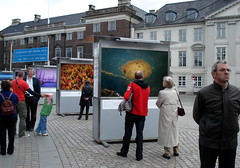
Having wandered through the exhibition at Kongens Nytorv in Copenhagen and now also enjoyed the accompanying book of 100 Places to Remember Before They Disappear I can't help but take note of a couple of them here.

Because the descriptions in some cases explicitly mentions conflicts. Granted: Many will change with potential drastic consequences. Be it because they become uninhabitable, hence sources of climate change induced migration, or become unsuited for agriculture, leading to loss of food production with all the negative consequences of that. Or because of any of the other potential negative changes. But most are "just" pretty spots that will change due to climate change.

DSC06551x

In chronological order of the book, the spots that are related to conflict by the 100 Places project:

#11 The North Pole, Russia/Canada/Denmark


As the Arctic thaws resources of oil, gas and minerals become increasingly available for extraction. But whose resources are they?

#16 Tian Shan, Kazakhstan/Kyrgyzstan/China


The glaciers atop this mountain range provides the water for the breadbasket and powerhouse of Kazakhstan. But due to miniscule drops in precipitation through the last 50 years they have shrunk by 36% already. Climate change will most likely accelerate this drastically. Competition for the remaining water resources will intensify. Neighbours some seriously troubled regions.

#26 Lake Chad, Chad/Cameroon/Niger/Nigeria


This lake is basically an essential source of life in a very arid region of all more or less "failed states". Competition between tribes and nations already intensifying as the lake is drying up rapidly.

#30 Kalahari Desert


Also drying up even beyond what it already is this desert is the last refuge of the die hard San people. But climate change could be the final blow to their basis of existence.

#68 Bering Sea, Russia/USA


This sea is the source of some 2 billion US dollars worth of fishing shared by Russia and USA. But as the waters warm the ecosystem and biodiversity is changing completely. At the very least the fishermen will have to go elsewhere or catch different fish. The worst... well... will begin with trade negotiations, I assume.

#79 Kordofan, Sudan


We've all heard of Darfur. Over and over again. And I've pointed to the vicious cycles between environmental degradation. But I guess Darfur is no longer pretty enough for a photograph in a project like 100 Places? Anyway, Sudan also has a big forest of "hashab" trees (Latin: Acacia senegal) which is the source of the largest production of rubber in the world. But business is slow both because of the nearby Darfur trouble, drought and rising temperatures which has caused a severe decline in forestry productivity. When this region of Sudan also loses it's livelihood...

#84 Niger Delta


This is "all of the above". Beautiful nature, oil pollution, ethnic violence, mass poverty, multinational corporations, rising seas, increasing storms, decline in freshwater availability, increased diseases spreading... huge chance of migration.

#87 Amman, Jordan/Israel/others


Well it's in the Middle East. Historically ideal situation for a fertile capital. But now human over-use of water resources and climate change is lowering the water level of the Dead Sea by one meter per year because less and less water flows by the Jordan River. Agricultural land is turning into desert as you read this. A glance at a map and it becomes obvious this can become a very, very big problem.


All of the above issues will of course get intertwined with the other issues of some of the regions. Like the pipelines running through central Asia. The existing political and historical animosities between certain countries. Perhaps it's in the nick of time these photographs were exhibited. Soon the footage could be less pretty.

(This post is also posted as part of the TH!NK ABOUT IT #2 Climate Change blogging competition. Most of these places are also marked in my Ecowar Battlefields Google map.)

Monday, September 07, 2009

Another MUST SEE: Crude - The Real Price of Oil


Just saw HOME, still planning to see DIRT and now this, CRUDE. (Haven't these people heard of lower case letters?) Another 2009 film about environmental exploitation and the hidden costs of it; mostly poor and/or indigenous people abused by Western companies and consumers.


More at the official website, IMDb, Hollywood and Fine / Crude: The cost of social Darwinism, ifc.com / Joe Berlinger's Crude New Film. From the reviews:
Crude [...] will be in the thick of the Oscar fight.

a heartbreaking and compellingly multifaceted epic about the so-called "Amazon Chernobyl" case


Part of this story was also told in an episode of the tv series Extreme Oil [IMDb].

Sunday, August 16, 2009

Wednesday, June 24, 2009

A Drop of Life: Short film about water conflict

"As I became aware of the mounting global water crisis, I realized that it represented a clash of cultures – between a culture that values water as a shared sacred source of all life and a corporate culture that regards water as a commodity to be bought and sold."


Quote Shalini Kantayya, director of A Drop of Life - a futuristic sci-fi flick about the mounting water crisis winning Best Short Film at Palm Beach International as well as the Audience Choice Award at the IUOW Film competition. Will check it out some time (two years late anyway).


Who controls water controls life


Found at lifewithinme.com. Shalini Kantayyas website. A Drop of Life at Imdb.com.

Saturday, May 09, 2009

Ecowar movies: Edutainment suggestions

Noticing the clamour over the new animated movie Battle for Terra (or just Terra) and it's interesting theme I put it on my Must See list - right next to Blood Diamond which is way over due. Then the logical idea came: make a list of movies for Ecowar!

Only four movies made it onto the list so far. But I would love to get recommendations for more! Please spam.

Battle for Terra
"A peaceful alien planet faces annihilation, as the homeless remainder of the human race sets its eyes on Terra. Mala, a rebellious Terrian teenager, will do everything she can to stop it." - IMDb plot
US Republican reviewers are all up in arms about this one. They say it's "Bush Bashing". I don't know what to think about that - especially since I haven't watched it yet. But in an interview with the writer he explained the rationale for the story as him not buying into the premise of War of the Worlds - that an entire species should be "evil". Seems very reasonable to me! Thus far in human history new territory has been considered something to exploit. Why not an inhabited planet? We might be in need of some planetary migration before we know it.

The Happening
"A strange, horrible and unprecedented crisis begins in Central Park. A high school science teacher, his wife and a young girl do what they can to survive it." - IMDb plot
Many would argue the science in this one is about as far out as the science in The Matrix. I don't think it is, although it's taken to quite a cinematic extreme. It's Gaia Theory. Somehow the human population pressure provokes a seriously negative feedback. It's not a very good movie due to various factors but it has it's moments. Like this line:
Nursery Owner: "You know plants have the ability to target specific threats. Tobacco plants when attacked by heliothis caterpillars will send out a chemical attracting wasps to kill just those caterpillars. We don't know how plants obtain these abilities, they just evolve very rapidly."
There Will Be Blood
A story about family, greed, religion, and oil, centered around a turn-of-the-century prospector in the early days of the business." - IMDb plot
No way I could omit this masterpiece although the conflict is largely explained in metaphorical measures and business rivalry.

Blood Diamond
A fisherman, a smuggler, and a syndicate of businessmen match wits over the possession of a priceless diamond. - IMDb plot
My final choice is also the least fictional - I suppose because as I mentioned I haven't watched it. Yet! Said to be a bit "tough" to watch.

Of course, there are movies about some of the wars that I have blogged about here. But I have a hard time thinking of any that really touches upon the ecowar issue. Also, I have excluded The Matrix trilogy - because blocking the sun is simply so stupid no one would ever consider it (think twice) and because the science in it isn't always that educational (human batteries?).

Thursday, September 04, 2008

Poison Fire: Oil in Nigeria

"Since oil was discovered in the Delta people have known no peace."
- Israel Aloja, Environmental Rights Action


Oil, which could potentially have allowed Nigeria to be one of the wealthiest countries in Africa has instead led it to become one of the poorest.

A series of repressive and corrupt governments in Nigeria have been supported and maintained by western governments and oil corporations, keen on benefitting from the fossil fuels that can be exploited.

[...]

According to Human Rights Watch, “multinational oil companies are complicit in abuses committed by the Nigerian military and police.”

- background article Nigeria and Oil at globalissues.org

Search This Blog