Showing posts with label Kazakhstan. Show all posts

Sunday, December 18, 2011

Trouble in Kazakhstan oil city

Oil industry workers have been protesting layoffs and demanding raises. Authorities have answered with a crackdown: reports of dead and injured, mobile network and internet censored. International networks of hackers are providing dial-up internet communication just like they did in Egypt early 2011.
"The protesters blocking the railway refused to leave the area and the clashes started. I am now in the hospital. One 25-year-old young man was shot in the head and died. Eight men were wounded and the number of the wounded is increasing." - Bauyrzhan, local


Read about Kazakhstan in Ecowar - Natural Resources and Conflict (the book) pages beginning 57, 104 and 114.

Via /. read Kazakhstan says it has restored order in oil town where 10 were killed in riots, Kazakhstan Disables the Internet, Situation Remains Tense In Western Kazakhstan After Deadly Clashes.


Monday, August 08, 2011

News not on my TV, not in my newspaper...

Colombia, oil
The Marxist rebels in Colombia, FARC, bombed an oil company's car. One died, six were injured. Why? Probably as part of an extortion scheme.
"This attack ... is a true crime against humanity."
 - Vice President Angelino Garzon
Well, at least it's an attack on the country's oil business.

View Larger Map
Sources: Reuters / Colombia bomb kills oil worker, injures 6 people, Latin American Herald Tribune / One Killed by Rebel Landmine in Colombia.

Central Asia, water
Kyrgyzstan and Tajikistan are upstream countries with lots of water fresh from the glaciers in the high mountains of Central Asia. Uzbekistan and Kazakhstan are downstream and suffering from the worst drought in decades. The latter are asking for more water from the former, claiming water belongs to everyone and rivers flow free. But Kyrgyzstan is asking for natural resources in return (ie Kazakhstan is the worlds number one uranium producer) and Tajikistan is constructing what will become the highest dam in the world. Kazakhstan refuse to trade in naturals (perhaps preferring world market prices?) and Tajikistan insist on damming the river since their energy supply is already rationed.

Negotiations have stalled. Uzbekistan has cut its gas export to Tajikistan and allegedly is also holding up Tajik exports on its border. Global warming is projected to raise temperatures by 2-3 degrees Celcius within 50 years; the glaciers are already melting because of this and future droughts will only grow in numbers and intensity.

View Larger Map
Source: Spero News / Central Asia: Danger of war over water growing.

The world, climate change
Another renowned columnist is speaking up. This time it's Eric Hammel in Foreign Policy.
I cannot fathom the prevailing so-what attitude as the FEMA-grade weather disasters mount toward becoming serial and routine occurrences. [...] Global famine is going to force the use of our military as a police force organized to feed unknowable masses of people [...] The only force on Earth with the inherent capability to police, process, house, feed, and move refugees on a mass scale is the U.S. military, but, though its reach is global, its capacity and stamina are nonetheless limited, probably to one or two major disasters at a time, not the overlapping rolling meta-disaster climatologists predict.
Read: Foreign Policy / Is climate change the biggest national security challenge we are facing?


Tuesday, September 29, 2009

100 Places to Remember - at least 8 of which are to die for

Having wandered through the exhibition at Kongens Nytorv in Copenhagen and now also enjoyed the accompanying book of 100 Places to Remember Before They Disappear I can't help but take note of a couple of them here.

Because the descriptions in some cases explicitly mentions conflicts. Granted: Many will change with potential drastic consequences. Be it because they become uninhabitable, hence sources of climate change induced migration, or become unsuited for agriculture, leading to loss of food production with all the negative consequences of that. Or because of any of the other potential negative changes. But most are "just" pretty spots that will change due to climate change.
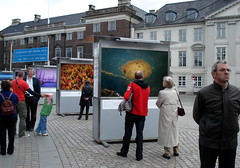
DSC06551x

In chronological order of the book, the spots that are related to conflict by the 100 Places project:

#11 The North Pole, Russia/Canada/Denmark


As the Arctic thaws resources of oil, gas and minerals become increasingly available for extraction. But whose resources are they?

#16 Tian Shan, Kazakhstan/Kyrgyzstan/China


The glaciers atop this mountain range provides the water for the breadbasket and powerhouse of Kazakhstan. But due to miniscule drops in precipitation through the last 50 years they have shrunk by 36% already. Climate change will most likely accelerate this drastically. Competition for the remaining water resources will intensify. Neighbours some seriously troubled regions.

#26 Lake Chad, Chad/Cameroon/Niger/Nigeria


This lake is basically an essential source of life in a very arid region of all more or less "failed states". Competition between tribes and nations already intensifying as the lake is drying up rapidly.

#30 Kalahari Desert


Also drying up even beyond what it already is this desert is the last refuge of the die hard San people. But climate change could be the final blow to their basis of existence.

#68 Bering Sea, Russia/USA


This sea is the source of some 2 billion US dollars worth of fishing shared by Russia and USA. But as the waters warm the ecosystem and biodiversity is changing completely. At the very least the fishermen will have to go elsewhere or catch different fish. The worst... well... will begin with trade negotiations, I assume.

#79 Kordofan, Sudan


We've all heard of Darfur. Over and over again. And I've pointed to the vicious cycles between environmental degradation. But I guess Darfur is no longer pretty enough for a photograph in a project like 100 Places? Anyway, Sudan also has a big forest of "hashab" trees (Latin: Acacia senegal) which is the source of the largest production of rubber in the world. But business is slow both because of the nearby Darfur trouble, drought and rising temperatures which has caused a severe decline in forestry productivity. When this region of Sudan also loses it's livelihood...

#84 Niger Delta


This is "all of the above". Beautiful nature, oil pollution, ethnic violence, mass poverty, multinational corporations, rising seas, increasing storms, decline in freshwater availability, increased diseases spreading... huge chance of migration.

#87 Amman, Jordan/Israel/others


Well it's in the Middle East. Historically ideal situation for a fertile capital. But now human over-use of water resources and climate change is lowering the water level of the Dead Sea by one meter per year because less and less water flows by the Jordan River. Agricultural land is turning into desert as you read this. A glance at a map and it becomes obvious this can become a very, very big problem.


All of the above issues will of course get intertwined with the other issues of some of the regions. Like the pipelines running through central Asia. The existing political and historical animosities between certain countries. Perhaps it's in the nick of time these photographs were exhibited. Soon the footage could be less pretty.

(This post is also posted as part of the TH!NK ABOUT IT #2 Climate Change blogging competition. Most of these places are also marked in my Ecowar Battlefields Google map.)

Sunday, February 01, 2009

Indian analysis: "USA might have benefited a great deal from its [lost] war in Afghanistan"

What hits Russian interests most is that if the Caucasian route materialises, the US would have consolidated its military presence in South Caucasus on a long-term basis. Ever since the conflict in the Caucasus in August, the US has maintained a continuous naval presence in the Black Sea, with regular port calls in Georgia. The indications are that the US is planning a carefully calibrated ground presence in Georgia as well. Talks are in the final stages for a US-Georgia Security and Military Agreement. US Deputy Assistant Secretary of State Matt Bryza visited Tbilisi for consultations in this regard.

Another dramatic fallout is that the proposed land route covering Georgia, Azerbaijan, Kazakhstan and Turkmenistan can also be easily converted into an energy corridor and become a Caspian oil and gas corridor bypassing Russia. Such a corridor has been a long-cherished dream for Washington. Furthermore, European countries will feel the imperative to agree to the US demand that the transit countries for the energy corridor are granted NATO protection in one form or the other. That, in turn, leads to NATO's expansion into the Caucasus and Central Asia.

Search This Blog