Even if wars are not all about oil, soldiers have certainly been killed for oil: Up to one in three US casualties has happened at gasoline convoys. Check out how solar panels are saving lives and improving the flexibility of US Marines deep in foreign deserts: Grist / U.S. military kicks more ass by using less fossil-fuel energy.
"Other people are busy saving the planet; this is about saving Marine lives [...] I’d kiss a polar bear if it meant getting one Marine off an IED-filled highway."
- Col. Bob Charette, director of the Marine Corps Expeditionary Energy Office
Irrespective of one's sentiments towards US soldiers in Afghanistan, the story is a parable for all of society. As the article finishes: "In a time of rising fossil-fuel prices and increasingly apparent climate dangers, the tether of fuel binds all of us — homes, businesses, communities, and whole economies — to a future of vulnerability and instability. Using less energy and generating more of our own is about more than dollars spent or saved. It’s about self-determination. That makes for a more effective military and a more secure, productive society".
You should think the politicians most eager for war would support such initiatives. But no. Because those politicians are at the same time the ones whose careers are sponsored by the existing energy sector hegemony. Read Slate / Why We Need a Greener Military and Wired / Republicans Order Navy to Quit Buying Biofuels for the full story about right wing politicians working hard to pass a law banning military spending on fuels more expensive than conventional oil. But since it is designed to obstruct initiatives to experiment with (currently relatively expensive) biofuels it explicitly omits alternative energy sources based on coal and gas (probably to allow shale gas, fracking et cetera).
In a way it's hard to believe the hypocrisy, the idiocy, the callousness. On the other hand it all makes depressing sense. Strong powers in business and politics accumulate vast fortunes on the people wasting obsolete energy and endangering their lives at home, at work and abroad.
One of the unpleasant effects of climate change is its tendency to incite further conflict where such already exist and in some cases war is already looming. Sociologist and writer Christian Parenti is blaming "pathologies of neoliberalism" and Cold War leftovers that converge with climate change effects for inciting further conflict where it already lingers. Already by now large parts of the political landscape are out of the target group of Parenti's message but he supports his assertion by way of his good storytelling based on personal experiences and interviews - and he finishes with an almost pro-capitalism conclusion.
Chapter 2 is pretty much a summary of some of the military reports I have linked to in Ecowar posts tagged 'military' plus a few other. Chapter 3 is a brief history of the US military which at first seems a bit thorough for a climate change book but actually shows how it has been on a long journey from conventional "European" warfare to guerrilla warfare inspired by North American Indian tribes and Ernesto "Che" Guevara. And ends up with a grim forecast (p. 36) of "the essence of militarized adaption to climate chaos: dirty war forever." In part, global counter-insurgency is an adaption to climate change that most of us wouldn't agree to if given the choice.
Part 2 is about Africa and describe how the Cold War proxy-wars have left unresolved conflicts now to converge with climate change effects, mostly via Parenti's own experiences visiting the areas. Most notably the stories from northern Kenyan herders who increasingly arm themselves to defend and raid cattle as droughts kill off livestock. Chapter 7 details the Cold War prequel to the current desert anarchy in Somalia. Chapter 8, the last of part 2, is a brilliant description of what a failed state is exactly.
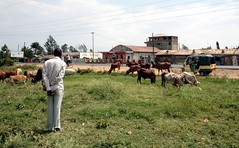
I traveled in Kenya January/February 2011. This photo is from the suburbs of Kisumu. I enjoyed the view over the Rift Valley and Lake Victoria. It is a bit chilling to read Parenti's stories from Kenya - in fact the book begins and ends with the corpse of a cattle herder left to rot under a tree and the questions of and answers to who killed him. All of the brutal incidents and trends in drought and plunder play out some kilometers away down the great valley.
Part 3 is about Asia and observes how in Afghanistan"the poppy economy and its armed defense are local adaption mechanisms" (wheat use six times more water than poppy which is worth 50 times the price). Chapter 10 is a rare insight to the conflicts in Kyrgyzstan - a lot more interesting than it may sound! Parenti then moves on to the India-Pakistan conflict of declining river flows, provoking dams, mass-murderous droughts, devastating floods, cross border state terrorism, suicide by pesticide Monsanto farmers and Maoist guerrillas. Very complex and under-reported in Western media yet clearly fueled by climate change.
Part 4 is about Latin America and the US. On page 181 Parenti's main message is summed up:
"catastrophic convergence: policies that create poverty and violence are now colliding with the new realities of climate change, and together these three forces are creating socially destructive forms of adaption."
Brazil and Mexico receive treatment in each their own chapters. Not just the always shockingly brutal gang violence is described, so too are more positive examples of coping: an example of organic agriculture and Keynesian economics. The efforts by Bolivia are hailed before the US is described in less than praising terms.
However, although being very critical of neoliberalism and in favor of state run initiatives to halt pollution and force clean technologies forward, Parenti is distancing himself from radical approaches involving revolutionary changes to the economy and society as we know it. First of all for a simple reason: There is no time. We need to start solving the climate problem now, thus we need to start doing it with tools known to work within the capitalist system. And it can be done, Parenti argues, because we have both the technology and the money. Fossil energies probably only have a lead right now because it has been so heavily subsidized for decades. And if there is money now for blowing up bubbles (housing, food etc) to create poverty as prices go up, unemployment and riots as the bubbles burst then, surely, that money could be redirected towards sustainable development.
Christian Parenti's Tropic of Chaos is a great book. Concise, well written and fair in reasoning. It isn't exhaustive as many conflicts from around the world are left untold of. It isn't academic as it assumes basic understanding of the climate, the economy and world affairs and simply move on with its stories from there while it doesn't dig into recent scientific results either. At times, perhaps, it's a bit too much a book of stories as Parenti shares many details of the converging issues. It is brave as it is critical of both the far-right media environment as well as of Bill "350" McKibben. Tropic of Chaos is the third book about how (not if) climate change is causing increased conflict I have read. If you want to read only one book about climate change and war this book should probably be it. (Alternatives are the more imaginative and dystopic Climate Wars by Gwynne Dyer reviewed here December 2010 and the scientifically precise and short Climate Conflict by Jeffrey Mazo reviewed here April 2011.)
Further reading/viewing for you right now: Large parts of the book can be read at Google Books. Also, Christian Parenti has given interviews on the book and its topics...
"The military runs scenarios of what the future will bring. What they see is not so much an increase in conventional warfare between states as an increase in humanitarian crisis, civil war, banditry, religious wars, state breakdown. And they realize that the armed forces will be called on to respond with various forms of low-intensity conflict: counter-insurgency, direct intervention, humanitarian intervention, shoring-up allied states, as well as increased training and advisory roles in these conflicts. [... In international negotiations] The United States has played a non-productive role, a destructive role. It has not taken the UN Framework Convention on Climate Change negotiations seriously, and as a result they have broken down. We are the largest economy in the world, and until recently we were the largest greenhouse gas emitter in the world before China overtook us. The world looks to the United States for leadership but U.S. actions, especially at Copenhagen, were really depressing. [...] What will change the U.S. position? Protest, clearly. There has to be a movement that forces the Obama administration to do this. The Obama administration is proving itself to be very right-wing on many issues, including this one."
oil and fuel leaks could devastate coastal communities and environments. NOAA is taking an inventory of more than 30,000 coastal shipwrecks. It has narrowed the worst-threat list to 233 vessels. That could lead to efforts to remove oil before it washes ashore.
"The number of birds [migrating
through Afghanistan] has dropped by 85 percent."
a just-released, far-reaching study estimating the cost of these wars to the United States at $4 trillion. [...] since September 11, 2001, the wars have claimed the lives of 6,000 U.S. troops and 2,300 contractors, and the number of displaced Afghans and Iraqis is eight million.
Currently hunger devastates East Africa
Aid organizations complain donations suffer from people being on vacation while the disaster has many under-reported consequences. One such is that the Refugee crisis threatens wildlife in northern Kenya.
“The influx of refugees is not only degrading the environment due to demand for firewood for cooking and building shelters but those that have not enlisted in the camps are relying on game meat for food.”
- Thomas Mailu, The Kenya Wildlife Service (KWS)
Meanwhile in Nairobi Kenyan Police Fire Tear Gas at Food Protest, which happen as a consequence of the drought too, and fuel prices, which, of course, is linked to world market whims.
"Here in Africa, we are paying a high price for a rapidly changing climate - more droughts, food crises and it is set only to get worse. We can see how climate change is already aggravating the competition for resources and the economic stability all over this continent. [...] Many of our countries have experienced decades of environmental mismanagement or outright neglect. Indeed, some governments-including my own-have facilitated the plunder of the forests, the degradation of the land and unsustainable agricultural practices. Many communities in Africa are already threatened by the negative impacts of climate change. Children in Africa are dying from malnutrition as women struggle to farm on land that is less and less productive. People on coastlines are losing their homes as the seas consume the coastlines."
Just signs of the decline?
Like we have to pay on environmental and financial debts of past wars even as current wars and environmental decline unfold and worsen, so too can we expect history to repeat itself. Soon both demand and supply of the basic building blocks of society will fundamentally change
"The struggle for energy resources is guaranteed to grow ever more intense for a simple reason: there is no way the existing energy system can satisfy the world’s future requirements."
He's talking about a thirty years 'war' between energy sources and the powers that wield them, not a world war. But clearly a war that will weaken some states, empower others. Regarding water, the Wall Street Journal is even more worried: Water Wars May Lie Ahead.
The World Bank in a report said that 1.4 million people could be facing water scarcity by 2025. But the Organization for Economic Co-operation and Development (OECD) forecast is even more gloomy. It estimates that 47% of the world’s population could face water stress in the same period–equivalent to more than three billion people. [...] Egypt and Ethiopia have been battling the issue for the share of the Nile’s water reserves, and Israel–already fighting Palestine for territory that includes precious water reserves–has started to charge the agricultural sector high rates for using the resource.
January and February of 2011 have seen the people of Tunisia and Egypt in unprecedented protests. While it seems the overwhelming sentiment of the people in the streets are for less repression and corruption, more freedom and democracy Western commentators have mentioned the danger of radical Muslim influences. Fortunately, this weekend a few voices of reason were allowed some space.
"This isn't just about the Muslim Brotherhood and it isn't just about politics. [...] This is about hunger, about poverty, about food production about a change of world economy. [...] The demographic change is very significant [...poor African states already heavily reliant on food imports because of weak farming sectors] cannot afford to live on imports of grains at world prices, and those prices are going to remain high and unstable [...] It's perfectly understandable how this spark went off, although it's not simple to predict when it's going to happen [...] This is a global ecological phenomenon, of rising world populations, increasing climate unsustainability and pushing up against the barriers of food productivity in many places. [...] My rule of thumb is the dry lands are the most combustible part of the world, all of the Sahel to the Horn of Africa, across the Red Sea to Yemen, Iran, Iraq, Afghanistan, Pakistan. This is all one vast ecological zone of extraordinary stress, with a lot of war in it already. [...] This is one large swathe of 10,000 miles of potential instability"
- Jeffrey Sachs, Earth Institute
"Many governments are suffering from demographic fatigue, unable to cope with the steady shrinkage in cropland and freshwater supply per person or to build schools fast enough for the swelling ranks of children."
- Lester Brown, Earth Policy Institute
"Countries with very youthful age structures have an elevated likelihood of experiencing a civil conflict."
- Richard Cincotta, US demographer
I have mentioned Jared Diamond before - professor of geography and author of several outstanding books. But so far I haven't mentioned the most obvious: the illustration on page 497 of (my Penguin Books paperback edition of) Collapse there is an illustration of two world maps, one highlighting "Political Trouble Spots of the Modern World" the other "Environmental Trouble Spots of the Modern World". The message is, of course, that those two maps highlight exactly the same countries.
Some of these I have already written and/or linked to stories about: Haiti, Iraq, Somalia, Rwanda, Afghanistan, Pakistan, Bangladesh, Indonesia and Philippines. So far I haven't blogged about Burundi, Madagascar, Nepal, Mongolia and Solomon Islands but these places are also marked on Diamonds map. What did I miss?
Catching up: Diamonds trouble spots
Burundi is on Diamonds map because it was involved in the Rwandan territorial dispute and overpopulation inspired genocide and seems to be in sort of the same situation. Solomon Islands is experiencing what some sources describe as the worst illegal logging in the world and so much corruption and violence of all sorts it is being called a "failed state". It has depended on Australia and New Zealand to intervene and restore some order. Basically consisting of rain forest and beach it is also rich in minerals but most live from fishing and subsistence farming.
The other three countries is in neither contents (chapter headlines) or index of the book. Weird. But Madagascar has experienced quite a bit of violence and struggle for control since its independence - including a period of military dictatorship and an coup d'état attempt November 2006 [Wikipedia]. It has a unique and rich ecology but is subject to massive deforestation due to both primitive agriculture, mining and logging. Don't forget corruption and poverty. Nepal we have all heard of, right? When the crown prince killed his parents the Queen and the King in 2001 from alleged love sickness. Now it's a young republic, still a biodiversity hotspot receiving many refugees from Bhutan, China and elsewhere. When Collapse was published it was still in civil war with a Maoist guerilla. Google quickly turned up Environment Assessment of Nepal – Emerging Issues and Challenges mentioning deforestation, hydropower income, melting glaciers and so on.
Regarding Mongolia I must be missing out on something. It's poor and basically a steppe with some mineral resources. But it seems to be enjoying rather peaceful relations with most countries.
That's all just from about half an hour of browsing Wikipedia and the CIA facts site.
Adding up: The World Map of Trouble
I gladly add the missing pieces you provide to my puzzle.
But Professor Diamond, why did you exclude Colombia, Ecuador, Chile, Peru, Zimbabwe, Egypt, Ethiopia, Liberia, Congo, Azerbaijan and many of the other countries featured on my Ecowar Battlefields map? My map is hardly Nobel Prize material - these conflicts and environmental issues are secret only to those who willingly close their eyes to them.
Jared Diamond seems to merely provide his map as an after thought, some left hand work. And it is only meant to underline one of many points of his book. Before reading this final chapter one has been painstakingly dragged through the major environmental and political convergences of known history. I'll just real quick sum up the main messages.
Deforestation, deforestation, deforestation. We never seem to learn though cutting down trees planting nothing in return has brought down many societies of our past. What we have erred in over and over throughout history we are now repeating on a global scale. People just can't seem to get into their heads that mankind is dependent on trees. Deforestation plus the fact that all the problems are linked, every corner of our ecosystem invaluable.
"Deforestation was a or the major factor in all of the collapses of past societies described in this book [that's Collapse ...] Other valuable natural habitats besides forests are also being destroyed. [...] But biodiversity losses of small inedible species often provokes the response, "Who cares?" [... But] Elimination of lots of lousy little species regularly causes big harmful consequences for humans, just as does randomly knocking out many of the lousy little rivets holding together an airplane."
[Collapse p. 488-489]
The problems are there and they are only growing in size. We can choose to ignore them for some time but sooner or later we will address them. But how?
"Thus, because we are rapidly advancing along this non-sustainable course, the world's environmental problems will get resolved, in one way or another, within the lifetimes of the children and young adults alive today. The only question is whether they will become resolved in pleasant ways of our own choice, or in unpleasant ways not of our choice, such as warfare, genocide, starvation, disease epidemics, and collapses of societies. While all of those grim phenomena have been endemic to humanity throughout our history, their frequency increases with environmental degradation, population pressure, and the resulting poverty and political instability."
[Collapse p. 498]
If you don't have the book there is always the internet. Here are three Jared Diamond related articles, just for starters:
Privatization is the preferred solution from those who brought us into this situation of scarcity and escalating conflict: traditional capitalist believers in growth seemingly unaware of the fact our ecosystem is finite. Smecker lists cases from around the world - USA, Canada, Belize, Argentina, The Philippines, Bolivia, Bolivia, Indonesia, South Africa, Australia, Sudan, Mexico, China, Venezuela, Zimbabwe, Tunisia, Cuba, Iran, Iraq, Syria, India, North and South Korea, Israel and Palestine, Egypt, Ethiopia and The United Kingdom - and sum up the adverse effects which are left unsaid by the privatization people; the observed cons rather than the imagined pros:
Prices go up. Especially problematic to poor people in developing countries who cannot afford the extra cost and are particularly dependend on water.
Pollution go up. Distribution by plastic bottles - preferred for monetization - is ridiculously polluting compared to locally extracted tap water plus the private water companies have poor environment track records.
Private water companies are multinational not local. Profits do not develop the exploited areas.
Water quality declines as it is only taken care of to a profitable minimum.
Ecological destruction of downstream habitat as ecosystems are derived of their water. Including threats to animal species populations (including salmon, steelhead and trout).
Failure to protect public ownership of water and water rights.
Wasted water and neglect of conservation.
The article does not solely blame industrialization, capitalism and privatization - climate change (itself a side effect of industrialization and population growth) is also pointed out.
Industrialized Farming Endangers World Food Supply by Karin Friedemann is a short, aggressive attack on multinationals and their taking over of not just the worlds water but its soils, sun, gene pools and political systems too.
The Oil-for-Food program in Iraq forced the large-scale importation of food after the first Gulf War. Devastated Iraqi farmers then became the victims of USAID. [..] Under US occupation, Iraqi farmers must pay a “technology fee” plus an annual license fee to agribusinesses supplying the seeds and equipment. [...] The war provides these corporations with both a lucrative short-term market in the blossoming “reconstruction” industry and an opportunity to integrate Afghanistan into their global production networks and markets in the long term.
In other words an example of 'disaster capitalism'. Essentially another route of aggravating our water issues as the top-down multinational approach to agriculture is based upon highly industrialized, export oriented mono-cultural farming.
Three decades of war and severe drought have already damaged the country's environment with widespread desertification and deforestation and loss of vegetation and wildlife, deputy head of Afghanistan's National Environmental Protection Agency said.
But now, overpopulation in Afghanistan's cities, the burning of poor quality fuel, thousands of imported old cars, no proper waste management or sewage system and a boom in construction, have worsened air pollution, Jarullah Mansoori said.
[...]
"We are three times more polluted than the other capitals in the region. If everything is left as it is now, after two or three years, we will not be able to live in Kabul, said Mansoori.
"We will have to leave for another place, where we can find clean air, clean water and clean food. This is called environmental migration. When environmental migration takes place then it's a huge social problem," he said.
What hits Russian interests most is that if the Caucasian route materialises, the US would have consolidated its military presence in South Caucasus on a long-term basis. Ever since the conflict in the Caucasus in August, the US has maintained a continuous naval presence in the Black Sea, with regular port calls in Georgia. The indications are that the US is planning a carefully calibrated ground presence in Georgia as well. Talks are in the final stages for a US-Georgia Security and Military Agreement. US Deputy Assistant Secretary of State Matt Bryza visited Tbilisi for consultations in this regard.
Another dramatic fallout is that the proposed land route covering Georgia, Azerbaijan, Kazakhstan and Turkmenistan can also be easily converted into an energy corridor and become a Caspian oil and gas corridor bypassing Russia. Such a corridor has been a long-cherished dream for Washington. Furthermore, European countries will feel the imperative to agree to the US demand that the transit countries for the energy corridor are granted NATO protection in one form or the other. That, in turn, leads to NATO's expansion into the Caucasus and Central Asia.
The US is currently pressuring a reluctant Afghan government for permission to do aerial spraying of poppy fields.
As heroin exports rise and battlefield successes become rarer, the US intends to start doing what they have been doing in Colombia for years: Carpet bombing the drug crop fields with Monsanto-made glyphosate, Roundup Ultra. What could seem like a win-win strategy has many darker sides to it though.
"Aerial spraying is a bad idea, first because the Afghans have to do the eradication if it is to avoid a backlash from farmers and play into the hands of Taliban propaganda. Western aircraft spraying Afghan fields doesn't look like the government is responsible. There are also bound to be charges that people's health or animals have been affected and there is sure to be collateral damage to legal crops." - European counter-narcotics official in the Telegraph article
So, how has the Chemical War on Drugs fared in Colombia? Well, most biologically interesting is the appearance of a glyphosate resistant - "Roundup Ready" - variety of the coca bush (source: Wired, Wikipedia)! And yes, there has been reports of health problems in farmer populations and damage to legal crops. One lengthy, thorough and critical look at Plan Colombia is CorpWatch.org's Toxic Drift: Monsanto and the Drug War in Colombia (2001). From that article:
"The twelve indigenous peoples have been suffering under this plague as if it were a government decree to exterminate our culture and our very survival. Our legal crops -- our only sustenance -- manioc, banana, palms, sugar cane, and corn have been fumigated. Our sources of water, creeks, rivers, lakes, have been poisoned, killing our fish and other living things. Today, hunger is our daily bread. In the name of the Amazonian Indigenous people I ask that the fumigations be immediately suspended." - José Francisco Tenorio.
A short, short summary is billions of tax payer's money have been spent, wide stretches of Colombian biosphere scorched, coca production is up, cocaine prices are down and abuse on the rise, the civil war is still raging and the Monsanto stock price is up and climbing. Of course, each of these results have been influenced by numerous factors, not just Roundup. But personally I fail to see the big success worth copying.