Showing posts with label desertification. Show all posts

Thursday, January 12, 2012

Watch DIRT! The Movie

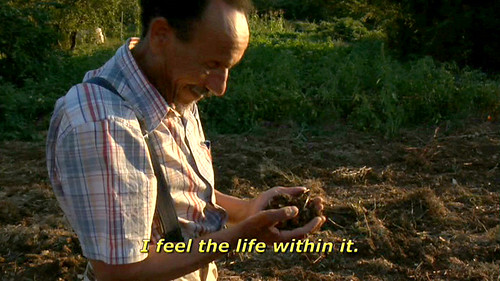
I just watched DIRT! The Movie for free at dotSUB. A really good movie about soil and the importance of a healthy biosphere of rich biodiversity. Takes a couple of detours (ie one about various spiritual connections to soil) that may seem weird depending on who you are and is quite a bit pro-organic agriculture but all in all a good, educational movie about not just soil, but about deforestation, climate change, agriculture - and a bit about conflict too!

Trailer:

Full movie:


"You create deserts where you are and eventually these micro deserts form much bigger areas. And we can't live very happily in a desert. And so we start fighting between farming communities and nomadic communities over land that is not a desert, that still has dirt. Desertification or land degradation is one good way of undermining security in any country."
- Wangari Maathai [0:29]
"There is a very strong correlation between human degradation and environmental degradation."
 - Sebastiao Salgado, photographer [0:42]

Although I just watched it, I could certainly use having the full quality DVD on my shelf along with HOME, FUEL, FOOD Inc, CRUDE and the other (upper case letter) enviro-flicks.

Pierre Rhabi holds dirt

Find DIRT! The Movie: at their own website, at YouTube, at Facebook, at Twitter and at IMDb.


Sunday, October 25, 2009

Video: NATO chief on security challenge from climate change


Climate change will have a significant impact on our overall security environment both in the south and in the north.


All of his examples have been detailed here at Ecowar. But he says two things: One, the solutions should be political, not military; and two, the military can contribute by lowering CO2 emissions.

Monday, February 23, 2009

Afghans killed... by pollution too

Three decades of war and severe drought have already damaged the country's environment with widespread desertification and deforestation and loss of vegetation and wildlife, deputy head of Afghanistan's National Environmental Protection Agency said.

But now, overpopulation in Afghanistan's cities, the burning of poor quality fuel, thousands of imported old cars, no proper waste management or sewage system and a boom in construction, have worsened air pollution, Jarullah Mansoori said.

[...]

"We are three times more polluted than the other capitals in the region. If everything is left as it is now, after two or three years, we will not be able to live in Kabul, said Mansoori.

"We will have to leave for another place, where we can find clean air, clean water and clean food. This is called environmental migration. When environmental migration takes place then it's a huge social problem," he said.

Sunday, December 21, 2008

In Niger, a war for what's beneath the desert

A battle is unfolding on the stark mountains and scalloped dunes of northern Niger between a band of Tuareg nomads, who claim the riches beneath their homeland are being taken by a government that gives them little in return, and an army that calls the fighters drug traffickers and bandits.


...new screenwriter badly needed... this plot won't make another news block buster!

Niger's northern desert caps one of the world's largest deposits of uranium, and demand for it has surged as global warming has increased interest in nuclear power. Growing economies like China and India are scouring the globe for the crumbly ore known as yellowcake. A French mining company is building the world's largest uranium mine in northern Niger, and a Chinese state company is building another mine nearby.

Uranium could infuse Niger with enough cash to catapult it out of the kind of poverty that causes one in five children here to die before their fifth birthday.

Or it could end in a calamitous war that leaves Niger more destitute than ever. Mineral wealth has fueled conflict across Africa for decades, a series of bloody, smash-and-grab rebellions that shattered nations. The misery wrought has left many Africans to conclude that mineral wealth is a curse.

[...]

The hardships of global warming and desertification, which eats away grazing land, further impoverished the Tuareg, forcing many to abandon herding. Yet as its fertility degraded, their land became increasingly sought after as the global price of uranium rose steadily. This paradox would prove explosive.

Tuesday, December 02, 2008

Another Darfur Casualty: Trees

On top of the human toll, the conflict in Darfur is afflicting the environment [...] on Mount Marra, the highest peak in the area, there were about 100 trees for each acre of land in the 1990s, on average; by 2001 that was down to 50, and it is now about 20.

Desertification helped spark the war in Darfur in the first place. To boil it down in its simplest terms, the mostly nomadic Arab tribes began clashing with the settled African clans over shrinking grazing lands and scarce water in Darfur

Thursday, July 19, 2007

Darfur: Drought or Islamism?

It's not that I want to write up an excuse for religious extremism. It's not even that I claim expertise in the whole Darfur situation in particular. It's just that for quite some time I have noticed the natural resources vs. civil war link that should get this blog noticed. Yet I also noticed some political writers drumming to the 'Muslim Terrorist' beat at the mention of Darfur. For examples see The Darfur Genocide and Global Warming by Fred Thompson and Ban Ki Moon: Super Genius by Mac Johnson. What beautiful little civil war in far off Africa - perfect for both Islamophobic fearmongering and neo-conservative UN-subversion. A brief quote from the latter rant:
In Darfur, radical Muslim militias have taken to slaughtering Christian and Pagan farmers for fun and profit. Since radical Muslims elsewhere in the world are generally a peaceful lot, Ban Ki Moon has wisely seen that it must be the weather setting them off.


Then yesterday the news break that an underground water source has been found in Sudan: AP / Scientists Find Lake Remnants in Sudan. I cannot help but quote:
"Much of the unrest in Darfur and the misery is due to water shortages," said geologist Farouk El-Baz, director of the Boston University Center for Remote Sensing, [...] "There have been two long episodes of drought during the past 20 years, each lasting for about seven years," the scientist said, adding that the drought aggravated tensions between Darfur's ethnic African tribesmen and nomadic Arabs.


This month the UN Environment Programme (UNEP) released a report on the issue: 'Sudan Post-Conflict Environmental Assessment' (full report in PDF | website | summary at PeopleAndPlanet / 'Environmental decay a root cause of Sudan strife'). Also, AP recently delivered an article on the war-resource link (Experts: Darfur Faces Environment Crisis) in which it is concisely explained how droughts triggered the war and how the war worsened the environmental crisis in return.

To date, I haven't noticed any right wing nutcase blogger crack jokes at the actual problems at play, let alone any actual right wing politician addressing them. What they haven't figured out is how to profit, I suspect. But perhaps now water has been found and the experts have been so outspoken on the loose-loose situation there, the neocons will have to find other issues to spin for the next "anti-terror law" or whatever.

PS: Sorry for being a bit more cynical and political than I originally intended to be at this blog. Couldn't help it in this case. Guess that Mac Johnson guy got to me.
Wednesday, July 11, 2007

UN study on policies regarding desertification

Overcoming One of the Greatest Environmental Challenges of Our Times: Re-thinking Policies to Cope with Desertification

Over the past few years, it has become increasingly clear that desertification is one of the most pressing global environmental challenges of our time, threatening to reverse the gains in sustainable development that we have seen emerge in many parts of the world. It is a process that can inherently destabilize societies by deepening poverty and creating environmental refugees who can often add stress to areas that may not yet be degraded. The impacts of desertification are exacerbated by political marginalization of the dryland poor, by the slow growth of health and education infrastructure and by the lack of livelihood alternatives to resource depleting agricultural practices.

Search This Blog