Even if wars are not all about oil, soldiers have certainly been killed for oil: Up to one in three US casualties has happened at gasoline convoys. Check out how solar panels are saving lives and improving the flexibility of US Marines deep in foreign deserts: Grist / U.S. military kicks more ass by using less fossil-fuel energy.
"Other people are busy saving the planet; this is about saving Marine lives [...] I’d kiss a polar bear if it meant getting one Marine off an IED-filled highway."
- Col. Bob Charette, director of the Marine Corps Expeditionary Energy Office
Irrespective of one's sentiments towards US soldiers in Afghanistan, the story is a parable for all of society. As the article finishes: "In a time of rising fossil-fuel prices and increasingly apparent climate dangers, the tether of fuel binds all of us — homes, businesses, communities, and whole economies — to a future of vulnerability and instability. Using less energy and generating more of our own is about more than dollars spent or saved. It’s about self-determination. That makes for a more effective military and a more secure, productive society".
You should think the politicians most eager for war would support such initiatives. But no. Because those politicians are at the same time the ones whose careers are sponsored by the existing energy sector hegemony. Read Slate / Why We Need a Greener Military and Wired / Republicans Order Navy to Quit Buying Biofuels for the full story about right wing politicians working hard to pass a law banning military spending on fuels more expensive than conventional oil. But since it is designed to obstruct initiatives to experiment with (currently relatively expensive) biofuels it explicitly omits alternative energy sources based on coal and gas (probably to allow shale gas, fracking et cetera).
In a way it's hard to believe the hypocrisy, the idiocy, the callousness. On the other hand it all makes depressing sense. Strong powers in business and politics accumulate vast fortunes on the people wasting obsolete energy and endangering their lives at home, at work and abroad.
"The Venus Project is an attempt to bring world peace and all the nations together. If you don't want war, killing, [?] crime you have to redesign the way society works, you have to declare all the Earth's resources as a common heritage of all the world's people [...]
We don't go to another country to bring democracy, we go there for their resources. Oil, metal, cheap labor. We don't go to bring democracy. We took this land [...] we stole it [...then] we put up a sign: 'Thou Shall Not Steal'."
This interview is from February 2010. Scandalously no-one has told me about it a long time ago.
Apparently, Mr. Fresco share the notion that access to natural resources is the need behind many conflicts. He also is a bit of a dreamer and extremely critical of western democracy.
The U.S. Navy is asking government investigators to suppress information concerning the toxic water scandal at the Marine Corps' Camp Lejeune, according to a letter obtained Thursday by The Huffington Post. [...] Government watchdogs and environmental advocates said they interpret the letter as further evidence of a Navy effort to evade culpability for what many call the worst and largest drinking water contamination in U.S. history. [...] The research is a prerequisite for a series of health studies exploring links between chemical exposures and what appears to be increased levels of disease among former Camp Lejeune residents, including male breast cancer and childhood leukemia.
Last year, a scandalous video emerged of a U.S. marine throwing a puppy off a cliff. Now there is this video of a soldier repeatedly beating a sheep with a baseball bat to the whoops and laughter of other soldiers who are looking on.
Warning: Watching this video is unpleasant.
Military psychologists and psychiatrists are aware, as are all psychologists and psychiatrists, that gratuitous cruelty to animals, especially when it gives pleasure to the perpetrator, is an indicator of other anti-social problems that need to be taken most seriously. Juveniles who decapitate neighborhood cats or hang the family dog from a tree are almost guaranteed to go on to other violent crimes if they are not stopped and dealt with. All the "school shooters" have a history of cruelty to animals, as does every known serial killer from Son of Sam to Jeffrey Dahmer.
Kyrgyzstan and Tajikistan are upstream countries with lots of water fresh from the glaciers in the high mountains of Central Asia. Uzbekistan and Kazakhstan are downstream and suffering from the worst drought in decades. The latter are asking for more water from the former, claiming water belongs to everyone and rivers flow free. But Kyrgyzstan is asking for natural resources in return (ie Kazakhstan is the worlds number one uranium producer) and Tajikistan is constructing what will become the highest dam in the world. Kazakhstan refuse to trade in naturals (perhaps preferring world market prices?) and Tajikistan insist on damming the river since their energy supply is already rationed.
Negotiations have stalled. Uzbekistan has cut its gas export to Tajikistan and allegedly is also holding up Tajik exports on its border. Global warming is projected to raise temperatures by 2-3 degrees Celcius within 50 years; the glaciers are already melting because of this and future droughts will only grow in numbers and intensity.
Another renowned columnist is speaking up. This time it's Eric Hammel in Foreign Policy.
I cannot fathom the prevailing so-what attitude as the FEMA-grade weather disasters mount toward becoming serial and routine occurrences. [...] Global famine is going to force the use of our military as a police force organized to feed unknowable masses of people [...] The only force on Earth with the inherent capability to police, process, house, feed, and move refugees on a mass scale is the U.S. military, but, though its reach is global, its capacity and stamina are nonetheless limited, probably to one or two major disasters at a time, not the overlapping rolling meta-disaster climatologists predict.
Oceanographer for the U.S. Navy, RADM David Titley discusses the hot topic of climate change, and its impending ramifications on national security. Listen as he details some of the top facts and figures you should know about climate change and your future, explained in terms that even the most unfamiliar with science would be able to understand.
Disposition / key points of his speech:
How he changed from skeptic to concerned.
"We are operating in nature's casino. I intend to count the cards."
A number of the most obvious explanations: not the sun, better models etc.
Funny comparison between carbon dioxide in the atmosphere to alcohol in the blood.
[From 15:47] Why the army cares about climate change.
"Changes in the opening of the Arctic. [...The Bering Strait could get] the importance of the Strait of Malacca and the Strait of Hormuz [combined] because we have fossil fuels coming out and we [USA] and Russia together control that strait - that's a big change."
"What's gonna happen to the sea level rise?" The IPCC under-estimates sea level rise. "We're the navy. We tend to build our bases at sea level. [...] But it's more than that; it's the US infrastructure. Look at where our oil refineries are. [They are in Houston, New Orleans, Oakland] it's all at sea level."
Ocean acidification could become a food security issue for one billion people.
Found via Peter Sinclair (thanks). (He also cut up the video in the two parts so go there if you prefer that.)
A study by a German military think tank has analyzed how "peak oil" might change the global economy. The internal draft document -- leaked on the Internet -- shows for the first time how carefully the German government has considered a potential energy crisis.
[...]
The study is a product of the Future Analysis department of the Bundeswehr Transformation Center, a think tank tasked with fixing a direction for the German military. The team of authors, led by Lieutenant Colonel Thomas Will, uses sometimes-dramatic language to depict the consequences of an irreversible depletion of raw materials. It warns of shifts in the global balance of power, of the formation of new relationships based on interdependency, of a decline in importance of the western industrial nations, of the "total collapse of the markets" and of serious political and economic crises.
1. Introduction
In the past, resources have always triggered conflicts, mostly of regional nature. For the future, the authors expect this to become a global problem, as scarcity (mainly of crude oil) will affect everybody.
2. The Importance of Oil
regional conflicts can always at least partially be attributed to resources, such as in the Caucasus region, the Middle East or in Nigeria, or they fuel conflicts due to the wealth they create (such as in Africa).
The report sees – within a timeframe until the year 2040 – a changed international security layout based on new risks (including transport risks for fuels) and new roles of actors in a possible conflict around the distribution of increasingly scarce resources.
[...]
focusing on the key suppliers of oil: Russia, Norway and the U.K. It is noted that both European partners are already past their peak and that Germany is increasingly dependent on Russia, which currently is reliable but not necessarily so in the long term.
3. Possible Scenarios After Global Peak Oil
The Middle East is identified as a very dangerous region with high external involvement from many players and thus a very unstable overall situation.
Overall, the report expects a reduction of the importance of “Western values” related to democracy, and human rights in the context of politically motivated alliances, which increasingly are driven by emerging economies such as China – likely leading to double standards. Emerging economies are equally expected to receive higher recognition in international organizations, particularly those with strength in resources (such as Russia).
[...]
New conflicts are potentially arising from oil exploration in international or disputed ocean waters, where multiple issues arise, particularly around the arctic circle, with further geopolitical risks for conflict.
Also, the shift to natural gas is reviewed as an extension of the “oil age”, because it might be able to replace crude oil as a bridging source until new solutions are found. The risks for problems from transporting gas (pipelines) and the related issues (as seen between Russia and its neighbors during the past years) are highlighted.
Equally, nuclear power as a potential source is highlighted – emphasizing the risk for safety and the proliferation of nuclear technology. This would also require an increasing shift towards electricity.
[...]
Damaging infrastructure through hostile acts (sabotage, war) might become an attractive target for groups or countries with a tendency to use violence. The same is expected for electricity and natural gas-related infrastructure – they all might require higher protection.
Generally, the focus of risks is expected in the region which the authors consider the “strategic ellipse” (a term used for the region East of Europe reaching from Saudi Arabia in the South to Russia and former Soviet Union countries in the North), because a majority of oil reserves are located in this area.
[...]
High oil prices would further affect almost all aspects of society, as it will also influence the cost of chemicals and all products derived from them, which might substantially alter the nature of value chains and make certain things uneconomical – ultimately leading to higher unemployment during a transformational phase away from an oil based economy.
[...]
the changes and likely reduction in standard of living might render societies less stable and make them more attracted to extremist political positions and even trigger changes in government systems, as trust into key actors in politics will diminish. This might be a particular risk for the relatively young democratic countries in Eastern Europe.
[...]
more expensive transportation and increasing problems “at home” might reduce the ability of larger countries to intervene internationally (politically and/or with military action), and also lower the readiness to provide help to poorer countries. The focus will be more on a country’s egotistic (energy) interest and not so much on an ideal of transferring Western values. The gap will likely not be filled by NGOs, as they will be affected by similar limits.
Overall, international institutions will be weakened, as they will have less resources to provide help and support, and it becomes equally possible that help will be attached to direct (energy) needs of the donors.
4. Challenges for Germany
Armed forces would also be significantly affected by fossil fuel limits, as they are very dependent on oil products. Significant investments in alternative energy procurement technologies (biofuels, coal-to-liquids – Fischer-Tropsch) and applications (electric and hybrid vehicles) would be required, with long transition times. Further, local energy-independence of stationary troop infrastructure (like military bases) using more renewable sources would be beneficial. Long term objective would be to fully convert Germany’s armed forces to only use renewable energy sources by 2100.
"[Government] public lines on peak oil are 'not quite right'. They need to take account of climate change and put more emphasis on reducing demand and also the fact that peak oil may increase volatility in the market."
[...]
Last year the Guardian revealed that the IEA [International Energy Agency] was also riven with dissent over the issue with senior staff members privately telling newspaper they thought the official numbers on future global oil supply were over-optimistic.
[...]
an internal IEA source said: "Many inside the organisation believe that maintaining oil supplies at even 90m to 95m barrels a day would be impossible, but there are fears that panic could spread on the financial markets if the figures were brought down further. And the Americans fear the end of oil supremacy because it would threaten their power over access to oil resources."
[...]
Kjell Aleklett, a professor of physics at Uppsala University in Sweden and author of a report The Peak of the Oil Age, claims crude production is more likely to be 75m barrels a day by 2030 than the "unrealistic" 105m projected by the IEA.
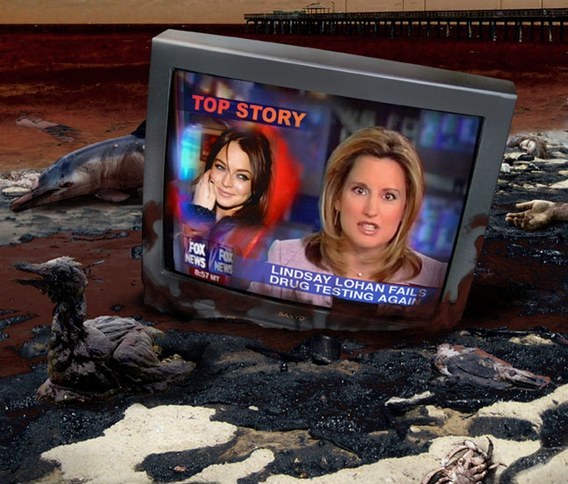
According to Politico Fox News rejected an ad linking oil consumption with troop deaths. I'd like to try and make up for (a millionth of) that so here it is:
Fox News, however, are excused as they have been busy reporting other "breaking news":
Must be a tough job breaking a celebrity drug scandal while the ocean is leaking oil!
"If you wait for 100% certainty on the battlefield something bad is going to happen."
- retired Vice Admiral Dennis McGinn
The boys in Tehran may not like it. The boys at FOX News may not like it. And the boys from BP may not like it.
Climate Change will have profound implications for the security of every nation.
Experienced military experts have come to some conclusions on what's coming.
The - now former - German President Horst Köhler has just resigned after a slip of tongue in an interview about his visit to the German troops in Afghanistan. So, what did he say?
[military operations serves to] protect our interests, for example, free trade routes, or to prevent regional instability, which might certainly have a negative effect on our trade, jobs and income.
33 retired US generals and admirals have written a strong appeal for a climate change bill.
Climate change is threatening America’s security. The Pentagon and security leaders of both parties consider climate disruption to be a “threat multiplier” – it exacerbates existing problems by decreasing stability, increasing conflict, and incubating the socioeconomic conditions that foster terrorist recruitment. The State Department, the National Intelligence Council and the CIA all agree, and all are planning for future climate-based threats.
America’s billion-dollar-a-day dependence on oil makes us vulnerable to unstable and unfriendly regimes. A substantial amount of that oil money ends up in the hands of terrorists. Consequently, our military is forced to operate in hostile territory, and our troops are attacked by terrorists funded by U. S. oil dollars, while rogue regimes profit off of our dependence. As long as the American public is beholden to global energy prices, we will be at the mercy of these rogue regimes. Taking control of our energy future means preventing future conflicts around the world and protecting Americas here at home.
It is time to secure America with clean energy. We can create millions of jobs in a clean energy economy while mitigating the effects of climate change across the globe. We call on Congress and the administration to enact strong, comprehensive climate and energy legislation to reduce carbon pollution and lead the world in clean energy technology.
Inhabitat.com has an article with images of this story. It is just one of several green Pentagon projects.
"A huge milestone was recently reached at Eglin Air Force Base in Florida when an A-10C Thunderbolt jet took to the air running its engine on plant based fuel. The Air Force is the largest consumer of petroleum in the Department of Defense — they guzzle 2.4 billion gallons per year — and is hoping to wean themselves off foreign oil in the coming years. This flight was the first step in proving to their critics that measures can and will be taken to clean up the energy that fuels their aircraft.
Hydrotreated Renewable jet fuel made from the camelina plant was used during the flight. The camelina plant is weed-like, needs little resources to grow and isn’t a food source, making it a great option for biofuel.
[...]
Air Force officials have announced that they’d like to have half of their total fleet running on alternative fuels by 2016 and make sure that all of their aircraft have been certified to operate on those fuels by 2012."
"Granted, all of this is currently going towards greening the military — an oxymoron if we’ve ever heard of one. But one must still remember that research projects developed in the military have often changed the world for the better."
"climate change, energy security, and economic stability are inextricably linked.
[...]
climate-related changes are already being observed in every region of the world, including the United States and its coastal waters
[...]
Assessments conducted by the intelligence community indicate that climate change could have significant geopolitical impacts around the world, contributing to poverty, environmental degradation, and further weakening of fragile governments. Climate change will contribute to food and water scarcity, will increase the spread of disease, and may spur or exacerbate mass migration.
While climate change alone does not cause conflict, it may act as an accelerant of instability or conflict, placing a burden to respond on civilian institutions and militaries around the world. In addition, extreme weather events may lead to increased demands for defense support to civil authorities for humanitarian assistance or disaster response both within the United States and overseas.
[...]
To support cooperative engagement in the Arctic, DoD strongly supports accession to the United Nations Convention on the Law of the Sea."
[...]
Energy efficiency can serve as a force multiplier, because it increases the range and endurance of forces in the field and can reduce the number of combat forces diverted to protect energy supply lines, which are vulnerable to both to both asymmetric and conventional attacks and disruptions.
"Environmental stress, caused by both climate change and a range of other factors, will act as a threat multiplier in fragile states around the world, increasing the chances of state failure. This is likely to increase demands for the ADF to be deployed on additional stabilisation, post-conflict reconstruction and disaster relief operations in the future. [...] Climate change is unlikely to increase the risk of major conflict, although there is one exception: The Arctic is melting, potentially making the extraction of undersea energy deposits commercially viable. Conflict is a remote possibility if these disputes are not resolved peacefully. [...] From a defence planning perspective, we don't know how quickly these changes will occur, exactly what their impact will be, or how states and societies will react [...] Nevertheless, climate change may affect security by increasing stress on fragile states, state and societal competition for resources, environmental threats to ADF infrastructure and increasing the frequency and severity of extreme weather events."
It starts out criticizing elements of the economic system - boring to many by definition but perhaps a little more interesting here in the financial crisis? - and moves on (about 21 minutes into the movie) to discuss examples of how financial tools are preferred by the West (the US) before using the military to gain cheap access to 3rd world natural resources. It's essentially John Perkins, former NSA associate, talking about the topics of his book, Confessions of an Economic Hit Man [Official site | Wikipedia | Google Books].
This video is the 10 last minutes of John Perkins talking:
What he says about Iraq:
"Iraq, actually, is a perfect example of the way the whole system works. We economic hitmen are the first line of defense: We go in, we try to corrupt the government and get them to accept these huge loans which we then use as leverage to basically own them. If we fail [...] then the second line of defense is we send in the jackals. The jackals either overthrow governments or they assassinate. And once that happens then a new government comes in and they'll toe the line because the new president will know what will happen if he doesn't. In the case of Iraq both of those things failed [...] so, in '91 we send in the troops and we take out the Iraqi military [...assuming] Saddam is gonna come around. [...] So the economic hitmen go back in in the 90ies... without success. If they'd had success he'd still be running the country, we'd be selling him all the fighter jets he'd want [...] the jackals couldn't take him out again [either] so we sent in the military once again and this time they did the complete job [...] in the process creating for ourselves some very, very lucrative reconstruction deals."
Very much not surprising. But nice to hear from an insider. His conclusion makes me think of Michael Hardt and Antonio Negri's Empire. Regarding Iraq specifically, we've had some hard-to-believe right wing postulates that the war-for-oil theory is left wing propaganda pointing at non-US (yet Western) companies getting many contracts. First of all, it really doesn't matter as long as these companies supply for the (so called "free") world market. Second, recently U.S. Companies Join Race on Iraqi Oil Bonanza.
Towards the end the movie sums up in some more philosophical discussions (including some hippie stuff). Some of it is undeniable Ecowar cornerstones.
"The most important issue at hand is the intelligent management of the earth's resources. [...] Our true problems in life are technical, not political. [...] Society today is backwards. With politicians constantly talking about protection and security rather than creation, unity and progress. The US alone now spends about 500,000,000,000 dollars annually on defense. That is enough to send every high school senior in America to a four year college. In the 1940ies the Manhattan Project produced the first true weapon of mass destruction. This programme employed 130,000 people at an extreme financial cost. Imagine what our life would be like today if that group of scientists, in stead of working on a way of killing people, worked on a way to create a self-sustaining, abundant world. [...] It is time to unleash something much more powerful: weapons of mass creation."
Of course, just like America is addicted to oil (George W. Bush's own words) it's also addicted to war. At least, shutting down the military would be a mega-shock to the financial system. That is why I enjoyed it very much when in Kim Stanley Robinson's Science in the Capital series the US military is literally battling climate change. Also a topic discussed in the new copy of Ode Magazine: Jim Channon: Mobilizing the military to clean up the earth.
The true battle in the future is not between nations; it’s about repairing the damage we’re doing to our planet. [...] the army must set about reforesting the Earth, planting billions of trees and cleaning up the fresh water reserves. [...] The Marines will protect and restore the dying coral reefs and coastal wetlands while the Air Force monitors carbon emissions, ozone depletion and air pollution. [...] The Navy, Channon says, should be tasked with measuring rising ocean temperatures and melting polar ice as well as policing illegal dumping and overfishing of the seas. [...] siphon excess water from the oceans and channel it into the desert basins of the planet to create enormous salt water lakes [...] transport thousands of refugees from the Pacific Islands to these areas, where they may tend giant new fishponds
These quotes are the visions of retired U.S. Army Lieutenant Colonel Jim Channon - who's portrayed by Jeff Bridges in The Men Who Stare at Goats which appears to be a lot more fun than Zeitgeist Addendum.
But ironically, this has caused some bookmarked stories to go nowhere as I haven't addressed conflict at TH!NK yet. Here is a couple. Later I'll round up some Ecowar at TH!NK, stay tuned.
Climate change could kill 250,000 children Ouch! That's the kind of headline that makes even hardened bloggers like me ask for some less pathos. Dead children, very well.
over 900 million children in the next generation will be affected by water shortages and 160 million more children will be at risk of catching malaria – one of the biggest killers of children under five – as it spreads to new parts of the world.
Not that controversial. It's just a bit of math and the obvious observation that climate change will aggravate existing issues. But I don't know about the "spin value" of this story.
"Environmental security and climate change in particular are now issues which threaten world security and peace," says Brigadier General Wendell King of the US Army Command and General Staff College in Fort Leavenworth, Kansas.
Remind me to get my hands on the latest print of New Scientist.
The impact of climate change will make the poorest communities across the world poorer. Many of them are already affected by conflict and instability and thus face a dual risk. International Alert’s new research finds that the consequences of climate change will fuel violent conflict, which itself hinders the ability of governments and local communities to adapt to the pressures of climate change. We’ve identified 46 countries at risk of violent conflict and a further 56 facing a high risk of instability as a result of climate change.
Just sharing a handful of recent links. Will post much more at TH!NK soon, I promise.
Climate change will have a significant impact on our overall security environment both in the south and in the north.
All of his examples have been detailed here at Ecowar. But he says two things: One, the solutions should be political, not military; and two, the military can contribute by lowering CO2 emissions.
[Throughout human history there have been] many deliberate acts to destroy or exploit the natural environment to achieve military goals. In the 5th century BC the retreating Scythians poisoned the water wells in an effort to slow the advancing Persian army. Roman troops razed the city of Carthage in 146 BC and poisoned the surrounding soil with salt to prevent its future cultivation. The American Civil War saw the widespread implementation of ’scorched earth’ policies.
[...]
At this moment the world is witnessing a continuing humanitarian and environmental catastrophe in the western region of Darfur in Sudan, which has seen the poisoning of water wells and drinking water installations as part of a deliberate government-supported strategy by the Janjaweed militia to eliminate or displace the ethnic black Africans living in that region.
[...]
environmental damage and exploitation is still largely regarded, as rape once was, as an 'unfortunate but inevitable' consequence of war. It is, of course, true that war and armed conflict are inherently destructive of the environment, but that is no reason to allow leaders to deliberately or recklessly target the environment in order to achieve their military goals.
By the Pentagon's own figures, the U.S. military uses more fossil fuels than any other single entity. But the Pentagon's figures only take into consideration vehicle transport and facility maintenance. They don’t account for the energy needed to build something like the massive imperial embassy or mega-bases in Iraq or reconstruct the rest of the country. They also don’t factor in the energy used by related branches, like NASA, the nuclear industry, or the thousands of contractors that make or do things for the military.”
Yet the U.S. military isn't listed as one of the World Wildlife Fund's 'footprint issues'. Nor is it mentioned by the Natural Resources Defense Council or Sierra Club as the largest consumer of the 'dirty fuels' both lobby against.
Wendell Berry, who … spent most of his life linking issues of the environment to the many maladies of our society, once said that just as military violence is ignored by most conservationists, violence against the earth is a matter ignored by most pacifists. The antiwar and environmental movements must bond over this common enemy and see, as Berry put it, that we cannot hope to end violence against each other until we end our violence against the earth.
You could, perhaps, call it the "military-ecological complex". For the world's most powerful armies are going green, trying to kickstart an environmental-technological revolution in civvy street in the process.
[...]
Half of [the US military] wartime casualties are sustained by convoys, which are mostly carrying fuel and are a favoured target for enemies. It estimates that every 1 per cent of fuel saved means 6,444 soldiers do not have to travel in a vulnerable convoy.
One simple innovation – insulating tents in Iraq and Afghanistan with a layer of hard foam, reducing the need to heat and cool them – has saved 100,000 gallons of fuel a day. The Pentagon aims to get a quarter of its energy from renewable sources by 2025. It is to buy 4,000 electric cars (the world's largest single order) for use on its bases, and is developing hybrid armoured vehicles for the battlefield.
It has saved fuel by cutting the weight of aircraft – removing floor mats, redundant tools, loading thick manuals on to laptops, and using lighter paint – and within seven years plans to fly them on a 50/50 blend of ordinary fuel and biofuel, probably made from algae.
[...]
Scientists hope that the massive spending power of the military will spin off environmental technologies into civilian life, as jet engines, microchips, and global positioning systems did in the past. "We can be a test bed for a lot of things that normally would not seem to make powerful economic sense," said the US Assistant Army Secretary, Keith Eastin.
Being the devils advocate for a second: If they did go to war to secure oil in the first place how ironic if the warfare itself will lead to less need for oil!
We don't want to think too much about it. But every time we buy a new gadget we support a mining industry of questionable ethics. In the case of the mines in eastern Congo it is extraordinary brutal.
In a time of desperate need for re-forestation to fight climate change, in Congo wide swaths of jungle have been cleared to make way for 15,000-25,000 poor boys and men working under slave-like conditions, living in tents on mud, guarded by "autonomous" army units, earning little while risking their lives. Although a violent environment the biggest killers are diseases and collapsing caves.
A movie about these mines, Blood in the Mobile, is in the works. The trailer is ready:
(If you haven't seen Darren Aronofsky's The Fountain at least watch the trailer for the music which is taken from that film. Beautiful!)
As they say:
"Different armed groups are fighting to gain control over the mine."
The Democratic Republic of the Congo, scene of the deadliest conflict since World War II, remains mired in violence in significant part because of the international demand for electronic products that requires minerals found in the eastern Congo. The minerals mined here are used to make our iPhones, laptops and MP3 players, but at a great expense. Armed groups finance themselves through the illicit conflict mineral trade and fight over control of mines and taxation points inside Congo.
Congo is mentioned in the 100 Places to Remember project (see previous post). But it only concerns the deforestation of the precious original Itubi forest; home to the Mbuti pygmy people, endangered leopards, chimps, okapis etc. Deforestation not only removes essential carbon sinks it releases CO2 corresponding to about a fourth of the worlds fossil fuel use.
18th February 2009 Israeli forces shot a twenty year-old Palestinian farmer as he worked his land in the village of Al-Faraheen, east of Khan Younis in the Gaza Strip.
some green thinkers are now coming to a surprising conclusion: In exceptional circumstances, they say, the only effective way to protect the environment may be at the barrel of a gun. [...] in certain cases of severe ecological harm, the international community may be justified in mustering troops to intervene, with or without the permission of the host country. [...] "If you consider how people fight over oil and other resources, I don't see any more noble cause than to fight over the preservation of the planet," says Alex Cornelissen, director of Sea Shepherd's Operation Galapagos.
[...]
In South Africa, a college for rangers, established about 20 years ago, offers military-style training to park rangers from around the continent. In recent years the urgency has grown. Many contemporary poachers form heavily armed, well-organized gangs, often from neighboring countries. [...] According to estimates, about 1,000 rangers worldwide have been killed in the line of duty in the past 10 years, 130 of them in just one national park, Virunga, in the Democratic Republic of Congo. [...] After taking office last May, Brazil's new environment minister, Carlos Minc, sent the military to seize cattle on illegally deforested land, and he has suggested that army regiments patrol the Amazon's nature reserves.
[...]
possible scenarios in which armed intervention might be called for on ecological grounds [...includes...] an imminent environmental disaster [...] in which spillover effects to neighboring countries were foreseen [...] would be consistent with existing international law, because the goals would include protecting citizens from the repercussions.
On Wednesday, October 8th, Morelos Governor Marco Adame called out more than 1,500 police personnel from the State Police and from the Paramilitary Federal Police force to the indigenous town of Xoxocotla. Law enforcement agencies were instructed to dismantle a series of road blockades along the Alpuyeca-Jojutla highway. Residents of Xoxocotla [...] had set up the blockades to show solidarity with teachers who have been on strike in Morelos for nearly two months.
The teachers of Morelos and the townspeople of Xoxocotla are united in a common struggle to stop the rapid privatization of public resources. Teachers on strike in Morelos are trying to halt a new set of educational reforms they say would open the doors to the participation of private capital in the public education system. Xoxocotla, on the other hand, is desperately trying to save the aquifer which feeds its municipal water system from being sucked dry from private condominium developers who skirt local zoning laws.