Showing posts with label World Bank. Show all posts

Wednesday, December 24, 2014

2014 bookmarks - the year in war over natural resources

From the depths of my bookmarks (that were all automatically tweeted) on conflict and natural resources, here is a quick review of the way in which Earth was plundered for natural resources in the past year. Year 2014, the 100th anniversary of the first war to run on oil.

In short, 2014 was just more of the same. Like...
But a lot more of the same also means obscure news stories grow into reports from acknowledged organizations—like when
Some of the worst news this year was how Islamic State grew out of the chaos in Iraq and Syria, and became known not as the richest terrorist group in the world, but as the poorest terrorist country. Because they successfully occupy and exploit vast oil fields, loot everything lootable while controlling many smuggler's routes and ruthless dealers. I get how they control the population by mass executions rivaling the worst in history, denying crucial water supplies to villages and other callous misdeeds. But how do they manage to sell oil worth millions of dollars every single day even as all eyes are on the region? Money talks, of course, anywhere and anytime, but still?

Part of the answer came in this fascinating report by Suzan Fraser and Yilmaz Akinci from the border between Turkey and Syria, where... hillbillies, basically... tell how they have always been smuggling. Everyone did it. For generations. So, suddenly a few more bearded men came with a bit more oil than usual. It worked for a time, but Turkish police cracked down on it. Their large scale “pipeline” was smacked into smaller, obscure “pipelines” - like the ones the Islamic terrorists have for every other country, apparently.

Probably more efficient that the Turkish police, however, is the Saudi Arabian financial muscle. To them and most of their allies, the sum of benefits of a low oil price seems to currently triumph the more obvious benefits of a high oil price. Mainly by cutting the cash flow to Iran, Syria, Islamic State, Russia, even North American non-conventional (fossil) energy producers and others. In fact, I've seen some speculate Saudi Arabia has almost won the war on Ukraine's behalf as Russia's weakening rubles soon cannot pay for any more war. Speaking of Ukraine: This country used to be self-sufficient in coal, but the territory occupied by rebels and Russians just happen to host 66 coal mines, leaving Ukraine's power plants under-supplied; and the shores off now Russian Crimea just happen to be full of gas. What a coincidence.

That was all just slightly scratching the surface of year 2014 in war for natural resources. On slightly more positive notes, Interpol published a most-wanted list of environmental criminals at large – go get 'em – and Egypt and Ethiopia seems to be agreeing on how to share the Nile.
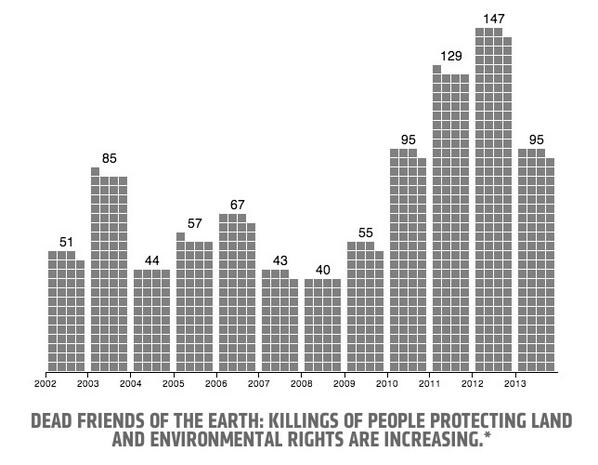
https://twitter.com/Global_Witness/status/456347470071463936

Happy New Year!


Wednesday, January 20, 2010

Zeitgeist & the eco-military

I watched a movie called Zeitgeist Addendum yesterday after months of having had it recommended from people. I recommend it: Download the DVD from the project website for free or watch it on YouTube. Here's some notes and comments...

It starts out criticizing elements of the economic system - boring to many by definition but perhaps a little more interesting here in the financial crisis? - and moves on (about 21 minutes into the movie) to discuss examples of how financial tools are preferred by the West (the US) before using the military to gain cheap access to 3rd world natural resources. It's essentially John Perkins, former NSA associate, talking about the topics of his book, Confessions of an Economic Hit Man [Official site | Wikipedia | Google Books].

This video is the 10 last minutes of John Perkins talking:


What he says about Iraq:

"Iraq, actually, is a perfect example of the way the whole system works. We economic hitmen are the first line of defense: We go in, we try to corrupt the government and get them to accept these huge loans which we then use as leverage to basically own them. If we fail [...] then the second line of defense is we send in the jackals. The jackals either overthrow governments or they assassinate. And once that happens then a new government comes in and they'll toe the line because the new president will know what will happen if he doesn't. In the case of Iraq both of those things failed [...] so, in '91 we send in the troops and we take out the Iraqi military [...assuming] Saddam is gonna come around. [...] So the economic hitmen go back in in the 90ies... without success. If they'd had success he'd still be running the country, we'd be selling him all the fighter jets he'd want [...] the jackals couldn't take him out again [either] so we sent in the military once again and this time they did the complete job [...] in the process creating for ourselves some very, very lucrative reconstruction deals."


Very much not surprising. But nice to hear from an insider. His conclusion makes me think of Michael Hardt and Antonio Negri's Empire. Regarding Iraq specifically, we've had some hard-to-believe right wing postulates that the war-for-oil theory is left wing propaganda pointing at non-US (yet Western) companies getting many contracts. First of all, it really doesn't matter as long as these companies supply for the (so called "free") world market. Second, recently U.S. Companies Join Race on Iraqi Oil Bonanza.

Towards the end the movie sums up in some more philosophical discussions (including some hippie stuff). Some of it is undeniable Ecowar cornerstones.


"The most important issue at hand is the intelligent management of the earth's resources. [...] Our true problems in life are technical, not political. [...] Society today is backwards. With politicians constantly talking about protection and security rather than creation, unity and progress. The US alone now spends about 500,000,000,000 dollars annually on defense. That is enough to send every high school senior in America to a four year college. In the 1940ies the Manhattan Project produced the first true weapon of mass destruction. This programme employed 130,000 people at an extreme financial cost. Imagine what our life would be like today if that group of scientists, in stead of working on a way of killing people, worked on a way to create a self-sustaining, abundant world. [...] It is time to unleash something much more powerful: weapons of mass creation."


Of course, just like America is addicted to oil (George W. Bush's own words) it's also addicted to war. At least, shutting down the military would be a mega-shock to the financial system. That is why I enjoyed it very much when in Kim Stanley Robinson's Science in the Capital series the US military is literally battling climate change. Also a topic discussed in the new copy of Ode Magazine: Jim Channon: Mobilizing the military to clean up the earth.

The true battle in the future is not between nations; it’s about repairing the damage we’re doing to our planet. [...] the army must set about reforesting the Earth, planting billions of trees and cleaning up the fresh water reserves. [...] The Marines will protect and restore the dying coral reefs and coastal wetlands while the Air Force monitors carbon emissions, ozone depletion and air pollution. [...] The Navy, Channon says, should be tasked with measuring rising ocean temperatures and melting polar ice as well as policing illegal dumping and overfishing of the seas. [...] siphon excess water from the oceans and channel it into the desert basins of the planet to create enormous salt water lakes [...] transport thousands of refugees from the Pacific Islands to these areas, where they may tend giant new fishponds


These quotes are the visions of retired U.S. Army Lieutenant Colonel Jim Channon - who's portrayed by Jeff Bridges in The Men Who Stare at Goats which appears to be a lot more fun than Zeitgeist Addendum.

Thursday, April 10, 2008

Biofuel dilemmas

People are realizing biofuels are no magic wand to our global carbon issues. What is quite obvious to anyone with a bit of training in systems ecology was confirmed this February by a study published in Science. I may or may not do a ResearchBlogging entry on it some time, but for now I do with these popularized versions:

In short, sure biofuels draw energy from carbon produced in this cycle as opposed to a fossilized one, hence doesn't contribute directly to the greenhouse effect. But if used as an excuse to keep consuming and clearing forest it's a disaster - corn fields hold just a fraction of the carbon (and numerous other ecosystem services) a forest does, and if it competes with food production in a starving world, well... it's no rocket science.

March saw a number of warnings from people and organizations perhaps having read the above mentioned Science paper: Nestle in minding their (food not fuel) business (Biofuel boom threatens food supplies: Nestle), Professor Bob Watson a.o. (Top scientists warn against rush to biofuel, Biofuels threaten 'billions of lives'), Indian Finance Minister P. Chidambaram (Indian minister attacks biofuels), US Army veteran and rancher John Carter (The Clean Energy Scam) and many others. The last article is a quite lengthy TIME piece I can only recommend; it portrays the grotesque contrast between Brazil's long standing and relatively sensible and successful biofuel practice and how the US rapidly messes things up globally by their (not so capitalist) biofuel subsidies. I now know 20% of carbon emissions are due to deforestation and that the benefit of biofuel will only level the deforestation emissions in on average 400 years.

"There are real problems with the unsustainability of biofuels, [...cutting down rainforest to grow the crops is...] profoundly stupid". - John Beddington, UK government chief scientific adviser.


MSN Finance did an article on the market situation (Could we really run out of food?) - advising their readers to invest in agriculture and noting poor rice producing countries have begun imposing limitations to exports. None other than the world bank is in the choir (World Bank Expects More High Food Prices) warning us this is a situation we'll have to deal with in many years ahead and informs they almost doubled their agricultural loans.

"[...] you can now add "peak wheat" to your political and investment lexicon. And it's a lot worse [than peak oil.]" - Jon Markman, MSN Finance.


The number of ways that this situation can lead to conflicts are more than I can count. But don't give up your hybrid yet. Although biofuels are clearly part of the problem, they could be part of the solution as well. I'm thinking the science fiction like news of engineered bacteria and algae producing biofuel or making the existing processes more efficient (Breeding the Oil Bug and many others).

The article that kicked me off putting together this post was The Biggest Green Mistake. It's using hypertext the way hypertext was meant to be used (contrary to most media) meaning it links to tons of sources in the text. It's arguing we need more genetic engineering and radical technical solutions - I'm confident I don't fully agree but they are definitely onto something.

Search This Blog