Showing posts with label movies. Show all posts

Thursday, January 12, 2012

Watch DIRT! The Movie

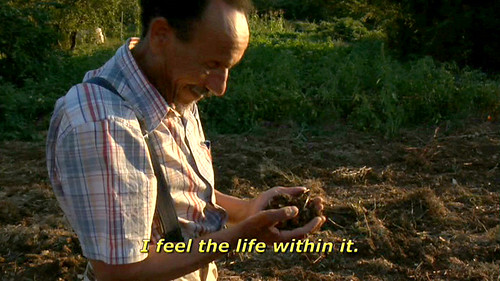
I just watched DIRT! The Movie for free at dotSUB. A really good movie about soil and the importance of a healthy biosphere of rich biodiversity. Takes a couple of detours (ie one about various spiritual connections to soil) that may seem weird depending on who you are and is quite a bit pro-organic agriculture but all in all a good, educational movie about not just soil, but about deforestation, climate change, agriculture - and a bit about conflict too!

Trailer:

Full movie:


"You create deserts where you are and eventually these micro deserts form much bigger areas. And we can't live very happily in a desert. And so we start fighting between farming communities and nomadic communities over land that is not a desert, that still has dirt. Desertification or land degradation is one good way of undermining security in any country."
- Wangari Maathai [0:29]
"There is a very strong correlation between human degradation and environmental degradation."
 - Sebastiao Salgado, photographer [0:42]

Although I just watched it, I could certainly use having the full quality DVD on my shelf along with HOME, FUEL, FOOD Inc, CRUDE and the other (upper case letter) enviro-flicks.

Pierre Rhabi holds dirt

Find DIRT! The Movie: at their own website, at YouTube, at Facebook, at Twitter and at IMDb.


Friday, July 08, 2011

Wangari Maathai: "If the rivers stop flowing, people will fight."

Wednesday the 6th of July 2011 Wangari Maathai received a honorary doctorate at Copenhagen University and spoke about her work with the Green Belt movement, the Taking Roots movie and more. Watch her speech, I recorded it for you:


[15:39] Protecting forests is extremely important [...] also very important for conflict [...] many of the local conflicts that we were having, especially in East Africa, [...] were being fed by competition over resources. Especially over land, [?], farming land, water, watering points [?]. And many of these conflicts are unavoidable unless we learn to manage the resources in a responsible way, in an accountable way and also we learn to share these resources in a more equitable way. Now, these are words, but when you translate them into practicalities on the ground it is actually [?] possible to stop people fighting. If there is no water and there is only one watering point people will fight over that watering point. If the rivers stop flowing [...] people will fight. And usually when people fight, that's when [the developed, rich world hear about the developing, 3rd world and begin to wonder] 'why are they fighting?'. Well they are fighting over resources because either those resources are degraded, they are diminished or they are exhausted or they are not being shared equitably.


Tuesday, October 19, 2010

A Crude Awakening (four years late)

Predating the first post at this present blog by about 13 months in 2006 the documentary A Crude Awakening warned of the implications of oil soon running out.

From Wikipedia's section "Findings", my emphasis:
overall conclusions were that a global peak was imminent (if not already occurring), more wars would be fought to control access to oil resources, and economies most dependent on oil (or relying on trade with oil-dependent nations) would suffer dire consequences
At IMDb the user cross-45 rates it 10/10 and from his review:
This film puts into perspective and also gives me many answers for the bloodshed carried out in many of the wars of the last century, and continuing into this century
Already in the trailer, a woman says:
Oil is a magnet for war. Oil starts wars. 

Welcome to my Ecowar Movies list (and my 'Must See' list), A Crude Awakening.


See IMDbthe Wikipedia entry and the official site. (Thanks to Lara Smallman for alerting me about this one.)

Tuesday, July 13, 2010

The wisdom of zombie movies

Just read a nice observation at The Christian Science Monitor:
If war, as one wit famously observed, is “God’s way of teaching Americans geography,” then environmental disasters such as the BP oil spill seem to be the primary way that Americans learn about ecology.
In the absence of environmental disasters we watch zombie movies. Consider their key ingredients: extreme violence and number of casualties, crazed fight over or race for the few remaining resources, collapsing civilization and often an outbreak of man made disease.

I already mentioned The Happening along with a couple of non-zombie movies. This one isn't really a zombie movie though and the threat is at most indirectly caused by humanity.


28 Days Later... is a real classic. Human made disease released by misguided animal rights activism. Its sequel isn't as good though.

Also, I have to mention Dawn of the Dead and Zombieland although they are a bit stereotypical and doesn't explore any natural resources conflict or any other deep theme as far as I remember. But they are quite entertaining and has some canned food and survivalism.

While also technically not a zombie movie the recent The Road takes place in a post-apocalyptic wasteland where human flesh and hidden stashes of canned food are the only resources available.


And in The Crazies we follow a group of uninfected running from both government extermination and crazy slaughter in the aftermath the army spilling a plane-load of a biological weapon compounds into the drinking water of a small town.

As the user "K J E" writes in her Flixter review:
In this day and age, the true horror of The Crazies is in the fact that any of us could find ourselves in a similar situation. This is definitely a film which should make you think, and think hard and long about this world in which we live.
I'll have to watch The Book of Eli some time soon. (Hope it's better than The Road!) Which zombie movies would you suggest? Please comment!

Perhaps you have been sceptically reading my blog for some time and now wonder if I finally lost it? But zombie movies are, sadly, perhaps more efficient at educating scaring people of the frailties of society than any rationalist blog preferring solid research and eloquent essays.


Saturday, February 27, 2010

Occupation 101

Just watched Occupation 101 two years late. It's a gripping documentary about the history and status quo of the Israeli occupation of Palestinian lands. While not being about battle for resources it does mention the grabbing of fertile lands by Jewish settlers.


[In 1947] The UN - under pressure - proposed to divide the land into two states. An Arab state and a Jewish state. Arabs were to be given 43% of the land despite the fact that they made up more than two thirds of the population and owned over 92% of the land. Jews were to be given 56% although they comprised only one third of the population and owned less than 8% of the total area. [...] They were given not only most of the land, they were given the most fertile land. [21:10]


[Today Israeli] settlements are strategically built colonies of Israel [on UN designated "Arab" land] that are connected by a network of roads which separates each Palestinian community from the next and confine their ability to expand. They are often constructed around the best farmland and resources. [11:10]


You can watch the whole thing using the above embedded Google Video og you can order the DVD from the official website.

Wednesday, January 20, 2010

Zeitgeist & the eco-military

I watched a movie called Zeitgeist Addendum yesterday after months of having had it recommended from people. I recommend it: Download the DVD from the project website for free or watch it on YouTube. Here's some notes and comments...

It starts out criticizing elements of the economic system - boring to many by definition but perhaps a little more interesting here in the financial crisis? - and moves on (about 21 minutes into the movie) to discuss examples of how financial tools are preferred by the West (the US) before using the military to gain cheap access to 3rd world natural resources. It's essentially John Perkins, former NSA associate, talking about the topics of his book, Confessions of an Economic Hit Man [Official site | Wikipedia | Google Books].

This video is the 10 last minutes of John Perkins talking:


What he says about Iraq:

"Iraq, actually, is a perfect example of the way the whole system works. We economic hitmen are the first line of defense: We go in, we try to corrupt the government and get them to accept these huge loans which we then use as leverage to basically own them. If we fail [...] then the second line of defense is we send in the jackals. The jackals either overthrow governments or they assassinate. And once that happens then a new government comes in and they'll toe the line because the new president will know what will happen if he doesn't. In the case of Iraq both of those things failed [...] so, in '91 we send in the troops and we take out the Iraqi military [...assuming] Saddam is gonna come around. [...] So the economic hitmen go back in in the 90ies... without success. If they'd had success he'd still be running the country, we'd be selling him all the fighter jets he'd want [...] the jackals couldn't take him out again [either] so we sent in the military once again and this time they did the complete job [...] in the process creating for ourselves some very, very lucrative reconstruction deals."


Very much not surprising. But nice to hear from an insider. His conclusion makes me think of Michael Hardt and Antonio Negri's Empire. Regarding Iraq specifically, we've had some hard-to-believe right wing postulates that the war-for-oil theory is left wing propaganda pointing at non-US (yet Western) companies getting many contracts. First of all, it really doesn't matter as long as these companies supply for the (so called "free") world market. Second, recently U.S. Companies Join Race on Iraqi Oil Bonanza.

Towards the end the movie sums up in some more philosophical discussions (including some hippie stuff). Some of it is undeniable Ecowar cornerstones.


"The most important issue at hand is the intelligent management of the earth's resources. [...] Our true problems in life are technical, not political. [...] Society today is backwards. With politicians constantly talking about protection and security rather than creation, unity and progress. The US alone now spends about 500,000,000,000 dollars annually on defense. That is enough to send every high school senior in America to a four year college. In the 1940ies the Manhattan Project produced the first true weapon of mass destruction. This programme employed 130,000 people at an extreme financial cost. Imagine what our life would be like today if that group of scientists, in stead of working on a way of killing people, worked on a way to create a self-sustaining, abundant world. [...] It is time to unleash something much more powerful: weapons of mass creation."


Of course, just like America is addicted to oil (George W. Bush's own words) it's also addicted to war. At least, shutting down the military would be a mega-shock to the financial system. That is why I enjoyed it very much when in Kim Stanley Robinson's Science in the Capital series the US military is literally battling climate change. Also a topic discussed in the new copy of Ode Magazine: Jim Channon: Mobilizing the military to clean up the earth.

The true battle in the future is not between nations; it’s about repairing the damage we’re doing to our planet. [...] the army must set about reforesting the Earth, planting billions of trees and cleaning up the fresh water reserves. [...] The Marines will protect and restore the dying coral reefs and coastal wetlands while the Air Force monitors carbon emissions, ozone depletion and air pollution. [...] The Navy, Channon says, should be tasked with measuring rising ocean temperatures and melting polar ice as well as policing illegal dumping and overfishing of the seas. [...] siphon excess water from the oceans and channel it into the desert basins of the planet to create enormous salt water lakes [...] transport thousands of refugees from the Pacific Islands to these areas, where they may tend giant new fishponds


These quotes are the visions of retired U.S. Army Lieutenant Colonel Jim Channon - who's portrayed by Jeff Bridges in The Men Who Stare at Goats which appears to be a lot more fun than Zeitgeist Addendum.

Friday, October 02, 2009

Our mobiles are bleeding

We don't want to think too much about it. But every time we buy a new gadget we support a mining industry of questionable ethics. In the case of the mines in eastern Congo it is extraordinary brutal.

In a time of desperate need for re-forestation to fight climate change, in Congo wide swaths of jungle have been cleared to make way for 15,000-25,000 poor boys and men working under slave-like conditions, living in tents on mud, guarded by "autonomous" army units, earning little while risking their lives. Although a violent environment the biggest killers are diseases and collapsing caves.

A movie about these mines, Blood in the Mobile, is in the works. The trailer is ready:


(If you haven't seen Darren Aronofsky's The Fountain at least watch the trailer for the music which is taken from that film. Beautiful!)


As they say:
"Different armed groups are fighting to gain control over the mine."


Furthermore, TreeHugger.com has a slideshow of 34 photographs: The Incredible Story of Conflict Mineral Mining in Images.
The Democratic Republic of the Congo, scene of the deadliest conflict since World War II, remains mired in violence in significant part because of the international demand for electronic products that requires minerals found in the eastern Congo. The minerals mined here are used to make our iPhones, laptops and MP3 players, but at a great expense. Armed groups finance themselves through the illicit conflict mineral trade and fight over control of mines and taxation points inside Congo.


Congo is mentioned in the 100 Places to Remember project (see previous post). But it only concerns the deforestation of the precious original Itubi forest; home to the Mbuti pygmy people, endangered leopards, chimps, okapis etc. Deforestation not only removes essential carbon sinks it releases CO2 corresponding to about a fourth of the worlds fossil fuel use.

More: Official Blood in the Mobile website, Raise Hope for Congo.

Monday, September 07, 2009

Another MUST SEE: Crude - The Real Price of Oil


Just saw HOME, still planning to see DIRT and now this, CRUDE. (Haven't these people heard of lower case letters?) Another 2009 film about environmental exploitation and the hidden costs of it; mostly poor and/or indigenous people abused by Western companies and consumers.


More at the official website, IMDb, Hollywood and Fine / Crude: The cost of social Darwinism, ifc.com / Joe Berlinger's Crude New Film. From the reviews:
Crude [...] will be in the thick of the Oscar fight.

a heartbreaking and compellingly multifaceted epic about the so-called "Amazon Chernobyl" case


Part of this story was also told in an episode of the tv series Extreme Oil [IMDb].

Sunday, August 16, 2009

Wednesday, June 24, 2009

A Drop of Life: Short film about water conflict

"As I became aware of the mounting global water crisis, I realized that it represented a clash of cultures – between a culture that values water as a shared sacred source of all life and a corporate culture that regards water as a commodity to be bought and sold."


Quote Shalini Kantayya, director of A Drop of Life - a futuristic sci-fi flick about the mounting water crisis winning Best Short Film at Palm Beach International as well as the Audience Choice Award at the IUOW Film competition. Will check it out some time (two years late anyway).


Who controls water controls life


Found at lifewithinme.com. Shalini Kantayyas website. A Drop of Life at Imdb.com.

Saturday, June 13, 2009

Let's go HOME - to a sustainable carbon cycle

The world spends
12 times more on military expenditures
than on aid to developing countries
Quote Home, the new environmental film by Yann Arthus-Bertrand which I just watched. The film is available for free on YouTube for some time and I'd generally recommend it. Rather than detailing one or a couple of issues or projects this is a "big picture" approach that starts out explaining how life came to be on the piece of rock we call Earth and how we have disrupted this phenomenal emergence of an ecosystem. A fine educational movie with plenty of slow motion bird perspective scenery. To the average ecologist it's a bit romantic at times - which will probably also turn-off the typical in-denial fossil fuel lover.

The scenery - of both nature and civilization - is at many times throughout the film so beautiful I'd like to see it again in an IMAX cinema. If it is shown in Copenhagen I'd try and drag along some friends. Because more people need to see this. Unfortunately, in my opinion, it would have benefited from a pinch of simple chemical formulas to nail home the carbon cycle disruption point.

The quote I put at the top of this page is of course mostly a thought provoker. We can't reverse the situation just like that, but it's a healthy little fantasy to think of. And it underlines the fact that we increasingly protect the resources we have with costly force rather than make efforts to help others sustain themselves.

(Official poster. Also see the Official website of Home | imdb.com entry)

Home does not mention wars or conflicts except indirectly like in the quote. But as it illustrates a wide range of issues - lack of water, deforestation, climate change, you name it - and how they are connected it isn't exactly a quantum leap to see it's subject in relation to possible conflicts. The finishing quarter of an hour is a "positive" segment. We get to see gigantic windmill and solar cell parks, ocean wave harvesting "snakes" and more.

You want more free stuff from the Internet? How about moving on from something informational to something that helps? Here are a couple of suggestions:

Free rice is a little English vocabulary game that makes you score and donate grains of rice for the hungry by each correct word.

Fight World Hunger


Or study, interact and support the UN World Food Programme Students And Teachers section.

Fight World Hunger

People who are not starving are less likely to go out and exploit more of our dwindling resources or fight each other over spoils. That's not rocket science.
Saturday, May 09, 2009

Ecowar movies: Edutainment suggestions

Noticing the clamour over the new animated movie Battle for Terra (or just Terra) and it's interesting theme I put it on my Must See list - right next to Blood Diamond which is way over due. Then the logical idea came: make a list of movies for Ecowar!

Only four movies made it onto the list so far. But I would love to get recommendations for more! Please spam.

Battle for Terra
"A peaceful alien planet faces annihilation, as the homeless remainder of the human race sets its eyes on Terra. Mala, a rebellious Terrian teenager, will do everything she can to stop it." - IMDb plot
US Republican reviewers are all up in arms about this one. They say it's "Bush Bashing". I don't know what to think about that - especially since I haven't watched it yet. But in an interview with the writer he explained the rationale for the story as him not buying into the premise of War of the Worlds - that an entire species should be "evil". Seems very reasonable to me! Thus far in human history new territory has been considered something to exploit. Why not an inhabited planet? We might be in need of some planetary migration before we know it.

The Happening
"A strange, horrible and unprecedented crisis begins in Central Park. A high school science teacher, his wife and a young girl do what they can to survive it." - IMDb plot
Many would argue the science in this one is about as far out as the science in The Matrix. I don't think it is, although it's taken to quite a cinematic extreme. It's Gaia Theory. Somehow the human population pressure provokes a seriously negative feedback. It's not a very good movie due to various factors but it has it's moments. Like this line:
Nursery Owner: "You know plants have the ability to target specific threats. Tobacco plants when attacked by heliothis caterpillars will send out a chemical attracting wasps to kill just those caterpillars. We don't know how plants obtain these abilities, they just evolve very rapidly."
There Will Be Blood
A story about family, greed, religion, and oil, centered around a turn-of-the-century prospector in the early days of the business." - IMDb plot
No way I could omit this masterpiece although the conflict is largely explained in metaphorical measures and business rivalry.

Blood Diamond
A fisherman, a smuggler, and a syndicate of businessmen match wits over the possession of a priceless diamond. - IMDb plot
My final choice is also the least fictional - I suppose because as I mentioned I haven't watched it. Yet! Said to be a bit "tough" to watch.

Of course, there are movies about some of the wars that I have blogged about here. But I have a hard time thinking of any that really touches upon the ecowar issue. Also, I have excluded The Matrix trilogy - because blocking the sun is simply so stupid no one would ever consider it (think twice) and because the science in it isn't always that educational (human batteries?).

Thursday, September 04, 2008

Poison Fire: Oil in Nigeria

"Since oil was discovered in the Delta people have known no peace."
- Israel Aloja, Environmental Rights Action


Oil, which could potentially have allowed Nigeria to be one of the wealthiest countries in Africa has instead led it to become one of the poorest.

A series of repressive and corrupt governments in Nigeria have been supported and maintained by western governments and oil corporations, keen on benefitting from the fossil fuels that can be exploited.

[...]

According to Human Rights Watch, “multinational oil companies are complicit in abuses committed by the Nigerian military and police.”

- background article Nigeria and Oil at globalissues.org

Friday, August 17, 2007

It's the 11th hour


That's right - I just played my part in viral whoring of Leonardo DiCaprio's new film, The 11th hour [IMDb]. But it really touched my heart getting an email from Mikhail Gorbachev and Stephen Hawking (read: an email from the web 2.0 ad company they hired to push the thing). No, seriously: sure, I'm going to watch it sometime.

I even watched The Great Global Warming Swindle [IMDb] and An Inconvenient Truth [IMDb] as they were both recently broadcast on Danish TV. One is pretty good layman's science weirdly drenched in US American pathos, the other is a sadly funny mix of conspiracy theories. Figure out which is which yourself - I don't make up my opinion from movies. I've been reading the science for years, I'm happy to brag. But of course most people don't and movies are invaluable in communicating to any wider audience.

“With the onset of global warming and other catastrophic events, environmentalism has become a broader unifying human issue. We as citizens, leaders, consumers and voters, have the opportunity to help integrate ecology into governmental policy and every day living standards.”
- DiCaprio.

Search This Blog