Showing posts with label Nigeria. Show all posts

Sunday, March 27, 2011

Pollution, corruption, business as usual... and corporate charity in Nigeria

February Nigerian militant groups were scrambling for "surveillance jobs" - wanting to get paid for making sure what they use to steal will not get stolen?
FIVE thousand pipeline surveillance job slots intended for former militants to secure oil facilities in Delta State has pitched former militants in the state against one another, even as members of the Movement for the Emancipation of the Niger Delta, MEND, Urhobo chapter, have vowed to make the state ungovernable if the job slots allotted to them were not increased and given to militant leaders of the area for distribution.
See MEND threatens war over pipeline surveillance job in Delta.

Whatever the precise outcome of those negotiations they haven't been entirely successful. Oil companies spend millions on charities and advertising to stay popular and when showing journalists around they did a helicopter tour of outlaw camps for refining stolen crude:


See photos at Oil firm projects showcased ahead of Nigerian poll.


Posters show smiling students posing after receiving university scholarships. New roads appear on formerly potholed mud tracts. Millions of dollars are promised to improve the lives of the desperate poor. These campaigns by oil company Royal Dutch Shell PLC and other foreign firms make it seem they are running for office in crude-rich Nigeria, which will hold crucial presidential, federal and local elections in the coming weeks. The multinational firms have spent hundred of millions of dollars toward projects they advertise as improving the life of those living in the country's troubled Niger Delta. [...] Some estimate as much as 550 million gallons of oil have spilled in the delta from failing pipes and attacks since production began — at a rate roughly comparable to one Exxon Valdez disaster per year. Shell flew journalists in a helicopter over a cleared area in the delta where locals ran makeshift refineries turning stolen crude tapped from pipelines into diesel and kerosene. The company blamed nearly all of its oil spills in 2009 on sabotage from thieves and militants. Environmentalists and community activists routinely blame Shell for the spills, pointing at the company's aging pipelines and poor cleanup efforts.
See AP / Oil firms showcase giving ahead of Nigeria poll, but many blame them for environmental damage.


Wednesday, December 22, 2010

Read "Crude World" by Peter Maass

News about the oil business, campaigns against it's foul play, news about pollution incidents, academic studies dealing with the many implications of the importance of oil and similar reports are not infrequent. Quite a few entries at this present blog deals with oil. But how about a first hand account of visits to the oil business hotspots of the world? From an acknowledged journalist with a critical approach and an open mind. About 220 pages telling the stories of the people living from or in the shadow of oil extraction... that's Crude World.


Chances are you'll gobble it up like a SUV does gasoline but there's plenty in its ten creatively titled chapters to digest more thoroughly. Scarcity, introducing with the stories of a poster-boy whistleblower from inside the number one consuming nation, USA; Plunder, about the disturbingly overlooked textbook case of Equatorial Guinea; Rot, taking us down the polluted rivers of the Niger Delta; Contamination, continues with stories from the misery of the Ecuadorean jungle; Fear, dives into the psychology of the oil business and the ignorance and innocence of its workers; Greed, is composed of a handful of stories about the callousness of the oil business even when operating inside the West; Desire, is a bit of the impossible to ignore story of the Gulf Wars; Alienation, has the perhaps most scary story of the ghost country called Saudi Arabia; Empire, is a peek below the surface of the apparently feel-good story of Russia; and Mirage ends off the book with a similarly critical look at the naive story of the Boliviarians in Venezuela.

Around the world indeed. Plenty of facts but served in dishes of true stories. Warmly recommended.

Can't help quoting a few good quotes about the US relation to the Middle East:

“Let our position be absolutely clear. An attempt by any outside force to gain control of the Persian Gulf region will be regarded as an assault on the vital interests of the United States of America, and such an assault will be repelled by any means necessary, including military force.”
- US President Jimmy Carter, 1980

“Access to Persian Gulf oil and the security of key friendly states in the area are vital to US national security. The United States remains committed to defending its vital interests in the region, if necessary through the use of military force, against any power with interests inimical to our own.”
- US President George Bush in “National Security Directive 54”

“Armed with an arsenal of these weapons of terror, and seated atop ten percent of the world's oil reserves, Saddam Hussein could then be expected to seek domination of the entire Middle East, take control of a great portion of the world's energy supplies, directly threaten America's friends throughout the region, and subject the United States or any other nation to nuclear blackmail.”
- Dick Cheney, August 2002

Democracy Now! interviewed Peter Maass during the BP oil "spill" in the Mexican Gulf:


Also, he's talking for hours on YouTube! About the book in general...


...about Russia...


...about Nigeria...


...about Iraq...


...and about related subjects in many more recordings.

Regarding the Iraq War... was it about oil then? To Maass it turns out it's not whether the war was about oil - it's how it was about oil.


Sunday, April 04, 2010

Press clips: Water, pollution, oil, diamonds...

Spending my time brewing up rants for development.thinkaboutit.eu Ecowar news stories get a little less attention. But here are a bunch from my news alerts that I couldn't just delete. Some of the usual suspects.


First diamonds: Dealers try to thwart conflict diamond trade in Zimbabwe, but loopholes persist

The World Diamond Council (WDC) has recently urged that action be taken to end human rights abuses being committed in the Marange diamond fields of Zimbabwe. Allegations against the Zimbabwean military of forced labor, child labor, the killing of more than 200 people, beatings, smuggling, and corruption have arisen, according to Human Rights Watch (HRW), which has asked diamond retailers to publicly commit to not purchasing or selling diamonds from Zimbabwe.


African oil. Niger Delta first: Nupeng Condemns Killing of Oil Workers and Q+A-The implications of bomb attacks in Nigeria's oil delta.

Killings, bombs, the president hospitalized, a cease fire broken, worker's unions complaining.

Secondly, Sudan hangs two for killing Chinese oil workers.

Sudan executed two people convicted of killing four oil workers, two of them Chinese, in one of the country's most energy-rich regions, state media reported on Wednesday.


So, fighting over oil and diamonds but regarding the "Water War" it's a story of peace effort I got: US to engage India, Pakistan to sort out water disputes

"We want to help countries avoid conflict over water. The potential for conflict over it exists not only in Pakistan and in India, but in other places as well," said Maria Otero, the US undersecretary of state for democracy and global affairs.


Discussion of this topic: Are future wars going to be fought over water or will leaders be able to resolve conflicts as they have many times in the past?

In years to come, unless everyone comes together to help those who are now in need of pure water, no treaty will hold back people who are dying of thirst. Ultimately, governments will not have control through written agreements when billions of people are vying for water that will quench the thirst of a few million. The time is now as far as educating people all over the world how to manage the water available to them. Education is the best weapon during any conflict. It is the only weapon that just might keep a world from fighting over the one thing that is absolutely necessary to sustain life.


Meanwhile, more people are getting killed by water, rather than over water: Dirty water kills more people than war: UN and Polluted water kills more people than war: UN.

At least 1.8 million children under the age of five die every year from water-related diseases, or one every 20 seconds, the report said, and over half the world’s hospital beds are occupied with people suffering from illnesses linked to contaminated water.

[...]

“If the world is to thrive, let alone to survive on a planet of 6 billion people heading to over 9 billion by 2050,” UNEP’s Steiner said, “we need to get collectively smarter and more intelligent about how we manage waste, including waste water.”


Oh by the way, air pollution kills too: Air pollution is 'killing thousands of Londoners'.

Early results of a study commissioned by the mayor suggest 4,300 Londoners will die prematurely every year as a result of poor air quality.

Sunday, February 07, 2010

Minor oil conflicts saber rattling

Oil conflicts are not just about Iraq, Afghanistan and obscure former Soviet republics in between.

The Falkland Islands

As drilling equipment approaches Falkland Oil & Gas stocks are up. So is the Argentine-UK diplomatic heat.

"The Foreign Ministry reiterates its sovereign rights over the Malvinas Islands, South Georgia and the South Sandwich Islands and the sea surrounding them, which form a part of its national territory. [...] Argentina again warns the UK about the illegality and consequences of this new unilateral action, extensive to all private actors involved, that they will be liable of future legal demands in the maximum tribunals, for the potential exploration and exploitation of Argentine resources."
- Argentine Foreign Ministry sources


"The British Government will continue to support the development of [The Falkland Islands'] hydrocarbons sector, the British Government will continue to work with you on this agenda. [There are] no doubts about United Kingdom's sovereignty over the Falkland Islands."
- British Prime Minister Gordon Brown


Sources: U.K. Says ‘No Doubt’ on Falklands After Argentina Row, Argentina warns UK about Falkland Islands oil.

Nigeria

In Nigeria the president leaving the country to undergo heart surgery plus some Christian vs Muslim tension is increasing existing tensions.

"All companies related to the oil industry in the Niger Delta should prepare for an all-out onslaught [...] Nothing will be spared."
- Jomo Gbomo of the Movement for the Emancipation of the Niger Delta (MEND)


We want to own our land, we want control of the land and the resources, so we can determine who comes to our land, but instead we have communities that have been forcibly relocated from their land so that oil companies can start operations."
- Henry Okah, leader of MEND


Sources: Nigerian rebels threaten 'all-out oil war', Nigeria militants call off truce in oil-rich Niger Delta.


Tuesday, December 08, 2009

Nnimmo Bassey: "Leave the oil in the soil, leave the coal in the hole"

The alternative to the official UN COP15 summit is called Klimaforum09 - free, open for all and packed with interesting speaks, workshops and exhibitions. It opened this Monday, the 7th of December, simultaneously with COP15.

The main attraction was, hands down, Naomi Klein. She is also getting the attention on the website so far: Last chance to save the world says Naomi Klein is basically the only new article there right now.

At least as inspiring as her was one Nnimmo Bassey whose speech I give you my recording of right away. Watch (well, listen) now. Very critical of COP15 this African is.


Activist and author Nnimmo Bassey was awarded a TIME Magazine Hero of the Environment 2009 award. Rather than being a climate change activist he's from a oil corporation vs. human rights background:

"Oil has been the destruction of the Nigerian economy. It destroys the relation between the people and the state."

As quoted from the TIME article. From the speech in the video:

"People say that crude oil is an easy and cheap form of energy. But it's not the truth. Crude oil may be cheap but only because people are not paying the price. If you see what is going on in the oil fields: The pollution, the degradation, the human rights abuses, the murders and the killings - I would like you to tell me how much one drop of oil should cost." (4:07)

I have previously blogged about Nigeria. It's one of the epicentres of climate change impact. We write about it, they got it: Deforestation and desertification (as mentioned briefly in the video speech), violence over oil and a life giving but drying out lake.

The other aspects of the opening ceremony included - besides Naomi Klein - one Henry Saragih and a percussionist playing on melting ice (yes!). Stay tuned for more!

(As you may have guessed, my visit to klimaforum09 was largely inspired by my participation in TH!NK ABOUT IT #2 about climate change. So, this video is cross posted at my column there.)

Tuesday, September 29, 2009

100 Places to Remember - at least 8 of which are to die for

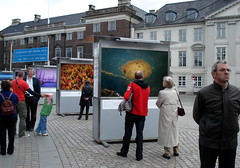
Having wandered through the exhibition at Kongens Nytorv in Copenhagen and now also enjoyed the accompanying book of 100 Places to Remember Before They Disappear I can't help but take note of a couple of them here.

Because the descriptions in some cases explicitly mentions conflicts. Granted: Many will change with potential drastic consequences. Be it because they become uninhabitable, hence sources of climate change induced migration, or become unsuited for agriculture, leading to loss of food production with all the negative consequences of that. Or because of any of the other potential negative changes. But most are "just" pretty spots that will change due to climate change.

DSC06551x

In chronological order of the book, the spots that are related to conflict by the 100 Places project:

#11 The North Pole, Russia/Canada/Denmark


As the Arctic thaws resources of oil, gas and minerals become increasingly available for extraction. But whose resources are they?

#16 Tian Shan, Kazakhstan/Kyrgyzstan/China


The glaciers atop this mountain range provides the water for the breadbasket and powerhouse of Kazakhstan. But due to miniscule drops in precipitation through the last 50 years they have shrunk by 36% already. Climate change will most likely accelerate this drastically. Competition for the remaining water resources will intensify. Neighbours some seriously troubled regions.

#26 Lake Chad, Chad/Cameroon/Niger/Nigeria


This lake is basically an essential source of life in a very arid region of all more or less "failed states". Competition between tribes and nations already intensifying as the lake is drying up rapidly.

#30 Kalahari Desert


Also drying up even beyond what it already is this desert is the last refuge of the die hard San people. But climate change could be the final blow to their basis of existence.

#68 Bering Sea, Russia/USA


This sea is the source of some 2 billion US dollars worth of fishing shared by Russia and USA. But as the waters warm the ecosystem and biodiversity is changing completely. At the very least the fishermen will have to go elsewhere or catch different fish. The worst... well... will begin with trade negotiations, I assume.

#79 Kordofan, Sudan


We've all heard of Darfur. Over and over again. And I've pointed to the vicious cycles between environmental degradation. But I guess Darfur is no longer pretty enough for a photograph in a project like 100 Places? Anyway, Sudan also has a big forest of "hashab" trees (Latin: Acacia senegal) which is the source of the largest production of rubber in the world. But business is slow both because of the nearby Darfur trouble, drought and rising temperatures which has caused a severe decline in forestry productivity. When this region of Sudan also loses it's livelihood...

#84 Niger Delta


This is "all of the above". Beautiful nature, oil pollution, ethnic violence, mass poverty, multinational corporations, rising seas, increasing storms, decline in freshwater availability, increased diseases spreading... huge chance of migration.

#87 Amman, Jordan/Israel/others


Well it's in the Middle East. Historically ideal situation for a fertile capital. But now human over-use of water resources and climate change is lowering the water level of the Dead Sea by one meter per year because less and less water flows by the Jordan River. Agricultural land is turning into desert as you read this. A glance at a map and it becomes obvious this can become a very, very big problem.


All of the above issues will of course get intertwined with the other issues of some of the regions. Like the pipelines running through central Asia. The existing political and historical animosities between certain countries. Perhaps it's in the nick of time these photographs were exhibited. Soon the footage could be less pretty.

(This post is also posted as part of the TH!NK ABOUT IT #2 Climate Change blogging competition. Most of these places are also marked in my Ecowar Battlefields Google map.)

Tuesday, February 17, 2009

Equatorial Guinea: Oil found yesterday, coup attempted today

Mega-disclaimer: I haven't looked into the details. These two pieces of news may very well be entirely unrelated. Or they could be completely entwined. In any case when such news converge I simply have to take note.

For starters how about a usually credible source: BBC / Mystery over E Guinea gun battle
An unidentified armed group has launched an attack on the presidential palace in Malabo, the capital of Equatorial Guinea.
Nigerian "oil liberation" militants are being blamed but deny.

Those with subscriptions to a site called Ifra PR are supposedly able read this news piece: Noble Energy discovers oil in Equatorial Guinea. I have to admit I do not subscribe (sic!) but the excerpt at Google News goes: "The Government of Equatorial Guinea is extremely pleased that another oil...". Alternatively there is Equatorial Guinea Oil and Gas Report Q1 2009.

However, oil wasn't found yesterday. From the CIA:
The discovery and exploitation of large oil reserves have contributed to dramatic economic growth in recent years. [...] the government has stated its intention to reinvest some oil revenue into agriculture [...] No longer eligible for concessional financing because of large oil revenues, the government has been trying to agree on a "shadow" fiscal management program with the World Bank and IMF. Government officials and their family members own most businesses. Undeveloped natural resources include titanium, iron ore, manganese, uranium, and alluvial gold. Growth remained strong in 2008, led by oil.
But see what I mean? And I thought I'd have trouble proving my point with this blog!

Sunday, December 14, 2008

Highlights: CNN's Planet in Peril - Battle Lines

CNN has been so kind to produce the Ecowar TV-series: I have been watching a bit of their Planet in Peril - Battle Lines series lately.


World's most valuable resource, a curse for most Nigerians
Hundreds of billions of dollars has been made from the Niger Delta's oil reserves and many people have gotten very rich. Conversely, the average Nigerian has suffered as a result of the country's oil prosperity. [...] there have been more than 6,000 oil spills in the Niger Delta -- that is equal to more than 10 times the amount spilled from the Exxon Valdez in 1989. Yet, there is no international outcry and rarely are the spills reported


Surveying elephants with jubilation and horror
over the last four decades, the number of Central African elephants has dwindled from nearly two hundred thousand to several thousand: the pace of the loss has been hugely shocking and disturbing. The global demand for ivory combined with war in neighboring Sudan has nearly killed off the Central African elephant.


Polar bears resort to cannibalism as Arctic ice shrinks
"The Arctic sea ice melt is a disaster for the polar bears," according to Kassie Siegel, staff attorney for the Center for Biological Diversity. "They are dependent on the Arctic sea ice for all of their essential behaviors, and as the ice melts and global warming transforms the Arctic, polar bears are starving, drowning, even resorting to cannibalism because they don't have access to their usual food sources."


Legal battle over forest is victory for Paraguayan Indians
A small tribe of Indians in Paraguay who have had virtually no contact with the outside world won a legal battle this week when rights groups stopped a Brazilian company from continuing to bulldoze the forest to clear land for cattle ranches.


Global warming could increase terrorism, official says
Climate change "will aggravate existing problems such as poverty, social tensions, environmental degradation, ineffectual leadership and weak political institutions," Thomas Fingar said. "All of this threatens the domestic stability of a number of African, Asian, Central American and Central Asian countries."

Thursday, September 04, 2008

Poison Fire: Oil in Nigeria

"Since oil was discovered in the Delta people have known no peace."
- Israel Aloja, Environmental Rights Action


Oil, which could potentially have allowed Nigeria to be one of the wealthiest countries in Africa has instead led it to become one of the poorest.

A series of repressive and corrupt governments in Nigeria have been supported and maintained by western governments and oil corporations, keen on benefitting from the fossil fuels that can be exploited.

[...]

According to Human Rights Watch, “multinational oil companies are complicit in abuses committed by the Nigerian military and police.”

- background article Nigeria and Oil at globalissues.org

Search This Blog