During a broad scope text on the suicidal tendencies of our global society Noam Chomsky touches a couple of resource conflict topics.
all over the world – Australia, India, South America – there are battles going on, sometimes wars. In India, it's a major war over direct environmental destruction, with tribal societies trying to resist resource extraction operations that are extremely harmful locally, but also in their general consequences
So, at one extreme you have indigenous, tribal societies trying to stem the race to disaster. At the other extreme, the richest, most powerful societies in world history, like the United States and Canada, are racing full-speed ahead to destroy the environment as quickly as possible.
[during the Korean War] everything else in North Korea had been destroyed, the [US] air force was sent to destroy North Korea's dams, huge dams that controlled the water supply – a war crime, by the way, for which people were hanged in Nuremberg. [...] the water pouring down, digging out the valleys, and the Asians scurrying around trying to survive. [...] It meant the destruction of their rice crop, which in turn meant starvation and death. How magnificent!
However, flooding an area did not automatically get generals hanged after the WWII. This tactic was used by China, the Dutch, the Soviet Union, Germany and Great Britain. At least. To be honest, I haven't checked if any German soldiers were hanged for drowning people in this way. But my wild guess is no.
"If the Earth wars were a sporting contest, here's how the half-time score might stand at the beginning of 2012..."
Georff Hiscock concludes his near 300 pages factual account of who owns the world with a surprisingly relaxed "scoreboard":
1st: USA 10 points
2nd: China 8p
3rd - 4th: Europe, Japan 6p
5th - 6th: Russia, India 5p
7th: Brazil 4p
8th - 10th: Mexico, Canada, Australia 3p
11th - 14th: Saudi Arabia, Qatar, Kuwait, UAE 2p
15th - 22nd: South Korea, Indonesia, South Africa, Nigeria, Turkey, Iran, Central Asian republics, Mongolia 1p
Vietnam, Venezuela, Colombia, Chile and some African countries also in 1st division but still no points
EARTH WARS is a concise business report on the current deals in global energy and metals production as seen from down under. It also mentions the main water disputes but does not go into details on food production controversies. It is a treasure trove of information and numbers on especially Asian contracts but often the most important situations from other important continents such as South America or Africa are mentioned as after little more than afterthoughts at the end of chapters.
It's business report like writing is it's strength and it's weakness. The "bullshit factor" is one of the lowest I have ever seen. In many ways this book is just pure reporting. However, at times it is a tough read. And occasionally I wonder if I better run double checks on some numbers: Having been flipping through numerous skeptical blogs, articles and books earlier, I am of the impression that repository estimations and future extraction plans are not always that crystal clear. Did Hiscock leave out some valid doubts somewhere?
To get an impression of what the book offers you can look at the contents on page "v". Or you can take a glance at the 27 lists in it, because the chapters are very much structured as walk-throughs of those lists. So, "Exhibit 3.3" is a top ten of Russian oil and gas companies (no. 1 is Gazprom) - well that part of chapter three is an ordered sequence of paragraphs briefing on the owners, sizes and belongings of those companies. Pretty much.
One gem of the book is it's quite detailed second chapter on "geographical flashpoints". This chapter contained the bulk of the info I needed for my "contested resource territories" map published yesterday (take a look!).
The book hardly takes into account climate change. That may seem weird, but actually Hiscock barely bother predicting the future. Which is actually quite a relief. As such, it is fair enough not to mention projected environmental impacts decades into the future. The demand for renewable energy, however, is mentioned. Compared to the focus on the business as usual going on with fossil energy the demand for renewable energy looks depressingly weak.
If I had used it for my own book, it would certainly be on my list of recommended reading. It's not for everyone, though. Those other books are typically more into storytelling (like witnessing pollution in Nigeria or dictatorships in South America) or typical popular science (past societal collapses, influence of climate change on geopolitics). Normal books. Geoff Hiscock's book is a business book that doesn't dream and doesn't imagine anything.
Either way, there is absolutely no reason to doubt a fierce global business war is raging over our natural resources. That much is very clear after Hiscock's documentation. As documentation of this situation the book is a very valuable contribution. But it's not exactly edutainment.
Geoff Hiscock (2012): EARTH WARS - The Battle for Global Resources at Google Books, book website.
One of the unpleasant effects of climate change is its tendency to incite further conflict where such already exist and in some cases war is already looming. Sociologist and writer Christian Parenti is blaming "pathologies of neoliberalism" and Cold War leftovers that converge with climate change effects for inciting further conflict where it already lingers. Already by now large parts of the political landscape are out of the target group of Parenti's message but he supports his assertion by way of his good storytelling based on personal experiences and interviews - and he finishes with an almost pro-capitalism conclusion.
Chapter 2 is pretty much a summary of some of the military reports I have linked to in Ecowar posts tagged 'military' plus a few other. Chapter 3 is a brief history of the US military which at first seems a bit thorough for a climate change book but actually shows how it has been on a long journey from conventional "European" warfare to guerrilla warfare inspired by North American Indian tribes and Ernesto "Che" Guevara. And ends up with a grim forecast (p. 36) of "the essence of militarized adaption to climate chaos: dirty war forever." In part, global counter-insurgency is an adaption to climate change that most of us wouldn't agree to if given the choice.
Part 2 is about Africa and describe how the Cold War proxy-wars have left unresolved conflicts now to converge with climate change effects, mostly via Parenti's own experiences visiting the areas. Most notably the stories from northern Kenyan herders who increasingly arm themselves to defend and raid cattle as droughts kill off livestock. Chapter 7 details the Cold War prequel to the current desert anarchy in Somalia. Chapter 8, the last of part 2, is a brilliant description of what a failed state is exactly.
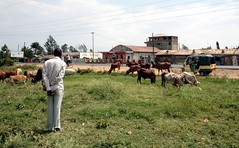
I traveled in Kenya January/February 2011. This photo is from the suburbs of Kisumu. I enjoyed the view over the Rift Valley and Lake Victoria. It is a bit chilling to read Parenti's stories from Kenya - in fact the book begins and ends with the corpse of a cattle herder left to rot under a tree and the questions of and answers to who killed him. All of the brutal incidents and trends in drought and plunder play out some kilometers away down the great valley.
Part 3 is about Asia and observes how in Afghanistan"the poppy economy and its armed defense are local adaption mechanisms" (wheat use six times more water than poppy which is worth 50 times the price). Chapter 10 is a rare insight to the conflicts in Kyrgyzstan - a lot more interesting than it may sound! Parenti then moves on to the India-Pakistan conflict of declining river flows, provoking dams, mass-murderous droughts, devastating floods, cross border state terrorism, suicide by pesticide Monsanto farmers and Maoist guerrillas. Very complex and under-reported in Western media yet clearly fueled by climate change.
Part 4 is about Latin America and the US. On page 181 Parenti's main message is summed up:
"catastrophic convergence: policies that create poverty and violence are now colliding with the new realities of climate change, and together these three forces are creating socially destructive forms of adaption."
Brazil and Mexico receive treatment in each their own chapters. Not just the always shockingly brutal gang violence is described, so too are more positive examples of coping: an example of organic agriculture and Keynesian economics. The efforts by Bolivia are hailed before the US is described in less than praising terms.
However, although being very critical of neoliberalism and in favor of state run initiatives to halt pollution and force clean technologies forward, Parenti is distancing himself from radical approaches involving revolutionary changes to the economy and society as we know it. First of all for a simple reason: There is no time. We need to start solving the climate problem now, thus we need to start doing it with tools known to work within the capitalist system. And it can be done, Parenti argues, because we have both the technology and the money. Fossil energies probably only have a lead right now because it has been so heavily subsidized for decades. And if there is money now for blowing up bubbles (housing, food etc) to create poverty as prices go up, unemployment and riots as the bubbles burst then, surely, that money could be redirected towards sustainable development.
Christian Parenti's Tropic of Chaos is a great book. Concise, well written and fair in reasoning. It isn't exhaustive as many conflicts from around the world are left untold of. It isn't academic as it assumes basic understanding of the climate, the economy and world affairs and simply move on with its stories from there while it doesn't dig into recent scientific results either. At times, perhaps, it's a bit too much a book of stories as Parenti shares many details of the converging issues. It is brave as it is critical of both the far-right media environment as well as of Bill "350" McKibben. Tropic of Chaos is the third book about how (not if) climate change is causing increased conflict I have read. If you want to read only one book about climate change and war this book should probably be it. (Alternatives are the more imaginative and dystopic Climate Wars by Gwynne Dyer reviewed here December 2010 and the scientifically precise and short Climate Conflict by Jeffrey Mazo reviewed here April 2011.)
Further reading/viewing for you right now: Large parts of the book can be read at Google Books. Also, Christian Parenti has given interviews on the book and its topics...
"The military runs scenarios of what the future will bring. What they see is not so much an increase in conventional warfare between states as an increase in humanitarian crisis, civil war, banditry, religious wars, state breakdown. And they realize that the armed forces will be called on to respond with various forms of low-intensity conflict: counter-insurgency, direct intervention, humanitarian intervention, shoring-up allied states, as well as increased training and advisory roles in these conflicts. [... In international negotiations] The United States has played a non-productive role, a destructive role. It has not taken the UN Framework Convention on Climate Change negotiations seriously, and as a result they have broken down. We are the largest economy in the world, and until recently we were the largest greenhouse gas emitter in the world before China overtook us. The world looks to the United States for leadership but U.S. actions, especially at Copenhagen, were really depressing. [...] What will change the U.S. position? Protest, clearly. There has to be a movement that forces the Obama administration to do this. The Obama administration is proving itself to be very right-wing on many issues, including this one."
Oil have been found in the underground below Lake Albert on the border between Uganda and the Democratic Republic of the Congo. Western companies are working with the Ugandan government to get development under way but a myriad of issues seem to delay the project: Criminal and rebel activity is up and rising, Ugandan democracy is struggling for control with the shady closed door negotiations and now US troops enter the picture. Al Jazeera summed up the situation in less than two minutes, October 14th:
Recipe for an oil war
Heritage Oil and Tullow Oil are guessing the 2.5 billion barrel or larger field is the largest onshore field found in sub-saharan Africa in more than two decades. Production of 150,000 barrels of oil per day by 2015 place Uganda among top 50 oil producing nations is planned. The latter company, Irish Tullow Oil, is now accused of having bribed three Ugandan ministers with 100 million USD in July 2010 in return for concessions. The ministers resigned October 2011. Tullow denies allegations, maintain an anti-bribe image and have funded a lake rescue station which they claim have already saved the lives of more than 70 local fishermen. Also in the deal are French Total and Chinese Cnooc. Those corporations are expected to claim 2/3 of the 3-4 billion USD hoped to be made annually.
A leaked US embassy cable (Wikileaks, #08KAMPALA393) reveals Uganda have been asking for help stepping up security in and around the oil rich area. John Morley of Tullow Oil is quoted for saying that as oil activity on Lake Albert increase a security presence would be vital. The cable mention "several clashes on Lake Albert between oil companies and entities from the Democratic Republic of Congo (DRC) demonstrate that oil production has increased local tensions and exacerbated cross-border hostilities". In 2007 a British drilling platform worker was killed by Congolese soldiers who claimed the barge had strayed into Congolese waters. Although the Ugandan and Congolese governments are talking and are in agreement concerning the precise geography of the border the armed forces on the Congolese side of the border are not always government-related.
An intervention overdue?
Several militias fight in the area and in just recent months thousands have had to fled their homes, hundreds have been kidnapped. Adding to the Congolese militias the Democratic Liberation Forces of Rwanda (FDLR) rebels as well as the infamous Lord’s Resistance Army (LRA) led by Joseph Kony add to the insecurity. FDLR is a Hutu group whose two top leaders are held in France and Germany on charges of crimes against humanity yet whose troops raped at least 154 civilians from July 30 to August 3, 2010, in the town of Luvungi. LRA is the Ugandan theocratic militia of self-proclaimed prophet Joseph Kony, who claims to be acting on orders from spirits sent by God, and whose ranks have been inflated by an estimated 66,000 children abducted for soldiering. October 2005 the International Criminal Court (ICC) issued arrest warrants on Kony and four other leading members of LRA; the 33 charges include murder, enslavement, sexual enslavement and pillaging.
Recently, the Ugandan presiden spent US$780 million on six Russian jet fighters. A decision that raises eyebrows in a country with a GDP of less than 500USD per capita.
"We don’t live in an enemy-free neighbourhood. So, don’t look at the purchase in terms of cost. The Great Lakes region is one of the most unsafe regions."
- Ugandan presiden Yoweri Museveni
Since 2008 the US have donated more than 40 million USD on supporting the Local counter-militia efforts. And now 100 Green Berets have been sent as military advisers for the governments of the region. They are receiving a warm welcome.
"For 20 years, the government of Uganda has been pleading with our American and European friends to help in the LRA problem, because these are international terrorists. We wanted our friends to help in providing technical support — such as intelligence — because they have the best."
- Uganda's acting foreign minister Henry Okello Oryem
"Any support to tackle the LRA is a good move [...] South Sudan is already working with Uganda's army in operations against the LRA, and we will be pleased to work with anyone who can help us combat the threat [...] We have large communities whose lives are ruined by these rebels, so the sooner we can end this once and for all will be something we will look forward to."
- South Sudan army spokesman Philip Aguer
"The Central African Republic today more than needs external assistance like that of United States [...] Many hundreds of our people have been killed, others kidnapped or displaced, their homes ransacked, destroyed, their possessions looted. It is unbearable."
- CAR Deputy defence minister Jean-Francis Bozize
A recent report, "Oil Extraction and the Potential for Domestic Instability in Uganda", warns about other dangers than cross-border guerrilla warfare: the possible side-effects of a sudden large scale resource industry entering a developing economy. President Museveni, who first seems to have orchestrated the addition of a third presidential term to the constitution then won a low turnout election disputed by international observers, is already speaking of "his" oil.
"If Museveni gains access to substantial oil revenue, the combination of considerable oil funds and strong presidential powers could increase the ability of his government to remain in power indefinitely. [...] Increases in corrupt behavior would essentially require secrecy in government dealings. A reduction in government transparency in oil and tax revenue management would then incentivize Museveni’s government to become increasingly autocratic in its relationship with the public and political opponents, as has so often been the pattern in other oil producing states."
Also, susceptibility to the Dutch Disease should be considered:
"If the government does not reinvest revenues into public works to soften the blow of economic change, domestic instability may ensue [...] The poor and disaffected youths are the most likely to turn to violence in order to redress socio-political grievances. A young, growing, and increasingly urban population indicates the potential for civil strife in Uganda. The added stress of urban migration associated with oil production may only exacerbate the dynamics behind civil strife. [...] If Museveni’s government makes its decisions public and is held accountable, it is more likely to choose anti-corruption policies that are favorable to the public interest."
The report estimate the risk of civil war in Uganda as 1.96% if the new found resource wealth is handled wisely, 14.05% if not. Dutch Disease effects could be both mitigated and worsened by the fact that multiple industries are likely to boom: in 2010 firms from Russia, China, India, Australia and South Africa started operating in Uganda after finds of copper, iron ore, cobalt, tin, gold and platinum.
"We must be Africa’s Norway. We must manage our oil resources in the stellar manner in which Botswana has managed its wealth from diamonds."
- Bank of Uganda Governor, Emmanuel Mutebile
We haven't heard much from the hopeful Iraqi politicians who once voiced similar intentions with their oil. However, it does seem Obama is at least trying to do better than his predecessor(s). And if a US president can't even go to war against someone as evil as Joseph Kony he truly can do nothing at all - yet, who knows if the Tea Party will side with Kony and his lunatic army?
Spending my time brewing up rants for development.thinkaboutit.eu Ecowar news stories get a little less attention. But here are a bunch from my news alerts that I couldn't just delete. Some of the usual suspects.
The World Diamond Council (WDC) has recently urged that action be taken to end human rights abuses being committed in the Marange diamond fields of Zimbabwe. Allegations against the Zimbabwean military of forced labor, child labor, the killing of more than 200 people, beatings, smuggling, and corruption have arisen, according to Human Rights Watch (HRW), which has asked diamond retailers to publicly commit to not purchasing or selling diamonds from Zimbabwe.
Sudan executed two people convicted of killing four oil workers, two of them Chinese, in one of the country's most energy-rich regions, state media reported on Wednesday.
"We want to help countries avoid conflict over water. The potential for conflict over it exists not only in Pakistan and in India, but in other places as well," said Maria Otero, the US undersecretary of state for democracy and global affairs.
In years to come, unless everyone comes together to help those who are now in need of pure water, no treaty will hold back people who are dying of thirst. Ultimately, governments will not have control through written agreements when billions of people are vying for water that will quench the thirst of a few million. The time is now as far as educating people all over the world how to manage the water available to them. Education is the best weapon during any conflict. It is the only weapon that just might keep a world from fighting over the one thing that is absolutely necessary to sustain life.
At least 1.8 million children under the age of five die every year from water-related diseases, or one every 20 seconds, the report said, and over half the world’s hospital beds are occupied with people suffering from illnesses linked to contaminated water.
[...]
“If the world is to thrive, let alone to survive on a planet of 6 billion people heading to over 9 billion by 2050,” UNEP’s Steiner said, “we need to get collectively smarter and more intelligent about how we manage waste, including waste water.”
A very long list of conflicts over natural resources have been on my to-do list for some time. November 2009, however, the Pacific Institute for Studies in Development, Environment, and Security made available a very neat looking database on Water and Conflict online. Currently it lists 203 conflicts over water. My "top 10" so to speak:
Around 3000 BC: "Ancient Sumerian legend recounts the deeds of the deity Ea, who punished humanity for its sins by inflicting the Earth with a six-day storm. The Sumerian myth parallels the Biblical account of Noah and the deluge, although some details differ." Sorry, couldn't help it.
Around 2500 BC: "Lagash-Umma Border Dispute: the dispute over the “Gu’edena” (edge of paradise) region begins. Urlama, King of Lagash from 2450 to 2400 BC, diverts water from this region to boundary canals, drying up boundary ditches to deprive Umma of water. His son Il cuts off the water supply to Girsu, a city in Umma (present-day Iraq)." Here, water supply is used as a military tool. There are plenty of examples from the Fertile Crescent BC.
605 - 562 BC: "Nebuchadnezzar builds immense walls around Babylon, using the Euphrates and canals as defensive moats surrounding the inner castle." OK so the guy they named a "ship" after in The Matrix trilogy invented the moat.
1748: "Ferry house on Brooklyn shore of East River burns down. New Yorkers accuse Brooklynites of having set the fire as revenge for unfair East River water rights." Original terrorism from the USA. The US and Canada provides many examples of civilians sabotaging dams and reservoirs to the list and at least one murder.
1870s to 1881: "Recurrent friction and eventual violent conflict over water rights in the vicinity of Tularosa, New Mexico (USA) involving villagers, ranchers, and farmers."
WWII: "Hydroelectric dams routinely bombed as strategic targets" and at least eight other specific incidents mentioned.
1947 onwards: Pakistan, India and Bangladesh in disputes over the Ganges and Indus.
1951-1953: "Jordan makes public its plans to irrigate the Jordan Valley by tapping the Yarmouk River. Israel responds by commencing drainage of the Huleh swamps located in the demilitarized zone between Israel and Syria; border skirmishes ensue between Israel and Syria. [...] Israel begins construction of its National Water Carrier to transfer water from the north of the Sea of Galilee out of the Jordan basin to the Negev Desert for irrigation. Syrian military actions along the border and international disapproval lead Israel to move its intake to the Sea of Galilee." This was just the beginning - several more examples on the list.
1963-1964: "Creation of boundaries in 1948 leaves Somali nomads under Ethiopian rule. Border skirmishes occur over disputed territory in Ogaden desert where critical water and oil resources are located; cease-fire is negotiated only after several hundred are killed."
1978-1984: "Demonstrations in Juba, Sudan in 1978 opposing the construction of the Jonglei Canal lead to the deaths of two students. Construction of the Jonglei Canal in the Sudan is forcibly suspended in 1984 following a series of attacks on the construction site."
1982: "177 civilians killed in Rio Negro [Guatemala] over opposition to Chixoy hydroelectric dam."
From history to forecast
I've also been thinking about writing a summary of the history of climate change and conflict for both Ecowar and TH!NK (although it'd probably be better suited for a bigger project). But when someone else does just that and does a good job, all I do is link. Such is the first link here: A brief history of climate change and conflict by James R. Lee. Most of its examples are also discussed in detail in Jared Diamond's Collapse. One isn't: The extinction of Neanderthals which seems to have been caused by a combination of cooling climate and Sapiens' expansion northward.
First, the article re-emphasizes the fact that climate change causing conflict isn't a simple cause and effect relationship. It cannot be said often enough: Both sociology (which would be the social science to predict and explain conflict) and ecology (the natural science accounting climatic impacts) are complex areas of understanding. Looking at mainly the impacts of the medieval warm period and the Little Ice Age on such civilizations as the Mayans, the Vikings and the Anasazi principles and trends are boldly extracted. These I'll further simplify (re-hashed quotes) for conciseness.
Historical case studies suggest three paths from climate change to conflict:
Sustained trends: conflict has the potential to emerge after a sustained period of divergent climate patterns
Intervening variables: climate change alone won't cause conflict but, along with other factors, will contribute to and shape it
The need for conflict triggers: an assassination, extreme natural event, or random act of group violence--is usually required to ignite violent conflict
Current climate change conflicts are crudely lumped in two categories:
Hot areas: Between smaller groups (tribes, cities) fighting in desperation for access to resources mainly made scarce by changes in precipitation and increased evaporation ("water wars")
Cold areas: Between states seeking the opportunity to exploit resources made available by warming temperatures
These principles are suggested as guidelines for preparing for the wars and fights of the future.
Years of excessive use of water for irrigating fields, a drying trend from global warming, a record drought and astronomical scale pollution all adds up to trouble in India.
Harvests go down, farmer income the same direction, malnourishment and desperation up. So much according to The Star / India: Dying of thirst a family was murdered in a riot over water. (We need a -cide word somewhere between homi- and geno- for this!)
"We are running out of it, and crops are going to slow. We will see more hunger, more disputes and clashes. More theft." - Naranjan Singh, a 63-year-old farmer
"In a decade, India could look like Darfur. You have people running out of water, and it's a recipe for killing. It really does make people desperate. You go without it for just three days and you've had it." - Vandana Shiva, nuclear physicist and water activist
"Climate change is threatening our ecosystems, water scarcity is becoming a way of life and pollution is a growing threat to our health and habitat." - Prime Minister Manmohan Singh
Over-use of water is a problem that has created as the so-called "Green Revolution" of decades past sought to address other issues. Human caused depletion was confirmed by NASA satellites last month. (Source: NASA data shows groundwater trouble)
In a late evening soon to end brief spell of energetic RSS-feed checking ending a day of trying to sleep away a flu attack I find We Can't Ignore the Security Threat from Climate Change by John Kerry, US Senator, is a kind of follow-up and sum-up to the articles I posted Sunday, August 02, 2009: US Senators, military join chorus: Climate change is a security threat that leaves little to be misunderstood.
Make no mistake: catastrophic climate change represents a threat to human security, global stability, and -- yes -- even to American national security.
Climate change injects a major new source of chaos, tension, and human insecurity into an already volatile world. It threatens to bring more famine and drought, worse pandemics, more natural disasters, more resource scarcity, and human displacement on a staggering scale. We risk fanning the flames of failed-statism, and offering glaring opportunities to the worst actors in our international system. In an interconnected world, that endangers all of us.
[...]
We don't know with certainty whether climate change pushed Darfur over the edge, but we do know that it will cause more tension just like we've seen in Darfur.
Once you accept the science, it's clear that such massive environmental change will create dislocation, destruction, chaos, and conflict.
[...]
Nowhere is the connection between climate and security more direct than in South Asia -- home to al Qaeda. Scientists now warn that the Himalayan glaciers which supply fresh water to a billion people in the region could disappear completely by 2035. Think about what this means: Water from the Himalayans flows through India and Pakistan. India's rivers are not only vital to its agriculture but are also critical to its religious practice. Pakistan, for its part, is heavily dependent on irrigated farming to avoid famine.
At a moment when the U.S. government is scrambling to ratchet down tensions and preparing to invest billions of dollars to strengthen Pakistan's capacity to deliver for its people -- climate change could work so powerfully in the opposite direction.
Notice that I am adding the bold formatting to selected text. I chose what to quote here. This is not because I think those issues are the most important and pressing issues in the world. But they certainly are important and not least extremely underexposed by media. Plus it's simply the topic of this particular blog to highlight conflict-nature links. But I don't wish to put any judgement on what is more catastrophic: never ending civil war, mass extinctions, cataclysmic floodings or what ever else we'll see. Anyway, here's Kerrys best or most unique observation:
Unfortunately, not everyone in Washington appreciates the stakes. It's tragic that we live at a time when if one were to dismiss the threat of terrorism, you'd be sent home in the next election. But there are no similar political consequences if you dismiss the science or the threat of climate change.
Indeed, Kerry. We seem to have a major political dichotomy at our hands here.
Do yourself a favour and read the whole thing at Huffington Post.
Writer Wendy Barnaby has written an essay for academic journal Nature in stead of a book for her publisher as the conclusion on "water wars" wouldn't sell. Some facts...
There are 263 cross-boundary waterways in the world. Between 1948 and 1999, cooperation over water, including the signing of treaties, far outweighed conflict over water and violent conflict in particular. Of 1,831 instances of interactions over international freshwater resources tallied over that time period (including everything from unofficial verbal exchanges to economic agreements or military action), 67% were cooperative, only 28% were conflictive, and the remaining 5% were neutral or insignificant. In those five decades, there were no formal declarations of war over water.
Three examples are explored a bit further: the Israel-Palestine, the India-Pakistan and the Nile water conflict situations. The Nile issue is about how the countries surrounding it were forced into cooperation following years of low level conflicts and the India-Pakistan issue on how cooperation has been set up in a treaty with the help of the World Bank despite the two countries being engaged in an ongoing military conflict. The Israel-Palestine issue is presented a bit weird:
it is foolish for Israel, a water-short country, to grow and then export products such as oranges and avocados, which require a lot of water to cultivate
Yes it is. Israel and most neighbours have water shortages but alleviate it by importing grain. There are a whole bunch of inconvenient truths not mentioned, but one is:
Palestinian and Israeli water professionals interact on a Joint Water Committee, established by the Oslo-II Accords in 1995. It is not an equal partnership: Israel has de facto veto power on the committee.
I'll dig out some more facts soon (in the mean time try my Israel and Palestine tags). But let's just note Wendy Barnaby's main conclusions:
Inequitable access to water resources is a result of the broader conflict and power dynamics: it does not itself cause war [...] predictions of armed conflict come from the media and from popular, non-peer-reviewed work
Undoubtedly true that main stream media is better at sensationalistic headlines than scientific journals. But is this move from simplistic causation to hen-or-egg discussion a bit too easy? I mean demand is very likely to go up, supply very likely to go down. Leading to cooperation or conflict.
water 'embedded' in traded products could be important in explaining the absence of conflict over water [...] as poor countries diversify their economies, they turn away from agriculture and create wealth from industries that use less water. As a country becomes richer, it may require more water overall to sustain its booming population, but it can afford to import food to make up the shortfall
most importantly, improve the conditions of trade for developing countries to strengthen their economies
Sure. That's what the WTO is for, right? ;-)
Barnaby, W. (2009). Do nations go to war over water? Nature, 458 (7236), 282-283 DOI: 10.1038/458282a
Every outbreak of violence has its own distinctive origins and characteristics. All, however, are driven by a similar combination of anxiety about the future and lack of confidence in the ability of established institutions to deal with the problems at hand.
[...]
The riots that erupted in the spring of 2008 in response to rising food prices suggested the speed with which economically related violence can spread.
[...]
The cost of food is now closely tied to the price of oil and natural gas because petrochemicals are so widely and heavily used in the cultivation of grains.
[...]
zero economic growth in the developing world and rising food prices -- and you have a perfect recipe for unrelenting civil unrest and violence.
[...]
Statistical modeling shows that economic crises increase the risk of regime-threatening instability if they persist over a one to two year period
People are rioting in the streets over the spiralling cost of food, but what is causing the crisis?
[...]
There were street riots over the price of basic foods in Mexico and India last year, and in Jakarta, Indonesia, last week. China and Russia have slapped controls on food prices to prevent unrest and inflation. Low-income Americans are feeling the pinch of 10 per cent increases for bread, 19 per cent for milk. Italians boycotted pasta for a day last September in protest at a 7 per cent price ...
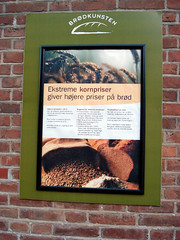
Danish bakery poster on rising bread prices. Doesn't mention "climate change" or "global warming" but blame the Chinese for buying our food, two years of bad harvests, biofuel, droughts in Southern Europe and empty granaries.