Showing posts with label China. Show all posts

Tuesday, January 08, 2013

Review: EARTH WARS - The Battle for Global Resources

"If the Earth wars were a sporting contest, here's how the half-time score might stand at the beginning of 2012..."
Georff Hiscock concludes his near 300 pages factual account of who owns the world with a surprisingly relaxed "scoreboard":
  • 1st: USA 10 points
  • 2nd: China 8p
  • 3rd - 4th: Europe, Japan 6p
  • 5th - 6th: Russia, India 5p
  • 7th: Brazil 4p
  • 8th - 10th: Mexico, Canada, Australia 3p
  • 11th - 14th: Saudi Arabia, Qatar, Kuwait, UAE 2p
  • 15th - 22nd: South Korea, Indonesia, South Africa, Nigeria, Turkey, Iran, Central Asian republics, Mongolia 1p
  • Vietnam, Venezuela, Colombia, Chile and some African countries also in 1st division but still no points
EARTH WARS is a concise business report on the current deals in global energy and metals production as seen from down under. It also mentions the main water disputes but does not go into details on food production controversies. It is a treasure trove of information and numbers on especially Asian contracts but often the most important situations from other important continents such as South America or Africa are mentioned as after little more than afterthoughts at the end of chapters.

It's business report like writing is it's strength and it's weakness. The "bullshit factor" is one of the lowest I have ever seen. In many ways this book is just pure reporting. However, at times it is a tough read. And occasionally I wonder if I better run double checks on some numbers: Having been flipping through numerous skeptical blogs, articles and books earlier, I am of the impression that repository estimations and future extraction plans are not always that crystal clear. Did Hiscock leave out some valid doubts somewhere?

To get an impression of what the book offers you can look at the contents on page "v". Or you can take a glance at the 27 lists in it, because the chapters are very much structured as walk-throughs of those lists. So, "Exhibit 3.3" is a top ten of Russian oil and gas companies (no. 1 is Gazprom) - well that part of chapter three is an ordered sequence of paragraphs briefing on the owners, sizes and belongings of those companies. Pretty much.

One gem of the book is it's quite detailed second chapter on "geographical flashpoints". This chapter contained the bulk of the info I needed for my "contested resource territories" map published yesterday (take a look!).

The book hardly takes into account climate change. That may seem weird, but actually Hiscock barely bother predicting the future. Which is actually quite a relief. As such, it is fair enough not to mention projected environmental impacts decades into the future. The demand for renewable energy, however, is mentioned. Compared to the focus on the business as usual going on with fossil energy the demand for renewable energy looks depressingly weak.

If I had used it for my own book, it would certainly be on my list of recommended reading. It's not for everyone, though. Those other books are typically more into storytelling (like witnessing pollution in Nigeria or dictatorships in South America) or typical popular science (past societal collapses, influence of climate change on geopolitics). Normal books. Geoff Hiscock's book is a business book that doesn't dream and doesn't imagine anything.

Either way, there is absolutely no reason to doubt a fierce global business war is raging over our natural resources. That much is very clear after Hiscock's documentation. As documentation of this situation the book is a very valuable contribution. But it's not exactly edutainment.

 
Geoff Hiscock (2012): EARTH WARS - The Battle for Global Resources at Google Books, book website.


Thursday, June 28, 2012

Greenland to export uranium & rare earth minerals to China?

Perhaps you have already heard oil corporations are looking for oil in the Arctic seas around Greenland. But also the Chinese show some interest in Denmark, Greenland's mineral wealth especially. Greenland holds untouched resources of uranium which pose a dilemma to the nuclear free kingdom. Recently, Hu Jintao visited Denmark and Danish politicians visited China.
"I hope we can soon change the zero tolerance [towards nuclear industries] and have the uranium that we have extracted, instead of being an Arctic open-air museum." - Doris Jakobsen, Greenland politician
"Such production will be a game changer for the otherwise non-nuclear kingdom that is uninformed and virginal in this area. It will raise the kingdom's importance internationally because it will be a [world top-10] producer. Historically we've been spared from considering this." - Cindy Vestergaard, researcher at DIIS
"I don't think there are countries eager to obtain uranium for nuclear weapons use. Despite that uranium could still be spread. But countries that would be interested in uranium for weapons have been able to get it all the time." - Per Kalvig researcher at GEUS
Quick Google Translate aided quotes from Information.dk / Skal Grønland være storeksportør af uran?

Greenland Mining and Energy Ltd looking for uranium in Narsaq, south Greenland.

"We were allowed to talk about Greenland's autonomy to the members of the local [Tibetan] government and Communist Party, and there was great interest from people in Yushu." - Doris Jakobsen, Greenland politician
Quick Google Translate aided quotes from Information.dk / Grønlandsk varsomhed over for Kina


Sunday, November 27, 2011

War for territory - World tour November 2011

We live in peaceful times. Conflicts being linked to something as mundane as natural resources is a conspiracy theory. Just kidding...

Cambodia: Villages razed to clear land for sugar plantation
Amnesty International and other organisations have exposed the Cambodian authorities' systematic failure to protect people from forced evictions. Forced evictions in the name of economic development now occur regularly across Cambodia, as local elites and foreign investors seek to capitalize on a newly privatized land market and take control of the country's natural resources.


Colombia: Tribes flee civil war and gold miners

About 10% of the hunter-gatherer Awa tribe have fled their ancestral mountain homes in the past decade. Some now survive as subsistence farmers on small lots provided by the government.

The tribe has been fighting palm oil plantations encroaching on their land for about 16 years, the civil war between leftist FARC and the government has produced an extremely dangerous territory including indigenous grounds littered with landmines and lately gold mines have taken away even more land and polluting its surroundings.


Read: BBC / Colombia's indigenous peoples face uncertain future, SOS Childrens' Villages / Dealing with the threat of landmines in Colombia.

Peru: Indigenous tribes protest planned gold mines

Several protesters were injured on November 25th when police dispersed anti-gold mine demonstration with tear gas. The US-based Newmont Mining Corporation plan to reconstruct local water flows used in farmers' irrigation. Locals protest mining projects throughout Peru and injuries are not uncommon.
"Companies come here, take the gold and then go away - just like in colonial times. People feel cheated." - Jorge Rimarachin


Read: AFP / Peruvian gold mine, locals clash over resources , MercoPress / Peruvian peasants clash with police to protest against gold mine in the Andes.


Sudan - South Sudan border: Ethnic cleansing?

After a brief spell in international media as a success story, newly founded South Sudan is now fighting a "war by proxy" paramilitaries with Sudan. The latter appear to currently be evicting certain ethnic groups.


SAF Aircrafts at El Obeid Airbase
DigitalGlobe imagery shows the presence of Antonov An-26's and other aircraft at El Obeid Airbase on 14 November 2011.

The Sea: The race for off-shore resources intensifying world wide

One third of oil production is now off-shore and the rate is climbing. Resources are found in the Arctic, in the South Chinese Sea, in the Mediterranean and elsewhere. Chinese and Turkish warships circle Vietnamese and Israeli drilling ships and platforms in each their own gunboat diplomatic efforts. These countries as well as the US, Russia and others are investing in new aircraft carriers, cruisers and destroyers.


Read: The New York Times / A New Era of Gunboat Diplomacy.


All just one big hoax. All of the above from the month of November 2011.


Sunday, October 16, 2011

Obama intervenes in Ugandan oil trouble zone

Oil have been found in the underground below Lake Albert on the border between Uganda and the Democratic Republic of the Congo. Western companies are working with the Ugandan government to get development under way but a myriad of issues seem to delay the project: Criminal and rebel activity is up and rising, Ugandan democracy is struggling for control with the shady closed door negotiations and now US troops enter the picture. Al Jazeera summed up the situation in less than two minutes, October 14th:


Recipe for an oil war

Heritage Oil and Tullow Oil are guessing the 2.5 billion barrel or larger field is the largest onshore field found in sub-saharan Africa in more than two decades. Production of 150,000 barrels of oil per day by 2015 place Uganda among top 50 oil producing nations is planned. The latter company, Irish Tullow Oil, is now accused of having bribed three Ugandan ministers with 100 million USD in July 2010 in return for concessions. The ministers resigned October 2011. Tullow denies allegations, maintain an anti-bribe image and have funded a lake rescue station which they claim have already saved the lives of more than 70 local fishermen. Also in the deal are French Total and Chinese Cnooc. Those corporations are expected to claim 2/3 of the 3-4 billion USD hoped to be made annually.

A leaked US embassy cable (Wikileaks, #08KAMPALA393) reveals Uganda have been asking for help stepping up security in and around the oil rich area. John Morley of Tullow Oil is quoted for saying that as oil activity on Lake Albert increase a security presence would be vital. The cable mention "several clashes on Lake Albert between oil companies and entities from the Democratic Republic of Congo (DRC) demonstrate that oil production has increased local tensions and exacerbated cross-border hostilities". In 2007 a British drilling platform worker was killed by Congolese soldiers who claimed the barge had strayed into Congolese waters. Although the Ugandan and Congolese governments are talking and are in agreement concerning the precise geography of the border the armed forces on the Congolese side of the border are not always government-related.

An intervention overdue?

Several militias fight in the area and in just recent months thousands have had to fled their homes, hundreds have been kidnapped. Adding to the Congolese militias the Democratic Liberation Forces of Rwanda (FDLR) rebels as well as the infamous Lord’s Resistance Army (LRA) led by Joseph Kony add to the insecurity. FDLR is a Hutu group whose two top leaders are held in France and Germany on charges of crimes against humanity yet whose troops raped at least 154 civilians from July 30 to August 3, 2010, in the town of Luvungi. LRA is the Ugandan theocratic militia of self-proclaimed prophet Joseph Kony, who claims to be acting on orders from spirits sent by God, and whose ranks have been inflated by an estimated 66,000 children abducted for soldiering. October 2005 the International Criminal Court (ICC) issued arrest warrants on Kony and four other leading members of LRA; the 33 charges include murder, enslavement, sexual enslavement and pillaging.

Recently, the Ugandan presiden spent US$780 million on six Russian jet fighters. A decision that raises eyebrows in a country with a GDP of less than 500USD per capita.
"We don’t live in an enemy-free neighbourhood. So, don’t look at the purchase in terms of cost. The Great Lakes region is one of the most unsafe regions."
- Ugandan presiden Yoweri Museveni

Since 2008 the US have donated more than 40 million USD on supporting the Local counter-militia efforts. And now 100 Green Berets have been sent as military advisers for the governments of the region. They are receiving a warm welcome.

"For 20 years, the government of Uganda has been pleading with our American and European friends to help in the LRA problem, because these are international terrorists. We wanted our friends to help in providing technical support — such as intelligence — because they have the best."
- Uganda's acting foreign minister Henry Okello Oryem

"Any support to tackle the LRA is a good move [...] South Sudan is already working with Uganda's army in operations against the LRA, and we will be pleased to work with anyone who can help us combat the threat [...] We have large communities whose lives are ruined by these rebels, so the sooner we can end this once and for all will be something we will look forward to."
- South Sudan army spokesman Philip Aguer

"The Central African Republic today more than needs external assistance like that of United States [...] Many hundreds of our people have been killed, others kidnapped or displaced, their homes ransacked, destroyed, their possessions looted. It is unbearable."
- CAR Deputy defence minister Jean-Francis Bozize

Thus, the link between the US troops and the oil is still a "conspiracy theory". Obama and the US is simply making friends while helping the world get rid of monsters. Human Rights Watch has advocated for intervention for years.


Yet at home knee-jerk reactions are dominated by right-wing isolationism/grudges and left-wing anti-war sentiments.

The enemy within

A recent report, "Oil Extraction and the Potential for Domestic Instability in Uganda", warns about other dangers than cross-border guerrilla warfare: the possible side-effects of a sudden large scale resource industry entering a developing economy. President Museveni, who first seems to have orchestrated the addition of a third presidential term to the constitution then won a low turnout election disputed by international observers, is already speaking of "his" oil.

"If Museveni gains access to substantial oil revenue, the combination of considerable oil funds and strong presidential powers could increase the ability of his government to remain in power indefinitely. [...] Increases in corrupt behavior would essentially require secrecy in government dealings. A reduction in government transparency in oil and tax revenue management would then incentivize Museveni’s government to become increasingly autocratic in its relationship with the public and political opponents, as has so often been the pattern in other oil producing states."

Also, susceptibility to the Dutch Disease should be considered:

"If the government does not reinvest revenues into public works to soften the blow of economic change, domestic instability may ensue [...] The poor and disaffected youths are the most likely to turn to violence in order to redress socio-political grievances. A young, growing, and increasingly urban population indicates the potential for civil strife in Uganda. The added stress of urban migration associated with oil production may only exacerbate the dynamics behind civil strife. [...] If Museveni’s government makes its decisions public and is held accountable, it is more likely to choose anti-corruption policies that are favorable to the public interest."

The report estimate the risk of civil war in Uganda as 1.96% if the new found resource wealth is handled wisely, 14.05% if not. Dutch Disease effects could be both mitigated and worsened by the fact that multiple industries are likely to boom: in 2010 firms from Russia, China, India, Australia and South Africa started operating in Uganda after finds of copper, iron ore, cobalt, tin, gold and platinum.

"We must be Africa’s Norway. We must manage our oil resources in the stellar manner in which Botswana has managed its wealth from diamonds."
- Bank of Uganda Governor, Emmanuel Mutebile

We haven't heard much from the hopeful Iraqi politicians who once voiced similar intentions with their oil. However, it does seem Obama is at least trying to do better than his predecessor(s). And if a US president can't even go to war against someone as evil as Joseph Kony he truly can do nothing at all - yet, who knows if the Tea Party will side with Kony and his lunatic army?


View Larger Map

Sources include: The Independent (Uganda) / Oil could cause war, Capital News (Kenya) / Uganda welcomes US troops to hunt rebel leaders, Sunday Monitor (Uganda) / Here is what is at stake with Uganda’s oil, The Atlantic / Why Is Obama Sending Troops Against the Lord's Resistance Army?, allafrica.com / Uganda: Scramble for Minerals Begins.


Monday, July 11, 2011

Ecowar 2.1

Don't panic, you're at Ecowar. I merely changed the good old custom tweaked and heavily bloated design for a fresh standard one.

I'm also trying out some new stuff. Some stories develop too fast for a one-man blog to follow. But on the new page Inside the wire, under the radar the job is done by 'the crowd' and me curating content using Keepstream. For now I'm doing a stream about the Spratly Islands but plan more (any suggestions?).

In somewhat related news, I also set up a Benno Hansen Weekly at paper.li. Why? Well actually paper.li could be even smarter than Keepstream (comparing apples and oranges here) in that it does the job for you. If you sign up, it produces a "paper" for you based on which links the people you follow have been tweeting. Meaning, now I can check paper.li once a week and get an instant overview of what I "should" have been reading at Twitter (but perhaps didn't because it's almost impossible to keep up with). I'm trying to make it favor Ecowar related news.

Update: Due to popular demand the old background is back. It shows old barbed wire in Normandy with green grass and flowers underneath in stead of mud, blood and carcasses - White Flowers by Reid Gilman. Couldn't handle the grey overload and dystopia anyway :-)

White Flowers


Wednesday, June 22, 2011

China: Two coal miners sentenced to death for killing locals who protested pollution

A court in China's vast northern region of Inner Mongolia has sentenced to death a coal mine worker for killing a resident who had complained about pollution [...] Earlier this month, a court in the same part of Inner Mongolia ordered the execution of a man for murdering an ethnic Mongolian herder who had also protested against coal mine pollution, a killing that set off days of rare protests.

This past month five environmentalists have been murdered in Brazil. Police are - apparently - clueless.

Sources: Yahoo! / Chinese man gets death in pollution protest case, AP / Chinese sentenced to die for Mongol herder's death


Thursday, March 24, 2011

Asia: Oil, climate, conflict

A British company has been surveying for oil by Philippine request in waters China says is theirs.

Energy & Capital / China's Next Oil War:
China’s energy demand is insatiable. The country's state-owned oil firms are on an international buying spree and a disputed group of islands in the South China Sea could be the catalyst for the next oil war. [...] Learning from the West, China is picking up a big stick and enforcing its territorial claims... After all, the West has a long history of military adventures regarding rebels who sit on oil patches. [...] Today, China warned against any oil exploration without its consent in waters it claims in the South China Sea. This comes after a Philippine announcement that Forum Energy had completed a seismic survey for a piece of ocean near the Spratly Islands. The next step would be drilling. The oil-rich Spratlys are contested by Brunei, Malaysia, Taiwan, Vietnam, the Philippines, and China. [...] The Spratlys are a group of 100 islands that cover 410,000 square kilometers. Some 45 of these islands are occupied by small military units. In recent years, various countries have been building airstrips and bunkers to protect their claims — which, up until recently, have been used as fishing stations and scuba Meccas. But battles have been fought in the past... Strategypage.com, a historical military website, writes: "In 1988, China and Vietnam fought a naval battle, off the Spratly islands. The Chinese victory, in which a Chinese warship sank a Vietnamese transport carrying troops headed for one of the disputed islands, was followed by Chinese troops establishing garrisons on some of the islands. In 1992, Chinese marines landed on Da Lac reef, in the Spratly Islands. In 1995, Chinese marines occupied Mischief Reef, which was claimed by the Philippines." It is clear China intends to defend its claims over the Spratly islands. It is unknown how these conflicts will be resolved. [...] Oil is the lifeblood of the world economy. Eight of the last nine recessions in the U.S were preceded by high oil prices.

Elsewhere: AFP / China warns against S. China Sea oil exploration, Philippine Star / China's military dominance over Spratlys affecting international trade.

In slightly related news, I just updated my collection of climate change and COP-15 related cables in the Wikileaks "cablegate". This time a headline from a Japanese agenda dated 26th of June 2009 read: "Japan-U.S. Sea Power Dialogue [...] Study the possibility of the security environment worsening due to climate change."


Friday, July 02, 2010

The Last Oil Shock

The Last Oil Shock: A Survival Guide to the Imminent Extinction of Petroleum Man  by David Strahan had been on my wishlist at Amazon for about two years when I found it at a library sale for 2 euros.
It has an official website, as well as a two minutes video trailer:


Rather than a review, below is a selection of quotes from its extensive sources.


Quotes from the Preface

"I don't like the thought that oil production will peak and decline any more than I like the thought that I am going to die. But both are facts."
- Jean Laherrere, former oil explorer for Total
"[We face a] major historical discontinuity, by which I mean civilization itself is under threat."
- Colin Campbell, formerly working with BP, Texaco and others

Quotes from chapter 1: Sources in Washington

This is the chapter you must desperately avoid reading if you cling onto one of the usual excuses for attacking Saddam's Iraq. Full of interesting details, below is just a few choice quotes in chronological order:
January 26, 1998 PNAC sends a letter to President Bill Clinton:
[...] if Saddam does acquire the capability to deliver weapons of mass destruction, as he is almost certain to do if we continue along the present course, the safety of American troops in the region, of our friends and allies like Israel and the moderate Arab states, and a significant portion of the world’s supply of oil will all be put at hazard.
Signed by, among others, Donald Rumsfeld.

Louis Christian, an independent oil repository cartographer, was hired to chart Iraq in year 1998. Via the US Geological Survey but for who and what exactly?
"It seems to me the most likely suspect would be somebody high up in the administration that had a virtually unlimited budget that they don't have to itemize. Most likely the CIA or Pentagon."

November 1999 Dick Cheney gave a speech at Institute of Petroleum:
"[Demand is growing but production is declining so] where is the oil going to come from? [...] the Middle East with two thirds of the world's oil and the lowest cost, is still where the prize ultimately lies, even though companies are anxious for greater access there, progress continues to be slow [because of] US-imposed economic sanctions."
When George W. Bush took office with Cheney, Rumsfeld and other neo-cons Louis Christian's map was discussed at one of the very first meetings held. The Cheney Energy Task Force "melded" or "conflated" the "capture of new and existing oil and gas fields" with "policies towards rogue states" - which was revealed by Judicial Watch.
"We were acutely conscious of the fact that Saddam had carved up all the oil exploration deals and contracts with big non-US and non-UK multinationals."
- Carne Ross, former British in UN
That is the deals that would settle if sanctions were lifted and the run-down Iraqi oil sector hadn't damaged its oil fields before that.

The Iraq war happened. Colonel Gaddafi of Libya got the message, publicly 'renounced' weapons of mass destructions and took the unique step of offering 15 contracts for oil exploration to foreign companies, 11 of which were given to US firms.

Chapters 2 and 3 deals with peak oil itself. But mostly just experts admitting it's on its way. David Strahan isn't just one rogue journalist with a crazy idea; the other day - by coincidence - I saw this short video about peak oil:

Quotes from chapter 4: Long fuse, short fuse

Chapter four discusses which of the two oil issues - climate change and peak oil - is the biggest. It begins with an interesting anecdote: 16th of February 2005 Greenpeace decided to celebrate the Kyoto Treaty by setting off rape alarms attached to helium balloons inside the International Petroleum Exchange in London and raising a banner saying "Climate Change Kills. Stop Pushing Oil" outside. However, the traders reacted with fierce violence:
"They just went wild. They were trying so hard to hit us they fell over one another. "
- Greenpeace activist
"[Having a metal bookcase pulled down my head] wasn't great but it made a kind of barrier between us and them."
- Greenpeace director, Stephen Tindal
Stock exchange traders reacting to environmentalists with violence - just like fishermen, miners and lumberjacks.

The chapter ends with a former Greenpeace chief scientist's agreement with one of the postulates of the book - that the last oil shock will be a crisis every bit as profound as climate change:
"They're both problems that threaten the future as we know it, so I wouldn't like to draw a distinction. They certainly have different length fuses, but they're both large weapons of mass destruction. [...] Yes, of course, absolutely [peak oil has the shortest fuse]. If we were sensible, logical, joined-up thinkers, which we're not [we'd concentrate on peak oil]."
 - Jeremy Legget, geologist, author and more

The finer details

David Strahan then spends about 130 pages chronicling the many curious influences oil has on world society, the many small signs the oil hegemony is cracking up and the futility of attempts to do something about it.

Chapter 5, page 115 the US unemployment rate is linked to (correlated, explained) the oil price. And just consider what other things unemployment is linked to.
"There are good reasons why oil shocks hurt. When the oil sheikhs gets more of the world's money, someone has to end up with less. Profits drop, firms begin to go out of business, people lose their jobs."
 - Professor Andrew Oswald, Warwick University
Chapter 7, which is about OPEC and how it is lying about the volume of its resources, page 170 and onwards the fragile position of the Saudi Arabian monarchy is discussed (emphasis in bold added by me):
It's not hard to see why Saudi Arabia might want to exaggerate the scale of its oil resources; the position of its royal family demands it. For decades the fundamental contradiction of Saudi Arabian society has been that a population that largely adheres to Wahabism, the most puritanical, fundamentalist and xenophobic sect of Islam, is ruled by a royal family that is venal, bloated and Westward-leaning. The absolute monarchy has only managed to survive because its control of the oil has allowed it to buy American protection, and to bribe its own people. [...] Saudi Arabia's revenue from oil exports, which account for three-quarters of its income, collapsed [by 80% from 1980 to 2004...] half the population is under twenty-one, and the unemployment is thought to be as high as 25 per cent. There are frequent acts of terrorism and attacks on the security forces [...] The house of Saud has every reason to be terrified that it will soon go the way of the Shah of Iran. In these circumstances the royal family needs American protection more than ever before. 
Saudi Arabia's security pact with America was famously sealed when Roosevelt met Ibn Saud on his way back from the Yalta conference in 1945. Saudi oil production was negligible at the time, but US officials had already concluded that Saudi reserves constituted 'a stupendous source of strategic power, and one of the greatest material prizes in human history'. Although the meeting on board a US warship in the Suez Canal went unminuted, it is widely thought the two reached an understanding that has apparently survived to this day: America would guarantee the security of Saudi Arabia - and in effect the house of Saud - and in return the Saudis would guarantee US access to their vast reserves. In any event, successive US presidents have behaved as if that was the arrangement, providing the Saudis with billions of dollars in arms for both national defense and internal security. And Bush the Elder took America into the first Gulf War explicitly on that basis, declaring 'the sovereign independence of Saudi Arabia is of vital interest to the United States'.
There is no meaningful way to do an 'Ecowar excerpt' of chapter 8, Interesting Times, because it's relevant in its entirety. Continuing where chapter 7 left off it begins with the story of a half-botched and mis-reported Al-Qaeda attack on a Saudi oil field then detailing the complex geopolitics surrounding Mid East oil, Chinese influence especially. However, here is one of the more disturbing quotes, one that reminds us why it's a good thing Obama is in the White House:
"From the Bush administration's point of view, there is only one obvious and immediate way to alter this unappetizing landscape [ie of Iran-China deals] - by inducing 'regime change' in Iran and replacing the existing leadership with one far friendlier to US strategic interests."
- Professor and author Michael Klare
Or how about this one, page 182:
The world has never seen a problem like [peak oil]. Without massive mitigation more than a decade before the fact, the problem will be pervasive and will not be temporary. Previous energy transitions (wood to coal, coal to oil) were gradual and evolutionary; oil peaking will be abrupt and revolutionary.
OK, what internet crackpot said that? The US Department of Energy did in its Peaking of World Oil Production report. The chapter continues with many details of the economic battle already having raged for years. At times it's a bit eerie as some of its year 2006 predictions resemble what we are beginning to see in 2010, ie in the house prizing bubble that isn't exactly re-inflating.

Like the rest of the book chapter 9, Memo to Mr Wicks, is themed around one of the major dichotomies, conflicts or scandals in the subject. In this case the discrepancy between some of the ridicule the author received while researching the book and some of the most grave expert warnings. Like the one from the US Army Corps of Engineers:
Oil production is approaching its peak; low growth in availability can be expected for the next 5 to 10 years. As worldwide petroleum production peaks, geopolitics and market economics will cause even more significant price increases and security risks.
Finally the two last chapters are comprised of recommendations for politicians and people respectively. I'll leave those with a recommendation of the book - but no, one of his recommendations isn't "suicide by oil".

Update on the Iraqi oil law - and "alien scientists"


Since my choice of quotes focussed on the Iraq "liberation" it's only fair to finish with a video clip about the Iraqi oil law.
I also came across this next one more typical of the "YouTube underground":


Monday, June 21, 2010

The Growing Problem Of Oil Theft In China

China may be leaking more oil and gas from its pipeline network than any country in the world, much of it because of criminal activity.
the biggest and least-known problem is oil pilferage by thieves who drill into oil pipelines. This is the cause of at least 40 percent of China’s oil pipeline leaks. This criminal activity started in the early 1990s and it has never stopped since. Although alarm systems are installed along the pipelines, men have to be used to prevent oil theft.
Oil theft from pipelines has become so widespread that even undersea pipelines are being attacked. In 2006, both oil and gas pipelines at the bottom of the sea in the Shengli oilfield were drilled and 70 barrels of crude oil were stolen. But much more oil was spilled and that leak caused serious pollution in the area. The government came down hard on the perpetrators and two were executed. The Shengli oilfield had to pay hundreds of millions of dollars to fix the damaged pipelines, clean the seawater pollution and compensate local farmers.
Sometimes local police and security personnel side with the oil stealing criminals or even become their accomplices.
the rewards are too great for criminals to quit, even at the risk of the death penalty.

Tuesday, September 29, 2009

100 Places to Remember - at least 8 of which are to die for

Having wandered through the exhibition at Kongens Nytorv in Copenhagen and now also enjoyed the accompanying book of 100 Places to Remember Before They Disappear I can't help but take note of a couple of them here.

Because the descriptions in some cases explicitly mentions conflicts. Granted: Many will change with potential drastic consequences. Be it because they become uninhabitable, hence sources of climate change induced migration, or become unsuited for agriculture, leading to loss of food production with all the negative consequences of that. Or because of any of the other potential negative changes. But most are "just" pretty spots that will change due to climate change.

DSC06551x

In chronological order of the book, the spots that are related to conflict by the 100 Places project:

#11 The North Pole, Russia/Canada/Denmark


As the Arctic thaws resources of oil, gas and minerals become increasingly available for extraction. But whose resources are they?

#16 Tian Shan, Kazakhstan/Kyrgyzstan/China


The glaciers atop this mountain range provides the water for the breadbasket and powerhouse of Kazakhstan. But due to miniscule drops in precipitation through the last 50 years they have shrunk by 36% already. Climate change will most likely accelerate this drastically. Competition for the remaining water resources will intensify. Neighbours some seriously troubled regions.

#26 Lake Chad, Chad/Cameroon/Niger/Nigeria


This lake is basically an essential source of life in a very arid region of all more or less "failed states". Competition between tribes and nations already intensifying as the lake is drying up rapidly.

#30 Kalahari Desert


Also drying up even beyond what it already is this desert is the last refuge of the die hard San people. But climate change could be the final blow to their basis of existence.

#68 Bering Sea, Russia/USA


This sea is the source of some 2 billion US dollars worth of fishing shared by Russia and USA. But as the waters warm the ecosystem and biodiversity is changing completely. At the very least the fishermen will have to go elsewhere or catch different fish. The worst... well... will begin with trade negotiations, I assume.

#79 Kordofan, Sudan


We've all heard of Darfur. Over and over again. And I've pointed to the vicious cycles between environmental degradation. But I guess Darfur is no longer pretty enough for a photograph in a project like 100 Places? Anyway, Sudan also has a big forest of "hashab" trees (Latin: Acacia senegal) which is the source of the largest production of rubber in the world. But business is slow both because of the nearby Darfur trouble, drought and rising temperatures which has caused a severe decline in forestry productivity. When this region of Sudan also loses it's livelihood...

#84 Niger Delta


This is "all of the above". Beautiful nature, oil pollution, ethnic violence, mass poverty, multinational corporations, rising seas, increasing storms, decline in freshwater availability, increased diseases spreading... huge chance of migration.

#87 Amman, Jordan/Israel/others


Well it's in the Middle East. Historically ideal situation for a fertile capital. But now human over-use of water resources and climate change is lowering the water level of the Dead Sea by one meter per year because less and less water flows by the Jordan River. Agricultural land is turning into desert as you read this. A glance at a map and it becomes obvious this can become a very, very big problem.


All of the above issues will of course get intertwined with the other issues of some of the regions. Like the pipelines running through central Asia. The existing political and historical animosities between certain countries. Perhaps it's in the nick of time these photographs were exhibited. Soon the footage could be less pretty.

(This post is also posted as part of the TH!NK ABOUT IT #2 Climate Change blogging competition. Most of these places are also marked in my Ecowar Battlefields Google map.)

Thursday, September 03, 2009

China: Thousands riot over sewage pollution

That Chinese economic development is taking place more rapidly than environmental protection is no secret. Air pollution in larger cites have been among the worst in the world for years.

But a sewage leak was what finally sparked unrest in one town where for at least two years insufficient industrial water treatment has darkened river water and probably caused otherwise inexplicable cancer cases. Somewhere between 4,000 and 10,000 protesters clashed with 2,000 riot police leaving 10 injured and some property damage.

"The stench is awful. Nobody wants to buy our fish. We can't earn money. The fishing boats have been abandoned on the shore."
- Liu, local.


"Environmental quality is not satisfactory and environmental protection work is arduous."
- Zhou Shengxian, Environmental protection minister


Sources: New Tang Dynasty Television / 10,000 Clash with Police Over Sewage Pollution (with video), Guardian / Further anti-pollution riots break out in China, Telegraph / China riot: 10,000 villagers clash with police over industrial pollution
.

Friday, February 27, 2009

We're on the brink of disaster

Every outbreak of violence has its own distinctive origins and characteristics. All, however, are driven by a similar combination of anxiety about the future and lack of confidence in the ability of established institutions to deal with the problems at hand.

[...]

The riots that erupted in the spring of 2008 in response to rising food prices suggested the speed with which economically related violence can spread.

[...]

The cost of food is now closely tied to the price of oil and natural gas because petrochemicals are so widely and heavily used in the cultivation of grains.

[...]

zero economic growth in the developing world and rising food prices -- and you have a perfect recipe for unrelenting civil unrest and violence.

[...]

Statistical modeling shows that economic crises increase the risk of regime-threatening instability if they persist over a one to two year period

Sunday, February 01, 2009

Indian analysis: "USA might have benefited a great deal from its [lost] war in Afghanistan"

What hits Russian interests most is that if the Caucasian route materialises, the US would have consolidated its military presence in South Caucasus on a long-term basis. Ever since the conflict in the Caucasus in August, the US has maintained a continuous naval presence in the Black Sea, with regular port calls in Georgia. The indications are that the US is planning a carefully calibrated ground presence in Georgia as well. Talks are in the final stages for a US-Georgia Security and Military Agreement. US Deputy Assistant Secretary of State Matt Bryza visited Tbilisi for consultations in this regard.

Another dramatic fallout is that the proposed land route covering Georgia, Azerbaijan, Kazakhstan and Turkmenistan can also be easily converted into an energy corridor and become a Caspian oil and gas corridor bypassing Russia. Such a corridor has been a long-cherished dream for Washington. Furthermore, European countries will feel the imperative to agree to the US demand that the transit countries for the energy corridor are granted NATO protection in one form or the other. That, in turn, leads to NATO's expansion into the Caucasus and Central Asia.

Sunday, December 21, 2008

"Conflict over resources could reemerge"

GLOBAL TRENDS 2025: THE NATIONAL INTELLIGENCE COUNCIL'S 2025 PROJECT


"Aging populations in the developed world; growing energy, food, and water constraints; and worries about climate change will limit and diminish what will still be an historically unprecedented age of prosperity.

[...]

In terms of size, speed, and directional flow, the transfer of global wealth and economic power now under way — roughly from West to East — is without precedent in modern history. [...] First, increases in oil and commodity prices have generated windfall profits for the Gulf states and Russia. [...] If current trends persist, by 2025 China will have the world’s second largest economy and will be a leading military power. It also could be the largest importer of natural resources and the biggest polluter.

[...]

Resource issues will gain prominence on the international agenda. Unprecedented global economic growth—positive in so many other regards—will continue to put pressure on a number of highly strategic resources, including energy, food, and water, and demand is projected to outstrip easily available supplies over the next decade or so. [...] Lack of access to stable supplies of water is reaching critical proportions, particularly for agricultural purposes, and the problem will worsen because of rapid urbanization worldwide and the roughly 1.2 billion persons to be added over the next 20 years. [...] Climate change is expected to exacerbate resource scarcities. Although the impact of climate change will vary by region, a number of regions will begin to suffer harmful effects, particularly water scarcity and loss of agricultural production. [...] Agricultural losses are expected to mount with substantial impacts forecast by most economists by late this century.

[...]

Types of conflict we have not seen for awhile — such as over resources — could reemerge. Perceptions of energy scarcity will drive countries to take actions to assure their future access to energy supplies. In the worst case, this could result in interstate conflicts if government leaders deem assured access to energy resources, for example, to be essential for maintaining domestic stability and the survival of their regimes. However, even actions short of war will have important geopolitical consequences. Maritime security concerns are providing a rationale for naval buildups and modernization efforts, such as China’s and India’s development of blue-water naval capabilities. The buildup of regional naval capabilities could lead to increased tensions, rivalries, and counterbalancing moves but it also will create opportunities for multinational cooperation in protecting critical sea lanes. With water becoming more scarce in Asia and the Middle East, cooperation to manage changing water resources is likely to become more difficult within and between states.


And that's just from the summary. Chapters 4: Scarcity in the Midst of Plenty? and 5: Growing Potential for Conflict no doubt has plenty more for Ecowar. The report appears rather US centric and conservative though.

Also see...
BBC / US Global Trends report: Key points
Global Trends 2025, a new report written by the US National Intelligence Council (NIC) ahead of President-elect Barack Obama's inauguration, envisages a future world marked by diminished US power, dwindling resources, and more people.

The NIC, an independent government body, emphasises that its report is not about "crystal-ball gazing" but offers a range of potential futures, including the following key trends.


Blog "Tragedy of the Commons" / Global Trends 2025
Reports like these really cause me concern. This is not some crazy doomer on a wacko peak oil message board. This is a consensus of top American Intelligence Community officials.

Friday, March 07, 2008

Climate change and conflict frequency

The cornerstone of this blog here is a peer reviewed correlation of climate and war in historical China: see my first post from July 2007. I just wrote a thorough summary of the article at Shvoong.com; here's a shorter version and my own take on it.

Short summary


Zhang's study is a thorough mathematical correlation from climate to war frequency done on a macro-historical level. Warfare has already been theoretically described as an adaptive ecological strategy of humankind in situations of limited resources. Zhang provides some empirical evidence to go with the theory. The hypothesis of the study is that climate changes has catalyzed historical events by it's importance for agricultural productivity, and that temperature is the most important climatic factor due to it's very direct effect on growing season lengths, precipitation reliability, summer warmth etc.

The data used for the analysis are comprised of China's extensive historical records literally body counting 3 millennia back in time and a set of five different weather data measurements merged into one. The war data was pruned to 899 wars between year 1000 and 1911. The weather data synchronized with emphasis on the most reliable methods all of which correlate beautifully in regard to oscillations. Population data are available from year 1741 to 1851 "only".

The cold periods are defined by time frames of significantly low average temperatures. The cyclical pattern and the correlation is not just an abstract figure somewhat closer to 1 than 0. It is quite obvious how cold phases coincide with periods of high war frequency. The war periods generally lag the onset of cold phases by 10 to 30 years which makes sense since it would take some time for the reduced agricultural productivity to manifest as resource limitations and overpopulation.

The study goes into more detail; ie correlations are particularly strong for wars of type "rebellion" and stronger in the (wet, warm) south than in the (arid, cold) north. The north-south difference is explained by historical attitudes towards migration. Population growth is seen to rise (to 1.3%) during the 1741-1805 warm phase and drop (to 0.6%) during the 1806-1850 cold phase.

Zhang argues past research has been simplifying history, reducing causes of warfare to financial, political and ethnic ones while largely ignoring the ecosystem. Zhang emphasizes how current global warming is different from the warm phases of his study. However, his last words are that even if the developed world gets by most people still rely on simple farming techniques that are highly susceptible to ecological stress and that shortages of essential resources may "very likely" trigger future conflicts among groups of people.

Ecowar?


So, what does Zhang tell Ecowar? "Keep blogging"! Zhang must have been looking at some inconclusive data wondering pretty much the same thing I'm wondering when looking at the news of the world.

I have posted a bit about Jared Diamond who's straight out explaining some violence with what's basically "ecological stress". While Zhang highlights temperature drops, what we're mostly seeing right now is issues sparked from a temperature rise, ie drought. My Darfur: Drought or Islamism? post has the whole issue in it's little nutshell. Just like the Chinese food shortages inspired "rebellion", rising food prices gets today's consumers "up in arms". The UN has read the writing on the wall and has analyzed the Security risk of climate change. Et cetera, click backwards in time on my blog if you like. There are also more peer reviewed research on the subject out there which I plan to blog some time.

My enthusiasm when beginning this blog was fueled by the publication of Zhangs study. Although all I'd read was a journalist's interpretation. That article has now been pulled from the web. At the same time I have grown as weary of pseudo-science and political rants dressed as science in the blogosphere. So what better opportunity to introduce my flashy new Research Blogging icon!?


ResearchBlogging.org

Zhang, D.D., Zhang, J., Lee, H.F., He, Y. (2007). Climate Change and War Frequency in Eastern China over the Last Millennium. Human Ecology, 35(4), 403-414. DOI: 10.1007/s10745-007-9115-8


This basically means my post is about a piece of peer reviewed scientific work that I have read and understand myself. As well as a number of other criteria you can check out at Research Blogging. Anyway, I hope I just reinserted my cornerstone.


Sunday, January 27, 2008

World's poor are up in arms over food prices

People are rioting in the streets over the spiralling cost of food, but what is causing the crisis?

[...]

There were street riots over the price of basic foods in Mexico and India last year, and in Jakarta, Indonesia, last week. China and Russia have slapped controls on food prices to prevent unrest and inflation. Low-income Americans are feeling the pinch of 10 per cent increases for bread, 19 per cent for milk. Italians boycotted pasta for a day last September in protest at a 7 per cent price ...


Read New Scientist / World's poor are up in arms over food prices (subscription required).


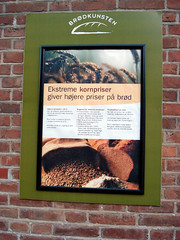
Bakery poster on rising bread pricesDanish bakery poster on rising bread prices. Doesn't mention "climate change" or "global warming" but blame the Chinese for buying our food, two years of bad harvests, biofuel, droughts in Southern Europe and empty granaries.

Monday, July 09, 2007

Chinese study correlates climate change with wars

Climate change, and the resulting shortage of ecological resources, could be to blame for armed conflicts in the future, according to David Zhang from the University of Hong Kong and colleagues. Their research, which highlights how temperature fluctuations and reduced agricultural production explain warfare frequency in eastern China in the past, has been published online in Springer’s journal Human Ecology.


Main points in short:
  • Wars throughout Chinese history correlated to cold periods in climate change cycles
  • Situations of "ecological stress" spurs conflict and should be taken into account in other historical reviews of war
  • In the future resource shortages could create conflicts and wars


The original article is available to subscribers only, but of course they have the abstract for free: Zhang et al: Climate Change and War Frequency in Eastern China over the Last Millennium. Human Ecology, 2007.

Search This Blog