THIS Syrian disaster is like a superstorm. It’s what happens when an extreme weather event, the worst drought in Syria’s modern history, combines with a fast-growing population and a repressive and corrupt regime and unleashes extreme sectarian and religious passions, fueled by money from rival outside powers
"The drought did not cause Syria’s civil war", said the Syrian economist Samir Aita, but, he added, the failure of the government to respond to the drought played a huge role in fueling the uprising. What happened, Aita explained, was that after Assad took over in 2000 he opened up the regulated agricultural sector in Syria for big farmers, many of them government cronies, to buy up land and drill as much water as they wanted, eventually severely diminishing the water table. This began driving small farmers off the land into towns, where they had to scrounge for work. [...] "State and government was invented in this part of the world, in ancient Mesopotamia, precisely to manage irrigation and crop growing," said Aita, "and Assad failed in that basic task."
For more about the invention of government to manage irrigation and granaries see Ecowar the book pages 13-14.
The best jobs in Hasakah Province, Syria’s oil-producing region, were with the oil companies. But drought refugees, virtually all of whom were Sunni Muslims, could only dream of getting hired there. "Most of those jobs went to Alawites from Tartous and Latakia," said Zakaria [Zakaria, teenager], referring to the minority sect to which President Assad belongs and which is concentrated in these coastal cities.
"We could accept the drought because it was from Allah," said Abu Khalil [cotton farmer, smuggler and Free Syrian Army commander], "but we could not accept that the government would do nothing." Before we parted, he pulled me aside to say that all that his men needed were anti-tank and antiaircraft weapons and they could finish Assad off. "Couldn’t Obama just let the Mafia send them to us?" he asked. "Don’t worry, we won’t use them against Israel."
For more Syria see Ecowar the book page 24 and click the Syria-tag on this present blog. Also, I have linked to about 40 articles about Syria from the twitter account.
One of the unpleasant effects of climate change is its tendency to incite further conflict where such already exist and in some cases war is already looming. Sociologist and writer Christian Parenti is blaming "pathologies of neoliberalism" and Cold War leftovers that converge with climate change effects for inciting further conflict where it already lingers. Already by now large parts of the political landscape are out of the target group of Parenti's message but he supports his assertion by way of his good storytelling based on personal experiences and interviews - and he finishes with an almost pro-capitalism conclusion.
Chapter 2 is pretty much a summary of some of the military reports I have linked to in Ecowar posts tagged 'military' plus a few other. Chapter 3 is a brief history of the US military which at first seems a bit thorough for a climate change book but actually shows how it has been on a long journey from conventional "European" warfare to guerrilla warfare inspired by North American Indian tribes and Ernesto "Che" Guevara. And ends up with a grim forecast (p. 36) of "the essence of militarized adaption to climate chaos: dirty war forever." In part, global counter-insurgency is an adaption to climate change that most of us wouldn't agree to if given the choice.
Part 2 is about Africa and describe how the Cold War proxy-wars have left unresolved conflicts now to converge with climate change effects, mostly via Parenti's own experiences visiting the areas. Most notably the stories from northern Kenyan herders who increasingly arm themselves to defend and raid cattle as droughts kill off livestock. Chapter 7 details the Cold War prequel to the current desert anarchy in Somalia. Chapter 8, the last of part 2, is a brilliant description of what a failed state is exactly.
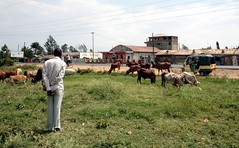
I traveled in Kenya January/February 2011. This photo is from the suburbs of Kisumu. I enjoyed the view over the Rift Valley and Lake Victoria. It is a bit chilling to read Parenti's stories from Kenya - in fact the book begins and ends with the corpse of a cattle herder left to rot under a tree and the questions of and answers to who killed him. All of the brutal incidents and trends in drought and plunder play out some kilometers away down the great valley.
Part 3 is about Asia and observes how in Afghanistan"the poppy economy and its armed defense are local adaption mechanisms" (wheat use six times more water than poppy which is worth 50 times the price). Chapter 10 is a rare insight to the conflicts in Kyrgyzstan - a lot more interesting than it may sound! Parenti then moves on to the India-Pakistan conflict of declining river flows, provoking dams, mass-murderous droughts, devastating floods, cross border state terrorism, suicide by pesticide Monsanto farmers and Maoist guerrillas. Very complex and under-reported in Western media yet clearly fueled by climate change.
Part 4 is about Latin America and the US. On page 181 Parenti's main message is summed up:
"catastrophic convergence: policies that create poverty and violence are now colliding with the new realities of climate change, and together these three forces are creating socially destructive forms of adaption."
Brazil and Mexico receive treatment in each their own chapters. Not just the always shockingly brutal gang violence is described, so too are more positive examples of coping: an example of organic agriculture and Keynesian economics. The efforts by Bolivia are hailed before the US is described in less than praising terms.
However, although being very critical of neoliberalism and in favor of state run initiatives to halt pollution and force clean technologies forward, Parenti is distancing himself from radical approaches involving revolutionary changes to the economy and society as we know it. First of all for a simple reason: There is no time. We need to start solving the climate problem now, thus we need to start doing it with tools known to work within the capitalist system. And it can be done, Parenti argues, because we have both the technology and the money. Fossil energies probably only have a lead right now because it has been so heavily subsidized for decades. And if there is money now for blowing up bubbles (housing, food etc) to create poverty as prices go up, unemployment and riots as the bubbles burst then, surely, that money could be redirected towards sustainable development.
Christian Parenti's Tropic of Chaos is a great book. Concise, well written and fair in reasoning. It isn't exhaustive as many conflicts from around the world are left untold of. It isn't academic as it assumes basic understanding of the climate, the economy and world affairs and simply move on with its stories from there while it doesn't dig into recent scientific results either. At times, perhaps, it's a bit too much a book of stories as Parenti shares many details of the converging issues. It is brave as it is critical of both the far-right media environment as well as of Bill "350" McKibben. Tropic of Chaos is the third book about how (not if) climate change is causing increased conflict I have read. If you want to read only one book about climate change and war this book should probably be it. (Alternatives are the more imaginative and dystopic Climate Wars by Gwynne Dyer reviewed here December 2010 and the scientifically precise and short Climate Conflict by Jeffrey Mazo reviewed here April 2011.)
Further reading/viewing for you right now: Large parts of the book can be read at Google Books. Also, Christian Parenti has given interviews on the book and its topics...
"The military runs scenarios of what the future will bring. What they see is not so much an increase in conventional warfare between states as an increase in humanitarian crisis, civil war, banditry, religious wars, state breakdown. And they realize that the armed forces will be called on to respond with various forms of low-intensity conflict: counter-insurgency, direct intervention, humanitarian intervention, shoring-up allied states, as well as increased training and advisory roles in these conflicts. [... In international negotiations] The United States has played a non-productive role, a destructive role. It has not taken the UN Framework Convention on Climate Change negotiations seriously, and as a result they have broken down. We are the largest economy in the world, and until recently we were the largest greenhouse gas emitter in the world before China overtook us. The world looks to the United States for leadership but U.S. actions, especially at Copenhagen, were really depressing. [...] What will change the U.S. position? Protest, clearly. There has to be a movement that forces the Obama administration to do this. The Obama administration is proving itself to be very right-wing on many issues, including this one."
Global patterns of civil conflict are directly associated with planetary-scale climate change. Specifically in tropical countries, the risk of civil war have just been shown to double in warmer El Niño years (to about 6% risk per country per year) compared to cooler La Niña years (when the risk is about 3%).
"When you think about it, car accidents happen all the time. But they become more likely based on some environmental conditions, like when it's raining or icy. [...] What we found is quite a bit stronger than a mere correlation."
- Solomon Hsiang
According to Solomon M. Hsiang and colleagues, however, all of the above evidence is 'anecdotal'. And it certainly isn't as concrete as their own work: Running a wide selection of statistical analysis methods on on the one hand a data set of occurrences of organized political violence of more than 25 battle-related deaths and on the other climatological records of the El Niño / Southern Oscillation (ENSO) phenomenon.
Looking into their analysis, the authors note how some conflicts seem to be re-occurring events and some seem to be merely 'displaced' in time, accelerated by the climatic shifts. Also, low-income countries are most strongly affected - but are they more at risk of climate induced conflict because they are poor and lack the means to mitigate the effects of environmental impacts? or are they poor because their political stability is sensitive to the ENSO cycle, perhaps even inherently unstable, conflict prone and poor because they are located where the ENSO climate pattern is strongest? Or is a third factor, not considered in this study, influencing or guiding the sensitivity to climate and poverty in relation to conflict proneness?
The increase in conflict risk during the about three degrees Celsius warmer El Niño years roughly corresponds to the decrease observed when average income is increased tenfold. So, could climate wars 'easily' be eliminated by raising the incomes in tropical countries by a mere 1000%? Hsiang and colleagues warn against generalization of their results to apply to global anthropogenic climate change without throughout discussions of climate-conflict links. Yet, perhaps they need not look far: weather directly influences the effectiveness of agriculture, the output of which determines food supply; and since food demand is not exactly down the recently identified link from food prices to risk of riots appears to be rather significant in this respect.
Hsiang, S., Meng, K., & Cane, M. (2011). Civil conflicts are associated with the global climate Nature, 476 (7361), 438-441 DOI: 10.1038/nature10311
How does rebel access to natural resources affect conflict? "How". Not "if". That is the question investigated by Päivi Lujala of the Norwegian University of Science and Technology, recently published in the Journal of Peace Research.
Or rather: Where previous research has either suggested a link or sought to explain it by an indirect effect through resource abundance tending to corrupt weak governments Lujala sets out to look closer at the influence of the more exact locations of the resources (something I believe for example Le Billon did already).
Lujala is confident enough to state in the introduction that "new data on localities of hydrocarbon fields throughout the world, shows that crude oil and natural gas directly affect rebel movements [...] easily extractable resources, such as gemstones, have an effect on rebel groups." The relationship is quantified - for example:
"If resources are located inside the actual conflict zone, the duration of conflict is doubled." And...
"oil and gas reserves have this effect on duration regardless of whether there has been production or not."
Regarding the initiation of rebellion "onshore [not offshore] oil production increases the risk of conflict onset by 50%."
And "secondary diamond production increases the risk of conflict onset by more than 40%."
One of the things I have been pondering is the simple distinguishing of states of societies in just two categories: in peace or in war. It is insufficient for intelligent discussion. Lujala is adding words to this argument: "natural resources, especially those that are easily exploited, provide motivation and means for rebel uprisings." In other words, rebellions may just be organized crime with political agendas attached. Of course, even more or less "legitimate" rebel groups could be driven to resource exploitation if their financial resources are exhausted in a prolonged conflict.
Hydrocarbons have traditionally been categorized as non-lootable as production usually requires substantial international industrial activities. But Lujala finds oil reserves even not in production does have effects and explains it by rebels potentially being "willing to engage in a long conflict [...] if the future price is large enough". While regarding reserves in production exceptions are seen in Nigeria where large scale looting occurs and in Columbia where rebels extort oil companies. However, note that regarding gas "production has no effect on conflict onset." Gas probably appears too hard to loot?
A look at the statistical analysis reveals how the data set was checked for influences other than profitable natural resources. The same tests are run for presence of mountainous regions, forest cover, language differences and difficult weather. It is worth noting that separatist conflicts (over territory rather than government power) and conflicts with one or more sides being democratic tends to last longer, while countries suffering from poverty and overpopulation are more prone to conflict onset.
Lujala, P. (2010). The spoils of nature: Armed civil conflict and rebel access to natural resources Journal of Peace Research, 47 (1), 15-28 DOI: 10.1177/0022343309350015
Also see Ross, 2004 which is mentioned by Lujala several times.
The event had an initial resource crisis: Too many spectators had showed up and in choosing between fighting over seats or exchanging the limited resource, the room, organizers fortunately chose the latter. Hence, the talk is also a bit chaotic (presentation projector starts 6 min into the talk, microphone 11 mins into it).
"The essential simple assumption would [be to] think: more temperature, more conflict. It's not that simple if you look at previous data. [...] there was a drop of conflict with the end of The Cold War despite the fact there was temperature rise. You cannot make that simple link here. Because conflicts have many reasons, not just global warming."
"[We] have looked at major conflict constellations that may be relevant in the future. One is water, one is food, one is natural disasters [...] the fourth one is migration as a factor. These could contribute each of themselves but also in their combination."
"The final choice [...] the world is facing: Are we moving towards [...] more environment destruction, more instability and war - and the link between these two - or are we moving toward [...] sustainable development, emission reduction, peace and security, and the [...] links between peace, security and [...mumbles...sustainable development]?"
The talks had this description in the Klimaforum09 programme:
Climate change will create both floods and draught and force millions of poor people to flee their homes. The world will be short of the basic needs of human beings. We will experience more conflicts about farmland, water and food. According to UN, 20 million people were made homeless because of climate related disasters in 2008. We need solutions that are social and global just and responsible. We need the money used on weapons of mass destruction and warfare to be transferred to social and sustainable development.
Dr. Joachim Spangenberg, Germany and Prof. Dr. Claus Montonen Finland also spoke. I'll post some clips of them later.
They promised to put their presentations online and I'll link as soon as I see them.
Writer Wendy Barnaby has written an essay for academic journal Nature in stead of a book for her publisher as the conclusion on "water wars" wouldn't sell. Some facts...
There are 263 cross-boundary waterways in the world. Between 1948 and 1999, cooperation over water, including the signing of treaties, far outweighed conflict over water and violent conflict in particular. Of 1,831 instances of interactions over international freshwater resources tallied over that time period (including everything from unofficial verbal exchanges to economic agreements or military action), 67% were cooperative, only 28% were conflictive, and the remaining 5% were neutral or insignificant. In those five decades, there were no formal declarations of war over water.
Three examples are explored a bit further: the Israel-Palestine, the India-Pakistan and the Nile water conflict situations. The Nile issue is about how the countries surrounding it were forced into cooperation following years of low level conflicts and the India-Pakistan issue on how cooperation has been set up in a treaty with the help of the World Bank despite the two countries being engaged in an ongoing military conflict. The Israel-Palestine issue is presented a bit weird:
it is foolish for Israel, a water-short country, to grow and then export products such as oranges and avocados, which require a lot of water to cultivate
Yes it is. Israel and most neighbours have water shortages but alleviate it by importing grain. There are a whole bunch of inconvenient truths not mentioned, but one is:
Palestinian and Israeli water professionals interact on a Joint Water Committee, established by the Oslo-II Accords in 1995. It is not an equal partnership: Israel has de facto veto power on the committee.
I'll dig out some more facts soon (in the mean time try my Israel and Palestine tags). But let's just note Wendy Barnaby's main conclusions:
Inequitable access to water resources is a result of the broader conflict and power dynamics: it does not itself cause war [...] predictions of armed conflict come from the media and from popular, non-peer-reviewed work
Undoubtedly true that main stream media is better at sensationalistic headlines than scientific journals. But is this move from simplistic causation to hen-or-egg discussion a bit too easy? I mean demand is very likely to go up, supply very likely to go down. Leading to cooperation or conflict.
water 'embedded' in traded products could be important in explaining the absence of conflict over water [...] as poor countries diversify their economies, they turn away from agriculture and create wealth from industries that use less water. As a country becomes richer, it may require more water overall to sustain its booming population, but it can afford to import food to make up the shortfall
most importantly, improve the conditions of trade for developing countries to strengthen their economies
Sure. That's what the WTO is for, right? ;-)
Barnaby, W. (2009). Do nations go to war over water? Nature, 458 (7236), 282-283 DOI: 10.1038/458282a
Every outbreak of violence has its own distinctive origins and characteristics. All, however, are driven by a similar combination of anxiety about the future and lack of confidence in the ability of established institutions to deal with the problems at hand.
[...]
The riots that erupted in the spring of 2008 in response to rising food prices suggested the speed with which economically related violence can spread.
[...]
The cost of food is now closely tied to the price of oil and natural gas because petrochemicals are so widely and heavily used in the cultivation of grains.
[...]
zero economic growth in the developing world and rising food prices -- and you have a perfect recipe for unrelenting civil unrest and violence.
[...]
Statistical modeling shows that economic crises increase the risk of regime-threatening instability if they persist over a one to two year period
Three decades of war and severe drought have already damaged the country's environment with widespread desertification and deforestation and loss of vegetation and wildlife, deputy head of Afghanistan's National Environmental Protection Agency said.
But now, overpopulation in Afghanistan's cities, the burning of poor quality fuel, thousands of imported old cars, no proper waste management or sewage system and a boom in construction, have worsened air pollution, Jarullah Mansoori said.
[...]
"We are three times more polluted than the other capitals in the region. If everything is left as it is now, after two or three years, we will not be able to live in Kabul, said Mansoori.
"We will have to leave for another place, where we can find clean air, clean water and clean food. This is called environmental migration. When environmental migration takes place then it's a huge social problem," he said.
Somalia's humanitarian situation has been deteriorating in recent months, amid an increase in attacks on the country's transitional government by opposition fighters.
People living in the country are losing hope as politicians in the government, which was once seen as the best possible chance for Somalia, argue among themselves.
In Somalia's agricultural region the situation could not be more dire, as Al Jazeera's Mohammed Adow reports.
A battle is unfolding on the stark mountains and scalloped dunes of northern Niger between a band of Tuareg nomads, who claim the riches beneath their homeland are being taken by a government that gives them little in return, and an army that calls the fighters drug traffickers and bandits.
...new screenwriter badly needed... this plot won't make another news block buster!
Niger's northern desert caps one of the world's largest deposits of uranium, and demand for it has surged as global warming has increased interest in nuclear power. Growing economies like China and India are scouring the globe for the crumbly ore known as yellowcake. A French mining company is building the world's largest uranium mine in northern Niger, and a Chinese state company is building another mine nearby.
Uranium could infuse Niger with enough cash to catapult it out of the kind of poverty that causes one in five children here to die before their fifth birthday.
Or it could end in a calamitous war that leaves Niger more destitute than ever. Mineral wealth has fueled conflict across Africa for decades, a series of bloody, smash-and-grab rebellions that shattered nations. The misery wrought has left many Africans to conclude that mineral wealth is a curse.
[...]
The hardships of global warming and desertification, which eats away grazing land, further impoverished the Tuareg, forcing many to abandon herding. Yet as its fertility degraded, their land became increasingly sought after as the global price of uranium rose steadily. This paradox would prove explosive.
On top of the human toll, the conflict in Darfur is afflicting the environment [...] on Mount Marra, the highest peak in the area, there were about 100 trees for each acre of land in the 1990s, on average; by 2001 that was down to 50, and it is now about 20.
Desertification helped spark the war in Darfur in the first place. To boil it down in its simplest terms, the mostly nomadic Arab tribes began clashing with the settled African clans over shrinking grazing lands and scarce water in Darfur
My third research blogging post takes a real quick look at What Do We Know about Natural Resources and Civil War? by Michael Ross, year 2004. It is a review of several other studies; work by Paul Collier, Anke Hoeffler and James Fearon seems to have been among the most influential and the work of Le Billon - which I blogged about this March - is reviewed too.
The studies vary widely in scope and methodology: Covering from 27 to 262 civil wars, spanning various intervals from 1945 to 2000 and approaching issues such as missing data in entirely different ways. But a set of common issues and conclusions are identified.
Issues
Ross discusses causality issues that any investigation on environment-conflict links should pay attention to. I.e. "reverse causality": Years of unrest could drive off manufacturing businesses in turn leading to a higher dependence on exporting natural resources. Which then in turn could fuel outright conflict. Also, we are reminded how both resource dependence and war can be caused by a third variable. Or several variables. Many states dependent on the export of some local commodity have several other issues: poverty, corruption, harsh government etc. All of which could inspire conflict.
Some of the studies reviewed are criticized for using a very broad variable; "primary commodities". Other studies produce more significant correlations using finer definitions; oil, gems etc.
Common conclusions
One conclusion from a Collier & Hoeffler study seems a bit math-naive (which may be why I tend to pay attention):
[...] data suggest that resource dependence has a non-linear effect: it increases the likelihood of conflict until the resource exports-to-GDP ratio is 32%; beyond this point it diminishes the likelihood of conflict.
Oil increases the likelihood of conflict, particularly separatist.
Lootable commodities such as gems and drugs tend to lengthen existing conflicts.
There is no link between legal agriculture and civil war. (Despite most wars being fought in countries with large agricultural sectors.)
In some cases though, it appears diamonds have shortened wars by facilitating military victories.
Ross, M.L. (2004). What Do We Know about Natural Resources and Civil War?. Journal of Peace Research, 41(3), 337-356. DOI: 10.1177/0022343304043773
The US is currently pressuring a reluctant Afghan government for permission to do aerial spraying of poppy fields.
As heroin exports rise and battlefield successes become rarer, the US intends to start doing what they have been doing in Colombia for years: Carpet bombing the drug crop fields with Monsanto-made glyphosate, Roundup Ultra. What could seem like a win-win strategy has many darker sides to it though.
"Aerial spraying is a bad idea, first because the Afghans have to do the eradication if it is to avoid a backlash from farmers and play into the hands of Taliban propaganda. Western aircraft spraying Afghan fields doesn't look like the government is responsible. There are also bound to be charges that people's health or animals have been affected and there is sure to be collateral damage to legal crops." - European counter-narcotics official in the Telegraph article
So, how has the Chemical War on Drugs fared in Colombia? Well, most biologically interesting is the appearance of a glyphosate resistant - "Roundup Ready" - variety of the coca bush (source: Wired, Wikipedia)! And yes, there has been reports of health problems in farmer populations and damage to legal crops. One lengthy, thorough and critical look at Plan Colombia is CorpWatch.org's Toxic Drift: Monsanto and the Drug War in Colombia (2001). From that article:
"The twelve indigenous peoples have been suffering under this plague as if it were a government decree to exterminate our culture and our very survival. Our legal crops -- our only sustenance -- manioc, banana, palms, sugar cane, and corn have been fumigated. Our sources of water, creeks, rivers, lakes, have been poisoned, killing our fish and other living things. Today, hunger is our daily bread. In the name of the Amazonian Indigenous people I ask that the fumigations be immediately suspended." - José Francisco Tenorio.
A short, short summary is billions of tax payer's money have been spent, wide stretches of Colombian biosphere scorched, coca production is up, cocaine prices are down and abuse on the rise, the civil war is still raging and the Monsanto stock price is up and climbing. Of course, each of these results have been influenced by numerous factors, not just Roundup. But personally I fail to see the big success worth copying.
It turns out that [19th century] Bavaria kept remarkably comprehensive crime statistics - the most meticulous in Germany - and when laid out one on top of the other, there was a startlingly robust correlation between the amount of rain, the price of rye and the rate of property crime: they rose and fell together in lockstep.
[...] rainfall often has a surprisingly strong effect on violence
[...] The causes of any war are incredibly complex - or are they? The economists found that one of the most reliable predictors of civil war [in Africa during the 1980s or 1990s] is lack of rain.
The future
[...] the predicted rise in temperature will increase the death rate for American men by 1.7 percent and for women by 0.4 percent.
[...] global warming would produce a net agricultural gain in the US, [some] states would be the big winners and [some] would be the big losers.
Three female mountain gorillas and a male silverback gorilla were found shot dead this week inside a national park in the Democratic Republic of Congo, a conservation group said Thursday.
[...]
The skin of one of the dead gorillas was recovered from a latrine in a nearby camp of rebels fighting the government, the IGCP said.
Rebels in eastern Congo have killed and eaten two mountain gorillas, conservationists said Wednesday, adding they feared more of the endangered animals may have been slaughtered in the lawless region.
Business couldn't be better. Indeed, poaching in the once remote regions of Cameroon, Central African Republic, Equatorial Guinea, Gabon and Republic of Congo has become the most immediate threat to the survival of lowland gorillas.