Showing posts with label Mexico. Show all posts

Friday, October 28, 2011

Climate change and the new geography of violence

One of the unpleasant effects of climate change is its tendency to incite further conflict where such already exist and in some cases war is already looming. Sociologist and writer Christian Parenti is blaming "pathologies of neoliberalism" and Cold War leftovers that converge with climate change effects for inciting further conflict where it already lingers. Already by now large parts of the political landscape are out of the target group of Parenti's message but he supports his assertion by way of his good storytelling based on personal experiences and interviews - and he finishes with an almost pro-capitalism conclusion.


Chapter 2 is pretty much a summary of some of the military reports I have linked to in Ecowar posts tagged 'military' plus a few other. Chapter 3 is a brief history of the US military which at first seems a bit thorough for a climate change book but actually shows how it has been on a long journey from conventional "European" warfare to guerrilla warfare inspired by North American Indian tribes and Ernesto "Che" Guevara. And ends up with a grim forecast (p. 36) of "the essence of militarized adaption to climate chaos: dirty war forever." In part, global counter-insurgency is an adaption to climate change that most of us wouldn't agree to if given the choice.

Part 2 is about Africa and describe how the Cold War proxy-wars have left unresolved conflicts now to converge with climate change effects, mostly via Parenti's own experiences visiting the areas. Most notably the stories from northern Kenyan herders who increasingly arm themselves to defend and raid cattle as droughts kill off livestock. Chapter 7 details the Cold War prequel to the current desert anarchy in Somalia. Chapter 8, the last of part 2, is a brilliant description of what a failed state is exactly.
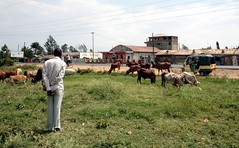
Urban herd
I traveled in Kenya January/February 2011. This photo is from the suburbs of Kisumu. I enjoyed the view over the Rift Valley and Lake Victoria. It is a bit chilling to read Parenti's stories from Kenya - in fact the book begins and ends with the corpse of a cattle herder left to rot under a tree and the questions of and answers to who killed him. All of the brutal incidents and trends in drought and plunder play out some kilometers away down the great valley.

Part 3 is about Asia and observes how in Afghanistan "the poppy economy and its armed defense are local adaption mechanisms" (wheat use six times more water than poppy which is worth 50 times the price). Chapter 10 is a rare insight to the conflicts in Kyrgyzstan - a lot more interesting than it may sound! Parenti then moves on to the India-Pakistan conflict of declining river flows, provoking dams, mass-murderous droughts, devastating floods, cross border state terrorism, suicide by pesticide Monsanto farmers and Maoist guerrillas. Very complex and under-reported in Western media yet clearly fueled by climate change.

Part 4 is about Latin America and the US. On page 181 Parenti's main message is summed up:
"catastrophic convergence: policies that create poverty and violence are now colliding with the new realities of climate change, and together these three forces are creating socially destructive forms of adaption."
Brazil and Mexico receive treatment in each their own chapters. Not just the always shockingly brutal gang violence is described, so too are more positive examples of coping: an example of organic agriculture and Keynesian economics. The efforts by Bolivia are hailed before the US is described in less than praising terms.

However, although being very critical of neoliberalism and in favor of state run initiatives to halt pollution and force clean technologies forward, Parenti is distancing himself from radical approaches involving revolutionary changes to the economy and society as we know it. First of all for a simple reason: There is no time. We need to start solving the climate problem now, thus we need to start doing it with tools known to work within the capitalist system. And it can be done, Parenti argues, because we have both the technology and the money. Fossil energies probably only have a lead right now because it has been so heavily subsidized for decades. And if there is money now for blowing up bubbles (housing, food etc) to create poverty as prices go up, unemployment and riots as the bubbles burst then, surely, that money could be redirected towards sustainable development.

Christian Parenti's Tropic of Chaos is a great book. Concise, well written and fair in reasoning. It isn't exhaustive as many conflicts from around the world are left untold of. It isn't academic as it assumes basic understanding of the climate, the economy and world affairs and simply move on with its stories from there while it doesn't dig into recent scientific results either. At times, perhaps, it's a bit too much a book of stories as Parenti shares many details of the converging issues. It is brave as it is critical of both the far-right media environment as well as of Bill "350" McKibben. Tropic of Chaos is the third book about how (not if) climate change is causing increased conflict I have read. If you want to read only one book about climate change and war this book should probably be it. (Alternatives are the more imaginative and dystopic Climate Wars by Gwynne Dyer reviewed here December 2010 and the scientifically precise and short Climate Conflict by Jeffrey Mazo reviewed here April 2011.)


Further reading/viewing for you right now: Large parts of the book can be read at Google Books. Also, Christian Parenti has given interviews on the book and its topics...

From Foreign Policy in Focus / Interview with Christian Parenti:
"The military runs scenarios of what the future will bring. What they see is not so much an increase in conventional warfare between states as an increase in humanitarian crisis, civil war, banditry, religious wars, state breakdown. And they realize that the armed forces will be called on to respond with various forms of low-intensity conflict: counter-insurgency, direct intervention, humanitarian intervention, shoring-up allied states, as well as increased training and advisory roles in these conflicts. [... In international negotiations] The United States has played a non-productive role, a destructive role. It has not taken the UN Framework Convention on Climate Change negotiations seriously, and as a result they have broken down. We are the largest economy in the world, and until recently we were the largest greenhouse gas emitter in the world before China overtook us. The world looks to the United States for leadership but U.S. actions, especially at Copenhagen, were really depressing. [...] What will change the U.S. position? Protest, clearly. There has to be a movement that forces the Obama administration to do this. The Obama administration is proving itself to be very right-wing on many issues, including this one."




Tuesday, December 14, 2010

Mexicans march in support of drug cartel

Perhaps you thought the year 2029 scenario mentioned in my summary of Gwynne Dyer's Climate Wars was a bit far fetched? Granted, Mexican states being ruled by warlords is a bit imaginative. So is reality.


Read Narco Blog / Mexicans March in Support of “ La Familia” Drug Cartel:
In an unprecedented event, on Sunday citizens of the Apatzingan community expressed support for La Familia drug cartel by organizing a march.  In recent days life has become so dangerous in Apatzingan that people have had to remain locked in their homes and losing their freedom to come and go. The recent Government coordinated attack was on the La Familia Michoacana Drug Cartel.  One of the clashes resulted in the death of Nazario Moreno, considered the leader of La Familia Michoacana.

Nazario’s death has provoked reactions from members of the drug cartel that have led to retaliation on some of the Michoacan local authorities.  The community of Apatzingan organized a march to protest the violence and over 500 people participated. The message was clear, showing outrage against federal forces that “attacked “ the town in recent days, leaving 11 people dead, including innocent bystanders.

The demonstration showed the support for La Familia Michoacana, in the Central Plaza by carrying signs that read messages like “Viva La Familia Michoacana”, “Nazario lives in our hearts” and “Get Out PFP.”
 Even the town mayor is in:
"The insecurity is not caused by the delinquent groups. It is the federal police, who, pardon me, but they go into houses, in almost the entire municipality."
 - Mayor Genaro Guizar
"[La Familia started as] a vigilante group to counter local street crime and law enforcement corruption. Now, La Familia Michoacana uses drug proceeds to fuel their agenda that encompasses a Robin Hood-type mentality — steal from the rich and give to the poor."
 - anonymous DEA officer

More sources: Los Angeles Times / Michoacan peace march turns into rally for La Familia drug lord, AP / Mexicans march in support of 'Craziest' kingpin.


Saturday, June 20, 2009

Freshwater industrialization, privatization and pollution

Two links for this blogs 20th post tagged 'water'.

Depraved Injustice and the Privatization of the Global Freshwater Commons by Frank Joseph Smecker is a critical look at the increasing privatization of the worlds freshwater resources.

Privatization is the preferred solution from those who brought us into this situation of scarcity and escalating conflict: traditional capitalist believers in growth seemingly unaware of the fact our ecosystem is finite. Smecker lists cases from around the world - USA, Canada, Belize, Argentina, The Philippines, Bolivia, Bolivia, Indonesia, South Africa, Australia, Sudan, Mexico, China, Venezuela, Zimbabwe, Tunisia, Cuba, Iran, Iraq, Syria, India, North and South Korea, Israel and Palestine, Egypt, Ethiopia and The United Kingdom - and sum up the adverse effects which are left unsaid by the privatization people; the observed cons rather than the imagined pros:
  • Prices go up. Especially problematic to poor people in developing countries who cannot afford the extra cost and are particularly dependend on water.
  • Pollution go up. Distribution by plastic bottles - preferred for monetization - is ridiculously polluting compared to locally extracted tap water plus the private water companies have poor environment track records.
  • Private water companies are multinational not local. Profits do not develop the exploited areas.
  • Water quality declines as it is only taken care of to a profitable minimum.
  • Ecological destruction of downstream habitat as ecosystems are derived of their water. Including threats to animal species populations (including salmon, steelhead and trout).
  • Failure to protect public ownership of water and water rights.
  • Wasted water and neglect of conservation.
The article does not solely blame industrialization, capitalism and privatization - climate change (itself a side effect of industrialization and population growth) is also pointed out.

Industrialized Farming Endangers World Food Supply by Karin Friedemann is a short, aggressive attack on multinationals and their taking over of not just the worlds water but its soils, sun, gene pools and political systems too.
The Oil-for-Food program in Iraq forced the large-scale importation of food after the first Gulf War. Devastated Iraqi farmers then became the victims of USAID. [..] Under US occupation, Iraqi farmers must pay a “technology fee” plus an annual license fee to agribusinesses supplying the seeds and equipment. [...] The war provides these corporations with both a lucrative short-term market in the blossoming “reconstruction” industry and an opportunity to integrate Afghanistan into their global production networks and markets in the long term.
In other words an example of 'disaster capitalism'. Essentially another route of aggravating our water issues as the top-down multinational approach to agriculture is based upon highly industrialized, export oriented mono-cultural farming.

Sunday, October 12, 2008

Forty Years After The Tlatelolco Massacre, The Mexican Army Attacks Civilians In The Indigenous Town of Xoxocotla

On Wednesday, October 8th, Morelos Governor Marco Adame called out more than 1,500 police personnel from the State Police and from the Paramilitary Federal Police force to the indigenous town of Xoxocotla. Law enforcement agencies were instructed to dismantle a series of road blockades along the Alpuyeca-Jojutla highway. Residents of Xoxocotla [...] had set up the blockades to show solidarity with teachers who have been on strike in Morelos for nearly two months.

The teachers of Morelos and the townspeople of Xoxocotla are united in a common struggle to stop the rapid privatization of public resources. Teachers on strike in Morelos are trying to halt a new set of educational reforms they say would open the doors to the participation of private capital in the public education system. Xoxocotla, on the other hand, is desperately trying to save the aquifer which feeds its municipal water system from being sucked dry from private condominium developers who skirt local zoning laws.


(My emphasis.)

Wednesday, January 30, 2008

Mexico: Death over dams

"I was there with him in the front seat of the truck when they killed him with a single shot to the head," Eugenia said. "We were coming back from a demonstration against the building of the dam, and our neighbor Cirilo Cruz, whom everyone knew was a supporter of the dam, just shot him." Eugenia’s two school-age children stood by her feet, seemingly unaware of the meaning and weight of her words.

Dubbed "La Parota" after a tall leafy tree native to the banks of the Papagayo River, the dam she spoke about is being aggressively pursued by Mexico's Comisión Federal de Electricidad (CFE). It would displace as many as twenty-five thousand people.

[...]

It is widely believed that the people supporting the dam are being paid off by the CFE. Cirilo Cruz Elacio, the man now in prison for having killed Tomás Cruz Zamora, is believed to be one of the first to have been paid between $100 and $300 to lend his support for the dam. The CFE is also accused of holding rushed and illegal assembly meetings to generate votes in favor of the dam, and of using excessive police force to prevent villagers from demonstrating against it.


Go to the original article (headline links) for full story and photo slideshow.

Sunday, January 27, 2008

World's poor are up in arms over food prices

People are rioting in the streets over the spiralling cost of food, but what is causing the crisis?

[...]

There were street riots over the price of basic foods in Mexico and India last year, and in Jakarta, Indonesia, last week. China and Russia have slapped controls on food prices to prevent unrest and inflation. Low-income Americans are feeling the pinch of 10 per cent increases for bread, 19 per cent for milk. Italians boycotted pasta for a day last September in protest at a 7 per cent price ...


Read New Scientist / World's poor are up in arms over food prices (subscription required).


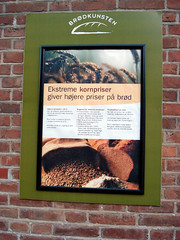
Bakery poster on rising bread pricesDanish bakery poster on rising bread prices. Doesn't mention "climate change" or "global warming" but blame the Chinese for buying our food, two years of bad harvests, biofuel, droughts in Southern Europe and empty granaries.

Wednesday, August 22, 2007

From the Ecowar frontiers

Middle East


Around one-third of a massive oil slick caused by Israeli bombing of a Lebanese power plant remains in the Mediterranean a year on from war

Source: Lebanon still cleaning oil spill one year after war - Middle East Times

Arctic


Canada's increased military presence in the Arctic poses environmental dangers as bullets, shells, shell casings and other war-game detritus wind up in ecologically sensitive waters and tundra

Source: globeandmail.com: War games in Arctic draw fire over impact on ecology

Central America


Campesinos in the southern Mexican state of Guerrero have been blocking access to an area where the government wants to build a huge dam and hydroelecric station, since 2003

Source: ENVIRONMENT-MEXICO: High Voltage Conflict Over Dam

Asia


Bullets, grenades, bombs, mortars and other war tools obliterate wildlife, disturb native habitats and poison the air, water and soil with toxic chemicals. This damage to the environment is very costly and can persist for generations.

Source: Concealed casualty of war - INQUIRER.net

Search This Blog