Showing posts with label ground water. Show all posts

Saturday, June 20, 2009

Freshwater industrialization, privatization and pollution

Two links for this blogs 20th post tagged 'water'.

Depraved Injustice and the Privatization of the Global Freshwater Commons by Frank Joseph Smecker is a critical look at the increasing privatization of the worlds freshwater resources.

Privatization is the preferred solution from those who brought us into this situation of scarcity and escalating conflict: traditional capitalist believers in growth seemingly unaware of the fact our ecosystem is finite. Smecker lists cases from around the world - USA, Canada, Belize, Argentina, The Philippines, Bolivia, Bolivia, Indonesia, South Africa, Australia, Sudan, Mexico, China, Venezuela, Zimbabwe, Tunisia, Cuba, Iran, Iraq, Syria, India, North and South Korea, Israel and Palestine, Egypt, Ethiopia and The United Kingdom - and sum up the adverse effects which are left unsaid by the privatization people; the observed cons rather than the imagined pros:
  • Prices go up. Especially problematic to poor people in developing countries who cannot afford the extra cost and are particularly dependend on water.
  • Pollution go up. Distribution by plastic bottles - preferred for monetization - is ridiculously polluting compared to locally extracted tap water plus the private water companies have poor environment track records.
  • Private water companies are multinational not local. Profits do not develop the exploited areas.
  • Water quality declines as it is only taken care of to a profitable minimum.
  • Ecological destruction of downstream habitat as ecosystems are derived of their water. Including threats to animal species populations (including salmon, steelhead and trout).
  • Failure to protect public ownership of water and water rights.
  • Wasted water and neglect of conservation.
The article does not solely blame industrialization, capitalism and privatization - climate change (itself a side effect of industrialization and population growth) is also pointed out.

Industrialized Farming Endangers World Food Supply by Karin Friedemann is a short, aggressive attack on multinationals and their taking over of not just the worlds water but its soils, sun, gene pools and political systems too.
The Oil-for-Food program in Iraq forced the large-scale importation of food after the first Gulf War. Devastated Iraqi farmers then became the victims of USAID. [..] Under US occupation, Iraqi farmers must pay a “technology fee” plus an annual license fee to agribusinesses supplying the seeds and equipment. [...] The war provides these corporations with both a lucrative short-term market in the blossoming “reconstruction” industry and an opportunity to integrate Afghanistan into their global production networks and markets in the long term.
In other words an example of 'disaster capitalism'. Essentially another route of aggravating our water issues as the top-down multinational approach to agriculture is based upon highly industrialized, export oriented mono-cultural farming.

Wednesday, March 25, 2009

Opinion: Nations don't go to war over water

Writer Wendy Barnaby has written an essay for academic journal Nature in stead of a book for her publisher as the conclusion on "water wars" wouldn't sell. Some facts...

There are 263 cross-boundary waterways in the world. Between 1948 and 1999, cooperation over water, including the signing of treaties, far outweighed conflict over water and violent conflict in particular. Of 1,831 instances of interactions over international freshwater resources tallied over that time period (including everything from unofficial verbal exchanges to economic agreements or military action), 67% were cooperative, only 28% were conflictive, and the remaining 5% were neutral or insignificant. In those five decades, there were no formal declarations of war over water.


Three examples are explored a bit further: the Israel-Palestine, the India-Pakistan and the Nile water conflict situations. The Nile issue is about how the countries surrounding it were forced into cooperation following years of low level conflicts and the India-Pakistan issue on how cooperation has been set up in a treaty with the help of the World Bank despite the two countries being engaged in an ongoing military conflict. The Israel-Palestine issue is presented a bit weird:
it is foolish for Israel, a water-short country, to grow and then export products such as oranges and avocados, which require a lot of water to cultivate

Yes it is. Israel and most neighbours have water shortages but alleviate it by importing grain. There are a whole bunch of inconvenient truths not mentioned, but one is:
Palestinian and Israeli water professionals interact on a Joint Water Committee, established by the Oslo-II Accords in 1995. It is not an equal partnership: Israel has de facto veto power on the committee.

I'll dig out some more facts soon (in the mean time try my Israel and Palestine tags). But let's just note Wendy Barnaby's main conclusions:

Inequitable access to water resources is a result of the broader conflict and power dynamics: it does not itself cause war [...] predictions of armed conflict come from the media and from popular, non-peer-reviewed work


Undoubtedly true that main stream media is better at sensationalistic headlines than scientific journals. But is this move from simplistic causation to hen-or-egg discussion a bit too easy? I mean demand is very likely to go up, supply very likely to go down. Leading to cooperation or conflict.

water 'embedded' in traded products could be important in explaining the absence of conflict over water [...] as poor countries diversify their economies, they turn away from agriculture and create wealth from industries that use less water. As a country becomes richer, it may require more water overall to sustain its booming population, but it can afford to import food to make up the shortfall


most importantly, improve the conditions of trade for developing countries to strengthen their economies


Sure. That's what the WTO is for, right? ;-)

ResearchBlogging.org


Barnaby, W. (2009). Do nations go to war over water? Nature, 458 (7236), 282-283 DOI: 10.1038/458282a


Search Google Books for Wendy Barnaby.

Wednesday, October 29, 2008

Atlas of hidden water may avert future conflict

Now, for the first time, a high-resolution map shows where underground aquifers store vast amounts of water.

[...The map project] has identified 273 trans-boundary aquifers: 68 in the Americas, 38 in Africa, 155 in Eastern and Western Europe and 12 in Asia.

Each trans-boundary aquifer holds the potential for international conflict – if two countries share an aquifer, pumping in one country will affect its neighbour's water supply.

[...]

In many parts of the world, around the Mediterranean for example, but also in the US and the Middle East, water tables are falling and aquifers are being infiltrated by seawater as agricultural practices pump water out faster than it can be replenished by rain.

When aquifers fall between countries, sustainable management requires international agreement. Yet, historically, many agreements have been weighted towards the richest or more powerful country.


Deeplink to map Groundwater resources of the world (4½ MB PDF).

Tuesday, August 26, 2008

Three cases of migration and conflict: Hurricane Katrina, Bangladesh and The Dust Bowl

"Environmental change can trigger large out-migration, which can cause violent conflict in areas receiving migrants."

A peer reviewed article on environmental migration would fit right into my little project here, right? As I realized Reuveny's Ecomigration and Violent Conflict: Case Studies and Public Policy Implications was a look at only three incidents and that two of these were from the USA my expectations dropped somewhat. Most of this is supposed to be going on in Africa, right?

Well, when the cases from the world's most affluent nation only confirms what speculation you have on the third world... this is a rather interesting article. The three cases are the 1930'ies US Dust Bowl [Wikipedia], Bangladesh since the 1950'ies especially the Farakka Barrage situation [Wikipedia] and August 2005's Hurricane Katrina [Wikipedia]. It's main conclusion you have already read above. But I'll look into a few details...

The theory

Standard migration theory operates with economic, political and other forces - not environmental. Doing so could have serious implications as governments have signed treaties to accept political refugees, not "environmental". However, already in 1985 a paper on droughts and land degradation in sub-Saharan countries concluded these problems caused "population movements".

I think it's pretty much stating the obvious: If you live from the land and suddenly you can't, you're a lot more likely to simply leave the area. It's a different type of border you seek to cross though: While "traditional migrants" would seek to cross a cultural or political border, environmental migrants just wish to leave the stricken area.

The mechanics of "ecomigration" issues is described in four non-exclusive parts:

  • "the in-migration can burden the destination's economy and resources, promoting native-migrant competition for jobs and other resources"

  • "the arrival of in-migrants may upset the existing ethnic balance"

  • "in-migration can enable ploys to exploit the situation and induce suspicions about such ploys"

  • "the conflict may follow existing fault lines"


In-migration is more likely to cause trouble in poor receiving counties than in rich. And migrating women, children and elderly having family ties in the receiving area are least likely to cause conflict. Trouble risk is also correlated to migration mass and period: the more and the faster the more problematic.

Reuveny finishes his theoretical stuff with a pinch of optimism:
"Migration can benefit the receiving area through several channels, including increasing the labor force and tax-base."


The cases

In the 1930s the US Great Plains were stricken by droughts and storms while the area's agricultural practices were far from geared towards the situation. Massive soil erosion and obvious declines in life quality resulted. The area was now called The Dust Bowl. Close to 2.5 million people out-migrated.

Most went to neighboring states but about 300,000 traveled to California. They were received as "ignorant filthy people", called "Okies", some argued Bible in hand that they were "inferior" and it was even suggested to pay them to be sterilized. They were beaten, their shacks burned and they were accused of "communism". In 1936 Los Angeles police stopped migrants at the state border. Welcome to California.

The Bangladesh case is a bit more typical. A small less developed country with a huge and growing population strains it's natural resources to a breaking point. It's geography happens to make it particularly vulnerable to both accumulated environmental stresses (soil erosion etc.) and periodic natural disasters (namely floods).

Then in 1975 the neighboring country builds a barrage, diverting water away from Bangladesh. Salt water intrudes the sinking fresh water resources and land productivity plummet. 35 million people were directly affected.

Some 12 to 17 million Bangladeshis have migrated illegally to India and about half a million to other areas in Bangladesh. Migrants have since clashed with residents over social, ethnic, religious, national and other proximate issues. Countless people have been killed in clashes.

Reading about Hurricane Katrina is particularly weird as this is fresh from TV memory. But as it turns out the case fits right in.

A combination of human and natural factors combined to aggravate a disaster situation: the Mississippi River had been turned into a maritime highway destroying natural sedimentation, land clearing and draining of swamps eliminated natural coastline protection, compromises led to levee building only protecting from hurricanes level 3. The false sense of security from the levee only led to more risky development.

80% of the population fled the area when weather forecasts told of the impending hurricane. Including 100,000 elderly and poor who were evacuated by the government. Shortly after Hurricane Rita hit too and US government estimates a total of nearly 2 million people were displaced.

As we all remember, New Orleans was smashed. One year after Katrina hit 2,180 people had died as a direct consequence of the storm, more than 200,000 people lost their jobs, about 335,000 homes were destroyed and only about 40% of New Orleans' population had returned.

Across the river from New Orleans the city of Gretna [Google Maps] had police block the entry of displaced people firing warning shots in the process. Rhode Island, South Carolina and West Virginia insisted more than half the evacuees they'd accepted were violent criminals. The city of Houston reported a rise in homicides of 70% in November and December 2005 and 28% in February 2006 compared to normals. March 2006 75% of Houston residents answered a poll they felt "strained" by the 150,000 migrants living there.

Reuveny sees three main similarities: The three societies all depended on their environments for livelihood, human actions or lack thereof exacerbated the disasters and political, economic, sociological and psychological factors overlapped with environmental ones. A number of obvious differences are mentioned too.


Climate change is expected to cause a wide array of disasters and stresses on our ecosystem. Sea level rise is just one of them. Flickr Creative Commons image is "Climate Change Refugees" by ItzaFineDay.


Can climate change cause migration and conflict in the future?

Reuveny says "yes". The evidence of impact scale is worrying already; history is there to suggest it will repeat itself.

If sea levels rise by just 1 meter more than 260 million people will be exposed to flooding. (Yes, that was two hundred and sixty million individual humans) Most of these Asians but at least some 14 million Europeans too. These people will have to move somewhere. Imagine something like 130 Katrinas but with permanent land loss and in countries less able to cope with the situation. Bitterly ironic since climate change is largely caused by rich, developed countries.

A set of initiatives for alleviation or solution is also proposed, but I dare not post it uncensored in the mere blogosphere. But Reuveny feels it's safe to assume...
"[...] the expected cost of climate change-induced ecomigration and conflict will likely rise quickly [...]"


ResearchBlogging.org

Reuveny, R. (2008). Ecomigration and Violent Conflict: Case Studies and Public Policy Implications. Human Ecology, 36(1), 1-13. DOI: 10.1007/s10745-007-9142-5


Tuesday, August 28, 2007

West Bank: Occupation bad for environment


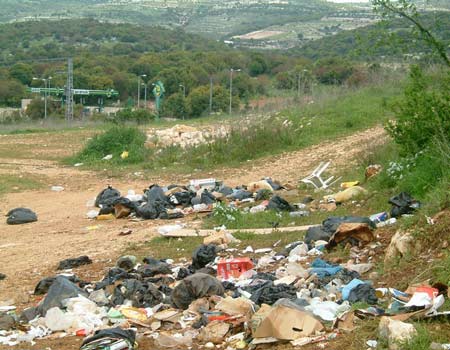
[...] during more than 40 years of Israeli control, the West Bank has become, either consciously or unconsciously, our garbage dump, and particularly that of the settlements and illegal outposts in the area. Toxic sewage from plants and sewage systems pouring into Palestinian agricultural and pasture areas are a routine matter. [...] The sewage and waste cause irreversible destruction and damage to the natural springs in these areas and to ground water in aquifers. Olive trees and crops belonging to residents in the territories are damaged forever; nature reserves or areas that were supposed to be declared as such are damaged and neglected, along with the direct damage to flora and fauna, and to the entire delicate ecological system that exists there. [...] The environmental hazards will not disappear even if we build a fence or define the territories as enemy territory. The area, in and of itself, is homogenous, despite the two peoples living there.


West Bank ecology. Picture from original article.


Search This Blog