Showing posts with label Jordan. Show all posts

Saturday, January 02, 2010

Thinking back: Climate change and conflict through the ages

The past three months I've been so busy writing for (and winning) the European Journalism Centre's TH!NK ABOUT IT #2: Climate Change blogging competition that stories I'd usually post here at Ecowar asap have lingered in my various link collections. But here's an excerpt of two of these.

A history of water wars

A very long list of conflicts over natural resources have been on my to-do list for some time. November 2009, however, the Pacific Institute for Studies in Development, Environment, and Security made available a very neat looking database on Water and Conflict online. Currently it lists 203 conflicts over water. My "top 10" so to speak:


  • Around 3000 BC: "Ancient Sumerian legend recounts the deeds of the deity Ea, who punished humanity for its sins by inflicting the Earth with a six-day storm. The Sumerian myth parallels the Biblical account of Noah and the deluge, although some details differ." Sorry, couldn't help it.

  • Around 2500 BC: "Lagash-Umma Border Dispute: the dispute over the “Gu’edena” (edge of paradise) region begins. Urlama, King of Lagash from 2450 to 2400 BC, diverts water from this region to boundary canals, drying up boundary ditches to deprive Umma of water. His son Il cuts off the water supply to Girsu, a city in Umma (present-day Iraq)." Here, water supply is used as a military tool. There are plenty of examples from the Fertile Crescent BC.

  • 605 - 562 BC: "Nebuchadnezzar builds immense walls around Babylon, using the Euphrates and canals as defensive moats surrounding the inner castle." OK so the guy they named a "ship" after in The Matrix trilogy invented the moat.

  • 1748: "Ferry house on Brooklyn shore of East River burns down. New Yorkers accuse Brooklynites of having set the fire as revenge for unfair East River water rights." Original terrorism from the USA. The US and Canada provides many examples of civilians sabotaging dams and reservoirs to the list and at least one murder.

  • 1870s to 1881: "Recurrent friction and eventual violent conflict over water rights in the vicinity of Tularosa, New Mexico (USA) involving villagers, ranchers, and farmers."

  • WWII: "Hydroelectric dams routinely bombed as strategic targets" and at least eight other specific incidents mentioned.

  • 1947 onwards: Pakistan, India and Bangladesh in disputes over the Ganges and Indus.

  • 1951-1953: "Jordan makes public its plans to irrigate the Jordan Valley by tapping the Yarmouk River. Israel responds by commencing drainage of the Huleh swamps located in the demilitarized zone between Israel and Syria; border skirmishes ensue between Israel and Syria. [...] Israel begins construction of its National Water Carrier to transfer water from the north of the Sea of Galilee out of the Jordan basin to the Negev Desert for irrigation. Syrian military actions along the border and international disapproval lead Israel to move its intake to the Sea of Galilee." This was just the beginning - several more examples on the list.

  • 1963-1964: "Creation of boundaries in 1948 leaves Somali nomads under Ethiopian rule. Border skirmishes occur over disputed territory in Ogaden desert where critical water and oil resources are located; cease-fire is negotiated only after several hundred are killed."

  • 1978-1984: "Demonstrations in Juba, Sudan in 1978 opposing the construction of the Jonglei Canal lead to the deaths of two students. Construction of the Jonglei Canal in the Sudan is forcibly suspended in 1984 following a series of attacks on the construction site."

  • 1982: "177 civilians killed in Rio Negro [Guatemala] over opposition to Chixoy hydroelectric dam."


From history to forecast

I've also been thinking about writing a summary of the history of climate change and conflict for both Ecowar and TH!NK (although it'd probably be better suited for a bigger project). But when someone else does just that and does a good job, all I do is link. Such is the first link here: A brief history of climate change and conflict by James R. Lee. Most of its examples are also discussed in detail in Jared Diamond's Collapse. One isn't: The extinction of Neanderthals which seems to have been caused by a combination of cooling climate and Sapiens' expansion northward.

First, the article re-emphasizes the fact that climate change causing conflict isn't a simple cause and effect relationship. It cannot be said often enough: Both sociology (which would be the social science to predict and explain conflict) and ecology (the natural science accounting climatic impacts) are complex areas of understanding. Looking at mainly the impacts of the medieval warm period and the Little Ice Age on such civilizations as the Mayans, the Vikings and the Anasazi principles and trends are boldly extracted. These I'll further simplify (re-hashed quotes) for conciseness.

Historical case studies suggest three paths from climate change to conflict:

  • Sustained trends: conflict has the potential to emerge after a sustained period of divergent climate patterns

  • Intervening variables: climate change alone won't cause conflict but, along with other factors, will contribute to and shape it

  • The need for conflict triggers: an assassination, extreme natural event, or random act of group violence--is usually required to ignite violent conflict


Current climate change conflicts are crudely lumped in two categories:

  • Hot areas: Between smaller groups (tribes, cities) fighting in desperation for access to resources mainly made scarce by changes in precipitation and increased evaporation ("water wars")

  • Cold areas: Between states seeking the opportunity to exploit resources made available by warming temperatures


These principles are suggested as guidelines for preparing for the wars and fights of the future.

Tuesday, September 29, 2009

100 Places to Remember - at least 8 of which are to die for

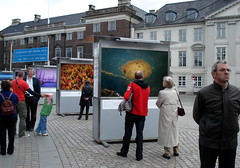
Having wandered through the exhibition at Kongens Nytorv in Copenhagen and now also enjoyed the accompanying book of 100 Places to Remember Before They Disappear I can't help but take note of a couple of them here.

Because the descriptions in some cases explicitly mentions conflicts. Granted: Many will change with potential drastic consequences. Be it because they become uninhabitable, hence sources of climate change induced migration, or become unsuited for agriculture, leading to loss of food production with all the negative consequences of that. Or because of any of the other potential negative changes. But most are "just" pretty spots that will change due to climate change.

DSC06551x

In chronological order of the book, the spots that are related to conflict by the 100 Places project:

#11 The North Pole, Russia/Canada/Denmark


As the Arctic thaws resources of oil, gas and minerals become increasingly available for extraction. But whose resources are they?

#16 Tian Shan, Kazakhstan/Kyrgyzstan/China


The glaciers atop this mountain range provides the water for the breadbasket and powerhouse of Kazakhstan. But due to miniscule drops in precipitation through the last 50 years they have shrunk by 36% already. Climate change will most likely accelerate this drastically. Competition for the remaining water resources will intensify. Neighbours some seriously troubled regions.

#26 Lake Chad, Chad/Cameroon/Niger/Nigeria


This lake is basically an essential source of life in a very arid region of all more or less "failed states". Competition between tribes and nations already intensifying as the lake is drying up rapidly.

#30 Kalahari Desert


Also drying up even beyond what it already is this desert is the last refuge of the die hard San people. But climate change could be the final blow to their basis of existence.

#68 Bering Sea, Russia/USA


This sea is the source of some 2 billion US dollars worth of fishing shared by Russia and USA. But as the waters warm the ecosystem and biodiversity is changing completely. At the very least the fishermen will have to go elsewhere or catch different fish. The worst... well... will begin with trade negotiations, I assume.

#79 Kordofan, Sudan


We've all heard of Darfur. Over and over again. And I've pointed to the vicious cycles between environmental degradation. But I guess Darfur is no longer pretty enough for a photograph in a project like 100 Places? Anyway, Sudan also has a big forest of "hashab" trees (Latin: Acacia senegal) which is the source of the largest production of rubber in the world. But business is slow both because of the nearby Darfur trouble, drought and rising temperatures which has caused a severe decline in forestry productivity. When this region of Sudan also loses it's livelihood...

#84 Niger Delta


This is "all of the above". Beautiful nature, oil pollution, ethnic violence, mass poverty, multinational corporations, rising seas, increasing storms, decline in freshwater availability, increased diseases spreading... huge chance of migration.

#87 Amman, Jordan/Israel/others


Well it's in the Middle East. Historically ideal situation for a fertile capital. But now human over-use of water resources and climate change is lowering the water level of the Dead Sea by one meter per year because less and less water flows by the Jordan River. Agricultural land is turning into desert as you read this. A glance at a map and it becomes obvious this can become a very, very big problem.


All of the above issues will of course get intertwined with the other issues of some of the regions. Like the pipelines running through central Asia. The existing political and historical animosities between certain countries. Perhaps it's in the nick of time these photographs were exhibited. Soon the footage could be less pretty.

(This post is also posted as part of the TH!NK ABOUT IT #2 Climate Change blogging competition. Most of these places are also marked in my Ecowar Battlefields Google map.)

Wednesday, March 25, 2009

Opinion: Nations don't go to war over water

Writer Wendy Barnaby has written an essay for academic journal Nature in stead of a book for her publisher as the conclusion on "water wars" wouldn't sell. Some facts...

There are 263 cross-boundary waterways in the world. Between 1948 and 1999, cooperation over water, including the signing of treaties, far outweighed conflict over water and violent conflict in particular. Of 1,831 instances of interactions over international freshwater resources tallied over that time period (including everything from unofficial verbal exchanges to economic agreements or military action), 67% were cooperative, only 28% were conflictive, and the remaining 5% were neutral or insignificant. In those five decades, there were no formal declarations of war over water.


Three examples are explored a bit further: the Israel-Palestine, the India-Pakistan and the Nile water conflict situations. The Nile issue is about how the countries surrounding it were forced into cooperation following years of low level conflicts and the India-Pakistan issue on how cooperation has been set up in a treaty with the help of the World Bank despite the two countries being engaged in an ongoing military conflict. The Israel-Palestine issue is presented a bit weird:
it is foolish for Israel, a water-short country, to grow and then export products such as oranges and avocados, which require a lot of water to cultivate

Yes it is. Israel and most neighbours have water shortages but alleviate it by importing grain. There are a whole bunch of inconvenient truths not mentioned, but one is:
Palestinian and Israeli water professionals interact on a Joint Water Committee, established by the Oslo-II Accords in 1995. It is not an equal partnership: Israel has de facto veto power on the committee.

I'll dig out some more facts soon (in the mean time try my Israel and Palestine tags). But let's just note Wendy Barnaby's main conclusions:

Inequitable access to water resources is a result of the broader conflict and power dynamics: it does not itself cause war [...] predictions of armed conflict come from the media and from popular, non-peer-reviewed work


Undoubtedly true that main stream media is better at sensationalistic headlines than scientific journals. But is this move from simplistic causation to hen-or-egg discussion a bit too easy? I mean demand is very likely to go up, supply very likely to go down. Leading to cooperation or conflict.

water 'embedded' in traded products could be important in explaining the absence of conflict over water [...] as poor countries diversify their economies, they turn away from agriculture and create wealth from industries that use less water. As a country becomes richer, it may require more water overall to sustain its booming population, but it can afford to import food to make up the shortfall


most importantly, improve the conditions of trade for developing countries to strengthen their economies


Sure. That's what the WTO is for, right? ;-)

ResearchBlogging.org


Barnaby, W. (2009). Do nations go to war over water? Nature, 458 (7236), 282-283 DOI: 10.1038/458282a


Search Google Books for Wendy Barnaby.

Search This Blog