Showing posts with label Somalia. Show all posts

Friday, October 28, 2011

Climate change and the new geography of violence

One of the unpleasant effects of climate change is its tendency to incite further conflict where such already exist and in some cases war is already looming. Sociologist and writer Christian Parenti is blaming "pathologies of neoliberalism" and Cold War leftovers that converge with climate change effects for inciting further conflict where it already lingers. Already by now large parts of the political landscape are out of the target group of Parenti's message but he supports his assertion by way of his good storytelling based on personal experiences and interviews - and he finishes with an almost pro-capitalism conclusion.


Chapter 2 is pretty much a summary of some of the military reports I have linked to in Ecowar posts tagged 'military' plus a few other. Chapter 3 is a brief history of the US military which at first seems a bit thorough for a climate change book but actually shows how it has been on a long journey from conventional "European" warfare to guerrilla warfare inspired by North American Indian tribes and Ernesto "Che" Guevara. And ends up with a grim forecast (p. 36) of "the essence of militarized adaption to climate chaos: dirty war forever." In part, global counter-insurgency is an adaption to climate change that most of us wouldn't agree to if given the choice.

Part 2 is about Africa and describe how the Cold War proxy-wars have left unresolved conflicts now to converge with climate change effects, mostly via Parenti's own experiences visiting the areas. Most notably the stories from northern Kenyan herders who increasingly arm themselves to defend and raid cattle as droughts kill off livestock. Chapter 7 details the Cold War prequel to the current desert anarchy in Somalia. Chapter 8, the last of part 2, is a brilliant description of what a failed state is exactly.
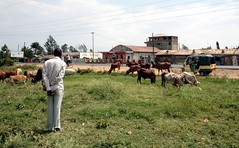
Urban herd
I traveled in Kenya January/February 2011. This photo is from the suburbs of Kisumu. I enjoyed the view over the Rift Valley and Lake Victoria. It is a bit chilling to read Parenti's stories from Kenya - in fact the book begins and ends with the corpse of a cattle herder left to rot under a tree and the questions of and answers to who killed him. All of the brutal incidents and trends in drought and plunder play out some kilometers away down the great valley.

Part 3 is about Asia and observes how in Afghanistan "the poppy economy and its armed defense are local adaption mechanisms" (wheat use six times more water than poppy which is worth 50 times the price). Chapter 10 is a rare insight to the conflicts in Kyrgyzstan - a lot more interesting than it may sound! Parenti then moves on to the India-Pakistan conflict of declining river flows, provoking dams, mass-murderous droughts, devastating floods, cross border state terrorism, suicide by pesticide Monsanto farmers and Maoist guerrillas. Very complex and under-reported in Western media yet clearly fueled by climate change.

Part 4 is about Latin America and the US. On page 181 Parenti's main message is summed up:
"catastrophic convergence: policies that create poverty and violence are now colliding with the new realities of climate change, and together these three forces are creating socially destructive forms of adaption."
Brazil and Mexico receive treatment in each their own chapters. Not just the always shockingly brutal gang violence is described, so too are more positive examples of coping: an example of organic agriculture and Keynesian economics. The efforts by Bolivia are hailed before the US is described in less than praising terms.

However, although being very critical of neoliberalism and in favor of state run initiatives to halt pollution and force clean technologies forward, Parenti is distancing himself from radical approaches involving revolutionary changes to the economy and society as we know it. First of all for a simple reason: There is no time. We need to start solving the climate problem now, thus we need to start doing it with tools known to work within the capitalist system. And it can be done, Parenti argues, because we have both the technology and the money. Fossil energies probably only have a lead right now because it has been so heavily subsidized for decades. And if there is money now for blowing up bubbles (housing, food etc) to create poverty as prices go up, unemployment and riots as the bubbles burst then, surely, that money could be redirected towards sustainable development.

Christian Parenti's Tropic of Chaos is a great book. Concise, well written and fair in reasoning. It isn't exhaustive as many conflicts from around the world are left untold of. It isn't academic as it assumes basic understanding of the climate, the economy and world affairs and simply move on with its stories from there while it doesn't dig into recent scientific results either. At times, perhaps, it's a bit too much a book of stories as Parenti shares many details of the converging issues. It is brave as it is critical of both the far-right media environment as well as of Bill "350" McKibben. Tropic of Chaos is the third book about how (not if) climate change is causing increased conflict I have read. If you want to read only one book about climate change and war this book should probably be it. (Alternatives are the more imaginative and dystopic Climate Wars by Gwynne Dyer reviewed here December 2010 and the scientifically precise and short Climate Conflict by Jeffrey Mazo reviewed here April 2011.)


Further reading/viewing for you right now: Large parts of the book can be read at Google Books. Also, Christian Parenti has given interviews on the book and its topics...

From Foreign Policy in Focus / Interview with Christian Parenti:
"The military runs scenarios of what the future will bring. What they see is not so much an increase in conventional warfare between states as an increase in humanitarian crisis, civil war, banditry, religious wars, state breakdown. And they realize that the armed forces will be called on to respond with various forms of low-intensity conflict: counter-insurgency, direct intervention, humanitarian intervention, shoring-up allied states, as well as increased training and advisory roles in these conflicts. [... In international negotiations] The United States has played a non-productive role, a destructive role. It has not taken the UN Framework Convention on Climate Change negotiations seriously, and as a result they have broken down. We are the largest economy in the world, and until recently we were the largest greenhouse gas emitter in the world before China overtook us. The world looks to the United States for leadership but U.S. actions, especially at Copenhagen, were really depressing. [...] What will change the U.S. position? Protest, clearly. There has to be a movement that forces the Obama administration to do this. The Obama administration is proving itself to be very right-wing on many issues, including this one."


Friday, August 05, 2011

How al Shabaab is wrecking Somalia

All those of us not living under a rock are aware of the famine in East Africa. Some of us have even read a bit about the al Shabaab militia getting in the way of relief efforts. Should one donate when part of the contribution might end up bribing the militia? A recent UN report shed some light on the details of the al Shabaab regime.

Al Shabaab generates $70-$100 million a year from various trade schemes, taxes, "jihad contributions" and extortion. Some of these money are demanded by gunpoint at roadblocks but much is earned in more sinister ways. For example by exporting charcoal, importing sugar and manipulating the accounting to allow illegal money transfers to fill up the artificial surplus.

"In a very real sense, al Shabaab is becoming a business: a network of mutually supportive interests in Somalia, Kenya, the Middle East, and even further afield. Even businessmen who are not ideologically aligned with al Shabaab have little incentive to see the Islamists displaced by a predatory and corrupt Transitional Federal Government."
- UN Report.

A terrorist militia extorting its own people even during a drought of historical proportions threatening the livelihoods of millions of people. That's bad enough. But pause for a moment to consider the complete and utter reckless idea of chopping down trees to export charcoal when your country is suffering from some of the worst deforestation and desertification in the world.

Avaaz is doing a petition to press for a deal with al Shabaab to allow food aid. They almost make it sound like the crisis is happening because of the US 'war on terror'. How about a petition to press for sanctions against Kenyan and Dubai based traders who make the al Shabaab business model possible? How about an investigation of how weapons supposed to arm African Union peace keepers end up for sale on Mogadishu markets?

East African drought monitor, August 2011 and 36 months back. For Somalis the drought hit hard this year whereas the past years were easier on them.

What is your verdict, dear reader - do we sign the Avaaz petition or not?

Sources: Reuters / Factbox: U.N. Monitoring report on Somalia, Eritrea, Guardian / Somalia famine: The problems of delivering aid, Information.dk / Al-Shabaab ligner mere en regering end en oprørsbevægelse.


UPDATE: Al Shabaab militia’s tight grip on ‘desert’ charcoal trade
The taking of Ras Kamboni and Bur Gaboby, the two fishing towns by the sea that have been under the control of Al Shaabab, by the Kenya defence forces has struck an economic blow at the militia group.


Wednesday, July 20, 2011

While everyone's on holiday: Ghosts of the past, crises of the present and warnings for the future

From the distant and near past

The Washington Post reports Oil leaks from 233 World War II shipwrecks could threaten US coast as vessels corrode.
oil and fuel leaks could devastate coastal communities and environments. NOAA is taking an inventory of more than 30,000 coastal shipwrecks. It has narrowed the worst-threat list to 233 vessels. That could lead to efforts to remove oil before it washes ashore.

"The number of birds [migrating
through Afghanistan] has dropped by 85 percent."
Others are in shock staring at the Staggering Price Tag for Iraq, Afghanistan Wars.

a just-released, far-reaching study estimating the cost of these wars to the United States at $4 trillion. [...] since September 11, 2001, the wars have claimed the lives of 6,000 U.S. troops and 2,300 contractors, and the number of displaced Afghans and Iraqis is eight million.
Currently hunger devastates East Africa

Aid organizations complain donations suffer from people being on vacation while the disaster has many under-reported consequences. One such is that the Refugee crisis threatens wildlife in northern Kenya.

“The influx of refugees is not only degrading the environment due to demand for firewood for cooking and building shelters but those that have not enlisted in the camps are relying on game meat for food.”
 -  Thomas Mailu, The Kenya Wildlife Service (KWS)
Meanwhile in Nairobi Kenyan Police Fire Tear Gas at Food Protest, which happen as a consequence of the drought too, and fuel prices, which, of course, is linked to world market whims.

From this corner of the world aid agencies advise the Drought in east Africa the result of climate change and conflict. We told you so. And Kenya's own Wangari Maathai, Nobel Peace Laureate (whose speech at Copenhagen University I blogged recently), similarly calls for action on climate change:
"Here in Africa, we are paying a high price for a rapidly changing climate - more droughts, food crises and it is set only to get worse.  We can see how climate change is already aggravating the competition for resources and the economic stability all over this continent. [...] Many of our countries have experienced decades of environmental mismanagement or outright neglect. Indeed, some governments-including my own-have facilitated the plunder of the forests, the degradation of the land and unsustainable agricultural practices. Many communities in Africa are already threatened by the negative impacts of climate change. Children in Africa are dying from malnutrition as women struggle to farm on land that is less and less productive.  People on coastlines are losing their homes as the seas consume the coastlines."
Just signs of the decline?

Like we have to pay on environmental and financial debts of past wars even as current wars and environmental decline unfold and worsen, so too can we expect history to repeat itself. Soon both demand and supply of the basic building blocks of society will fundamentally change

Read, for example, Michael Klare's recent article Energy: the new thirty years' war or the interview with him, The new 30 Years War: Why energy will be the next battlefield.
"The struggle for energy resources is guaranteed to grow ever more intense for a simple reason: there is no way the existing energy system can satisfy the world’s future requirements."
He's talking about a thirty years 'war' between energy sources and the powers that wield them, not a world war. But clearly a war that will weaken some states, empower others. Regarding water, the Wall Street Journal is even more worried: Water Wars May Lie Ahead.
The World Bank in a report said that 1.4 million people could be facing water scarcity by 2025. But the Organization for Economic Co-operation and Development (OECD) forecast is even more gloomy. It estimates that 47% of the world’s population could face water stress in the same period–equivalent to more than three billion people. [...] Egypt and Ethiopia have been battling the issue for the share of the Nile’s water reserves, and Israel–already fighting Palestine for territory that includes precious water reserves–has started to charge the agricultural sector high rates for using the resource.


Saturday, June 19, 2010

UN envoy calls for tough Security Council action on recruitment of child soldiers

One of this week's UN campaign videos

"[...] today the nature of conflicts has changed dramatically. It can be prolonged by the race for natural resources [...]"

The news this week
The New York Times quotes United Nations officials and Somali human rights groups as saying the government is fielding hundreds of children, some as young as nine, on the front lines. The paper also reports that the United States, a strong backer of the government, is helping to pay the soldiers.
"[The US is] particularly concerned about the situation in Somalia [where all parties to the conflict have] placed several thousand children in the line of fire."
- US Ambassador to the UN Susan Rice

Report: Somali Government Using Child Soldiers, UN condemns Somalia's use of child soldiers, but US aid still flows, UNICEF seeks to end use of child soldiers across Central Africa.


Saturday, January 02, 2010

Thinking back: Climate change and conflict through the ages

The past three months I've been so busy writing for (and winning) the European Journalism Centre's TH!NK ABOUT IT #2: Climate Change blogging competition that stories I'd usually post here at Ecowar asap have lingered in my various link collections. But here's an excerpt of two of these.

A history of water wars

A very long list of conflicts over natural resources have been on my to-do list for some time. November 2009, however, the Pacific Institute for Studies in Development, Environment, and Security made available a very neat looking database on Water and Conflict online. Currently it lists 203 conflicts over water. My "top 10" so to speak:


  • Around 3000 BC: "Ancient Sumerian legend recounts the deeds of the deity Ea, who punished humanity for its sins by inflicting the Earth with a six-day storm. The Sumerian myth parallels the Biblical account of Noah and the deluge, although some details differ." Sorry, couldn't help it.

  • Around 2500 BC: "Lagash-Umma Border Dispute: the dispute over the “Gu’edena” (edge of paradise) region begins. Urlama, King of Lagash from 2450 to 2400 BC, diverts water from this region to boundary canals, drying up boundary ditches to deprive Umma of water. His son Il cuts off the water supply to Girsu, a city in Umma (present-day Iraq)." Here, water supply is used as a military tool. There are plenty of examples from the Fertile Crescent BC.

  • 605 - 562 BC: "Nebuchadnezzar builds immense walls around Babylon, using the Euphrates and canals as defensive moats surrounding the inner castle." OK so the guy they named a "ship" after in The Matrix trilogy invented the moat.

  • 1748: "Ferry house on Brooklyn shore of East River burns down. New Yorkers accuse Brooklynites of having set the fire as revenge for unfair East River water rights." Original terrorism from the USA. The US and Canada provides many examples of civilians sabotaging dams and reservoirs to the list and at least one murder.

  • 1870s to 1881: "Recurrent friction and eventual violent conflict over water rights in the vicinity of Tularosa, New Mexico (USA) involving villagers, ranchers, and farmers."

  • WWII: "Hydroelectric dams routinely bombed as strategic targets" and at least eight other specific incidents mentioned.

  • 1947 onwards: Pakistan, India and Bangladesh in disputes over the Ganges and Indus.

  • 1951-1953: "Jordan makes public its plans to irrigate the Jordan Valley by tapping the Yarmouk River. Israel responds by commencing drainage of the Huleh swamps located in the demilitarized zone between Israel and Syria; border skirmishes ensue between Israel and Syria. [...] Israel begins construction of its National Water Carrier to transfer water from the north of the Sea of Galilee out of the Jordan basin to the Negev Desert for irrigation. Syrian military actions along the border and international disapproval lead Israel to move its intake to the Sea of Galilee." This was just the beginning - several more examples on the list.

  • 1963-1964: "Creation of boundaries in 1948 leaves Somali nomads under Ethiopian rule. Border skirmishes occur over disputed territory in Ogaden desert where critical water and oil resources are located; cease-fire is negotiated only after several hundred are killed."

  • 1978-1984: "Demonstrations in Juba, Sudan in 1978 opposing the construction of the Jonglei Canal lead to the deaths of two students. Construction of the Jonglei Canal in the Sudan is forcibly suspended in 1984 following a series of attacks on the construction site."

  • 1982: "177 civilians killed in Rio Negro [Guatemala] over opposition to Chixoy hydroelectric dam."


From history to forecast

I've also been thinking about writing a summary of the history of climate change and conflict for both Ecowar and TH!NK (although it'd probably be better suited for a bigger project). But when someone else does just that and does a good job, all I do is link. Such is the first link here: A brief history of climate change and conflict by James R. Lee. Most of its examples are also discussed in detail in Jared Diamond's Collapse. One isn't: The extinction of Neanderthals which seems to have been caused by a combination of cooling climate and Sapiens' expansion northward.

First, the article re-emphasizes the fact that climate change causing conflict isn't a simple cause and effect relationship. It cannot be said often enough: Both sociology (which would be the social science to predict and explain conflict) and ecology (the natural science accounting climatic impacts) are complex areas of understanding. Looking at mainly the impacts of the medieval warm period and the Little Ice Age on such civilizations as the Mayans, the Vikings and the Anasazi principles and trends are boldly extracted. These I'll further simplify (re-hashed quotes) for conciseness.

Historical case studies suggest three paths from climate change to conflict:

  • Sustained trends: conflict has the potential to emerge after a sustained period of divergent climate patterns

  • Intervening variables: climate change alone won't cause conflict but, along with other factors, will contribute to and shape it

  • The need for conflict triggers: an assassination, extreme natural event, or random act of group violence--is usually required to ignite violent conflict


Current climate change conflicts are crudely lumped in two categories:

  • Hot areas: Between smaller groups (tribes, cities) fighting in desperation for access to resources mainly made scarce by changes in precipitation and increased evaporation ("water wars")

  • Cold areas: Between states seeking the opportunity to exploit resources made available by warming temperatures


These principles are suggested as guidelines for preparing for the wars and fights of the future.

Thursday, August 13, 2009

Environmental Trouble = Political Trouble -- Missing pieces from Jared Diamonds 'Collapse'

I have mentioned Jared Diamond before - professor of geography and author of several outstanding books. But so far I haven't mentioned the most obvious: the illustration on page 497 of (my Penguin Books paperback edition of) Collapse there is an illustration of two world maps, one highlighting "Political Trouble Spots of the Modern World" the other "Environmental Trouble Spots of the Modern World". The message is, of course, that those two maps highlight exactly the same countries.

Some of these I have already written and/or linked to stories about: Haiti, Iraq, Somalia, Rwanda, Afghanistan, Pakistan, Bangladesh, Indonesia and Philippines. So far I haven't blogged about Burundi, Madagascar, Nepal, Mongolia and Solomon Islands but these places are also marked on Diamonds map. What did I miss?

Catching up: Diamonds trouble spots


Burundi is on Diamonds map because it was involved in the Rwandan territorial dispute and overpopulation inspired genocide and seems to be in sort of the same situation. Solomon Islands is experiencing what some sources describe as the worst illegal logging in the world and so much corruption and violence of all sorts it is being called a "failed state". It has depended on Australia and New Zealand to intervene and restore some order. Basically consisting of rain forest and beach it is also rich in minerals but most live from fishing and subsistence farming.

The other three countries is in neither contents (chapter headlines) or index of the book. Weird. But Madagascar has experienced quite a bit of violence and struggle for control since its independence - including a period of military dictatorship and an coup d'état attempt November 2006 [Wikipedia]. It has a unique and rich ecology but is subject to massive deforestation due to both primitive agriculture, mining and logging. Don't forget corruption and poverty. Nepal we have all heard of, right? When the crown prince killed his parents the Queen and the King in 2001 from alleged love sickness. Now it's a young republic, still a biodiversity hotspot receiving many refugees from Bhutan, China and elsewhere. When Collapse was published it was still in civil war with a Maoist guerilla. Google quickly turned up Environment Assessment of Nepal – Emerging Issues and Challenges mentioning deforestation, hydropower income, melting glaciers and so on.

Regarding Mongolia I must be missing out on something. It's poor and basically a steppe with some mineral resources. But it seems to be enjoying rather peaceful relations with most countries.

That's all just from about half an hour of browsing Wikipedia and the CIA facts site.

Adding up: The World Map of Trouble


I gladly add the missing pieces you provide to my puzzle.

But Professor Diamond, why did you exclude Colombia, Ecuador, Chile, Peru, Zimbabwe, Egypt, Ethiopia, Liberia, Congo, Azerbaijan and many of the other countries featured on my Ecowar Battlefields map? My map is hardly Nobel Prize material - these conflicts and environmental issues are secret only to those who willingly close their eyes to them.


Vis The Ecowar battlefields på et større kort

In conclusions: Main issues and lessons


Jared Diamond seems to merely provide his map as an after thought, some left hand work. And it is only meant to underline one of many points of his book. Before reading this final chapter one has been painstakingly dragged through the major environmental and political convergences of known history. I'll just real quick sum up the main messages.

Deforestation, deforestation, deforestation. We never seem to learn though cutting down trees planting nothing in return has brought down many societies of our past. What we have erred in over and over throughout history we are now repeating on a global scale. People just can't seem to get into their heads that mankind is dependent on trees. Deforestation plus the fact that all the problems are linked, every corner of our ecosystem invaluable.

"Deforestation was a or the major factor in all of the collapses of past societies described in this book [that's Collapse ...] Other valuable natural habitats besides forests are also being destroyed. [...] But biodiversity losses of small inedible species often provokes the response, "Who cares?" [... But] Elimination of lots of lousy little species regularly causes big harmful consequences for humans, just as does randomly knocking out many of the lousy little rivets holding together an airplane."
[Collapse p. 488-489]

The problems are there and they are only growing in size. We can choose to ignore them for some time but sooner or later we will address them. But how?

"Thus, because we are rapidly advancing along this non-sustainable course, the world's environmental problems will get resolved, in one way or another, within the lifetimes of the children and young adults alive today. The only question is whether they will become resolved in pleasant ways of our own choice, or in unpleasant ways not of our choice, such as warfare, genocide, starvation, disease epidemics, and collapses of societies. While all of those grim phenomena have been endemic to humanity throughout our history, their frequency increases with environmental degradation, population pressure, and the resulting poverty and political instability."
[Collapse p. 498]

If you don't have the book there is always the internet. Here are three Jared Diamond related articles, just for starters:

Wednesday, April 15, 2009

Europe illegally dumps toxic, nuclear waste in Somali waters

Just discovered an angle to the Somali fishing-oil-piracy trouble that I somehow entirely missed: Dumped toxic waste!
"[Our motive is] to stop illegal fishing and dumping in our waters … We don’t consider ourselves sea bandits. We consider sea bandits [to be] those who illegally fish and dump in our seas and dump waste in our seas and carry weapons in our seas."
- Sugule Ali, Somali pirate

So, on top of the Somali fishermen being robbed by Western colleagues they are dying from mysterious diseases as all sorts of toxic waste - including nuclear - washes up shore. It became too apparent to ignore as the Tsunami speeded up and aggravated the situation and about 300 died. Some waste has been traced to European industries who have paid the Italian Mafia to dispose of it.
"There's uranium radioactive waste, there's leads, there's heavy metals like cadmium and mercury, there's industrial wastes, and there's hospital wastes, chemical wastes, you name it [...] These problems range from acute respiratory infections to dry, heavy coughing, mouth bleedings, abdominal hemorrhages, what they described as unusual skin chemical reactions."
- Nick Nuttall, UNEP

Monday, December 22, 2008

Somalia's agricultural region faces dire future


Somalia's humanitarian situation has been deteriorating in recent months, amid an increase in attacks on the country's transitional government by opposition fighters.

People living in the country are losing hope as politicians in the government, which was once seen as the best possible chance for Somalia, argue among themselves.

In Somalia's agricultural region the situation could not be more dire, as Al Jazeera's Mohammed Adow reports.

Sunday, November 23, 2008

Pirates and oil

November 17 Somali pirates captured Saudi oil tanker Sirius Star carrying over 2 million barrels of oil destined for the USA. This is probably a record bounty as well as the farthest from their home shores the Somali pirates have boarded a ship.

At first I didn't even think of posting it here. Although it is so obviously ecowar relevant. Fortunately, I just discovered a very interesting blog - Oil and Glory by Steve LeVine - that I will surely be visiting in the future and his latest post - Pirates and Oil.

But this story is a lot deeper than just criminals extorting oil and shipping companies. The shores of Somali used to be rich with fish that provided the livelihood for many fishermen and food for the country's citizen. Torn apart by civil war the Somali government is unable to protect it's waters which is being looted by foreign trawlers. From Europe too.

Consequently, fishermen have turned pirates. Read more at Protecting Somalia's Fishing Grounds and Somali Fishermen Support Somali Pirates.

Muslim militias have vowed to fight these pirates to have the 'Muslim oil' released (Militants, pirates may fight over Saudi oil tanker). More likely, they are in it for the US$25 million ransom - these militiamen have been less worried in the past.

Saturday, September 15, 2007

Search This Blog