Showing posts with label history. Show all posts

Tuesday, September 06, 2011

As on Helgoland, so in Cambodia

Once upon a time...
Forsete, son of Balder and Nanna, grandson of Odin, was a Norse and Frisian god of justice. The isle of Helgoland off the coast of what is now Schleswig-Holstein, Germany was sacred in his name. It was customary to settle disputes of all kinds by arranged battle on islands; the term for this, holmgang, means "walk on the isle". But Helgoland could have been the historical site of Glitnir, home of Forsete, a sacred spring and/or an ancient court. The Northumbrian missionary saint Willibrord (born year 658, dead 739) destroyed numerous "pagan" sites, including any related to the worship of Forsete on Helgoland.

The invention of bronze around year 3500 BC in the Middle East reached Western Europe and Scandinavia around 2200 to 1800 BC. Bronze consist of 90% copper and 10% tin - and one of the main sources of copper was the isle of Helgoland where the cliffs have a high copper content. People all over Scandinavia would pay in dear for bronze knives and jewelry with mined flint stone, collected amber and animal hides.

Perhaps the dispute between Forsete and Willibrord might not have been a religious one only. Perhaps it was Christians claiming both judiciary supremacy as well as mining rights? During the about 900 years following Willibrord's raze of Helgoland the island shrunk to a tiny fraction of its original size as copper mining accelerated.
Helgoland shrinking. Maps from year 800 (largest, white area), year 1300 (darkened) and year 1649 (two small isles, white areas) superimposed.
Helgoland today. Satellite photo via Google Maps shows remaining isles even smaller than in 1649.


Helgoland Acantilado 2

Right now in Asia...
Singapore, the success story of Asia, is growing. Not just economically: its land area has increased by about 20% in recent years and a further 100 square kilometers are already in planning. This is possible only by importing vast amounts of sand - 14.6 million tons in 2010. Malaysia banned sand export already in 1997. Entire Indonesian islands have been deleted from the world map so they too banned exports in 2007 but smuggling is said to continue. Vietnam followed with a ban in 2009.

Today sand companies have their eyes on Cambodia. Although sand export being partially banned since 2009 both corruption and poverty allows plenty of exports to continue. Nearly 800,000 tons a year is said to move from the area of Koh Kong to Singapore alone. Worth hundreds of millions of dollars the local governor (and businessman) is currently defying a temporary government ban to allow further research.

Besides the coastal lines being weakened, leading to loss of land, the destruction of the sea bed has caused about 85-90% drops in catches of fish, crab and lobster and a near 100% drop in tourism where digging machinery and sand carrying boats ruin the atmosphere day and night. An NGO had just successfully established a culture of catering to ecotourists, to discourage locals from poaching.

Koh Kong, Cambodia.

Singapore prides itself in environmentally responsible city planning. Cambodians joke about going there to plant a Cambodian flag.


 Sources: Nordiske guder og helte, Politiken; Illustreret Danmarkshistorie for folket, 1. del, C. Deleuran; Wikipedia (multiple entries), Forbes, August 2011 / Sand for sale; environment ravaged, DredgingToday.com / Cambodia: Controversial Sand Dredging on Tatai River Continues.


Thursday, April 28, 2011

Just read "Climate Conflict" by Jeffrey Mazo

The book Climate conflict - How global warming threatens security and what to do about it by Jeffrey Mazo of The International Institute For Strategic Studies is a concise discussion of historical, current and future geopolitics as influenced by climate change. It is kind of an academic version of the more popularizing Climate Wars by Gwynne Dyer (reviewed here at Ecowar December 2010). And highly recommended to anyone interested in geopolitics, security issues or climate change.


The bad part is it has an introductory chapter on climate change and one about Darfur - both topics that I for one is getting tired of paying for. The good par is that even these chapters are really good. Short, to the point and comprehensive enough to contain details I hadn't heard of before.


In Mazo's own words, the book is "intended to illustrate the social and security consequences of climate change that will manifest over the next two to three decades regardless of the policies adopted in the next few years to mitigate more severe impacts over the long term. [...] it assumes a best-case scenario in terms of international policy responses to climate change [...]". Assuming a best-case scenario for politics? Did you ever read anything that naive? But as he says: It doesn't matter for the near future anyway.

The historical chapter is almost like a summary of Jared Diamond's Collapse. The final two chapters are a bit unclear in disposition but solid in content. The short-short-short version of the conclusion is:
"It is clear that unmitigated climate change will be nothing less than disastrous for the global community."
But scholarly as it is it qualifies its findings:
"Just as no specific weather event can be definitively attributed to climate change because of normal variation within a complex system, specific social or political developments cannot be definitively attributed to climate or other environmental factors."

It doesn't really deal a lot with bad policy scenarios, local conflicts, resource conflicts related to energy choices and many other issues. But the core issues it sets out to explore it dutifully maps with a bullshit factor of zero. Buy it and read it.

Saturday, January 08, 2011

US ecowar soundtrack by Woody Guthrie

The 1913 Italian Hall Massacre


a tragedy that occurred on December 24, 1913 in Calumet, Michigan. Seventy-three men, women, and children, mostly striking mine workers and their families, were crushed to death in a stampede when someone falsely yelled "fire" at a crowded Christmas party. [Wikipedia]

The Ludlow Massacre


the violent deaths of 19 people during an attack by the Colorado National Guard on a tent colony of 1,200 striking coal miners and their families at Ludlow, Colorado on April 20, 1914. The deaths occurred after a day-long fight between strikers and the Guard. Two women and eleven children were asphyxiated and burned to death. Three union leaders and two strikers were killed by gunfire, along with one child, one passer-by, and one National Guardsman. In response, the miners armed themselves and attacked dozens of mines, destroying property and engaging in several skirmishes with the Colorado National Guard. [Wikipedia]

The Dust Bowl


[aka] or the Dirty Thirties was a period of severe dust storms causing major ecological and agricultural damage to American and Canadian prairie lands from 1930 to 1936 (in some areas until 1940). The phenomenon was caused by severe drought coupled with decades of extensive farming without crop rotation, fallow fields, cover crops or other techniques to prevent erosion. Deep plowing of the virgin topsoil of the Great Plains had displaced the natural grasses that normally kept the soil in place and trapped moisture even during periods of drought and high winds. [...] Millions of acres of farmland became useless, and hundreds of thousands of people were forced to leave their homes; many of these families (often known as "Okies", since so many of them [though not all of them] came from Oklahoma) traveled to California and other states, where they found economic conditions little better than those they had left. Owning no land, many traveled from farm to farm picking fruit and other crops at starvation wages. [Wikipedia]

this_machine_kills_fascists_1

Woodrow Wilson "Woody" Guthrie (1912–1967) is best known as an American singer-songwriter and folk musician, whose musical legacy includes hundreds of political, traditional and children's songs, ballads and improvised works. He frequently performed with the slogan "This Machine Kills Fascists" displayed on his guitar. [...] Such songwriters as Bob Dylan, Phil Ochs, Tom Paxton, and Mike Ness have acknowledged their debt to Guthrie as an influence. Guthrie traveled with migrant workers from Oklahoma to California and learned traditional folk and blues songs. Many of his songs are about his experiences in the Dust Bowl era during the Great Depression, earning him the nickname the "Dust Bowl Troubadour". [Wikipedia]


Friday, August 27, 2010

Food & War: Highlights from 'An Edible History of Humanity'

Have been reading An Edible History of Humanity by Tom Standage. Good reading I can recommend!

You will find it interesting too if you, like me, is into Jared Diamond's books, agriculture or the more practical aspects of history. It is written in an accessible form and not quite as academic in nature as Diamond's books. If you, also like me, have already read all of Diamond's books as well as a selection of related literature and journal articles it will be repetitive at places. But at the same time full of great quotes and little stories.

The book tells the history of human civilization through the development of our food production and culture. A highly relevant book to the present blogging project although food is a special type of natural resource or products hereof and history is a wider subject than conflict.
The fate of nations hangs upon their choice of food.
 - Jean-Anthelme Brillant-Savarin
Part I: The Edible Foundations of Civilization

First, the domestication of maize, wheat and rise is retold - essential beginning of the tale. Then the spread of farming discussed. Hunter-gatherer societies have always been and still are much more peaceful than farming societies. Why and how is explored and explained in chapter 2 from reasoning with the needs and circumstances of them as well as the historical conditions.

Chapter 3: Food, Wealth, and Power

Picking up where chapters 1 and 2 left off, now the gradual transition towards hierarchical social order is described. Especially the significance of irrigation is compelling; here are a few of the explanations for the onset of organized conflict:
One theory contends that a big man or leader can become more powerful by coordinating agricultural activity, particularly irrigation. [...] control of the irrigation system would confer power on the leader [...] the irrigation system might also need to be defended, using full-time soldiers funded by the food surplus and placed under the leader's control. [p. 41]
Another theory suggests that the communal storage of agricultural surpluses might provide the leader with an opportunity to establish greater control over his followers. [...] Increasingly elaborate public-works projects then legitimize the leader's position and require a growing number of administrators, who emerge as the ruling elite. [p. 42]
A third suggestion is that competition for agricultural land led to warfare between communities in areas where such land was environmentally circumscribed. [...] When one village defeated another it then appropriated the defeated village's land or forced its people to hand over a proportion of their harvest every year. [...] This all sounds plausible, but there is no evidence that people reached the limit of agricultural productivity in any of the places where stratified societies first emerged. In the event of a drought or a bad harvest, however, it is possible to imagine villages with food reserves coming under attack from neighboring villages where the food had run out. [p. 43]
Part III: Global Highways of Food

Standage delivers a great tale of a near-global multi-millennial trade war over spices (which I must admit I've been mostly ignorant of hitherto). A mostly non-violent conflict that occasionally flared into brutality. And, amazingly, indirectly contributed to the collapse of the Roman empire that spent two digit tonnes of gold on importing spices annually, later helped spread the plague to Italy. The latter includes one of the book's interesting detours: plague infected corpses were used by Mongols as catapult ammunition against slave trading Europeans [p. 80-81].
After the year 1500 there was no pepper to be had at Calicut that was not dyed red with blood.
 - Voltaire, 1756
It is also explained how trade spread Islam by it providing suitable customs and laws. Then how the Portuguese (Pedro Álvares Cabral and Vasco da Gama) finally navigated around Africa to find unarmed trade vessels and immediately exploited it with extreme violence - bombardments of random cities, torture of innocent traders, mass executions, extortion et cetera.

Later in the 16th century the English and Dutch stepped up to compete in spice trade and global violence:
Clove production was concentrated on the central islands of Ambon and Ceram so that it could be more tightly controlled; the ancient groves of clove trees on other islands were uprooted, the clove pickers massacred, and their villages burned down. Where clove production was permitted, the growing of other crops was outlawed, to ensure that the local people would be dependent on the Dutch for their food. [p. 99]
Similar regimes were established to control nutmeg and mace production. Locals were enslaved for workforce, power was ruthlessly enforced by mercenary samurai warriors hired in Japan and problematic villages razed.

Obviously, the slaves-sugar-rum triangle is discussed. And later in the book one of the first consumer boycotts when in the 1790 British wanted slavery free tea.

Part V: Food as a Weapon

Needless to say: this is a central part of the book for Ecowar scrutiny. But it contains only two chapters. Chapter 9 on how food crucially influences warfare and chapter 10 on how some conflicts have been entirely centered around food.

Chapter 9: The Fuel of War

This  chapter explains how Alexander the Great and Napoleon Bonaparte won numerous battles thanks to superior logistics. And how the English lost the American Revolutionary War due to inadequate supplies.

The fate of Europe and all further calculations depend upon the question of food. If only I will have bread, it will be child's play to beat the Russians.
 - Napoleon Bonaparte
Starvation destroys an army more often than does battle, and hunger is more savage than the sword. [...] whoever does not provide for food and other necessities, is conquered without fighting.
 - Vegetius, 4th century
If you occupy your enemies' storehouses and granaries and seize his accumulated resources in order to provision your army continuously, you will be victorious.
 - Medieval Chinese military handbook
Besides stories of how food has influenced war we also get the story of how war inspired culinary research: Around year 1800 the French invented canned food for soldiers rations but failed to keep the technology to themselves. And it concludes with the stories of how sabotage of supplies helped settle the American Civil War and how the German General Rommel fought and lost his North African battles over and because of Middle Eastern oil supplies.

Chapter 10: Food Fight
Food is a weapon.
 - Maxim Litvinov, Soviet Minister of Foreign Affairs, 1930-39
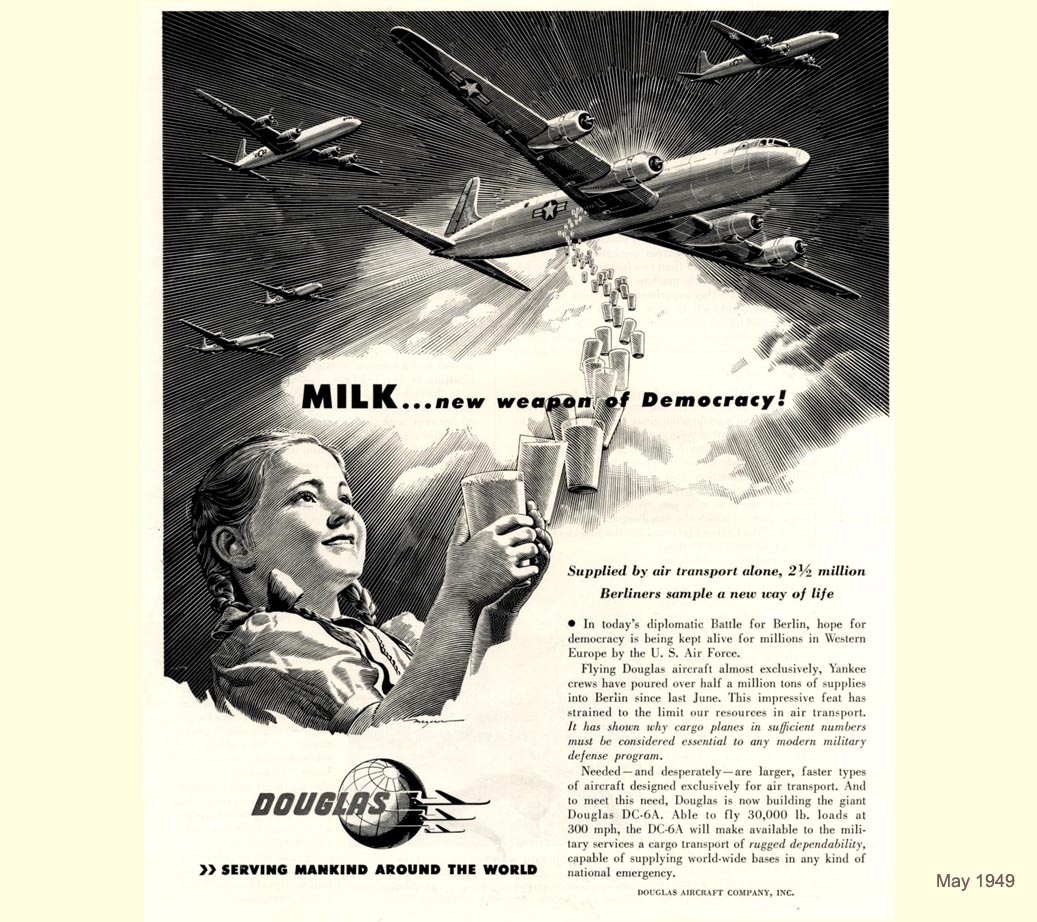
Beginning with the story of the Soviet blockade of West Berlin in the post-WWII era this chapter moves on to talk of the famines caused by Stalin and Mao. Thus, not a war story but some of the silent brutality of the Cold War.

"Milk... new weapon of Democracy". A 1949 ad for Douglas Aircraft Company.

Chapter 11: Feeding the World

Once fertilizer was invented it became the new limit defining factor in agricultural production. Hence subject of competition and conflict.
[...] huge deposits of sodium nitrate [...] had been discovered in Chile. Exports boomed, and in 1879 the War of the Pacific broke out between Chile, Peru and Bolivia over the ownership of a contested nitrate-rich region in the Atacama Desert. (Chile prevailed in 1883, depriving Bolivia of its coastal province so that it has been a land-locked country ever since.) [p. 204-205]
When Fritz Haber invented nitrogen fixation fertilizer could be produced chemically and natural deposits would not have to be fought over any more. Since then it has only contributed to the demand for fossil fuel as the process is energy intensive. Curiously, Haber also eagerly developed chemical weapons for the German war to use in the 1st World War - which drove his wife to commit suicide and earned him protests when later he was awarded the Nobel Prize.


For a quick view at the book's relevance to development issues please see TH!NK3 / Food & Development: Highlights from 'An Edible History of Humanity'.

Monday, May 24, 2010

Roosevelt's WWII Bill of Rights


From President Roosevelt's [Wikipedia] January 11, 1944 message to the Congress of the United States on the State of the Union in which he advocated a "Second Bill of Rights" [Wikipedia].

It is our duty now to begin to lay the plans and determine the strategy for the winning of a lasting peace and the establishment of an American standard of living higher than ever before known. We cannot be content, no matter how high that general standard of living may be, if some fraction of our people — whether it be one-third or one-fifth or one-tenth — is ill-fed, ill-clothed, ill-housed, and insecure.

This Republic had its beginning, and grew to its present strength, under the protection of certain inalienable political rights —among them the right of free speech, free press, free worship, trial by jury, freedom from unreasonable searches and seizures. They were our rights to life and liberty.

As our nation has grown in size and stature, however — as our industrial economy expanded — these political rights proved inadequate to assure us equality in the pursuit of happiness.

We have come to a clear realization of the fact that true individual freedom cannot exist without economic security and independence. Necessitous men are not free men. People who are hungry and out of a job are the stuff of which dictatorships are made.

In our day these economic truths have become accepted as self-evident. We have accepted, so to speak, a second Bill of Rights under which a new basis of security and prosperity can be established for all—regardless of station, race, or creed.

Among these are:

The right to a useful and remunerative job in the industries or shops or farms or mines of the nation;

The right to earn enough to provide adequate food and clothing and recreation;

The right of every farmer to raise and sell his products at a return which will give him and his family a decent living;

The right of every businessman, large and small, to trade in an atmosphere of freedom from unfair competition and domination by monopolies at home or abroad;

The right of every family to a decent home;

The right to adequate medical care and the opportunity to achieve and enjoy good health;

The right to adequate protection from the economic fears of old age, sickness, accident, and unemployment;

The right to a good education.

All of these rights spell security. And after this war is won we must be prepared to move forward, in the implementation of these rights, to new goals of human happiness and well-being.

Americas own rightful place in the world depends in large part upon how fully these and similar rights have been carried into practice for our citizens.

For unless there is security here at home, there can not be lasting peace in the world.


Never proposed, never passed. Franklin Delano Roosevelt was sick during the speech and died April 12, 1945.


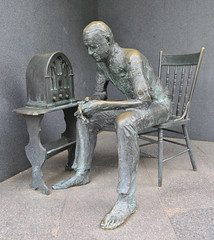
"FDR's "Fireside Chats" With America" by Tony the Misfit.


Monday, May 25, 2009

Water wars - myth or reality?

It appears the San Fransisco Gate runs a "water blog". Latest entry is a take on the concept of water wars.

There has been a lot of discussion about "water wars," a term that sounds great, but to which I do not subscribe: wars start and are fought for many reasons and while water has often been a target, tool, or objective of violence, it is certainly hard to ascribe the primary reason for any war to water alone.

That being said, there are very strong and clear connections between water and conflict.


What has impressed the blogger - Peter Gleick - is the list of water conflicts listed chronologically (Water Conflict Chronology) which I also linked to when taking note of the debate in Nature. Check out the post for his favourite "water wars". He finishes...

We must not be complacent about the political and military risks of water disputes. The past examples from the Chronology can help inform our current diplomacy and strengthen tools for reducing violence over water. [...] as tensions and conflicts over water grow, far more care and attention must be given by the diplomatic and military communities to water.


If you are new to my little blog here and as Mr Gleick not too keen on the concept of water wars I suggest you try clicking my water-tag then scroll down a bit. Enjoy.

Wednesday, March 11, 2009

Killing for Coal: The Ludlow Massacre and more

Coal's been generating controversy for about as long as it's been generating energy.

On April 20th 1914, coal was at the epicenter of the bloodiest battle in US labor history. It's called the Ludlow Massacre, after the mining town in Southern Colorado where coal miners went on strike demanding better conditions. The Colorado National Guard attacked a tent colony of striking miners and their families - 20 people were killed - most, women and children.


Interesting? Move right on to America's Deadliest Labor War which is an interview with the author of Killing for coal professor of history Thomas Andrews.

Also, I put it on the "curriculum". And the Ludlow massacre is on Wikipedia of course.

Monday, February 25, 2008

"We Will Abolish War"

This writer discusses the nature of organized violence and how to have less of it.

As far back as anthropologists have peered into human history and pre-history, they have found evidence of group bloodshed. [But] History offers many other examples of warlike societies that became peaceful very rapidly.


A key section is about Jared Diamond's latest book:

In his book, Collapse, the anthropologist Jared Diamond argues that many wars, both ancient and modern, spring from mismanagement of environmental resources. He notes, for example, that ethnic conflicts are only the proximate causes of the conflicts that have ravaged Rwanda, Somalia, and other African nations in the last decade. The ultimate cause is that overpopulation has led to deforestation, overgrazing and soil depletion and, hence, a Hobbesian struggle over dwindling resources.


Obviously there are some examples of wars not directly sparked by a fight over a natural resource. But Jared Diamond's book Collapse [Google Books] is about much more than that and I really don't know how to recommend it thoroughly enough. Watch this 74 minute lecture on it. If you in any way find the contents of this blog interesting, you will worship Jared Diamond's books. This isn't the first nor the last time I have linked to an article mentioning Diamond - try clicking the tag below. After reading John Horgan optimistic anti-war piece.

Monday, July 09, 2007

Chinese study correlates climate change with wars

Climate change, and the resulting shortage of ecological resources, could be to blame for armed conflicts in the future, according to David Zhang from the University of Hong Kong and colleagues. Their research, which highlights how temperature fluctuations and reduced agricultural production explain warfare frequency in eastern China in the past, has been published online in Springer’s journal Human Ecology.


Main points in short:
  • Wars throughout Chinese history correlated to cold periods in climate change cycles
  • Situations of "ecological stress" spurs conflict and should be taken into account in other historical reviews of war
  • In the future resource shortages could create conflicts and wars


The original article is available to subscribers only, but of course they have the abstract for free: Zhang et al: Climate Change and War Frequency in Eastern China over the Last Millennium. Human Ecology, 2007.

Search This Blog