Have been reading
An Edible History of Humanity by Tom Standage. Good reading I can recommend!
You will find it interesting too if you, like me, is into Jared Diamond's books, agriculture or the more practical aspects of history. It is written in an accessible form and not quite as academic in nature as Diamond's books. If you, also like me, have already read all of Diamond's books as well as a selection of related literature and journal articles it will be repetitive at places. But at the same time full of great quotes and little stories.
The book tells the history of human civilization through the development of our food production and culture. A highly relevant book to the present blogging project although food is a special type of natural resource or products hereof and history is a wider subject than conflict.
The fate of nations hangs upon their choice of food.
- Jean-Anthelme Brillant-Savarin
Part I: The Edible Foundations of Civilization
First, the domestication of maize, wheat and rise is retold - essential beginning of the tale. Then the spread of farming discussed. Hunter-gatherer societies have always been and still are much more peaceful than farming societies. Why and how is explored and explained in chapter 2 from reasoning with the needs and circumstances of them as well as the historical conditions.
Chapter 3: Food, Wealth, and Power
Picking up where chapters 1 and 2 left off, now the gradual transition towards hierarchical social order is described. Especially the significance of irrigation is compelling; here are a few of the explanations for the onset of organized conflict:
One theory contends that a big man or leader can become more powerful by coordinating agricultural activity, particularly irrigation. [...] control of the irrigation system would confer power on the leader [...] the irrigation system might also need to be defended, using full-time soldiers funded by the food surplus and placed under the leader's control. [p. 41]
Another theory suggests that the communal storage of agricultural surpluses might provide the leader with an opportunity to establish greater control over his followers. [...] Increasingly elaborate public-works projects then legitimize the leader's position and require a growing number of administrators, who emerge as the ruling elite. [p. 42]
A third suggestion is that competition for agricultural land led to warfare between communities in areas where such land was environmentally circumscribed. [...] When one village defeated another it then appropriated the defeated village's land or forced its people to hand over a proportion of their harvest every year. [...] This all sounds plausible, but there is no evidence that people reached the limit of agricultural productivity in any of the places where stratified societies first emerged. In the event of a drought or a bad harvest, however, it is possible to imagine villages with food reserves coming under attack from neighboring villages where the food had run out. [p. 43]
Part III: Global Highways of Food
Standage delivers a great tale of a near-global multi-millennial trade war over spices (which I must admit I've been mostly ignorant of hitherto). A mostly non-violent conflict that occasionally flared into brutality. And, amazingly, indirectly contributed to the collapse of the Roman empire that spent two digit tonnes of gold on importing spices annually, later helped spread the plague to Italy. The latter includes one of the book's interesting detours: plague infected corpses were used by Mongols as catapult ammunition against slave trading Europeans [p. 80-81].
After the year 1500 there was no pepper to be had at Calicut that was not dyed red with blood.
- Voltaire, 1756
It is also explained how trade spread Islam by it providing suitable customs and laws. Then how the Portuguese (
Pedro Álvares Cabral and
Vasco da Gama) finally navigated around Africa to find unarmed trade vessels and immediately exploited it with extreme violence - bombardments of random cities, torture of innocent traders, mass executions, extortion et cetera.
Later in the 16th century the English and Dutch stepped up to compete in spice trade and global violence:
Clove production was concentrated on the central islands of Ambon and Ceram so that it could be more tightly controlled; the ancient groves of clove trees on other islands were uprooted, the clove pickers massacred, and their villages burned down. Where clove production was permitted, the growing of other crops was outlawed, to ensure that the local people would be dependent on the Dutch for their food. [p. 99]
Similar regimes were established to control nutmeg and mace production. Locals were enslaved for workforce, power was ruthlessly enforced by mercenary samurai warriors hired in Japan and problematic villages razed.
Obviously, the slaves-sugar-rum triangle is discussed. And later in the book one of the first consumer boycotts when in the 1790 British wanted slavery free tea.
Part V: Food as a Weapon
Needless to say: this is a central part of the book for Ecowar scrutiny. But it contains only two chapters. Chapter 9 on how food crucially influences warfare and chapter 10 on how some conflicts have been entirely centered around food.
Chapter 9: The Fuel of War
This chapter explains how Alexander the Great and Napoleon Bonaparte won numerous battles thanks to superior logistics. And how the English lost the American Revolutionary War due to inadequate supplies.
The fate of Europe and all further calculations depend upon the question of food. If only I will have bread, it will be child's play to beat the Russians.
- Napoleon Bonaparte
Starvation destroys an army more often than does battle, and hunger is more savage than the sword. [...] whoever does not provide for food and other necessities, is conquered without fighting.
- Vegetius, 4th century
If you occupy your enemies' storehouses and granaries and seize his accumulated resources in order to provision your army continuously, you will be victorious.
- Medieval Chinese military handbook
Besides stories of how food has influenced war we also get the story of how war inspired culinary research: Around year 1800 the French invented canned food for soldiers rations but failed to keep the technology to themselves. And it concludes with the stories of how sabotage of supplies helped settle the American Civil War and how the German General Rommel fought and lost his North African battles over and because of Middle Eastern oil supplies.
Chapter 10: Food Fight
Food is a weapon.
- Maxim Litvinov, Soviet Minister of Foreign Affairs, 1930-39
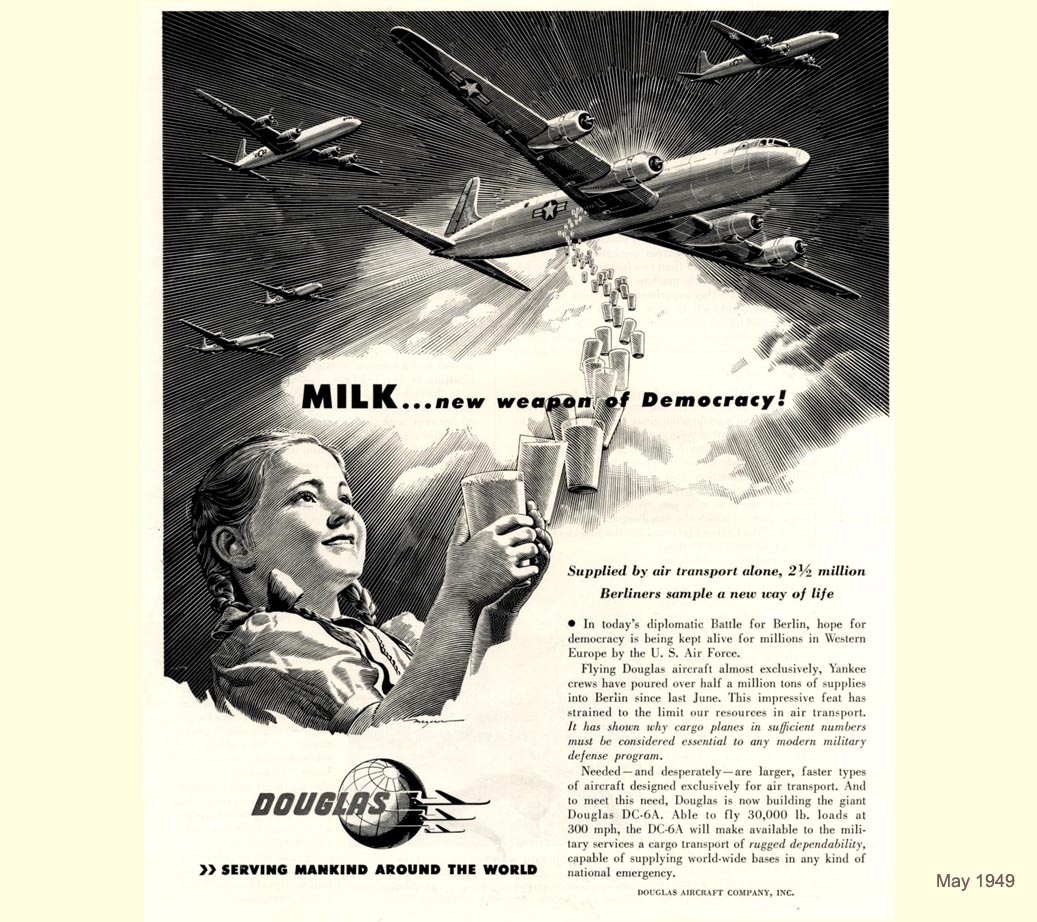
Beginning with the story of the Soviet blockade of West Berlin in the post-WWII era this chapter moves on to talk of the famines caused by Stalin and Mao. Thus, not a war story but some of the silent brutality of the Cold War.
"Milk... new weapon of Democracy". A 1949 ad for Douglas Aircraft Company.
Chapter 11: Feeding the World
Once fertilizer was invented it became the new limit defining factor in agricultural production. Hence subject of competition and conflict.
[...] huge deposits of sodium nitrate [...] had been discovered in Chile. Exports boomed, and in 1879 the War of the Pacific broke out between Chile, Peru and Bolivia over the ownership of a contested nitrate-rich region in the Atacama Desert. (Chile prevailed in 1883, depriving Bolivia of its coastal province so that it has been a land-locked country ever since.) [p. 204-205]
When Fritz Haber invented nitrogen fixation fertilizer could be produced chemically and natural deposits would not have to be fought over any more. Since then it has only contributed to the demand for fossil fuel as the process is energy intensive. Curiously, Haber also eagerly developed chemical weapons for the German war to use in the 1st World War - which drove his wife to commit suicide and earned him protests when later he was awarded the Nobel Prize.
For a quick view at the book's relevance to development issues please see
TH!NK3 / Food & Development: Highlights from 'An Edible History of Humanity'.