Wednesday, February 23, 2011

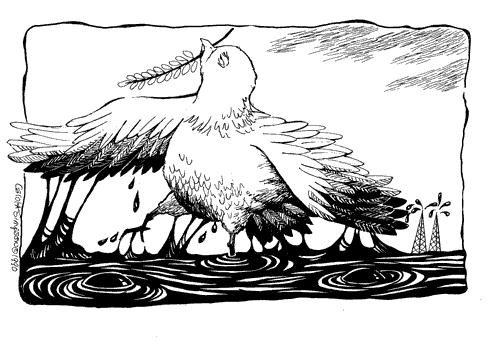
Oil: Enslavement, repression, revolution

'nuff said, Naomi:
"Our enslavement to oil has required the repression of millions of Arab people. As they shake off their bonds, so must we." - Naomi Klein
In celebration of this eminent tweet let me recycle two cartoons :-)


Update: Cover of The Economist
Cover of February 26th - March 4th 2011 "The Economist" magazine: "Blood and oil - Lessons from tyranny".


Monday, February 14, 2011

Sachs, Brown et al comment on Egypt, Tunesia etc

January and February of 2011 have seen the people of Tunisia and Egypt in unprecedented protests. While it seems the overwhelming sentiment of the people in the streets are for less repression and corruption, more freedom and democracy Western commentators have mentioned the danger of radical Muslim influences. Fortunately, this weekend a few voices of reason were allowed some space.

"This isn't just about the Muslim Brotherhood and it isn't just about politics. [...] This is about hunger, about poverty, about food production about a change of world economy. [...] The demographic change is very significant [...poor African states already heavily reliant on food imports because of weak farming sectors] cannot afford to live on imports of grains at world prices, and those prices are going to remain high and unstable [...] It's perfectly understandable how this spark went off, although it's not simple to predict when it's going to happen [...] This is a global ecological phenomenon, of rising world populations, increasing climate unsustainability and pushing up against the barriers of food productivity in many places. [...] My rule of thumb is the dry lands are the most combustible part of the world, all of the Sahel to the Horn of Africa, across the Red Sea to Yemen, Iran, Iraq, Afghanistan, Pakistan. This is all one vast ecological zone of extraordinary stress, with a lot of war in it already. [...] This is one large swathe of 10,000 miles of potential instability"
- Jeffrey Sachs, Earth Institute

"Many governments are suffering from demographic fatigue, unable to cope with the steady shrinkage in cropland and freshwater supply per person or to build schools fast enough for the swelling ranks of children."
- Lester Brown, Earth Policy Institute

"Countries with very youthful age structures have an elevated likelihood of experiencing a civil conflict."
- Richard Cincotta, US demographer

Sources: AFP / Food, demography are invisible drivers in Egypt uprising, Reuters / INTERVIEW-Arab protests show hunger threat to world-economist.


Thursday, February 10, 2011

Home, Sweet Home

Having just arrived home from Kenya - summed up at TH!NK3 in Touching. Brutal. Unfair. - I instantly find two stories from Kenya in my search alerts and one Ecowar-like post on the new TH!NK blog.

First, Photo District News / An Under-Reported War Over Water is an interview and background article about photographer Evan Abramson’s recent project called When the Water Ends: Africa’s Climate Conflicts. I have already mentioned Abramson's photos and short film and in fact borrowed a few seconds for my little Ecowar trailer.
Because of drought, the north end of Lake Turkana has retreated from southern Ethiopia into northern Kenya in the last 35 years. Abramson says there are unconfirmed reports that the Ethiopian government is arming indigenous tribes near its border with Kenya and encouraging them to assert their rights to the lake as it retreats. The Kenyan government, meanwhile, is disarming tribes within its borders, making them vulnerable to raids from Ethiopian tribes.
Adventurous photographers and journalists really should read this article about the production of Abramson's When the Water Ends. 7000 USD and one Canon EOS camera and the project began!

Secondly, Kenyan Daily Nation / Land conflict simmers in Rift Valley reports of futile government attempts to solve internal refugee issues.
The violence that rocked Likia in Njoro District on February 2 brought to the surface the simmering conflict over land in the Rift Valley [...] 70-year-old Kuria Wakaba was hacked to death and seven others critically injured brought to the fore the stark reality of unresolved land-based animosities. [...] The government had planned to resettle 850 families living in a camp in Nakuru town on a 2,400-acre piece of land in Mau Narok by December 31 last year.  But the plan was put on hold when members of the Maasai community opposed it. [...] Clashes over land use and ownership have been fuelled by politicians for their own benefit since the restoration of multiparty democracy in 1991 [Irin, a UN-affiliated humanitarian news and analysis agency says...] vast tracts of arable land in the Rift Valley were designated as White Highlands and reserved for European settlers during British rule. The pastoralist communities, mainly the Kalenjin and Maasai, were edged out. [... later, during Kenyan government administration] many well-connected politicians were illegally allocated public land.
Thirdly, a new blogger has appeared at the TH!NK platform with the bold postulate that water scarcity may contribute to future conflicts in the Middle East: TH!NK5 / Water politics and Middle East: a growing conflict. A new friend...


Tuesday, January 25, 2011

"The Great Food Crisis of 2011" by Lester Brown

As the new year begins, the price of wheat is setting an all-time high in the United Kingdom. Food riots are spreading across Algeria. Russia is importing grain to sustain its cattle herds until spring grazing begins. India is wrestling with an 18-percent annual food inflation rate, sparking protests. China is looking abroad for potentially massive quantities of wheat and corn. The Mexican government is buying corn futures to avoid unmanageable tortilla price rises.

Lester's article explains how "both sides of the food supply/demand equation" raise prizes mainly through environmental degradation of arable land, global warming, population growth, increasing consumption and related factors. Disturbingly high numbers ad libitum. It finishes:

The unrest of these past few weeks is just the beginning. It is no longer conflict between heavily armed superpowers, but rather spreading food shortages and rising food prices -- and the political turmoil this would lead to -- that threatens our global future. Unless governments quickly redefine security and shift expenditures from military uses to investing in climate change mitigation, water efficiency, soil conservation, and population stabilization, the world will in all likelihood be facing a future with both more climate instability and food price volatility. If business as usual continues, food prices will only trend upward.

Read the whole article at Foreign Policy or in Danish at Information.


Wednesday, January 19, 2011

Nile water match

Last fall I was just about to write a bit about Egypt threatening the Nile upstream countries not to increase their use of the river's water when... I don't know why I didn't. A 1929 treaty by the then British colonial rule reserved 80% of the Nile’s entire flow for Egypt and Sudan but May 2010 Ethiopia, Uganda, Tanzania, Kenya, the Democratic Republic of Congo, Burundi and Rwanda agreed to disagree with the old treaty.
"Not only is Egypt the gift of the Nile, this is a country that is almost completely dependent on Nile water resources. We have a growing population and growing needs. There is no way we can accept this kind of threat."
 - spokesman for the Egyptian Foreign Ministry, Hossam Zaki

[New York Times / Egypt and Thirsty Neighbors Are at Odds Over Nile | NPR / Ethiopia Claims High Ground In Right-To-Nile Debate]


Today James M. Dorsey published an article about an Egyptian football tournament at European Journalism Center's TH!NK5 Water blog: Egypt Employs Soccer to Assert Its Nile Basin Water Rights. Can't believe I nearly missed that one - better follow TH!NK5! So, what does a football tournament have to do with water conflict?
"The tournament aims to create awareness among all countries sharing the Nile Basin, to safeguard the water resource for the benefit of future generations. [...] Let’s face it, football is politics. That’s why countries pour money into hosting tournaments”
 - senior Egyptian official.
Egypt won the tournament beating Uganda in the final. [CAF / The Pharaohs win the first Nile Basin tournament]


Search This Blog