Sunday, August 21, 2011

New evidence UN Secretary General was killed by British mercenaries in 1961

This week new evidence that former UN Secretary General Dag Hammarskjöld was murdered on 18th September 1961 has been covered by The Guardian. The Wikipedia entry about him already lists a number of "conspiracy theories".

Who was Dag Hammarskjöld?

Swedish diplomat and economist who worked hard to promote peace tending to favor the independence of nations at a time when the world was locked in cold war and colonialism still characterized the business relationships between western corporations and developing nations. He intervened in the Suez crisis in 1957, angering Britain and France, and in the Bizerte crisis in 1961, angering France again. He morally supported newly independent Guinea, this time infuriating France who then whithdrew support for the UN Congo operation and encouraged French mercenaries to join the Congolese rebels fighting UN forces. Dag Hammarskjöld estabished the armed United Nations Emergency Force and generally strengthened the position of the United Nations considerably.

18 September 1961 the Douglas DC-6 transporting him and his delegation to cease-fire negotiations mysteriously crashed near the copper mining city Ndola (which is now in Zambia). The search and rescue mission was delayed. Official inquiries have failed to conclude on the cause of the crash and are inconsistent in certain details. These investigations were partly managed and influenced by the British military who were also there to protect British mining companies.
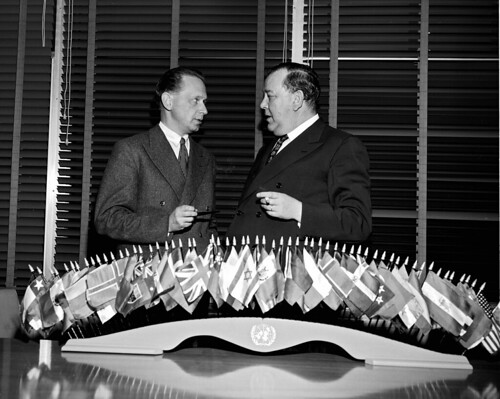
Dag Hammarskjöld with Trygve Lie
Dag Hammarskjöld (left), with his predecessor Trygve Lie today at UN Headquarters.
13 April 1953.

The conspiracy theories

Why was the rescue mission delayed? Why were local witnesses sent away, not interrogated? Why were the only survivor allowed to die unnecessarily in a poor local hospital? Why were poor reports on the cause of the crash rubber stamped? Didn't the British troops have conflicts of interest when they arranged the very peace negotiation Dag was to attend even while protecting the mining companies that supported the rebellion?

"... in order to pay a tribute to this great man, now vanished from the scene, and to his colleagues, all of whom have fallen victim to the shameless intrigues of the great financial Powers of the West... the Government has decided to proclaim Tuesday, 19 September 1961, a day of national mourning."
- Prime Minister of the Republic of the Congo, 1961

"Dag Hammarskjöld was on the point of getting something done when they killed him. Notice that I said, 'when they killed him'."
- Harry Truman, 33rd President of the United States (1945–1953)

Letter from Dag Hammarskjold top aides Conor Cruise O'Brien and George Ivan Smith detailing their version of the story; Guardian 1992.

"[I have] documents purporting to be from an institution called the SA Institute of Maritime Research discussing the sabotage of the aircraft in which the UN Secretary-General, Dag Hammarskjold, died on the night of September 17/18, 1961."
- Archbishop Desmond Tutu, 1998

The new evidence

A metal plate fragment from the DC6, previously unpublished UN telegrams and many interviews with local witnesses have been conducted by Göran Björkdahl and The Guardian the past three years. The telegraphs (cables) reveal anger from the US, British and almost all other major powers on the security council towards the UN military operation in Congo and Dag's support for decolonization. The witnesses all tell of a small plane opening fire on the larger, crashing plane.

"Hammarskjöld's DC6 was brought down [...] the motive was to maintain the west's control over Katanga minerals"
- Göran Björkdahl, Swedish aid worker, writing in Guardian

"It's clear there were a lot of circumstances pointing to possible involvement by western powers. The motive was there – the threat to the west's interests in Congo's huge mineral deposits. And this was the time of black African liberation, and you had whites who were desperate to cling on. Dag Hammarskjöld was trying to stick to the UN charter and the rules of international law. I have the impression from his telegrams and his private letters that he was disgusted by the behaviour of the big powers."
- Göran Björkdahl, Swedish aid worker, speaking to Guardian


Sources (if not as otherwise stated): Guardian / Dag Hammarskjöld unable to overcome Congo's troubled history, Guardian / Dag Hammarskjöld: evidence suggests UN chief's plane was shot down, Guardian / 'I have no doubt Dag Hammarskjöld's plane was brought down', UN cable 11 September 1961: UN frustrations with British behaviour spill over, Top secret UN cable 15 September 1961: Hammarskjöld rejects American criticism.


Wednesday, August 17, 2011

News from Kenya: food price spike worsen hunger, smartphone sales skyrocket

While the emergency in the Horn of Africa was triggered by prolonged droughts, especially in areas struggling with conflict and internal displacement such as Somalia, food prices that are near the record high levels seen in 2008 also contributed to the situation.
- The World Bank, Food Price Watch report according to The Guardian, August 2011 / Africa famine: soaring food prices intensifying crisis, report warns.

In a related news report by France 24 a 14 years old is armed with an AK-47 when herding his skinny goats in drought stricken northern Kenya.


Earlier this year, the Chinese firm Huawei unveiled IDEOS through Kenya’s telecom titan, Safaricom. So far, this $80 smartphone has found its way into the hands of 350,000+ Kenyans, an impressive sales number in a country where 40% of the population lives on less than two dollars a day. The IDEOS’s success in this market firmly establishes the open source Android as the smartphone of the people and demonstrates how unrelenting upswings in price-performance can jumpstart the spread of liberating technologies.
- Singularity Hub, August 2011 / $80 Android Phone Sells Like Hotcakes in Kenya, the World Next? (via Slashdot).

The tecnical specs are just slightly below those of "our" iPhones, Samsungs and HTCs but the price is about one tenth (yes, 1/10). In other words, Huawei and Google just saved Kenyans (800 USD minus 80 USD) times 350.000 equalling 252 million USD. At least. (Shows how incredibly conservative my 3 billion USD estimate on how much Linux has saved people and business recently was; see Apple, PCs, Linux and the economy.)

An entrepreneurial conference in Nairobi called Pivot25 showcased some of the most innovative Android apps in East Africa. Among these include M-Farm, an app that allows farmers to broadcast product prices and locations to the world via SMS. Another agri-app developed by Makerere University helps diagnose and track the spread of crop diseases via crowdsourcing. In a nation where agriculture accounts for nearly a quarter of GDP, apps like these could prove invaluable in maximizing harvests and facilitating the spread of precision farming.


[This blog post has been cross-posted to Linux vs Mac and TH!NK3.]


Monday, August 08, 2011

News not on my TV, not in my newspaper...

Colombia, oil
The Marxist rebels in Colombia, FARC, bombed an oil company's car. One died, six were injured. Why? Probably as part of an extortion scheme.
"This attack ... is a true crime against humanity."
 - Vice President Angelino Garzon
Well, at least it's an attack on the country's oil business.

View Larger Map
Sources: Reuters / Colombia bomb kills oil worker, injures 6 people, Latin American Herald Tribune / One Killed by Rebel Landmine in Colombia.

Central Asia, water
Kyrgyzstan and Tajikistan are upstream countries with lots of water fresh from the glaciers in the high mountains of Central Asia. Uzbekistan and Kazakhstan are downstream and suffering from the worst drought in decades. The latter are asking for more water from the former, claiming water belongs to everyone and rivers flow free. But Kyrgyzstan is asking for natural resources in return (ie Kazakhstan is the worlds number one uranium producer) and Tajikistan is constructing what will become the highest dam in the world. Kazakhstan refuse to trade in naturals (perhaps preferring world market prices?) and Tajikistan insist on damming the river since their energy supply is already rationed.

Negotiations have stalled. Uzbekistan has cut its gas export to Tajikistan and allegedly is also holding up Tajik exports on its border. Global warming is projected to raise temperatures by 2-3 degrees Celcius within 50 years; the glaciers are already melting because of this and future droughts will only grow in numbers and intensity.

View Larger Map
Source: Spero News / Central Asia: Danger of war over water growing.

The world, climate change
Another renowned columnist is speaking up. This time it's Eric Hammel in Foreign Policy.
I cannot fathom the prevailing so-what attitude as the FEMA-grade weather disasters mount toward becoming serial and routine occurrences. [...] Global famine is going to force the use of our military as a police force organized to feed unknowable masses of people [...] The only force on Earth with the inherent capability to police, process, house, feed, and move refugees on a mass scale is the U.S. military, but, though its reach is global, its capacity and stamina are nonetheless limited, probably to one or two major disasters at a time, not the overlapping rolling meta-disaster climatologists predict.
Read: Foreign Policy / Is climate change the biggest national security challenge we are facing?


Saturday, August 06, 2011

Where is the water? A 3 min video at Climate Change TV

I made a three minute video about lakes disappearing from Google Maps satellite photos and a rainy day in Copenhagen for Climate Change TV. Check it out.


If you like it, head over to the competition website and vote for it, please.

I haven't had the time to watch all of the other videos yet. But among those I have seen I'd mention The world has malaria and What happened at COP16? Got another favorite? Let me know and I'll check it out.


Friday, August 05, 2011

How al Shabaab is wrecking Somalia

All those of us not living under a rock are aware of the famine in East Africa. Some of us have even read a bit about the al Shabaab militia getting in the way of relief efforts. Should one donate when part of the contribution might end up bribing the militia? A recent UN report shed some light on the details of the al Shabaab regime.

Al Shabaab generates $70-$100 million a year from various trade schemes, taxes, "jihad contributions" and extortion. Some of these money are demanded by gunpoint at roadblocks but much is earned in more sinister ways. For example by exporting charcoal, importing sugar and manipulating the accounting to allow illegal money transfers to fill up the artificial surplus.

"In a very real sense, al Shabaab is becoming a business: a network of mutually supportive interests in Somalia, Kenya, the Middle East, and even further afield. Even businessmen who are not ideologically aligned with al Shabaab have little incentive to see the Islamists displaced by a predatory and corrupt Transitional Federal Government."
- UN Report.

A terrorist militia extorting its own people even during a drought of historical proportions threatening the livelihoods of millions of people. That's bad enough. But pause for a moment to consider the complete and utter reckless idea of chopping down trees to export charcoal when your country is suffering from some of the worst deforestation and desertification in the world.

Avaaz is doing a petition to press for a deal with al Shabaab to allow food aid. They almost make it sound like the crisis is happening because of the US 'war on terror'. How about a petition to press for sanctions against Kenyan and Dubai based traders who make the al Shabaab business model possible? How about an investigation of how weapons supposed to arm African Union peace keepers end up for sale on Mogadishu markets?

East African drought monitor, August 2011 and 36 months back. For Somalis the drought hit hard this year whereas the past years were easier on them.

What is your verdict, dear reader - do we sign the Avaaz petition or not?

Sources: Reuters / Factbox: U.N. Monitoring report on Somalia, Eritrea, Guardian / Somalia famine: The problems of delivering aid, Information.dk / Al-Shabaab ligner mere en regering end en oprørsbevægelse.


UPDATE: Al Shabaab militia’s tight grip on ‘desert’ charcoal trade
The taking of Ras Kamboni and Bur Gaboby, the two fishing towns by the sea that have been under the control of Al Shaabab, by the Kenya defence forces has struck an economic blow at the militia group.


Search This Blog