Showing posts with label Geneva Conventions. Show all posts

Wednesday, February 08, 2017

Du skal se dokumentaren om Stuxnet

Omkring år 2010 løb Irans atomprogram ind i mystiske problemer: Dels blev flere af deres atomfysikere snigmyrdet, dels brød centrifugerne på deres anlæg til forarbejdning af uran sammen. Problemerne viste sig at skyldes ondsindet software, der af Symantec fik navnet Stuxnet.

Stod Israel bag? Stod USA bag? Hvordan kunne det lade sig gøre at inficere det topsikre anlæg? Og ikke mindst: Hvad betyder alt dette for vores fremtidige opfattelse af it-sikkerhed og krigsførelse i cyberspace?
I understand the difference in destruction is dramatic, but this has the whiff of August 1945. Somebody just used a new weapon, and this weapon will not be put back into the box.


Ikke blot udpensler dokumentaren Zero Days mange flere detaljer, end jeg havde turdet håbe på, - som ganske vist til syvende og sidst hænger på anonyme kilder - den ender også med at underbygge en opfordring om at få en Genevekonvention for cyberkrig. Og det er da flot klaret, når man tænker på, det er en hel film om én computer-orm.
When you shut down a country's power grid, it doesn't just pop back up, you know. It's more like humpty-dumpty... And if all the king's men can't turn the lights back on or filter the water for weeks, then lots of people die. And something we can do to others, they can do to us too. Is that something that we should keep quiet? Or should we talk about it?
Jeg giver ikke filmen topkarakterer. Dertil er der for mange klip med kilder, der ikke vil udtale sig, og for uspændende formidling om selve softwaren. Men filmen er sindsygt væsentlig og absolut et must see, hvis man vil hævde at vide noget som helst om Irans atomprogram eller cyberwarfare.



Wednesday, December 24, 2014

2014 bookmarks - the year in war over natural resources

From the depths of my bookmarks (that were all automatically tweeted) on conflict and natural resources, here is a quick review of the way in which Earth was plundered for natural resources in the past year. Year 2014, the 100th anniversary of the first war to run on oil.

In short, 2014 was just more of the same. Like...
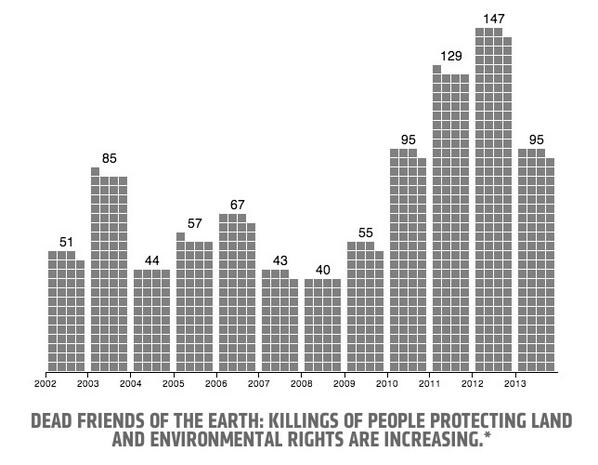
But a lot more of the same also means obscure news stories grow into reports from acknowledged organizations—like when
Some of the worst news this year was how Islamic State grew out of the chaos in Iraq and Syria, and became known not as the richest terrorist group in the world, but as the poorest terrorist country. Because they successfully occupy and exploit vast oil fields, loot everything lootable while controlling many smuggler's routes and ruthless dealers. I get how they control the population by mass executions rivaling the worst in history, denying crucial water supplies to villages and other callous misdeeds. But how do they manage to sell oil worth millions of dollars every single day even as all eyes are on the region? Money talks, of course, anywhere and anytime, but still?

Part of the answer came in this fascinating report by Suzan Fraser and Yilmaz Akinci from the border between Turkey and Syria, where... hillbillies, basically... tell how they have always been smuggling. Everyone did it. For generations. So, suddenly a few more bearded men came with a bit more oil than usual. It worked for a time, but Turkish police cracked down on it. Their large scale “pipeline” was smacked into smaller, obscure “pipelines” - like the ones the Islamic terrorists have for every other country, apparently.

Probably more efficient that the Turkish police, however, is the Saudi Arabian financial muscle. To them and most of their allies, the sum of benefits of a low oil price seems to currently triumph the more obvious benefits of a high oil price. Mainly by cutting the cash flow to Iran, Syria, Islamic State, Russia, even North American non-conventional (fossil) energy producers and others. In fact, I've seen some speculate Saudi Arabia has almost won the war on Ukraine's behalf as Russia's weakening rubles soon cannot pay for any more war. Speaking of Ukraine: This country used to be self-sufficient in coal, but the territory occupied by rebels and Russians just happen to host 66 coal mines, leaving Ukraine's power plants under-supplied; and the shores off now Russian Crimea just happen to be full of gas. What a coincidence.

That was all just slightly scratching the surface of year 2014 in war for natural resources. On slightly more positive notes, Interpol published a most-wanted list of environmental criminals at large – go get 'em – and Egypt and Ethiopia seems to be agreeing on how to share the Nile.

https://twitter.com/Global_Witness/status/456347470071463936

Happy New Year!


Wednesday, June 19, 2013

Noam Chomsky explains how to destroy the future

During a broad scope text on the suicidal tendencies of our global society Noam Chomsky touches a couple of resource conflict topics.
all over the world – Australia, India, South America – there are battles going on, sometimes wars. In India, it's a major war over direct environmental destruction, with tribal societies trying to resist resource extraction operations that are extremely harmful locally, but also in their general consequences

Here, Noam might be referring to the Dongria people vs. British Vedanta Resources. But there are other conflicts to choose from in India. And elsewhere.
So, at one extreme you have indigenous, tribal societies trying to stem the race to disaster. At the other extreme, the richest, most powerful societies in world history, like the United States and Canada, are racing full-speed ahead to destroy the environment as quickly as possible.
(Pssst Noam, there's this Arctic anomaly to your generalizing rule.)
[during the Korean War] everything else in North Korea had been destroyed, the [US] air force was sent to destroy North Korea's dams, huge dams that controlled the water supply – a war crime, by the way, for which people were hanged in Nuremberg. [...] the water pouring down, digging out the valleys, and the Asians scurrying around trying to survive. [...] It meant the destruction of their rice crop, which in turn meant starvation and death. How magnificent!
The Geneva Convention does protect the environment. Or rather: it professes to protect natural resources upon which the local population depends. See the Ecowar blog / 'Geneva Convention' needed to protect environment from war (Nov 2007) or Ecowar - Natural Resources and Conflict (the book, Dec 2011) pages 9, 29-30 and 120.

However, flooding an area did not automatically get generals hanged after the WWII. This tactic was used by China, the Dutch, the Soviet Union, Germany and Great Britain. At least. To be honest, I haven't checked if any German soldiers were hanged for drowning people in this way. But my wild guess is no.

Read How to destroy the future at The Guardian (Danish translation Sådan ødelægger vi fremtiden at Information). It is great reading like most of Noam's pieces.


Saturday, November 13, 2010

It is that time of the year when...

...some group, country or person cease the opportunity to call for stronger environmental protection during conflict. This year Iranian President Mahmoud Ahmadinejad suggest the UN adopt a convention to ban destruction of forests or pollution to reduce the pressure on the environment and natural resources. The occasion is, of course, International Day for Preventing the Exploitation of the Environment in War and Armed Conflict.


The time of the year when I note the Geneva Conventions already does address the environment:

Methods or means of warfare that are intended or may be expected to case widespread, long-term and severe damage to the environment are prohibited.
- (Protocol I, Art. 35, Sec. 3)

Attacks against crops, livestock and agricultural areas needed for food production for the civilian population are prohibited. [...] Attacks against civilian drinking water installation and irrigation works are prohibited.
- ( Protocol I, Art. 54 , Sec. 2)

(Quotes from genevaconventions.org)

But should the convention be stricter? Should it be more often enforced? Yes.


Tuesday, December 02, 2008

Lawyers call for international court for the environment

A former chairman of the Bar Council is calling for an international court for the environment to punish states that fail to protect wildlife and prevent climate change. [...] "The time is now ripe to set this up and get it going [...] Its remit will be overall climate change and the need for better regulation of carbon emissions but at the same time the implementation and enforcement of international environmental agreements and instruments."


To begin with we could enforce the Geneva Conventions.

Monday, November 10, 2008

Congo fighting is about water, timber and diamonds

"The natural environment enjoys protection under Protocol 1 of the Geneva Conventions. But this protection is often violated during war and armed conflict. Water wells are polluted, crops torched, forests cut down, soils poisoned, and animals killed, all in order to gain military advantage.

[...]

We have seen how environmental damage and the collapse of institutions are threatening human health, livelihoods and security. These risks can also jeopardize fragile peace and development in post-conflict societies. The environment and natural resources are crucial in consolidating peace within and between war-torn societies.

The United Nations attaches great importance to ensuring that action on the environment is part of our approach to peace. Protecting the environment can help countries create employment opportunities, promote development and avoid a relapse into armed conflict. On this International Day, let us renew our commitment to preventing the exploitation of the environment in times of conflict, and to protecting the environment as a pillar of our work for peace."


Quote United Nations Secretary-General Ban Ki-moon. My emphasis. Said on the International Day for Preventing the Exploitation of the Environment in War and Armed Conflict, which is observed each year on November 6 while on his way to negotiate peace in Congo.

Since the outbreak of fighting in August 1998, the conflicts have been rooted in struggles for control of natural resources such as water, timber, diamonds and other minerals as well as various political agendas


Via Environment News Service.

Tuesday, November 13, 2007

'Geneva Convention' needed to protect environment from war

"Although some positive outcomes can occur, such as when a vacated area becomes enriched with wildlife and vegetation, this is weighed against the destruction of social networks, systematic atrocities and the collapse of workable government. Future success after the conflict period may rely on natural resources and their careful management. Safeguarding natural resources in a conflict zone during the conflict itself makes sound social and economic sense for future stability."
- Dr Richard Pagett


"We also need to acknowledge that fighting occurs where resources are scarce due to over population, meaning we need sensible population policies. We must treat the environment and each other with more respect."
- Nick Reeves, CIWEM


Actually, the Geneva Conventions already does address the environment:

Methods or means of warfare that are intended or may be expected to case widespread, long-term and severe damage to the environment are prohibited.
- (Protocol I, Art. 35, Sec. 3)

Attacks against crops, livestock and agricultural areas needed for food production for the civilian population are prohibited. [...] Attacks against civilian drinking water installation and irrigation works are prohibited.
- ( Protocol I, Art. 54 , Sec. 2)

(Quotes from genevaconventions.org)

Search This Blog