"Hvis man ser på lande, der er afhængige af naturlige ressourcer, ser man en sløv udvikling, stor ulighed, autoritære regimer og udbredt korruption." - Peter Lewis, John Hopkins University
"I hele verden, i Saudi-Arabien, Iran, Irak, Rusland og Afrika, fører olie til korruption, diktatur og krig. Verden ville være et bedre sted, hvis vi ikke havde brug for olie. Og det har vi snart ikke mere." - speaker
De amerikanske myndigheders reaktion på demonstrationer og aktivisme kan være vidt forskellige. To nylige eksempler ridser forskellene op i skarp kontrast.
I januar 2016 besatte en gruppe svært bevæbnede, hvide mænd iklædt skudsikre veste, camouflagetøj og cowboyhatte Malheur National Wildlife Refuge i Oregon, USA. De ville protestere imod blandt andet fredningen og gebyrer for at avle kvæg i området. Imens besættelsen stod på kunne de ansatte i naturreservatet ikke passe deres jobs, men Bundy-brødrene kunne modtage post, mad og forsyninger. Samt bolldoze den lokale indianerstammes helligdom. Besættelsen varede i 40 dage, og kostede en militsmand livet. Under retssagen ødelagde medlemmer af gruppen endnu en indiansk helligdom. Oktober 2016 blev de to ledere af besættelsesaktionen frikendt.
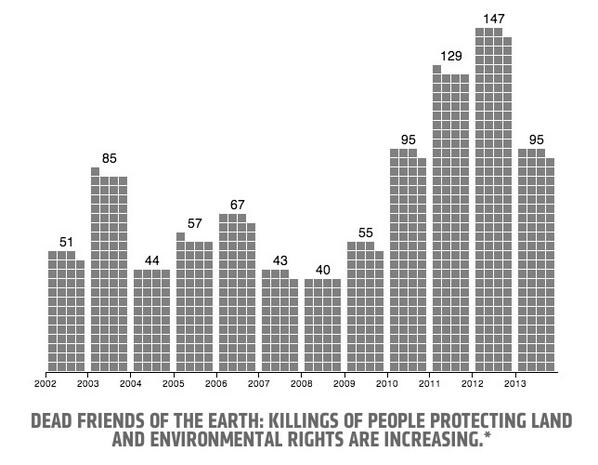
Ingen vil have Bakken-olierørledningen igennem sit eget nabolag, så den bliver lagt gennem et reservat. Igennem gravpladser og økologisk sårbare områder. Aktivister fra Sioux-stammen arrangerer ubevæbnede protester ved at slå lejr i rørledningens planlagte forløb og tweete #NoDAPL. De er blevet skubbet af vejen ved hjælp af pansrede mandskabsvogne, tåregas og knippelsuppe. De bliver i skrivende stund anholdt for optøjer og holdt fanget i tremmebure.
Pensioneret dommer Steve Russell har skrevet en klumme om netop denne forskel i håndteringen af Bundy-brødrene og Sioux-aktivisterne. Han og Kieran Suckling fra Center for Biological Diversity har udtalt sig til Democracy Now!
Chilcot-rapporten, der evaluerer Storbritanniens deltagelse i invasionen og besættelsen af Irak, afslører, at olie spillede en vigtig rolle for briterne. Og at briterne og amerikanerne udkæmpede en diplomatisk kamp om olien.
"Det ville være upassende for den britiske regering at indgå i diskussioner om fremtidig fordeling af Iraks olieindustri," sagde Sir David Manning, Tony Blairs udenrigspolitiske rådgiver, til Condoleezza Rice, George W. Bushs nationale sikkerhedsrådgiver, december 2002, "ikke desto mindre er det essentielt at britiske virksomheder får adgang til denne og andre sektorer på lige vilkår med amerikanske."
Allerede to måneder før invasionen mødtes den britiske regering med olieselskaberne BP og Shell, for at forberede deres kommende forretninger. Og til et møde mellem USA og Storbritanniens forsvarsministre, Donald Rumsfeld og Geoff Hoon, i 2003 havde sidstnævnte ligelig adgang til Iraks olie i på dagsordenen. I et notat fra september 2004 skriver embedsmænd om britiske virksomheders potentiale for "substantielle olieforretninger i de næste fem til ti år".
BP og Shell vandt nogle irakiske oliekontrakter ved auktioner mod blandt andet russiske og kinesiske firmaer, men briterne følte sig alligevel forfordelt. Således mødtes Edward Chaplin, Storbritanniens ambassadør i det besatte Irak, i december 2004 med Iraks premierminister Ayad Allawi for at tale BP og Shells sag. Irakiske embedsmænd gav udtryk for, de britiske virksomheder ikke udviste samme dedikation som andre landes olievirksomheder. BP og Shell har tilsyneladende afventet vedtagelse af en ny irakisk grundlov.
"Vi fik ikke noget som helst i oliesektoren," beskrev tidligere FN-ambassadør Sir Jeremy Q. Greenstock de britiske frustrationer til Chilcot-kommissionen, "besættelsesadministrationen holdt det på amerikanske hænder, for de ville selv styre oliesektoren."
Pointing at "invasion costs, occupation costs, international costs and investment costs", Emily Meierding says oil wars are just not worth fighting. With reference to The Falklands War (1982), The Iran-Iraq War (1980-1988), the Kuwait war (1990) and other wars, she argues these historical examples were about national pride, territory and Saddam Hussein's survival respectively. Similar alternative explanations for other wars.
So, why am I bookmarking this article? And why didn't I immediately delete my blog and forget about this whole thing?
Firstly, I have always bookmarked the opposing point of view. Go through my history of hundreds of ecowar bookmarks, and you will find plenty. Also see the beginning of chapter 4 (pages 74-) and the Objections part of chapter 6 (pages 123-) of my book, Ecowar - Natural Resources and Conflict.
Secondly, although Emily Meierding's headline says "nations aren't battling over resources", I don't think she really proves this statement in her text. What she does convincingly argue, is that in the cases she mentions, oil wasn't the primary causes of the conflict. To get academic about it, for each war one should list its causes and rate them in primary, secondary and even tertiary. I am guilty of having more or less skipped this discipline. But that doesn't mean conflicts with natural resources as their secondary causes aren't resource conflicts at all. For a very brief discussion of this, see the first chapter of my book or look up the works of some of the leading scholars.
What is also interesting about Emily Meierding's article, is how the discussion has gone full circle. When I first set out researching, claiming most wars were resource wars was taboo. While I wrote up the book, that changed (pages 126-128). Apparently, now it is quite main stream to associate natural resources with conflict. And what have we: An up and coming scholar seeking to prove things to be the other way around. Isn't that what we all want to achieve?
Some of the worst news this year was how Islamic State grew out
of the chaos in Iraq and Syria, and became known not as the
richest terrorist group in the world, but as the poorest terrorist
country. Because they successfully occupy
and exploit vast oil fields, loot
everything lootable while controlling
many smuggler's routes and ruthless dealers. I get how they
control the population by mass executions rivaling the worst in
history, denying
crucial water supplies to villages and other callous misdeeds.
But how do they manage to sell oil worth millions of dollars every
single day even as all eyes are on the region? Money talks, of
course, anywhere and anytime, but still?
Part of the answer came in this
fascinating report by Suzan Fraser and Yilmaz Akinci from the border
between Turkey and Syria, where... hillbillies, basically... tell
how they have always been smuggling. Everyone did it. For
generations. So, suddenly a few more bearded men came with a bit more
oil than usual. It worked for a time, but Turkish police cracked down
on it. Their large scale “pipeline” was smacked into smaller,
obscure “pipelines” - like the ones the Islamic terrorists have
for every other country, apparently.
Probably more efficient that the Turkish police, however, is the
Saudi Arabian financial muscle. To them and most of
their allies, the sum of benefits of a low oil price seems to
currently triumph the more obvious benefits of a high oil price.
Mainly by cutting the cash flow to Iran, Syria, Islamic State,
Russia, even North American non-conventional (fossil) energy producers and
others. In fact, I've seen some speculate Saudi Arabia has almost won
the war on Ukraine's behalf as Russia's weakening rubles soon cannot
pay for any more war. Speaking of Ukraine: This country used to be
self-sufficient in coal, but the
territory occupied by rebels and Russians just happen to host 66 coal
mines, leaving Ukraine's power plants under-supplied; and the
shores off now Russian Crimea just happen to be full of gas. What
a coincidence.
THIS Syrian disaster is like a superstorm. It’s what happens when an extreme weather event, the worst drought in Syria’s modern history, combines with a fast-growing population and a repressive and corrupt regime and unleashes extreme sectarian and religious passions, fueled by money from rival outside powers
"The drought did not cause Syria’s civil war", said the Syrian economist Samir Aita, but, he added, the failure of the government to respond to the drought played a huge role in fueling the uprising. What happened, Aita explained, was that after Assad took over in 2000 he opened up the regulated agricultural sector in Syria for big farmers, many of them government cronies, to buy up land and drill as much water as they wanted, eventually severely diminishing the water table. This began driving small farmers off the land into towns, where they had to scrounge for work. [...] "State and government was invented in this part of the world, in ancient Mesopotamia, precisely to manage irrigation and crop growing," said Aita, "and Assad failed in that basic task."
For more about the invention of government to manage irrigation and granaries see Ecowar the book pages 13-14.
The best jobs in Hasakah Province, Syria’s oil-producing region, were with the oil companies. But drought refugees, virtually all of whom were Sunni Muslims, could only dream of getting hired there. "Most of those jobs went to Alawites from Tartous and Latakia," said Zakaria [Zakaria, teenager], referring to the minority sect to which President Assad belongs and which is concentrated in these coastal cities.
"We could accept the drought because it was from Allah," said Abu Khalil [cotton farmer, smuggler and Free Syrian Army commander], "but we could not accept that the government would do nothing." Before we parted, he pulled me aside to say that all that his men needed were anti-tank and antiaircraft weapons and they could finish Assad off. "Couldn’t Obama just let the Mafia send them to us?" he asked. "Don’t worry, we won’t use them against Israel."
For more Syria see Ecowar the book page 24 and click the Syria-tag on this present blog. Also, I have linked to about 40 articles about Syria from the twitter account.
"If the Earth wars were a sporting contest, here's how the half-time score might stand at the beginning of 2012..."
Georff Hiscock concludes his near 300 pages factual account of who owns the world with a surprisingly relaxed "scoreboard":
1st: USA 10 points
2nd: China 8p
3rd - 4th: Europe, Japan 6p
5th - 6th: Russia, India 5p
7th: Brazil 4p
8th - 10th: Mexico, Canada, Australia 3p
11th - 14th: Saudi Arabia, Qatar, Kuwait, UAE 2p
15th - 22nd: South Korea, Indonesia, South Africa, Nigeria, Turkey, Iran, Central Asian republics, Mongolia 1p
Vietnam, Venezuela, Colombia, Chile and some African countries also in 1st division but still no points
EARTH WARS is a concise business report on the current deals in global energy and metals production as seen from down under. It also mentions the main water disputes but does not go into details on food production controversies. It is a treasure trove of information and numbers on especially Asian contracts but often the most important situations from other important continents such as South America or Africa are mentioned as after little more than afterthoughts at the end of chapters.
It's business report like writing is it's strength and it's weakness. The "bullshit factor" is one of the lowest I have ever seen. In many ways this book is just pure reporting. However, at times it is a tough read. And occasionally I wonder if I better run double checks on some numbers: Having been flipping through numerous skeptical blogs, articles and books earlier, I am of the impression that repository estimations and future extraction plans are not always that crystal clear. Did Hiscock leave out some valid doubts somewhere?
To get an impression of what the book offers you can look at the contents on page "v". Or you can take a glance at the 27 lists in it, because the chapters are very much structured as walk-throughs of those lists. So, "Exhibit 3.3" is a top ten of Russian oil and gas companies (no. 1 is Gazprom) - well that part of chapter three is an ordered sequence of paragraphs briefing on the owners, sizes and belongings of those companies. Pretty much.
One gem of the book is it's quite detailed second chapter on "geographical flashpoints". This chapter contained the bulk of the info I needed for my "contested resource territories" map published yesterday (take a look!).
The book hardly takes into account climate change. That may seem weird, but actually Hiscock barely bother predicting the future. Which is actually quite a relief. As such, it is fair enough not to mention projected environmental impacts decades into the future. The demand for renewable energy, however, is mentioned. Compared to the focus on the business as usual going on with fossil energy the demand for renewable energy looks depressingly weak.
If I had used it for my own book, it would certainly be on my list of recommended reading. It's not for everyone, though. Those other books are typically more into storytelling (like witnessing pollution in Nigeria or dictatorships in South America) or typical popular science (past societal collapses, influence of climate change on geopolitics). Normal books. Geoff Hiscock's book is a business book that doesn't dream and doesn't imagine anything.
Either way, there is absolutely no reason to doubt a fierce global business war is raging over our natural resources. That much is very clear after Hiscock's documentation. As documentation of this situation the book is a very valuable contribution. But it's not exactly edutainment.
Geoff Hiscock (2012): EARTH WARS - The Battle for Global Resources at Google Books, book website.
Island for sale. 2,166,000 km² (mostly still ice). 56,744 inhabitants (many working at minimum wage, animosity towards Greenpeace is legendary). Watch some of the world's last ice melt to reveal a wealth of riches below. Copper, zinc, iron, gold. Make your investment before it's taken.
Look at all the deposits that have already been found.
Off shore the most daring oil companies are already drilling amidst the fleeing icebergs. Buy your concession now, they are soon sold out.
Look at all the oil and gas extraction licenses that have already been signed.
PS: Yes, it's part of Denmark. But don't worry about the Danes, none of them care the least.
Even if wars are not all about oil, soldiers have certainly been killed for oil: Up to one in three US casualties has happened at gasoline convoys. Check out how solar panels are saving lives and improving the flexibility of US Marines deep in foreign deserts: Grist / U.S. military kicks more ass by using less fossil-fuel energy.
"Other people are busy saving the planet; this is about saving Marine lives [...] I’d kiss a polar bear if it meant getting one Marine off an IED-filled highway."
- Col. Bob Charette, director of the Marine Corps Expeditionary Energy Office
Irrespective of one's sentiments towards US soldiers in Afghanistan, the story is a parable for all of society. As the article finishes: "In a time of rising fossil-fuel prices and increasingly apparent climate dangers, the tether of fuel binds all of us — homes, businesses, communities, and whole economies — to a future of vulnerability and instability. Using less energy and generating more of our own is about more than dollars spent or saved. It’s about self-determination. That makes for a more effective military and a more secure, productive society".
You should think the politicians most eager for war would support such initiatives. But no. Because those politicians are at the same time the ones whose careers are sponsored by the existing energy sector hegemony. Read Slate / Why We Need a Greener Military and Wired / Republicans Order Navy to Quit Buying Biofuels for the full story about right wing politicians working hard to pass a law banning military spending on fuels more expensive than conventional oil. But since it is designed to obstruct initiatives to experiment with (currently relatively expensive) biofuels it explicitly omits alternative energy sources based on coal and gas (probably to allow shale gas, fracking et cetera).
In a way it's hard to believe the hypocrisy, the idiocy, the callousness. On the other hand it all makes depressing sense. Strong powers in business and politics accumulate vast fortunes on the people wasting obsolete energy and endangering their lives at home, at work and abroad.
Oil industry workers have been protesting layoffs and demanding raises. Authorities have answered with a crackdown: reports of dead and injured, mobile network and internet censored. International networks of hackers are providing dial-up internet communication just like they did in Egypt early 2011.
"The protesters blocking the railway refused to leave the area and the clashes started. I am now in the hospital. One 25-year-old young man was shot in the head and died. Eight men were wounded and the number of the wounded is increasing."
- Bauyrzhan, local
The European Union is about to take two small steps on the long journey of combating climate change: A small "tax" on air travel and another small tax on fossil fuels based on exactly how polluting the specific type of fossil fuel is. Both could ultimately end up in WTO courts; the former brought there by the US, the latter by tar sands would-be super-power Canada.
The European Union Emissions Trading Scheme Prohibition Act of 2011
The Republican majority US House of Representatives voted to bar US airlines from paying the tax on carbon emissions ("European Union Emissions Trading Scheme Prohibition Act of 2011"). The airline tax is part of the EU Emissions Trading System (ETS) from 2008; it hands out 85% of the industry's emissions to them for free, lets them buy the remaining 15% on a free (dirt cheap) market. The industry estimate the tax would cost US airlines about $3.1 billion between 2012 and 2020.
"This bill could ignite a trade war that would put tens of thousands of U.S. jobs in jeopardy. [...] By barring U.S.- based airlines from complying with applicable law for flights traveling to EU airports, this bill would compel those airlines either to drop their EU routes or become scofflaws."
- Annie Petsonk, Environmental Defense Fund
Pause for a second to consider the opposite situation: The EU or other countries prohibiting their corporations to comply with a US environmental law. Not to mention the facts that the Republican's arguments - that the EU law is a "competitive disadvantage" and in "violation of international law" are both simply wrong. Dear Obama, please archive this law in your paper recycling bin.
A tax based on the relative environmental harm done by different kinds of fuel doesn't sound that bad an idea does it? Well, Canada, currently projecting the billions it plans to make from transforming huge swaths of forest into polluted gravel deserts, consider it a European political attack on them. Elsewhere this would file under "conspiracy theory".
"We have the knowledge and the fact that the oil sands are more CO2-polluting than other kinds of fuel [...] And therefore we say it should have a specific value. It's nothing targeted against this particular fuel. We are doing that with all our different biofuels. It's the same methodology that we are applying for different things in the same directive [...] And now we are discussing this also with our member states, with the Commission, which has proposed this."
- Climate Commissioner Connie Hedegaard
"Canada's plans for tar sands will put the world on track for 6 degrees of warming, way past the globally accepted limit of 2 degrees [...] Six degrees would be game over."
- Franziska Achterberg, Greenpeace
The Fuel Quality Directive ranks...
coal-to-liquid: 172 grams of carbon per megajoule
oil shale: 131.3 grams
oil sands crude: 107 grams
conventional oil: 87.5 grams
Greenpeace is blaming Britain (Canada ally) and Estonia (having oil-shale resources) of delaying the legislation.
Oil have been found in the underground below Lake Albert on the border between Uganda and the Democratic Republic of the Congo. Western companies are working with the Ugandan government to get development under way but a myriad of issues seem to delay the project: Criminal and rebel activity is up and rising, Ugandan democracy is struggling for control with the shady closed door negotiations and now US troops enter the picture. Al Jazeera summed up the situation in less than two minutes, October 14th:
Recipe for an oil war
Heritage Oil and Tullow Oil are guessing the 2.5 billion barrel or larger field is the largest onshore field found in sub-saharan Africa in more than two decades. Production of 150,000 barrels of oil per day by 2015 place Uganda among top 50 oil producing nations is planned. The latter company, Irish Tullow Oil, is now accused of having bribed three Ugandan ministers with 100 million USD in July 2010 in return for concessions. The ministers resigned October 2011. Tullow denies allegations, maintain an anti-bribe image and have funded a lake rescue station which they claim have already saved the lives of more than 70 local fishermen. Also in the deal are French Total and Chinese Cnooc. Those corporations are expected to claim 2/3 of the 3-4 billion USD hoped to be made annually.
A leaked US embassy cable (Wikileaks, #08KAMPALA393) reveals Uganda have been asking for help stepping up security in and around the oil rich area. John Morley of Tullow Oil is quoted for saying that as oil activity on Lake Albert increase a security presence would be vital. The cable mention "several clashes on Lake Albert between oil companies and entities from the Democratic Republic of Congo (DRC) demonstrate that oil production has increased local tensions and exacerbated cross-border hostilities". In 2007 a British drilling platform worker was killed by Congolese soldiers who claimed the barge had strayed into Congolese waters. Although the Ugandan and Congolese governments are talking and are in agreement concerning the precise geography of the border the armed forces on the Congolese side of the border are not always government-related.
An intervention overdue?
Several militias fight in the area and in just recent months thousands have had to fled their homes, hundreds have been kidnapped. Adding to the Congolese militias the Democratic Liberation Forces of Rwanda (FDLR) rebels as well as the infamous Lord’s Resistance Army (LRA) led by Joseph Kony add to the insecurity. FDLR is a Hutu group whose two top leaders are held in France and Germany on charges of crimes against humanity yet whose troops raped at least 154 civilians from July 30 to August 3, 2010, in the town of Luvungi. LRA is the Ugandan theocratic militia of self-proclaimed prophet Joseph Kony, who claims to be acting on orders from spirits sent by God, and whose ranks have been inflated by an estimated 66,000 children abducted for soldiering. October 2005 the International Criminal Court (ICC) issued arrest warrants on Kony and four other leading members of LRA; the 33 charges include murder, enslavement, sexual enslavement and pillaging.
Recently, the Ugandan presiden spent US$780 million on six Russian jet fighters. A decision that raises eyebrows in a country with a GDP of less than 500USD per capita.
"We don’t live in an enemy-free neighbourhood. So, don’t look at the purchase in terms of cost. The Great Lakes region is one of the most unsafe regions."
- Ugandan presiden Yoweri Museveni
Since 2008 the US have donated more than 40 million USD on supporting the Local counter-militia efforts. And now 100 Green Berets have been sent as military advisers for the governments of the region. They are receiving a warm welcome.
"For 20 years, the government of Uganda has been pleading with our American and European friends to help in the LRA problem, because these are international terrorists. We wanted our friends to help in providing technical support — such as intelligence — because they have the best."
- Uganda's acting foreign minister Henry Okello Oryem
"Any support to tackle the LRA is a good move [...] South Sudan is already working with Uganda's army in operations against the LRA, and we will be pleased to work with anyone who can help us combat the threat [...] We have large communities whose lives are ruined by these rebels, so the sooner we can end this once and for all will be something we will look forward to."
- South Sudan army spokesman Philip Aguer
"The Central African Republic today more than needs external assistance like that of United States [...] Many hundreds of our people have been killed, others kidnapped or displaced, their homes ransacked, destroyed, their possessions looted. It is unbearable."
- CAR Deputy defence minister Jean-Francis Bozize
A recent report, "Oil Extraction and the Potential for Domestic Instability in Uganda", warns about other dangers than cross-border guerrilla warfare: the possible side-effects of a sudden large scale resource industry entering a developing economy. President Museveni, who first seems to have orchestrated the addition of a third presidential term to the constitution then won a low turnout election disputed by international observers, is already speaking of "his" oil.
"If Museveni gains access to substantial oil revenue, the combination of considerable oil funds and strong presidential powers could increase the ability of his government to remain in power indefinitely. [...] Increases in corrupt behavior would essentially require secrecy in government dealings. A reduction in government transparency in oil and tax revenue management would then incentivize Museveni’s government to become increasingly autocratic in its relationship with the public and political opponents, as has so often been the pattern in other oil producing states."
Also, susceptibility to the Dutch Disease should be considered:
"If the government does not reinvest revenues into public works to soften the blow of economic change, domestic instability may ensue [...] The poor and disaffected youths are the most likely to turn to violence in order to redress socio-political grievances. A young, growing, and increasingly urban population indicates the potential for civil strife in Uganda. The added stress of urban migration associated with oil production may only exacerbate the dynamics behind civil strife. [...] If Museveni’s government makes its decisions public and is held accountable, it is more likely to choose anti-corruption policies that are favorable to the public interest."
The report estimate the risk of civil war in Uganda as 1.96% if the new found resource wealth is handled wisely, 14.05% if not. Dutch Disease effects could be both mitigated and worsened by the fact that multiple industries are likely to boom: in 2010 firms from Russia, China, India, Australia and South Africa started operating in Uganda after finds of copper, iron ore, cobalt, tin, gold and platinum.
"We must be Africa’s Norway. We must manage our oil resources in the stellar manner in which Botswana has managed its wealth from diamonds."
- Bank of Uganda Governor, Emmanuel Mutebile
We haven't heard much from the hopeful Iraqi politicians who once voiced similar intentions with their oil. However, it does seem Obama is at least trying to do better than his predecessor(s). And if a US president can't even go to war against someone as evil as Joseph Kony he truly can do nothing at all - yet, who knows if the Tea Party will side with Kony and his lunatic army?
Kyrgyzstan and Tajikistan are upstream countries with lots of water fresh from the glaciers in the high mountains of Central Asia. Uzbekistan and Kazakhstan are downstream and suffering from the worst drought in decades. The latter are asking for more water from the former, claiming water belongs to everyone and rivers flow free. But Kyrgyzstan is asking for natural resources in return (ie Kazakhstan is the worlds number one uranium producer) and Tajikistan is constructing what will become the highest dam in the world. Kazakhstan refuse to trade in naturals (perhaps preferring world market prices?) and Tajikistan insist on damming the river since their energy supply is already rationed.
Negotiations have stalled. Uzbekistan has cut its gas export to Tajikistan and allegedly is also holding up Tajik exports on its border. Global warming is projected to raise temperatures by 2-3 degrees Celcius within 50 years; the glaciers are already melting because of this and future droughts will only grow in numbers and intensity.
Another renowned columnist is speaking up. This time it's Eric Hammel in Foreign Policy.
I cannot fathom the prevailing so-what attitude as the FEMA-grade weather disasters mount toward becoming serial and routine occurrences. [...] Global famine is going to force the use of our military as a police force organized to feed unknowable masses of people [...] The only force on Earth with the inherent capability to police, process, house, feed, and move refugees on a mass scale is the U.S. military, but, though its reach is global, its capacity and stamina are nonetheless limited, probably to one or two major disasters at a time, not the overlapping rolling meta-disaster climatologists predict.
Director Josh Tickell takes us along for his 11 year journey around the world to find solutions to America's addiction to oil. A shrinking economy, a failing auto industry, rampant unemployment, an out-of-control national debt, and an insatiable demand for energy weigh heavily on all of us. Fuel shows us the way out of the mess we're in by explaining how to replace every drop of oil we now use, while creating green jobs and keeping our money here at home. The film never dwells on the negative, but instead shows us the easy solutions already within our reach.
- summary at IMDb.com
FUEL won the audience award at the 2008 Sundance Film Festival, in 2009 it was nominated for a Writers Guild of America Award in 'Best Documentary Screenplay' category and it has also won a handful of minor awards.
Sudan's northern army seized control of the disputed, oil-producing Abyei region, officials said Sunday, forcing thousands to flee and bringing the country's north and south to the brink of full conflict.
"Most residents in Abyei town left yesterday (Saturday) and have gone south. There are reports of looting by armed groups."
- U.N. spokeswoman Hua Jiang
Control of oil-rich and fertile Abyei has been the main point of dispute between Sudan and South Sudan ahead of plans for the south to become a separate state on July 9, following a January referendum on independence. [...] The North and South were supposed to have withdrawn all of their forces from Abyei by this week except for a special joint force made up of units from both sides. The north supports the Arab Misseriya tribe that grazes its cattle in Abyei, and the south backs the Dinka Ngok tribe that lives there year round.
The international medical humanitarian organization Doctors Without Borders/Médecins Sans Frontières (MSF) is currently responding to the consequences of fighting in the Abyei region, in Sudan. Following violent clashes, the MSF hospital in Agok, 40 kilometers [24 miles] south of Abyei, received 42 wounded late Friday and early Saturday.
"Shell and BP could not afford not to have a stake in [Iraq] for the sake of their long-term future... We [are] determined to get a fair slice of the action for UK companies in a post-Saddam Iraq."
- Then Foreign Office's Middle East director Edward Chaplin, October 2002
"Baroness Symons agreed that it would be difficult to justify British companies losing out in Iraq in that way if the UK had itself been a conspicuous supporter of the US government throughout the crisis. [Trade Minister Symons agree to] report back to the companies before Christmas [on lobbyist progress in Washington]."
- Minutes of a meeting with BP, Shell and UK government, 31 October 2002
November 2002 the British Foreign Office invited BP to discuss opportunities posed by 'regime change':
"Iraq is the big oil prospect. BP are desperate to get in there and anxious that political deals should not deny them the opportunity to compete. The long-term potential is enormous..."
- Foreign Office memorandum, 13 November 2002
Pre-war, in public
"Let me just deal with the oil thing because... the oil conspiracy theory is honestly one of the most absurd when you analyse it. The fact is that, if the oil that Iraq has were our concern, I mean we could probably cut a deal with Saddam tomorrow in relation to the oil. It's not the oil that is the issue, it is the weapons..."
- Tony Blair, 6 February 2003
"We have no strategic interest in Iraq. If whoever comes to power wants Western involvement post the war, if there is a war, all we have ever said is that it should be on a level playing field. We are certainly not pushing for involvement."
- BP, 12 March 2003
"It is not in my or BP's opinion, a war about oil. Iraq is an important producer, but it must decide what to do with its patrimony and oil."
- Lord Browne, the then-BP chief executive, 12 March 2003
"We have neither sought nor attended meetings with officials in the UK Government on the subject of Iraq. The subject has only come up during conversations during normal meetings we attend from time to time with officials... We have never asked for 'contracts'."
- Shell, 12 March 2003
Post-leak
"Before the war, the Government went to great lengths to insist it had no interest in Iraq's oil. These documents provide the evidence that give the lie to those claims. We see that oil was in fact one of the Government's most important strategic considerations, and it secretly colluded with oil companies to give them access to that huge prize."
- Oil activist Greg Muttitt
It's a historical truth that when food prices rise, conflict increases. So it's no wonder that the spike in the cost of agricultural commodities in recent months has been a contributing factor to revolution in the Middle East. As the map below shows, people in relatively poor countries--including Egypt, Tunisia and others in the developing world--spend a much higher percentage of their incomes on food.
"We're in Libya because of oil. And I think both Japan and the nuclear technology and Libya and this dependence that we have upon imported oil have both once again highlighted the need for the United States to have a renewable energy agenda going forward. [The US is right to intervene] but it all goes back to the 5 million barrels of oil that we import from (the Organization of the Petroleum Exporting Countries) on a daily basis."
February Nigerian militant groups were scrambling for "surveillance jobs" - wanting to get paid for making sure what they use to steal will not get stolen?
FIVE thousand pipeline surveillance job slots intended for former militants to secure oil facilities in Delta State has pitched former militants in the state against one another, even as members of the Movement for the Emancipation of the Niger Delta, MEND, Urhobo chapter, have vowed to make the state ungovernable if the job slots allotted to them were not increased and given to militant leaders of the area for distribution.
Whatever the precise outcome of those negotiations they haven't been entirely successful. Oil companies spend millions on charities and advertising to stay popular and when showing journalists around they did a helicopter tour of outlaw camps for refining stolen crude:
Posters show smiling students posing after receiving university scholarships. New roads appear on formerly potholed mud tracts. Millions of dollars are promised to improve the lives of the desperate poor. These campaigns by oil company Royal Dutch Shell PLC and other foreign firms make it seem they are running for office in crude-rich Nigeria, which will hold crucial presidential, federal and local elections in the coming weeks. The multinational firms have spent hundred of millions of dollars toward projects they advertise as improving the life of those living in the country's troubled Niger Delta. [...] Some estimate as much as 550 million gallons of oil have spilled in the delta from failing pipes and attacks since production began — at a rate roughly comparable to one Exxon Valdez disaster per year. Shell flew journalists in a helicopter over a cleared area in the delta where locals ran makeshift refineries turning stolen crude tapped from pipelines into diesel and kerosene. The company blamed nearly all of its oil spills in 2009 on sabotage from thieves and militants. Environmentalists and community activists routinely blame Shell for the spills, pointing at the company's aging pipelines and poor cleanup efforts.
Oceanographer for the U.S. Navy, RADM David Titley discusses the hot topic of climate change, and its impending ramifications on national security. Listen as he details some of the top facts and figures you should know about climate change and your future, explained in terms that even the most unfamiliar with science would be able to understand.
Disposition / key points of his speech:
How he changed from skeptic to concerned.
"We are operating in nature's casino. I intend to count the cards."
A number of the most obvious explanations: not the sun, better models etc.
Funny comparison between carbon dioxide in the atmosphere to alcohol in the blood.
[From 15:47] Why the army cares about climate change.
"Changes in the opening of the Arctic. [...The Bering Strait could get] the importance of the Strait of Malacca and the Strait of Hormuz [combined] because we have fossil fuels coming out and we [USA] and Russia together control that strait - that's a big change."
"What's gonna happen to the sea level rise?" The IPCC under-estimates sea level rise. "We're the navy. We tend to build our bases at sea level. [...] But it's more than that; it's the US infrastructure. Look at where our oil refineries are. [They are in Houston, New Orleans, Oakland] it's all at sea level."
Ocean acidification could become a food security issue for one billion people.
Found via Peter Sinclair (thanks). (He also cut up the video in the two parts so go there if you prefer that.)