Showing posts with label palestine. Show all posts

Wednesday, December 24, 2014

2014 bookmarks - the year in war over natural resources

From the depths of my bookmarks (that were all automatically tweeted) on conflict and natural resources, here is a quick review of the way in which Earth was plundered for natural resources in the past year. Year 2014, the 100th anniversary of the first war to run on oil.

In short, 2014 was just more of the same. Like...
But a lot more of the same also means obscure news stories grow into reports from acknowledged organizations—like when
Some of the worst news this year was how Islamic State grew out of the chaos in Iraq and Syria, and became known not as the richest terrorist group in the world, but as the poorest terrorist country. Because they successfully occupy and exploit vast oil fields, loot everything lootable while controlling many smuggler's routes and ruthless dealers. I get how they control the population by mass executions rivaling the worst in history, denying crucial water supplies to villages and other callous misdeeds. But how do they manage to sell oil worth millions of dollars every single day even as all eyes are on the region? Money talks, of course, anywhere and anytime, but still?

Part of the answer came in this fascinating report by Suzan Fraser and Yilmaz Akinci from the border between Turkey and Syria, where... hillbillies, basically... tell how they have always been smuggling. Everyone did it. For generations. So, suddenly a few more bearded men came with a bit more oil than usual. It worked for a time, but Turkish police cracked down on it. Their large scale “pipeline” was smacked into smaller, obscure “pipelines” - like the ones the Islamic terrorists have for every other country, apparently.

Probably more efficient that the Turkish police, however, is the Saudi Arabian financial muscle. To them and most of their allies, the sum of benefits of a low oil price seems to currently triumph the more obvious benefits of a high oil price. Mainly by cutting the cash flow to Iran, Syria, Islamic State, Russia, even North American non-conventional (fossil) energy producers and others. In fact, I've seen some speculate Saudi Arabia has almost won the war on Ukraine's behalf as Russia's weakening rubles soon cannot pay for any more war. Speaking of Ukraine: This country used to be self-sufficient in coal, but the territory occupied by rebels and Russians just happen to host 66 coal mines, leaving Ukraine's power plants under-supplied; and the shores off now Russian Crimea just happen to be full of gas. What a coincidence.

That was all just slightly scratching the surface of year 2014 in war for natural resources. On slightly more positive notes, Interpol published a most-wanted list of environmental criminals at large – go get 'em – and Egypt and Ethiopia seems to be agreeing on how to share the Nile.
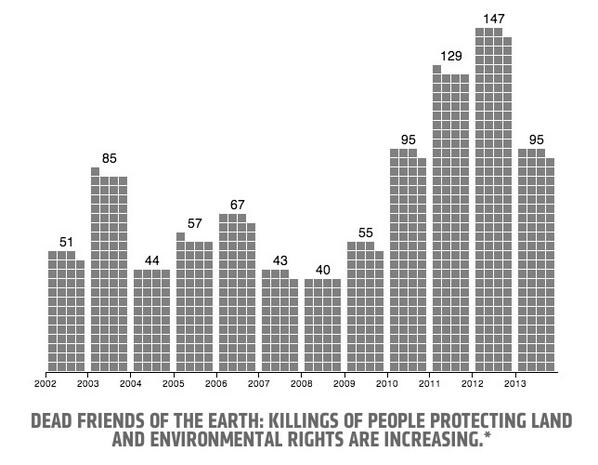
https://twitter.com/Global_Witness/status/456347470071463936

Happy New Year!


Saturday, May 26, 2012

A quite frank comment on climate migration from Israeli expert

Israeli expert says it exactly like he sees it after having researched his country's challenges:

"The migration wave is not a problem for the future. It is today; it is going on now [...] It will just increase from day to day. [...] In India, they shoot; in Nepal, they shoot; in Japan, they shoot [at refugees...] Millions perished along the Sahel [...] It’s the deterioration of Africa [...] I can see how the desert will penetrate slowly to Kiryat Gat, Gaza and Hebron – everywhere [...] If you accept what the scientists are saying, then there will be no question that people will be forced to leave the Negev. [...] Why are they coming to the North? Either because of population explosion or because of water loss [...] This is a microcosm of what is going on between the border of the Mediterranean climate and the semiarid zone. [...] I am one that fights for building fences all around Israeli borders [...] We are an island – we don’t belong to this region, and we have to defend Israel from waves of migration from Egypt from Jordan and maybe from Syria. If we want to keep Israel a Jewish state, we will have to defend ourselves from what I call ‘climate refugees,’ exactly as Europe is doing now [...we should provide the Palestinians and the Jordanians with sources of water] maybe this will bring peace. [...] I have to satisfy the Israeli citizens, to be human as much as I can [...] Whatever I do, we will not be as cruel as Europe. They have huge navies; they sink boats; they send them back."
- Prof. Arnon Soffer

Bold added by me. Although the warning is largely based on indisputable facts I foresee some controverse from certain parts of his comments.


From The Jerusalem Post / Defending Israel’s borders from ‘climate refugees'.


Wednesday, July 20, 2011

While everyone's on holiday: Ghosts of the past, crises of the present and warnings for the future

From the distant and near past

The Washington Post reports Oil leaks from 233 World War II shipwrecks could threaten US coast as vessels corrode.
oil and fuel leaks could devastate coastal communities and environments. NOAA is taking an inventory of more than 30,000 coastal shipwrecks. It has narrowed the worst-threat list to 233 vessels. That could lead to efforts to remove oil before it washes ashore.

"The number of birds [migrating
through Afghanistan] has dropped by 85 percent."
Others are in shock staring at the Staggering Price Tag for Iraq, Afghanistan Wars.

a just-released, far-reaching study estimating the cost of these wars to the United States at $4 trillion. [...] since September 11, 2001, the wars have claimed the lives of 6,000 U.S. troops and 2,300 contractors, and the number of displaced Afghans and Iraqis is eight million.
Currently hunger devastates East Africa

Aid organizations complain donations suffer from people being on vacation while the disaster has many under-reported consequences. One such is that the Refugee crisis threatens wildlife in northern Kenya.

“The influx of refugees is not only degrading the environment due to demand for firewood for cooking and building shelters but those that have not enlisted in the camps are relying on game meat for food.”
 -  Thomas Mailu, The Kenya Wildlife Service (KWS)
Meanwhile in Nairobi Kenyan Police Fire Tear Gas at Food Protest, which happen as a consequence of the drought too, and fuel prices, which, of course, is linked to world market whims.

From this corner of the world aid agencies advise the Drought in east Africa the result of climate change and conflict. We told you so. And Kenya's own Wangari Maathai, Nobel Peace Laureate (whose speech at Copenhagen University I blogged recently), similarly calls for action on climate change:
"Here in Africa, we are paying a high price for a rapidly changing climate - more droughts, food crises and it is set only to get worse.  We can see how climate change is already aggravating the competition for resources and the economic stability all over this continent. [...] Many of our countries have experienced decades of environmental mismanagement or outright neglect. Indeed, some governments-including my own-have facilitated the plunder of the forests, the degradation of the land and unsustainable agricultural practices. Many communities in Africa are already threatened by the negative impacts of climate change. Children in Africa are dying from malnutrition as women struggle to farm on land that is less and less productive.  People on coastlines are losing their homes as the seas consume the coastlines."
Just signs of the decline?

Like we have to pay on environmental and financial debts of past wars even as current wars and environmental decline unfold and worsen, so too can we expect history to repeat itself. Soon both demand and supply of the basic building blocks of society will fundamentally change

Read, for example, Michael Klare's recent article Energy: the new thirty years' war or the interview with him, The new 30 Years War: Why energy will be the next battlefield.
"The struggle for energy resources is guaranteed to grow ever more intense for a simple reason: there is no way the existing energy system can satisfy the world’s future requirements."
He's talking about a thirty years 'war' between energy sources and the powers that wield them, not a world war. But clearly a war that will weaken some states, empower others. Regarding water, the Wall Street Journal is even more worried: Water Wars May Lie Ahead.
The World Bank in a report said that 1.4 million people could be facing water scarcity by 2025. But the Organization for Economic Co-operation and Development (OECD) forecast is even more gloomy. It estimates that 47% of the world’s population could face water stress in the same period–equivalent to more than three billion people. [...] Egypt and Ethiopia have been battling the issue for the share of the Nile’s water reserves, and Israel–already fighting Palestine for territory that includes precious water reserves–has started to charge the agricultural sector high rates for using the resource.


Wednesday, November 03, 2010

Water wars!... or climate peace?

Two climate change stories: one driving African tribes into new conflict and another leading old foes on a shared diplomatic course.


The conflict


For thousands of years, nomadic herdsmen have roamed the harsh, semi-arid lowlands that stretch across 80 percent of Kenya and 60 percent of Ethiopia. [...] As temperatures in the region have risen and water supplies have dwindled, the pastoralists have had to range more widely in search of suitable water and land. That search has brought tribal groups in Ethiopia and Kenya in increasing conflict, as pastoral communities kill each other over water and grass.
Watch the video at yale.edu / When The Water Ends: Africa’s Climate Conflicts.


The diplomacy


Israel and the Palestinian Authority are among 15 Mediterranean nations who have just signed a historic agreement to work together to combat the effects of climate change, one month ahead of the next United Nations conference on climate change, meeting at Cancun in November. [...] Both Israel and Palestine are acutely aware of their vulnerability to climate change, which is expected to make water resources even more scarce for what is already the most water-stressed highly populated area in the world. The region faces a potential 4 degree rise in average temperatures and a 70% drop in precipitation. Sea level rise is expected to further contaminate nearby aquifers such as the coastal aquifer of Gaza that provides water to 1.5 million Palestinians. The annual decrease in rainfall is already raising farm prices for fruits and vegetables, and creating a two-tiered class system for water: those who can afford to pay, and those who can’t.

Check out the Mediterranean Climate Change Initiative website (via Green Prophet).

Sunday, April 11, 2010

Water Wars at TH!NK3

Today there are two water war articles at TH!NK 3 Developing World: WATER IS ANOTHER MATTER by Hanna Clarys and Are you ready for Water Wars? by Hemant Jain.

The latter is an illustration and a couple of links.


Hanna's article is about the situation in Palestine. A few excerpts:

Palestinians have three main water sources, namely the river Jordan, the mountain aquifer (which is water underneath the West Bank) and the coastal aquifer (water underneath Gaza and the coast). These water sources are shared with Lebanon, Syria, Jordan and Israel.


When Israel occupied the West Bank, Jerusalem and the Gaza strip in 1967 the common water sources were controlled by the Israeli government.


Israel is building a barrier through Palestinian territory. But even more strikingly: this wall-fence-roadblock-thing is annexing the most fertile lands and the best water wells, which means they are now out of Palestinian reach.


Pleas do go to the TH!NK3 site to read the whole thing... or better yet, just subscribe to the RSS right away :-)

Saturday, February 27, 2010

Occupation 101

Just watched Occupation 101 two years late. It's a gripping documentary about the history and status quo of the Israeli occupation of Palestinian lands. While not being about battle for resources it does mention the grabbing of fertile lands by Jewish settlers.


[In 1947] The UN - under pressure - proposed to divide the land into two states. An Arab state and a Jewish state. Arabs were to be given 43% of the land despite the fact that they made up more than two thirds of the population and owned over 92% of the land. Jews were to be given 56% although they comprised only one third of the population and owned less than 8% of the total area. [...] They were given not only most of the land, they were given the most fertile land. [21:10]


[Today Israeli] settlements are strategically built colonies of Israel [on UN designated "Arab" land] that are connected by a network of roads which separates each Palestinian community from the next and confine their ability to expand. They are often constructed around the best farmland and resources. [11:10]


You can watch the whole thing using the above embedded Google Video og you can order the DVD from the official website.

Monday, November 16, 2009

Holy Water War continues

I have largely given up covering the Israel-Palestine strife over water. But I keep bookmarking stories at my Water of The Holy Land Diigo list. However, Al Jazeera just released this video:


"This policy is not a new policy, there are lots of examples of Israel trying to force Palestinians to leave their land so settlements can expand easily [...] This is an organised Israeli policy designed to prevent the development of the Palestinian economy - knowing that agriculture is a major sector within the economy."
- Nader al-Khateeb, Friends of the Earth in the Middle East


"This scarcity has affected every walk of life for Palestinians [...] A greater amount of water has to be granted to them."
- Donatella Rovera, Amnesty International


Sources: Palestinian farmers denied access to water in disputed West Bank, Amnesty: Israel withholds water from Palestinians.

Friday, May 15, 2009

Debate on water wars in Nature

March 25, 2009 I posted Opinion: Nations don't go to war over water on a "peer reviewed opinion" (Nature 458, 282–283; 2009). In short, writer Wendy Barnaby discussed how a book project was stopped because research didn't turn up a significantly bloody past history of water wars. The objections are in and there are plenty of arguments on the shelf...


by psd


The potential for water conflict is on the increase by Z. W. Kundzewicz and P. Kowalczak disagree almost completely:
water has often been the object, target or weapon of military or terrorist action
...they say; referring to a quite thorough list of incidents. Although pointing to certain circumstances where cooperation is more likely than conflict, they finish...
as populations in water-stressed areas continue to grow and the demand for water increases to improve living standards with better sanitation and a water-intensive diet. In arid areas, water scarcity is likely to be exacerbated by climate change [...] The potential for water conflict — war or no war — deserves careful attention.


Increasing inequality is already making shortages worse by T. H. Meek and L. A. Meek says Barnaby was too "hasty" and points to her argument resting on at least three shady assumptions:
that developing nations will be able to afford food [...] that food itself is not also a limited resource being threatened by global warming [...that] poorer nations will become wealthier in the coming decades


Water is a source of cooperation rather than war by U. Shamir, S. Grand and N. Grand agree with Barnaby from the perspective of a senior adviser to the Israeli Water Authority. It is claimed that the Palestinian Territories receives more water from Israel than they are entitled to by the treaty.

Water: conflicts set to arise within as well as between states is by Ismail Serageldin, who was quoted by Barnaby, adds nuance:
arguments that have been made by others about international wars being unlikely for water, and they are probably right. But civil strife between competing groups within countries over water rights are very serious. [...] Drought has driven many tribes in Africa into terrain that they are not normally expected to occupy. When coupled with other factors such as ethnic or religious divides, this becomes a dangerous mix. Water may also become a casus belli between states, if the downstream nation is considerably stronger militarily than the one upstream, and the latter tries to block or reduce the flow of water.
His finish is perhaps the most important contribution:
The answer [...] is to manage our water resources better, learning from past experience, generalizing best practices and facing up to the mounting challenges that are coming our way, not to dismiss the issue as a myth.


Finally, in Water: resistance on the route towards a fair share for all M. Zeitoun largely agrees with Barnaby's attack on the "media hype" of water wars but like most others he adds details of conflicts within countries - from Iraq, Syria, Turkey, India... and Israel / Palestine:
Palestinian farmers eke out a living dependent on
highly variable and scarce rainfall, next door to the industrial farms of Israeli settlers whose irrigation water is state-subsidized.
And:
Water conflicts (not wars) are a clear and present danger for millions. They deserve our full collective scientific, financial and diplomatic attention.


by Snap®


On a more general note I'd say it is a bit naive to claim that because something didn't happen in the past - a declaration of war stating water as the issue - it will not happen in the future. Especially since conflict rarely plays by the book anyway and since low level conflicts about water seem to be common and on the rise.

Sunday, April 05, 2009

Water of the "Holy Land":


For quite some time I have been keeping an eye on the influence of water in the Israel vs Palestine conflict. On top of all the other 'ecowars' I have Google track for me. But I have been reluctant to post on it for a variety of reasons. Now I have decided to do something else: Just share the online research - and at the same time recommend an online tool, Diigo, that I have found extremely useful.

To go straight to the real thing please check out my Diigo list Water of The Holy Land.

Diigo is an online social bookmarking site with one distinct edge: it includes a 'web-marker pen'. As you read the article you want to take note of you can mark texts in yellow using your mouse just as you would reading a printed article using a yellow filt pen. What you see watching the list is all the text I have marked in all the articles I have bookmarked. So, don't disagree with me here. In stead critizise the sources, suggest missing information. (There are many other sweet features to Diigo and I have used it simultaneously with the competitor Twine for some time which it beats in nearly every category but I will move on to the subject now. Try this video for more on Diigo.)

The short-short version


  • The Middle East is an already relatively arid region getting drier by the season
  • Israel is exporting water intense crops (Oranges etc)
  • There is little water under the UN-approved Israeli territories
  • There is water in the Palestinian underground, the Golan heights and flowing from Lebanon
  • We just happen to see conflict in exactly these three areas

Highlights of the highlights

To add just a little more detail here are some copy/pasted texts from my Diigo highlights.
Israel ran out of water in the 1950s: it has not since then produced enough water to meet all of its needs, including food production. [...] Palestinian and Israeli water professionals interact on a Joint Water Committee, established by the Oslo-II Accords in 1995. It is not an equal partnership: Israel has de facto veto power on the committee
There are three major water sources for Israelis and Palestinians: the Jordan River system, the Mountain Aquifer, and the Coastal Aquifer. [...] The Jordan River system, which straddles the borders of Israel and the territories, is completely off limits to the Palestinians by order of the Israeli authorities [...] the Mountain Aquifer, 85 percent of which lies under the West Bank. The 1995 Oslo accords stipulated that Palestinians would have access to 20 percent of that aquifer, with Israel controlling the remaining 80 percent. A recent U.N. report, however, revealed that Israel has restricted Palestinian access to 12 percent. [...] since 1967 no Palestinian may drill a new well in the basin without Israeli permission [...] Until 2006, less than 10 percent of water in Gaza was fit for consumption. When Israel destroyed the water purifiers that year, purification of water has basically halted. [...] Under the Geneva Convention, the Israelis are required to supply the Palestinians with an adequate amount of water.
Israelis per capita use up to five times as much water as Palestinians
For many Palestinians, the fall harvest of some 10 million trees used to be a joyful ritual steeped in tradition. But the West Bank's olive groves have increasingly become a target of extremist Jewish settlers who, hilltop by hilltop, seek to expand their control over land they say they were promised by God. [...] Compounding the farmers' problems, more trees are harder to reach because they lie beyond Israel's lengthening West Bank separation barrier or close to Jewish settlements and their multiplying satellite camps.
4400 dunums of agricultural land are now behind the Israeli apartheid wall. Most of our [Palestinian] wells and water resources are now behind the Israeli wall.
The Golan Heights' key resource is not land but the Sea of Genneseret, or Lake Kinneret. Damascus lost the territory and the access to its water resources in the Six-Day War, with the water supply issue being more urgent for Israel than for Syria.
"Some of them [Israelis] will come and put dead animals and so on into the community water supply, and then-I mean, what do you do, if there's nothing else?"
A recent U.N. report found that Palestinians in some of the hardest-hit communities were spending as much as 30 percent to 40 percent of their income on water delivered by truck.
While I did not explicitly list sources they are extremely easily identified via the Diigo list.

Further simplification

What came first: The hen or the egg? The water issue or the war? As if simplifying the conflict to a rivalry over wells by quoting news sources wasn't enough let me just real quick do it by simplifying the recently popular Israel vs Palestine historical map and adding some water sources by life saver icons:


Critique very much welcome.

Update, June 2009: A Google Map companion (itself subject to updates).


Vis Israel & Neighbours, Water & Strife på et større kort

Wednesday, March 25, 2009

Opinion: Nations don't go to war over water

Writer Wendy Barnaby has written an essay for academic journal Nature in stead of a book for her publisher as the conclusion on "water wars" wouldn't sell. Some facts...

There are 263 cross-boundary waterways in the world. Between 1948 and 1999, cooperation over water, including the signing of treaties, far outweighed conflict over water and violent conflict in particular. Of 1,831 instances of interactions over international freshwater resources tallied over that time period (including everything from unofficial verbal exchanges to economic agreements or military action), 67% were cooperative, only 28% were conflictive, and the remaining 5% were neutral or insignificant. In those five decades, there were no formal declarations of war over water.


Three examples are explored a bit further: the Israel-Palestine, the India-Pakistan and the Nile water conflict situations. The Nile issue is about how the countries surrounding it were forced into cooperation following years of low level conflicts and the India-Pakistan issue on how cooperation has been set up in a treaty with the help of the World Bank despite the two countries being engaged in an ongoing military conflict. The Israel-Palestine issue is presented a bit weird:
it is foolish for Israel, a water-short country, to grow and then export products such as oranges and avocados, which require a lot of water to cultivate

Yes it is. Israel and most neighbours have water shortages but alleviate it by importing grain. There are a whole bunch of inconvenient truths not mentioned, but one is:
Palestinian and Israeli water professionals interact on a Joint Water Committee, established by the Oslo-II Accords in 1995. It is not an equal partnership: Israel has de facto veto power on the committee.

I'll dig out some more facts soon (in the mean time try my Israel and Palestine tags). But let's just note Wendy Barnaby's main conclusions:

Inequitable access to water resources is a result of the broader conflict and power dynamics: it does not itself cause war [...] predictions of armed conflict come from the media and from popular, non-peer-reviewed work


Undoubtedly true that main stream media is better at sensationalistic headlines than scientific journals. But is this move from simplistic causation to hen-or-egg discussion a bit too easy? I mean demand is very likely to go up, supply very likely to go down. Leading to cooperation or conflict.

water 'embedded' in traded products could be important in explaining the absence of conflict over water [...] as poor countries diversify their economies, they turn away from agriculture and create wealth from industries that use less water. As a country becomes richer, it may require more water overall to sustain its booming population, but it can afford to import food to make up the shortfall


most importantly, improve the conditions of trade for developing countries to strengthen their economies


Sure. That's what the WTO is for, right? ;-)

ResearchBlogging.org


Barnaby, W. (2009). Do nations go to war over water? Nature, 458 (7236), 282-283 DOI: 10.1038/458282a


Search Google Books for Wendy Barnaby.

Sunday, March 08, 2009

Video: Israeli Military Shooting Gaza Farmers

18th February 2009 Israeli forces shot a twenty year-old Palestinian farmer as he worked his land in the village of Al-Faraheen, east of Khan Younis in the Gaza Strip.


Sunday, January 18, 2009

War and Natural Gas: The Israeli Invasion and Gaza's Offshore Gas Fields

The BG Group drilled two wells in 2000: Gaza Marine-1 and Gaza Marine-2. Reserves are estimated by British Gas to be of the order of 1.4 trillion cubic feet, valued at approximately 4 billion dollars. These are the figures made public by British Gas. The size of Palestine's gas reserves could be much larger.

[...]

In 2006, British Gas "was close to signing a deal to pump the gas to Egypt." (Times, May, 23, 2007). According to reports, British Prime Minister Tony Blair intervened on behalf of Israel with a view to shunting the agreement with Egypt.

[...]

The decision to speed up negotiations with British Gas (BG Group) coincided, chronologically, with the planning of the invasion of Gaza initiated in June. It would appear that Israel was anxious to reach an agreement with the BG Group prior to the invasion, which was already in an advanced planning stage.

Wednesday, October 29, 2008

Atlas of hidden water may avert future conflict

Now, for the first time, a high-resolution map shows where underground aquifers store vast amounts of water.

[...The map project] has identified 273 trans-boundary aquifers: 68 in the Americas, 38 in Africa, 155 in Eastern and Western Europe and 12 in Asia.

Each trans-boundary aquifer holds the potential for international conflict – if two countries share an aquifer, pumping in one country will affect its neighbour's water supply.

[...]

In many parts of the world, around the Mediterranean for example, but also in the US and the Middle East, water tables are falling and aquifers are being infiltrated by seawater as agricultural practices pump water out faster than it can be replenished by rain.

When aquifers fall between countries, sustainable management requires international agreement. Yet, historically, many agreements have been weighted towards the richest or more powerful country.


Deeplink to map Groundwater resources of the world (4½ MB PDF).

Saturday, April 12, 2008

New Scientist: Is this the beginning of water wars?

Barcelona and the surrounding region are suffering the worst drought in decades. There are several possible solutions, including diverting a river, and desalinating water. But the city looks like it will ship water from the French port of Marseilles.


The Tigris and Euphrates rivers start in Turkey and supply Syria and Iraq. The Turkish government is building dams on those rivers, reducing the flow downstream and stoking long-standing tensions with its neighbours.


Somewhat sensationalist headline perhaps. But none the less... here we go. This situation is expected to worsen and spread. Trade solutions are still possible but as soon as neighboring countries start both thirsting more radical approaches will be attempted.

Tuesday, August 28, 2007

West Bank: Occupation bad for environment


[...] during more than 40 years of Israeli control, the West Bank has become, either consciously or unconsciously, our garbage dump, and particularly that of the settlements and illegal outposts in the area. Toxic sewage from plants and sewage systems pouring into Palestinian agricultural and pasture areas are a routine matter. [...] The sewage and waste cause irreversible destruction and damage to the natural springs in these areas and to ground water in aquifers. Olive trees and crops belonging to residents in the territories are damaged forever; nature reserves or areas that were supposed to be declared as such are damaged and neglected, along with the direct damage to flora and fauna, and to the entire delicate ecological system that exists there. [...] The environmental hazards will not disappear even if we build a fence or define the territories as enemy territory. The area, in and of itself, is homogenous, despite the two peoples living there.


West Bank ecology. Picture from original article.


Search This Blog