Thursday, September 06, 2018

ECOWAR has moved - update your bookmark and subscription now!

Ecowar is now published in a new corner of ecowar.eu - not here! Go there, bookmark it, subscribe to the RSS feed, please.


You can forget about this Blogger spot. See you!


Tuesday, November 28, 2017

Nej, tusindvis af nye videnskabelige studier har IKKE "trukket i klima-skeptisk retning"

[Dette indlæg er også bragt på ScienceBlog.dk - giv os et klik!]

---

Civilingeniør Frank Lansner viderebringer i sin blog på Børsen en variant af en falsk nyhed, der for tiden er trendy i klimabenægtende kredse: at en masse ny forskning skulle modbevise menneskeskabte klimaforandringer. Han skriver blandt andet:
"Det vælter ind med resultater der trækker I klima-skeptisk retning. [...] De 2 seneste år er publiceret henved 1000 klimarelaterede videnskabelige artikler [1] med resultater og konklusioner der på forskellig vis ikke synes at bekræfte at katastrofal menneskeskabt global opvarmning skulle være indtruffet. [...] Denne flod af artikler indikerer også at naturen hyppigt kan flå Jordens temperaturer op og ned igen og igen. Og dermed også at Jordens fauna og flora har evnet at komme igennem dette."
Lansners kilde er utroværdig
Bemærk hvordan Lansner med sit "[1]" henviser til en kilde som en sand akademiker. Han har dog kun to i alt: [1] er NoTricksZone, en kendt klimabenægter-blog, og [2] et af Lansners egne blogindlæg (fra maj 2017, også vildledende).

I teksten henviser Lansner til en tysk ekspert ved navn Pierre Gosselin. Denne er lige som Lansner ingeniør - og det er ham, der driver NoTricksZone. I forbindelse med dokumentarfilmen og bogen Merchants of Doubt blev det dokumenteret, at Gosselin er "højt på strå" i klimabenægterkredse.

Gosselin har på sin hjemmeside NoTricksZone længe fremført kendte, tilbageviste klimamyter. Som for eksempel at tidligere tiders varme perioder modbeviser menneskeskabte klimaforandringer i dag, at Jorden er for stor til, at os mennesker kan opvarme den, dårlig fysik og har henvist til forfalskede kilder.

Gamle usandheder med nye overdrivelser
I juni 2017 bragt Breitbart.com nyheden om, at 58 videnskabelige artikler fra første halvår 2017 modbeviste menneskeskabte klimaforandringer. Breitbart.com er et konspirationsteoretisk, stærkt højreorienteret, racistisk netmedie, der mest er kendt for at bringe en lind strøm af falske nyheder designet til at støtte Donald Trump under dennes valgkamp mod Hillary Clinton.

Breitbarts artikel henviste til en artikel på NoTricksZone, genbrugte en række (tvivlsomme) grafer og tilføjede sprog fra deres karakteristiske politiske møgspreder. Snopes.com har grundigt tilbagevist hver enkelt påstand i Breitbart og NoTricksZone's artikler. Blandt andet har Snopes kontaktet de forskere, NoTricksZone har brugt som kilder, og ikke en eneste ville bakke op om, at deres forskning kunne bruges til at konkludere sådan, som NoTricksZone har gjort. Snopes citerer flere forskere, der i varierende grader af harme korrigerer NoTricksZone; således for eksempel geolog Fatima Abrantes:
Artiklen er så dårlig, forfatteren ikke en gang opdager, at den figur, de har taget fra min forskningsartikel, ikke viser ny data, men gammel data, der viser en anomali i atmosfæren over det nordlige Spanien, produceret af andre forskere i 2011 og brugt som sammenligningsgrundlag. Vores resultater er i overensstemmelse med både globale og regionale prognoser, der tyder på, at denne region i Europa er blandt de mest sårbare med hensyn til global opvarmning.
Det er disse allerede grundigt tilbageviste artikler, Frank Lansner baserer sit blogindlæg i Børsen på. Og det er dem, han har kopieret sine grafer fra.

"De 2 seneste år er publiceret henved 1000 klimarelaterede videnskabelige artikler [1] med resultater og konklusioner der på forskellig vis ikke synes at bekræfte at katastrofal menneskeskabt global opvarmning skulle være indtruffet," skriver civilingeniør Frank Lansner d. 28. november 2017 på Børsens blogsider.

Det vælter ind med varmerekorder
Det ville helt sikkert fryde klimabenægterne, hvis ny forskning rent faktisk modbeviste menneskeskabte klimaforandringer, så de ikke længere behøvede fabrikere deres falske nyheder. Desværre for dem er det præcist modsatte tilfældet: Den lille fraktion af forskning, der ikke understøttede menneskeskabte klimaforandringer, viser sig ikke at holdenovember 2016 publicerede Theoretical and Applied Climatology et studie, der diskuterede fejlslagne forsøg på at reproducere de omdiskuterede "3% klimaskeptiske" studier.

Den lille fraktion af klimatologien udgjorde et halmstrå, klimabenægterne kunne klamre sig til. Men det halmstrå er nu så godt som væk. I mellemtiden taler virkeligheden sit eget sprog, idet 2017 bliver et af de varmeste år nogen sinde målt.

Når Børsens blogger kan berette om "henved 1000 klimarelaterede videnskabelige artikler", hvor selveste Breitbart kun kunne få det til 58 - så må han vel have en cirka 17 gange mere livlig fantasi end Trumps bedste trolde? Spørgsmålet er, hvad Børsen selv synes, de får ud af at lægge navn til en så usand online klumme?


Sunday, November 19, 2017

German professor Harald Welzer: "we will see a renaissance of violent conflict in the 21st century, and many of these conflicts will spring from climate change"

"You always have a higher potential for violent conflict when the survival conditions of groups of people are threatened. [...] if all these scientists and climate researchers are right, or even close to right, what does it mean for greater potential for violent conflict? I think the answers are not encouraging."

"My belief is that we will see a renaissance of violent conflict in the 21st century, and that many of these conflicts will spring from climate change."

"Ideology will always be a surface-level justification for conflict, but if you look deeply at the source of future conflicts, I think you’ll see a basic resource conflict at the bottom of it all."

Read Vox.com / How climate change could lead to more wars in the 21st century.


Sunday, April 23, 2017

Afgørelsens time (Time to choose)

"Hvis man ser på lande, der er afhængige af naturlige ressourcer, ser man en sløv udvikling, stor ulighed, autoritære regimer og udbredt korruption." - Peter Lewis, John Hopkins University 
"I hele verden, i Saudi-Arabien, Iran, Irak, Rusland og Afrika, fører olie til korruption, diktatur og krig. Verden ville være et bedre sted, hvis vi ikke havde brug for olie. Og det har vi snart ikke mere." - speaker 

Se Charles Fergusons dokumentar gratis på DR.dk indtil d. 29. april 2017.


Sunday, February 26, 2017

Trump åbner for import af mineraler fra krigszoner

Præsident Donald Trump planlægger at suspendere en lov, der pålægger amerikanske virksomheder åbenhed om oprindelsen af de råstoffer, de bruger. Dermed vil blandt andet såkaldte blod-diamanter atter frit kunne importeres fra for eksempel Congo.

Jobs eller børnearbejde?
Afsnit 1502 i "Dodd-Frank Wall Street Reform and Consumer Protection"-loven, der blev indført under Barack Obama i 2010, kræver mærkning af guld, diamanter, tin og andre mineraler udvundet i krigszoner og fejlslagne stater. Bestemmelsen hyldes af menneskrettighedsorganisationer for at hindre finansiering af krigshandlinger, børnearbejde og andre overgreb.

Men Dodd-Frank har kostet jobs og er gået ud over virksomheder i både USA og oprindelseslandene, skriver Trump-administrationen i et udkast, der den 8. februar 2017 blev lækket af The Guardian og The Intercept. Trump-administrationen lover en alternativ plan imod finansiering af ulovligheder i krigszoner inden 180 dage.

Kriminelle og korrupte forretninger
Suspension af de nuværende restriktioner er "en gave til de menneskerettighedskrænkende, væbnede grupper, der søger at udnytte Congos mineraler, samt en gave til virksomheder, der ønsker at lave kriminelle og korrupte forretninger," skriver organisationen Global Witness.

Væbnede grupper tjener i ly af borgerkrigen i Congo, der måske er den blodigste konflikt siden anden verdenskrig, penge på ureguleret minedrift. Råstofferne bruges af i-lande i vielsesringe, smart phones og missiler.

Dodd-Frank-loven blev vedtaget i kølvandet på finanskrisen efter 2008. Dens primære formål er ved regulering af den finansielle sektor at modvirke økonomiske kriser.


Monday, February 20, 2017

Invitation to fight the ecowar

I need YOU to write Ecowar.

I will assist. You get final say. Together we will produce a little something cool.

Read the full call for papers for further inspiration and instructions.

(Languages accepted: preferably English, Danish, perhaps German.)


Wednesday, February 08, 2017

Du skal se dokumentaren om Stuxnet

Omkring år 2010 løb Irans atomprogram ind i mystiske problemer: Dels blev flere af deres atomfysikere snigmyrdet, dels brød centrifugerne på deres anlæg til forarbejdning af uran sammen. Problemerne viste sig at skyldes ondsindet software, der af Symantec fik navnet Stuxnet.

Stod Israel bag? Stod USA bag? Hvordan kunne det lade sig gøre at inficere det topsikre anlæg? Og ikke mindst: Hvad betyder alt dette for vores fremtidige opfattelse af it-sikkerhed og krigsførelse i cyberspace?
I understand the difference in destruction is dramatic, but this has the whiff of August 1945. Somebody just used a new weapon, and this weapon will not be put back into the box.


Ikke blot udpensler dokumentaren Zero Days mange flere detaljer, end jeg havde turdet håbe på, - som ganske vist til syvende og sidst hænger på anonyme kilder - den ender også med at underbygge en opfordring om at få en Genevekonvention for cyberkrig. Og det er da flot klaret, når man tænker på, det er en hel film om én computer-orm.
When you shut down a country's power grid, it doesn't just pop back up, you know. It's more like humpty-dumpty... And if all the king's men can't turn the lights back on or filter the water for weeks, then lots of people die. And something we can do to others, they can do to us too. Is that something that we should keep quiet? Or should we talk about it?
Jeg giver ikke filmen topkarakterer. Dertil er der for mange klip med kilder, der ikke vil udtale sig, og for uspændende formidling om selve softwaren. Men filmen er sindsygt væsentlig og absolut et must see, hvis man vil hævde at vide noget som helst om Irans atomprogram eller cyberwarfare.




Tuesday, November 01, 2016

USA: Protester imod forvaltning af naturreservater behandles forskelligt

De amerikanske myndigheders reaktion på demonstrationer og aktivisme kan være vidt forskellige. To nylige eksempler ridser forskellene op i skarp kontrast.

Eksempel 1: Bundy-brødrenes besættelse af et naturreservat

I januar 2016 besatte en gruppe svært bevæbnede, hvide mænd iklædt skudsikre veste, camouflagetøj og cowboyhatte Malheur National Wildlife Refuge i Oregon, USA. De ville protestere imod blandt andet fredningen og gebyrer for at avle kvæg i området. Imens besættelsen stod på kunne de ansatte i naturreservatet ikke passe deres jobs, men Bundy-brødrene kunne modtage post, mad og forsyninger. Samt bolldoze den lokale indianerstammes helligdom. Besættelsen varede i 40 dage, og kostede en militsmand livet. Under retssagen ødelagde medlemmer af gruppen endnu en indiansk helligdom. Oktober 2016 blev de to ledere af besættelsesaktionen frikendt.

Eksempel 2: Sioux-stammens protest imod et olierør

Ingen vil have Bakken-olierørledningen igennem sit eget nabolag, så den bliver lagt gennem et reservat. Igennem gravpladser og økologisk sårbare områder. Aktivister fra Sioux-stammen arrangerer ubevæbnede protester ved at slå lejr i rørledningens planlagte forløb og tweete #NoDAPL. De er blevet skubbet af vejen ved hjælp af pansrede mandskabsvogne, tåregas og knippelsuppe. De bliver i skrivende stund anholdt for optøjer og holdt fanget i tremmebure.


Pensioneret dommer Steve Russell har skrevet en klumme om netop denne forskel i håndteringen af Bundy-brødrene og Sioux-aktivisterne. Han og Kieran Suckling fra Center for Biological Diversity har udtalt sig til Democracy Now!


Saturday, July 16, 2016

Chilcot-rapport: Irak-krigen handlede om olie

Chilcot-rapporten, der evaluerer Storbritanniens deltagelse i invasionen og besættelsen af Irak, afslører, at olie spillede en vigtig rolle for briterne. Og at briterne og amerikanerne udkæmpede en diplomatisk kamp om olien.

"Det ville være upassende for den britiske regering at indgå i diskussioner om fremtidig fordeling af Iraks olieindustri," sagde Sir David Manning, Tony Blairs udenrigspolitiske rådgiver, til Condoleezza Rice, George W. Bushs nationale sikkerhedsrådgiver, december 2002, "ikke desto mindre er det essentielt at britiske virksomheder får adgang til denne og andre sektorer på lige vilkår med amerikanske."

Allerede to måneder før invasionen mødtes den britiske regering med olieselskaberne BP og Shell, for at forberede deres kommende forretninger. Og til et møde mellem USA og Storbritanniens forsvarsministre, Donald Rumsfeld og Geoff Hoon, i 2003 havde sidstnævnte ligelig adgang til Iraks olie i på dagsordenen. I et notat fra september 2004 skriver embedsmænd om britiske virksomheders potentiale for "substantielle olieforretninger i de næste fem til ti år".

BP og Shell vandt nogle irakiske oliekontrakter ved auktioner mod blandt andet russiske og kinesiske firmaer, men briterne følte sig alligevel forfordelt. Således mødtes Edward Chaplin, Storbritanniens ambassadør i det besatte Irak, i december 2004 med Iraks premierminister Ayad Allawi for at tale BP og Shells sag. Irakiske embedsmænd gav udtryk for, de britiske virksomheder ikke udviste samme dedikation som andre landes olievirksomheder. BP og Shell har tilsyneladende afventet vedtagelse af en ny irakisk grundlov.

"Vi fik ikke noget som helst i oliesektoren," beskrev tidligere FN-ambassadør Sir Jeremy Q. Greenstock de britiske frustrationer til Chilcot-kommissionen, "besættelsesadministrationen holdt det på amerikanske hænder, for de ville selv styre oliesektoren."

Kilder: The Guardian / US and Britain wrangled over Iraq's oil in aftermath of war, Chilcot shows, Bloomberg / Iraq Inquiry Shows Oil Was a Consideration for U.K. Before War.


Wednesday, May 25, 2016

Surprise: Few wars are primarily about oil

The Washington Post recently published Oil wars: Why nations aren’t battling over resources by Emily Meierding. Does this article remove the entire foundation of this blog and the book I made of it?

Pointing at "invasion costs, occupation costs, international costs and investment costs", Emily Meierding says oil wars are just not worth fighting. With reference to The Falklands War (1982), The Iran-Iraq War (1980-1988), the Kuwait war (1990) and other wars, she argues these historical examples were about national pride, territory and Saddam Hussein's survival respectively. Similar alternative explanations for other wars.

So, why am I bookmarking this article? And why didn't I immediately delete my blog and forget about this whole thing?

Firstly, I have always bookmarked the opposing point of view. Go through my history of hundreds of ecowar bookmarks, and you will find plenty. Also see the beginning of chapter 4 (pages 74-) and the Objections part of chapter 6 (pages 123-) of my book, Ecowar - Natural Resources and Conflict.

Secondly, although Emily Meierding's headline says "nations aren't battling over resources", I don't think she really proves this statement in her text. What she does convincingly argue, is that in the cases she mentions, oil wasn't the primary causes of the conflict. To get academic about it, for each war one should list its causes and rate them in primary, secondary and even tertiary. I am guilty of having more or less skipped this discipline. But that doesn't mean conflicts with natural resources as their secondary causes aren't resource conflicts at all. For a very brief discussion of this, see the first chapter of my book or look up the works of some of the leading scholars.

What is also interesting about Emily Meierding's article, is how the discussion has gone full circle. When I first set out researching, claiming most wars were resource wars was taboo. While I wrote up the book, that changed (pages 126-128). Apparently, now it is quite main stream to associate natural resources with conflict. And what have we: An up and coming scholar seeking to prove things to be the other way around. Isn't that what we all want to achieve?


Saturday, May 07, 2016

Food Security and Conflict - speech and debate

Food Security and Conflict debate by Food Tank. Keynote speaker: David Beckmann, president of Bread for the World.
"The main concentration of world hunger now is in countries that are struggling with conflict."


Saturday, January 16, 2016

Read "THE OUTLAW OCEAN" series on New York Times

Check out New York Times' six part series about the medevial conditions on the high seas.
In this series on lawlessness on the high seas, Ian Urbina reveals that crime and violence in international waters often goes unpunished.
In particular, ‘SEA SLAVES’: THE HUMAN MISERY THAT FEEDS PETS AND LIVESTOCK reports of slavery-like working conditions onboard.
“Life at sea is cheap,” said Phil Robertson, deputy director of Human Rights Watch’s Asia division. “And conditions out there keep getting worse.”
And A RENEGADE TRAWLER, HUNTED FOR 10,000 MILES BY VIGILANTES of poaching and vigilantism!
Industrial-scale violators of fishing bans and protected areas are a main reason more than half of the world’s major fishing grounds have been depleted and by some estimates over 90 percent of the ocean’s large fish like marlin, tuna and swordfish have vanished. [...] Illegal fishing is a global business estimated at $10 billion in annual sales, and one that is thriving as improved technology has enabled fishing vessels to plunder the oceans with greater efficiency.


Wednesday, December 24, 2014

2014 bookmarks - the year in war over natural resources

From the depths of my bookmarks (that were all automatically tweeted) on conflict and natural resources, here is a quick review of the way in which Earth was plundered for natural resources in the past year. Year 2014, the 100th anniversary of the first war to run on oil.

In short, 2014 was just more of the same. Like...
But a lot more of the same also means obscure news stories grow into reports from acknowledged organizations—like when
Some of the worst news this year was how Islamic State grew out of the chaos in Iraq and Syria, and became known not as the richest terrorist group in the world, but as the poorest terrorist country. Because they successfully occupy and exploit vast oil fields, loot everything lootable while controlling many smuggler's routes and ruthless dealers. I get how they control the population by mass executions rivaling the worst in history, denying crucial water supplies to villages and other callous misdeeds. But how do they manage to sell oil worth millions of dollars every single day even as all eyes are on the region? Money talks, of course, anywhere and anytime, but still?

Part of the answer came in this fascinating report by Suzan Fraser and Yilmaz Akinci from the border between Turkey and Syria, where... hillbillies, basically... tell how they have always been smuggling. Everyone did it. For generations. So, suddenly a few more bearded men came with a bit more oil than usual. It worked for a time, but Turkish police cracked down on it. Their large scale “pipeline” was smacked into smaller, obscure “pipelines” - like the ones the Islamic terrorists have for every other country, apparently.

Probably more efficient that the Turkish police, however, is the Saudi Arabian financial muscle. To them and most of their allies, the sum of benefits of a low oil price seems to currently triumph the more obvious benefits of a high oil price. Mainly by cutting the cash flow to Iran, Syria, Islamic State, Russia, even North American non-conventional (fossil) energy producers and others. In fact, I've seen some speculate Saudi Arabia has almost won the war on Ukraine's behalf as Russia's weakening rubles soon cannot pay for any more war. Speaking of Ukraine: This country used to be self-sufficient in coal, but the territory occupied by rebels and Russians just happen to host 66 coal mines, leaving Ukraine's power plants under-supplied; and the shores off now Russian Crimea just happen to be full of gas. What a coincidence.

That was all just slightly scratching the surface of year 2014 in war for natural resources. On slightly more positive notes, Interpol published a most-wanted list of environmental criminals at large – go get 'em – and Egypt and Ethiopia seems to be agreeing on how to share the Nile.

https://twitter.com/Global_Witness/status/456347470071463936

Happy New Year!


Monday, April 07, 2014

Watch this one hour preview of Years of Living Dangerously

From the damage wrought by Hurricane Sandy to the upheaval caused by drought in the Middle East, this groundbreaking documentary event series provides first-hand reports on those affected by, and seeking solutions to, climate change.

This episode full of footage from Syria, Texas and Indonesia. Watch it.


Friday, December 27, 2013

2013 bookmarks

If year 2012 was the year Ecowar went from being this blog to being primarily a book, 2013 was the year when Ecowar resigned to merely being a category of bookmarks / tweets. To compensate You, my loyal reader, (and satisfy my own curiosity) here is a quick selection of highlights from the past year.

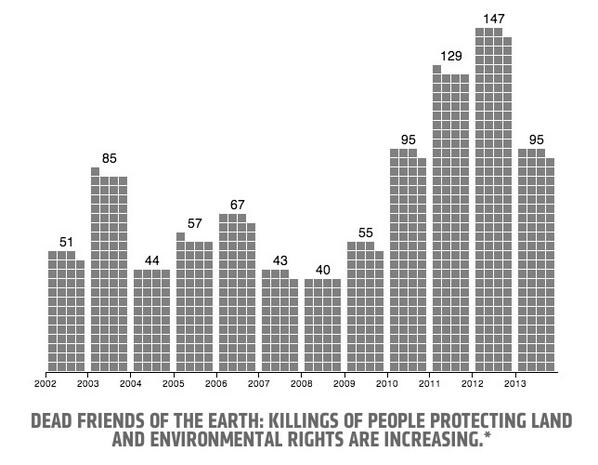
But 2013 was another year with an abundance of news stories about conflict linked to natural resources. It isn't even controversial any more, media now mention the links without hesitation. This annual post could pile thousands of words about war for oil, pollution for profits, murder for business et cetera. 2013 saw an increasingly independent Greenland retract the ban on uranium mining, the least meaningful COP meeting ever, extraordinarily brave Mexican villagers stand up to illegal logging by organized criminals and the CIA finally admit it orchestrated the 1953 Iran coup. Not to mention someone ought to list the names of the brave environmentalists that have been assassinated by corrupt governments or callous corporate thugs. But I give up! Some links, though, deserve more than just a tweet.

Proven correlations
The Ecowar blog and book has always built its foundation on solid scientific work. The core hypothesis has been supported by peer reviewed studies that has quantified the link between resources and violence (oil increases the likelihood of separatism, lootable commodities lengthen existing conflicts, resources in actual conflict zone doubles length of conflict, onshore oil reserves raise risk of rebellion by 50%, diamond production increase risk of conflict by 40%).

In 2013 the UN stated that 40% of all conflicts are linked to use of natural resources. A study found that climate change has caused a rise in violence. And, acknowledging the link, another blog investigated exactly when does oil lead to war. Not if.

Hidden causation
So, all wars are fought over natural resources. It's been accounted for, it's been explained. Cause and effect. But why? And why does no positive environmentalist progress seem to have the least effect on the underlying current of global disorder producing one small disaster after another? Hiding in plain sight: Capitalism. Not capitalism as an alternative to any other political ideology. Capitalism as the one and only religion every citizen on Earth abides by.

If supply and demand is to save the world, the fastest way to save it is to destroy it. Because only scarcity will raise the price of nature, making it worth anything at all in the Capitalist perspective. In 2013, desperate measures to save the endangered Black Rhino came down to selling a license for killing one specimen. You read that right. Last April David Roberts of grist.org realized that none of the world’s top industries would be profitable if they paid for the natural capital they use. There is a blindingly obvious disharmony between the major problems we face and the fundamental order which we use to put structure on anything we do.

2014
In 2014, keep googling news for "TTIP ISDS". TTIP (and TTP): The free trade negotiations we'd hardly have heard of if a crowdfunded bribe had not resulted in a leak to Wikileaks. ISDS: The rather invasive trade provision that (primarily) allows multinational corporations to sue developing nations of any alleged lost income in investments. (Confused? Friends of the Earth has a factsheet.) Poor countries and NGOs wants ISDS out of trade treaties, rich countries insist on keeping them enforced. Just one example of ISDS in action in 2013 would be Costa Rica getting sued for protecting its rain forest.

In examining the violent scramble for Earth's last resources there is no way around a look at the growth centric economic system that frames every political debate, business decision and daily life consideration. One organization that has gotten a lot of my attention in 2013 is Positive Money; begin with their article on how the banking system affects the environment.

Final recommendations

Happy / merry winter solistice, christmas and / or new year to everyone.


Friday, November 01, 2013

All wars are caused by the economy

Just kidding. Then again...

Prince Charles recently gave a speech in which he mentioned the causality behind the Syrian civil war as well as the financial system.

"The tragic conflict in Syria provides a terrifyingly graphic example, where a severe drought for the last seven years has decimated Syria's rural economy [...] Driving many farmers off their fields and into cities where, already, food was in short supply. [...] The time then has surely come for our financial institutions to recognise that the Earth is not a limitless resource that can be plundered at will, and to integrate that principle of stewardship into our financial structures." Quote Charles, Prince of Wales. Photograph by Victoria Johnson.


The organization Positive Money is pointing at side effects from the dominant economic system. Part of their reasoning is about how the banking system affects the environment, "how the current economic system contributes to environmental destruction and accelerated resource consumption":
  • Recessions (which are unavoidable in the current growth focused system) make people and governments care less about the environment
  • A debt-based money system may result in the need for continued economic growth (resulting in natural resource exploitation)
When the financial system is man made and our real problems rooted in resource scarcity, desperate needs and whims of nature how come we don't fix the first to at least not limit our ability to fix the latter? Could market fundamentalism have reached a religious grip on our societies?
"Modern economic theory is presented as a science. Elaborate mathematics and diagrams are employed to derive principles that are assumed to be universal among economic actors, even though the specialized math used is a “dated version” [...] and such diagrams “often contain outright fallacies” [...] After a closer examination of the dominant economic theory and its critics, one might come to the conclusion that it is actually a belief system quite similar to a religion, not an actual scientific study. [...] The word “economics” comes from a Greek term meaning “management of a household.” As evidenced by the recent meltdown at Fukushima, externalities recognize no national borders. Our household is the entire planet, and we can only make efficient use of its resources by recognizing it as a single system. There is only one biosphere. What happens to it affects us all. We need to redefine economics so that it actually ensures our total well-being to the greatest degree possible while maintaining an ecological balance. We need a holistic economic theory based on empirical data, not traditional notions."
 - Chet Gaines


Wednesday, June 19, 2013

Noam Chomsky explains how to destroy the future

During a broad scope text on the suicidal tendencies of our global society Noam Chomsky touches a couple of resource conflict topics.
all over the world – Australia, India, South America – there are battles going on, sometimes wars. In India, it's a major war over direct environmental destruction, with tribal societies trying to resist resource extraction operations that are extremely harmful locally, but also in their general consequences

Here, Noam might be referring to the Dongria people vs. British Vedanta Resources. But there are other conflicts to choose from in India. And elsewhere.
So, at one extreme you have indigenous, tribal societies trying to stem the race to disaster. At the other extreme, the richest, most powerful societies in world history, like the United States and Canada, are racing full-speed ahead to destroy the environment as quickly as possible.
(Pssst Noam, there's this Arctic anomaly to your generalizing rule.)
[during the Korean War] everything else in North Korea had been destroyed, the [US] air force was sent to destroy North Korea's dams, huge dams that controlled the water supply – a war crime, by the way, for which people were hanged in Nuremberg. [...] the water pouring down, digging out the valleys, and the Asians scurrying around trying to survive. [...] It meant the destruction of their rice crop, which in turn meant starvation and death. How magnificent!
The Geneva Convention does protect the environment. Or rather: it professes to protect natural resources upon which the local population depends. See the Ecowar blog / 'Geneva Convention' needed to protect environment from war (Nov 2007) or Ecowar - Natural Resources and Conflict (the book, Dec 2011) pages 9, 29-30 and 120.

However, flooding an area did not automatically get generals hanged after the WWII. This tactic was used by China, the Dutch, the Soviet Union, Germany and Great Britain. At least. To be honest, I haven't checked if any German soldiers were hanged for drowning people in this way. But my wild guess is no.

Read How to destroy the future at The Guardian (Danish translation Sådan ødelægger vi fremtiden at Information). It is great reading like most of Noam's pieces.


Sunday, May 19, 2013

"Without Water, Revolution"

From Without Water, Revolution by Thomas L. Friedman on The New York Times:
THIS Syrian disaster is like a superstorm. It’s what happens when an extreme weather event, the worst drought in Syria’s modern history, combines with a fast-growing population and a repressive and corrupt regime and unleashes extreme sectarian and religious passions, fueled by money from rival outside powers
"The drought did not cause Syria’s civil war", said the Syrian economist Samir Aita, but, he added, the failure of the government to respond to the drought played a huge role in fueling the uprising. What happened, Aita explained, was that after Assad took over in 2000 he opened up the regulated agricultural sector in Syria for big farmers, many of them government cronies, to buy up land and drill as much water as they wanted, eventually severely diminishing the water table. This began driving small farmers off the land into towns, where they had to scrounge for work. [...] "State and government was invented in this part of the world, in ancient Mesopotamia, precisely to manage irrigation and crop growing," said Aita, "and Assad failed in that basic task."
For more about the invention of government to manage irrigation and granaries see Ecowar the book pages 13-14.
The best jobs in Hasakah Province, Syria’s oil-producing region, were with the oil companies. But drought refugees, virtually all of whom were Sunni Muslims, could only dream of getting hired there. "Most of those jobs went to Alawites from Tartous and Latakia," said Zakaria [Zakaria, teenager], referring to the minority sect to which President Assad belongs and which is concentrated in these coastal cities.
"We could accept the drought because it was from Allah," said Abu Khalil [cotton farmer, smuggler and Free Syrian Army commander], "but we could not accept that the government would do nothing." Before we parted, he pulled me aside to say that all that his men needed were anti-tank and antiaircraft weapons and they could finish Assad off. "Couldn’t Obama just let the Mafia send them to us?" he asked. "Don’t worry, we won’t use them against Israel."
For more Syria see Ecowar the book page 24 and click the Syria-tag on this present blog. Also, I have linked to about 40 articles about Syria from the twitter account.

There is a preview of the book on the book website that includes page 13.

Saturday, May 04, 2013

For the youth


[Wikipedia]


Saturday, March 09, 2013

George W. Bush is painting too many puppies

My brain was going into my feet from reading Salon.com (not The Onion) / George W. Bush’s art teacher says he’ll “go down in the history books as a great artist”.


He has painted "more than 50" puppies!?

However, after posting this breaking news to Facebook, a friend of mine pointed out the cosmos in this chaos. It's been 23 years in the making...


Too many puppies are being shot in the dark
Too many puppies are trained not to bark at the sight of blood that must be spilled so that we may maintain our oil fields
Too many puppies, too many puppies


Search This Blog